
I don’t care that this is long - it’s my championship opus! I hope you stick with me, though. I really like how it ends.
When you live your life thinking that tomorrow will be worse than today, it often is. That’s how I lived mine for most of it. I remember a teacher in Lower School asking us about our sleep patterns, and at the time I was having a hard time going to bed.
“Why do you think that is?” She asked.
“You have to look forward to tomorrow to want to sleep,” I answered.
She looked concerned.
There’s been a lot of talk of healing around this Knicks championship, and I’m normally not so big on that word, nor any buzzwords, but only in that they’re often overused, or perhaps used most often by people who seem to have too many answers. Like their way is the best way.
However, in this moment, it does feel appropriate, as I’ve taken a beat away from Knicks coverage just to think about what happened, and feel it. With some time away, and by that I mean about two weeks, it does feel like finally winning, after all these years, has changed us. Like BC could stand for before championship, and AD, after drought. Like we don’t have to be quite so wounded. That it doesn’t have to be quite so bad.
As New Yorkers, mind your business is a way of life, and the fact that we’re all going somewhere else, head down - keep it movin’ - is ingrained so deeply that we don’t even see “outta my way” as rude. In fact, we see the opposite as true. You’re rude for walking slowly. You need to pay attention and move.
We all know how to keep to ourselves on the Subway, even when our chin is on your chest. We are sewn together, most of the time, through our temperament; we all know how to be separate, looking for ours. In many ways, that’s the point - different, disparate people all in line in their mentality; I need to get where I need to go and so, again, you should scatter. If we were to look out for each other then we wouldn’t get there as quickly. That’s what gives New York its pulse.
But now - and maybe it’s just right now - we have a different heartbeat.
It’s slower, and steadier, as people from all around the city, and beyond, come together. It’s palpable, and consistent, as we all care about the same thing - the same team - somehow, and we’ve become temporarily unified not in where we’re going, but in the fact that we’re willing to stop. Those with scars from team’s past can identify with each other’s plight, so maybe we break harder, as we no longer feel so alone. We get to pause and embrace and be present - as though it’s the first time we’ve ever seen each other - as we’ve survived hardship, and we believe that the collective consciousness is more important than the individual, or even the pulse; that the team is bigger than me, and the city gets to pick its head up and stare at the same thing for a while. We get to admire the Chrysler Building dressed in a Knicks jersey.
We all get the same view.
The Knicks winning might have changed the city, even if just for a moment, in a similar way to how sobriety changed me, and being a witness to the shift is something of a spiritual experience. We haven’t felt close at all since before Covid - things are different all over the world, and tribal. Boroughs and neighborhoods have more distaste for others than I remember, and something like Dimes Square has cultural relevance just because it’s new, which makes its residents feel superior. I spent a few years in Dimes Square before it had a title - my mom lived in the Forward Building on East Broadway. She moved because she didn’t like the spitting and the fish smell.
Back then it was called Chinatown. At least according to her.
We haven’t come together, as a city, in a real way since 9/11, and this is different than that. After tragedy, we needed each other. The blackout, slightly, as well, and maybe Hurricane Sandy, but nothing like this. And we’ve had more down years, since then - Covid did the opposite. We retreated, but we survived, and it finally feels like we’re back, or at least we’re still here. There’s nothing like the city when the Knicks win. The city’s different when the Knicks are good, but winning a championship was something we never thought possible.
Don’t leave before the miracle happens.
I’m forty, I’m married, and I have a dog and a little life upstate. We still have a place in Harlem - my wife had a rent controlled studio when we met - but I don’t feel like I need to live “in the mix” anymore. I did that for a long time, and my apartments were just where I slept, and eventually had a hard time leaving. The “underground man” chapter of my life contained less romance than I thought it might, and nature, and neighbors, and community, have something I didn’t think I needed - a little less of myself. My mom moved over ten times while I was growing up, and I felt like I wanted roots. We’re still in the city almost every week, but I think I found them.
My wife is my roots.
For many, many, many years before this, the closest I came to happiness was a break from reality, which I found in a number of different, dissident, and unfortunate, ways. A girlfriend, in high school, showed me that it didn’t have to be so bad. A painkiller in college, alongside a professor telling me I was good at something, allowed me to breathe a little easier. A promotion at my job, even if it was just from barback to bartender, showed me that life was worth living. A drink worked, as it dulled my senses, but eventually felt more like laughing gas at the dentist in that time moved quicker, yes, but I still knew I was getting drilled into. I still knew something hurt, somewhere, I just wasn’t quite as aware of where it was coming from. My breathing was steadier, but I didn’t have as much energy. I just wasn’t quite as able to leave.
Drugs worked best, in that, initially, they truly quieted the noise, but I was already drinking by then, so then it became both. It became worse, and so more, and then so much worse, so then so much more. I heard somebody say, once, that they had to get high to think about getting sober, because they couldn’t do anything until they got something in them. They needed to feel better before they could think.
I knew what he meant, and at that point you become defeated. By that point I’d given up.
But then something happens, if you're lucky, that changes your course. You either stop, or it kills you. Sometimes people say jails, institutions, or death, but you often stop in jails and institutions because you have to - you just don’t like it because you didn’t have a choice. So you comply, for a while, and when you get out you start over - fuck you for making me - and hopefully it gets bad enough that you’re willing to change. Either that or it’s over.
For most who get it, you lose enough, and you’re wrong enough, that you have a moment where you can see straight, and you make a decision. But for me it feels more cosmic than that, because I don’t remember.
I don’t know that I made a choice. It’s like I just survived long enough that something good finally happened. It’s like sometimes there’s a benefit in just not dying.
I didn’t want to live the way I was living, but I guess I didn’t want to die, because I didn’t kill myself.
Good things happen, too.
Something like switching to rooting for the Nets, when the Knicks were bad, in this greater Knicks metaphor, would be synonymous with giving up, and so certainly worse than death. You go down with the ship or the ship, somehow, gains footing. You stay the course because you’re loyal. You don’t see loyalty as a choice.
I don’t remember thinking that my sister had gotten sober, and having that inspire me. I don’t remember most hours of most days, then - just waking up, and getting right. I don’t remember giving up on the Knicks. I don’t remember not caring.
Getting high in my kitchen, while I watered my plants and listened to sports talk radio, I don’t know that I actively stopped being interested, but I know I couldn’t care as much as I used to because I couldn’t handle it. The good, or the bad, I couldn’t deal. I avoided the ups and downs of my life, which is all that it is to be a sports fan, because I avoided my feelings.
I wanted to feel nothing. I wanted to be ice cold.
I don’t remember making the decision, but I’m here, and I don’t remember thinking that my sister had done something to change our family’s course, but I know that on her 90th day she said a prayer that her brother, and her mother, would get this, and she has three more months than me.
Eighty seven days, actually.
When she wished, I was in the hospital.
I don’t need to know much more than that.
In addiction recovery there is discussion of progression - the idea that we only get worse. You always need more, and you will always need more after that, and then the things that you have to do to get there - lie, cheat, steal, isolate, hurt others in doing all of the above, and care very little about anyone other than yourself and how you feel in doing so - become who you are. I’m speaking in the second person because this is a disease, and the idea that I was different than you almost killed me, but the truth is my experience is just me doing those exact same things. I would’ve done anything to feel better, and I still would, and will, if I’m not vigilant about my recovery - most of which makes no sense to me. To do things beyond my understanding allows me to let my life get bigger, which is counterintuitive, but I have gleaned this; my alcoholism manifests in my resistance, so if I let go, I’m happy. If I don’t, I’m not, and it’s your fault. I hate, and you’re the problem. How dare you not let me have my way.
This thing never leaves - it waits for you. It’s waiting for me now, I think. It likes when things don’t go my way.
But it also doesn’t have great judgement. I’m still uncomfortable saying positive things about myself - my sadness was my identity - but I can see past it today, because I see it, but I see more than that, too. In doing so, I’m okay, and things in my life have worked out in a way I wake up every day awed by. I’ve lived long enough to see my city come back to life, and unify, as the Knicks have won the championship, and I care. I imagine, for some people who read this, that a sports team accomplishing something feels like who cares, too, but perhaps I can try to describe what it means for someone like me. Perhaps I can articulate what caring again, and then winning, represents to the little kid I was, because he was still a dreamer, and he lost some of that along the way, but this reminds me I’m still him, too.
He never left me.
So what this means to us is that all the years waiting, and hanging on, were worth it. It means that all the effort you put in is eventually rewarded - even though it doesn’t look like how you thought it would - and that when it matters people love each other, and care for each other. They look out for each other, and they don’t fight all the time, and they don’t leave. People don’t leave. We won’t leave.
We don’t.
There’s an immense amount of attention spent on gratitude in recovery, and I’ll admit the word used to really bother me. But, like any insult that actually stings, there’s a reason for that, and that’s because I didn’t have any, and likely never thought I could. I define gratitude today, though, as the not just the understanding that I’m lucky to be alive, but the practice - the discipline - of finding a way to frame that in response to my initial reaction to the world. If I like what I have, and I don’t need anymore, then if somehow more comes, then I’m lucky. If it doesn’t, I’m good, too, because I’m lucky to be alive - this part’s all dessert. If I don’t do that, then the world’s the problem, because I don’t have enough, and that isn’t fair. And when the world’s the problem, I’m mad at it, and the Knicks never win. Or, at least, I never get to see it, because I don’t survive long enough to get here. I wouldn’t have made it otherwise - I assure you. Quitting drinking and drugging and still being angry - and still blaming you - was a lateral move for someone like me.
I’m lucky that that got bad enough, too, because otherwise I would’ve never changed, and now look what I get to be a part of.
Dang.
It’s a hard life wringing your hands, wishing things were different. You don’t like your cards so you fold. It makes you wonder, when they say is that all there is, if they’re right. But gratitude isn’t the self-help code word I thought it was - the way people use protecting your peace today. Gratitude is wanting what you already have, and then getting out of the way, and then things get better.
Gratitude is belief when it’s hard to believe.
Both recovery and fandom require an irrational faith that tomorrow will be better than today, and I personally couldn’t have one without the other. I certainly couldn’t have gotten to see the Knicks win without recovery, but believe it or not I’m not sure I could’ve gotten this far in recovery without the Knicks. The Knicks remind me of that kid that I was, and remembering him, and embracing him, feels like a guiding force when the world gets sad and hard again. When you and your wife are so different that it feels like the best thing you can do for her is leave her alone. When that’s heartbreaking, but you do it anyway because it’s the right thing, and you're doing much better than you feel. But your thoughts are, then, unmanageable, and when you try and manage them and you get dark again. When the room gets too hot so what makes most sense is to try and figure out where and how to go.
But you stay, even when it doesn’t make sense to you, and you’re rewarded. You stay in New York when Ojai’s nicer - you buy an air conditioner for your house. You stay watching the Knicks when over a two year stretch - from 2018-2020 - they won a combined 38 games. The next year they would 41 - the same year you got sober - and then over fifty, every year, since then. You don’t believe in coincidences - you make that choice. You stay when it’s uncomfortable because it makes you better. You stay because that’s what faith is - that you’re doing the right thing, and your feelings aren’t as important as that. You stay because you’re strong, and your feelings make you fearful, and that feels weak, but it makes you sturdier to disprove it.
Pray for patience and you’ll get traffic. You trust that instead of crashing your car.
There’s been much discussion recently about what it means to be a New Yorker, and specifically that you have to be “born here” to consider yourself as such. However, the person who made this claim most famously lives somewhere like the Hollywood Hills, and given that New York City prides itself as a “melting pot,” this feels like a territorializing claim that’s unfounded. It feels like someone trying to prove something. To me, that feels wrong.
However, so does the recent transplant whose identity becomes New York City, and whose conversations become entirely informed by films like King of New York and The Professional and who reads mostly Knausgaard. Whose head is most certainly hot under that beanie in the summer off of the Jefferson L train. Who drinks to go margaritas from The Turkey’s Nest in August in McCarran Park. Who knows to get to Roberta’s early because the wait is part of the experience, but who prefers Ethiopian on Flushing and will be sure to remind you before your tables set.
To me, if you’re a Knicks fan you’re a New Yorker, but if you really want to start bragging about it stick with them when they’re bad, like I did. Prove it to yourself. Watch a season when they struggle, which I assure you will happen, at some point, and don’t walk away.
That’s how you prove yourself, to yourself, because you're not proving it to anyone else. You’re showing you how strong you are, because you’re learning what failure is. You're getting disappointed, and you’re feeling it, and you’re not running away.
We don’t run away.
I imagine it’s hard, sometimes, for people who don’t consider themselves that bad to really want to surrender to this disease. When you struggle enough - in my case, when you’re yellow enough - you don’t have a choice, and that makes it easier. You change or you die, as is oft quoted - and was, in the hospital, specifically told to me - and you get to know whether you want to survive or not.
Almost dying allowed me to be present, and grateful, when the Knicks finally won. I’m lucky to be alive, and to be a fan, and a New Yorker. I’m grateful I got to struggle - we did - because it made me better, and now the city gets to celebrate.
And even if most of the people didn’t stick through the hard times, we get to love them anyway - we can empathize - but they’ll never understand. It’s because we struggled, and don’t expect anything, that our life is sometimes perfect.
And even when it’s not, it’s still beyond our wildest dreams.
When I was working on my last book - a novel I just turned in about addiction in the city - I would watch Soft White Underbelly during particularly trying scenes because it was an exercise in empathy, and I needed to find some for my characters, and for myself. I’d never written about myself, or that time, before, and until that book I had I just wanted to erase him. It turns out I just needed to help walk him through.
In recovery, we can tell truly galling stories about ourselves - ones that outside of a church basement would most certainly end in death, or worse - but the fact that we’re there to tell them, with our head held high, is all the assurance we need. The worst things that we did, or situations we were in, become inspiring, because we remain.
The fact that we’re there and willing to tell our stories is both the answer, and the question.
Should I? He did. So, maybe? Maybe.
I understand that SWU is exploitative - it is - to have active addicts and alcoholics on camera, and Mark Laita would admit that. I worry that he gives his participants money, but where I’ve come down is to say that I think it’s better that these stories exist, even before recovery, because we get to see these people as people. I think it’s different than Euphoria, because he’s not deciding how they should be, and there’s no romance. He’s showing them, and the point is the warts, because it is far too easy to write off people in the midst of their disease. We should be faced with it, to deal with it. Looking the other way reminds me of what I wanted to do with me.
Moreover, many, many addicts and alcoholics portrayed seem sweet, and genuine, as they talk about the way they’ve lived, and continue to. They blame too much - usually their family - because they have to. If it’s their fault they’ll have to change, and many of them can’t, or at least don’t think they can. Oftentimes, they have to tell their story almost in third person, disconnected from themselves and their reality. Every once in a while they’ll stumble into something that forces them to feel remorse, which becomes guilt, and then shame, all within seconds, and you can see it, and this is usually when they want to leave, to use. Fear of their feelings makes death seem preferential. In the old days - as in, like, five years ago - there used to be heroin addict stories, but now those are gone. The heroin stories are almost entirely, now, fentanyl. Since that changed there are fewer and fewer people who come back for round two.
However, there are some episodes that portray not just the darkness, but how some people get to the light. In one episode, titled Padlocked in a Doghouse, Jeanine Coulter shares about the phenomena of Post Traumatic Growth. She was gnarly - used as hard as just about anyone - but somehow found recovery, and says that, through tools like sharing your story, being of service, and finding emotional regulation, you can come out of traumatic experiences better than you would have had you not gone through them at all. Sometimes dealing makes you stronger, and, in doing so, you gain a newfound appreciation of life - one that you might not have had otherwise.
In other words, she claims, all of the bad things that have happened to her may have happened for her, and I’m positive the same is true of me, and maybe my Knicks. Even though something like this sentiment might have been the exact sort of thing that kept me out of recovery early on - I was pretty cynical - but that just speaks to my resistance; pessimism is the easier choice. Doing something hard makes me feel capable, if I can survive it, and being optimistic, now, qualifies.
Our scars make us useful.
Jeanine Coulter further shares that the “girl in high school, who had so much promise, doesn’t have anything on the woman I became, and that’s “as a direct result of [her] addiction.” Through the disruption of a core belief - often something like I’m not enough, or I don’t deserve it - she became kinder, smarter, and stronger. She became the heroine of her own story; through her hardships she became a better version of herself.
I really admire her strength, especially given that, for a time, she actually lived in a doghouse.
The Knicks didn’t win a championship for 53 years, and I spent all of my twenties, and some of my thirties, fucking my life up. I didn’t feel like I deserved it - I wasn’t enough. Writing that feels trite now, because life is about so much more, but I didn’t know any better. I didn’t feel good and I made it go away.
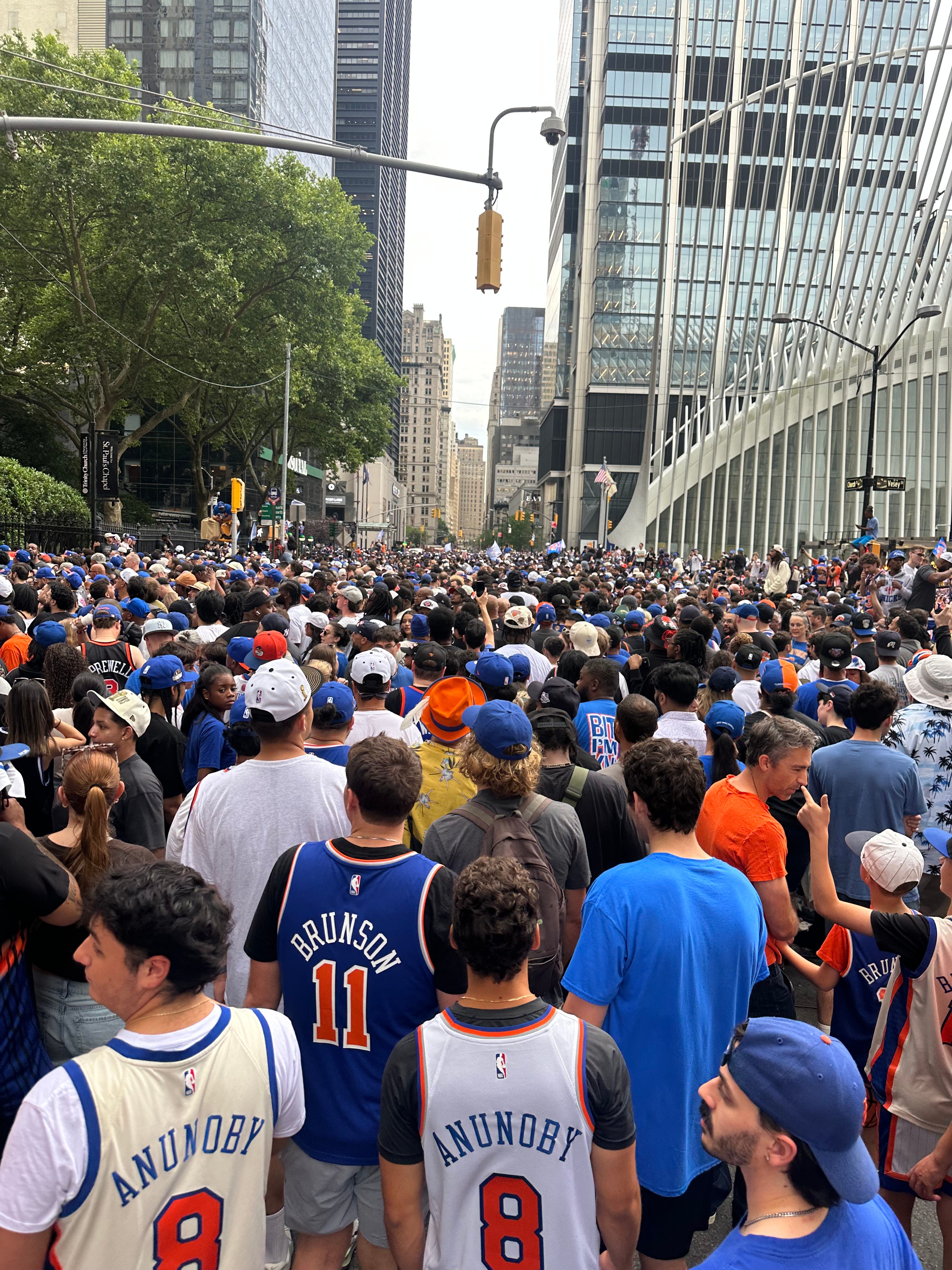
But I survived, and so did the Knicks, and we’re better off for it. We had the most joyous parade - I couldn’t even get in, but I didn’t give a shit. I went with my wife and we walked around and tasted it. I breathed in the sort of win you can only feel when you’ve lost a lot, but you keep going anyway. You find something, like Jalen Brunson always does, that lets you keep trying when it doesn’t make sense to - something bigger than you - and you believe, and your belief lets you know.
And once you know - the moment you know - they’re in trouble.
You’re better, like Brunson, because you felt overlooked, and incapable, and you found a way past it; you’re better because you were worse.
Recovery doesn’t change your past, it just gives it some meaning. My dad once said to me, in treatment, that he “wanted his son back,” but I didn’t like myself before, so I thought the only way I can make this work is if I get better.
And I think I got better.
The Knicks won, and maybe, today, I’m a little better than the guy with the towels tacked over the windows, and that makes me look forward to tomorrow.
I’m pretty sure that’s called hope.
Share, comment, love you so!
K
Comments
Nothing yet. Say the first thing.
Sign in to join the conversation.