
Let’s face it, we live in “interesting” times. Thanks to the persistent advancements from Moore’s Law, digital has continued to shrink the world and make us ever more connected. Conversely, we couldn’t feel more divided, lonely and often paralyzed by all the changes we’re navigating. Recent events even brought us a pandemic, wars, climate-related turmoil and uncertainty from generative AI. If anything, these events cause us to pause and question the status quo. Where do we find sources of hope? I believe it’s creativity and a nonlinear way of going about it.
To create a different future, we have to be prepared to do things differently.
Where did I find creativity as a lever to navigate this world of ours? For me, it started at Nike mid-career. Prior to Nike, I worked as an engineer in nuclear power cutting my teeth on product via nuclear reactors. Nike introduced me to newfound design communities that helped me understand the power of creativity. Since Nike, I’ve been able to weave a multidisciplinary career centered on unlocking innovation across different industry sectors. In the process, I’ve helped establish design in new spaces that hadn’t necessarily experienced its potential before.
During my time at BCG (Boston Consulting Group), I learned how to establish design as creative problem-solving capability at parity with the best experts from strategy and technology that we brought together to address new and emerging opportunities. I grew to understand design thinking in the midst of that runway, and liked how it could welcome other disciplines into a creative approach. At the same time, the maturity of creative understanding varied from team to team. I noticed how the business world at-large tended to de-risk any new approach.
If a human-centered approach worked on this project, companies want to codify the recipe and apply it on the next ten projects. What happens when the method breaks on the eleventh? Teams might feel like they are violating that method if they do something different. What results is a slow creep of formulaic behavior that causes teams to focus on creating outputs against a checklist versus sense-making their way to resonant and relevant outcomes. There are tons of process books when it comes to design thinking, but not a lot of books that speak to creative intuition.
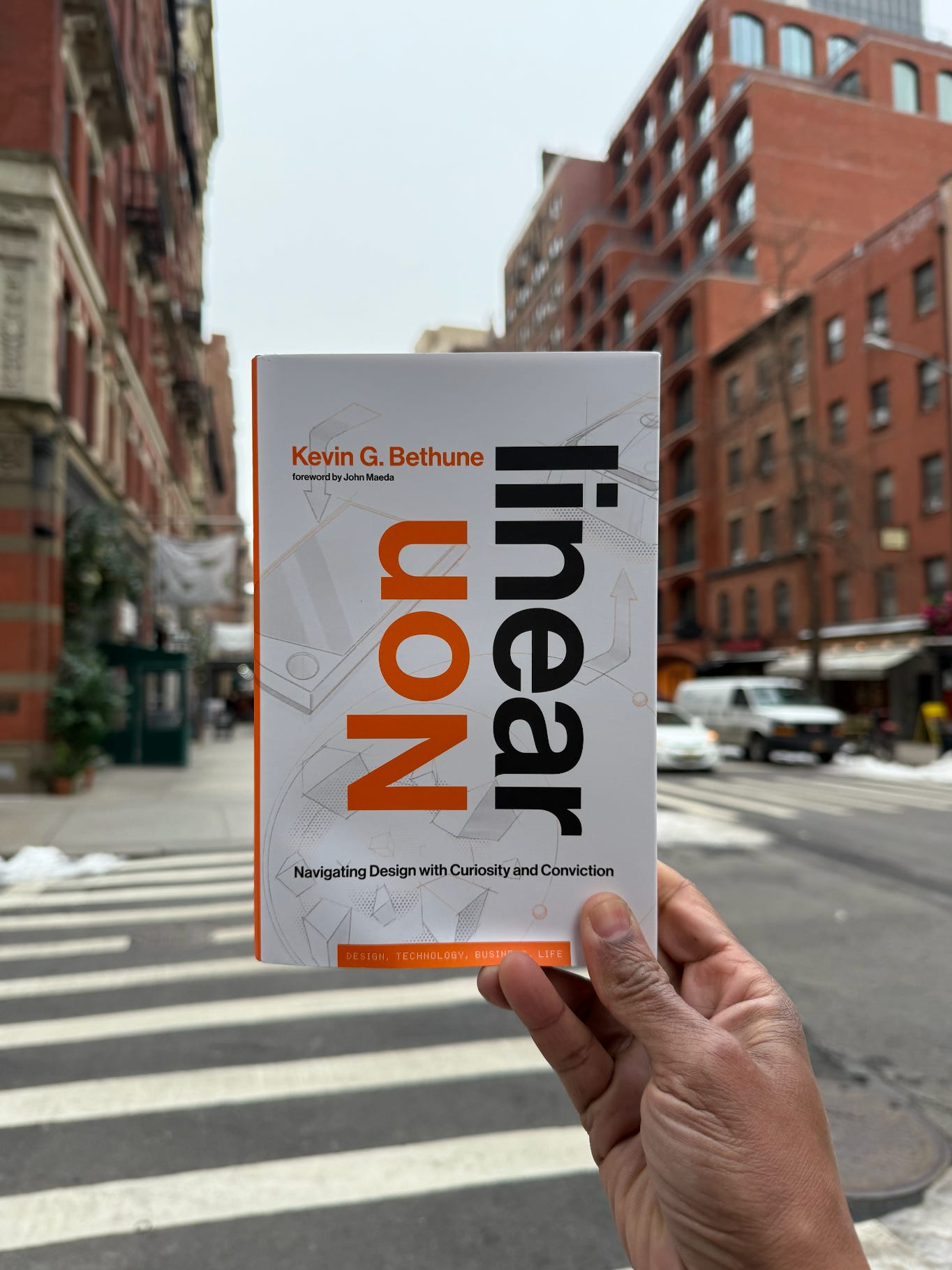
When it comes to the pursuit of creating meaningful innovation, we have to recognize that navigating ambiguity is part of the deal. In my new book, Nonlinear: Navigating Design with Curiosity and Conviction (The MIT Press), I bring to life the notion of a forest of ambiguity. As we meander, we take stock in what we know versus what we don’t know to inform our steps. We might be juggling quantitative data with qualitative insights to understand our choices. As we ideate, we learn at each step. Learning is the goal, not building to spec. By writing Nonlinear, my aim was to shine a light on this intuition in how we navigate.
When we understand that we have a litany of choices at each step, leveraging creativity in pursuit of innovation will feel less formulaic. As mentioned before, we’re navigating a rare confluence of so many paradigms affecting our reality. I’ve noticed differences in how people are reacting to these paradigms based on what’s perceivably predictable (i.e., linear) versus unpredictable and uncertain (i.e., nonlinear). I sketched this out in an illustrative 2x2 (please forgive my consulting brain) in an attempt to characterize these behaviors versus the nature of change.
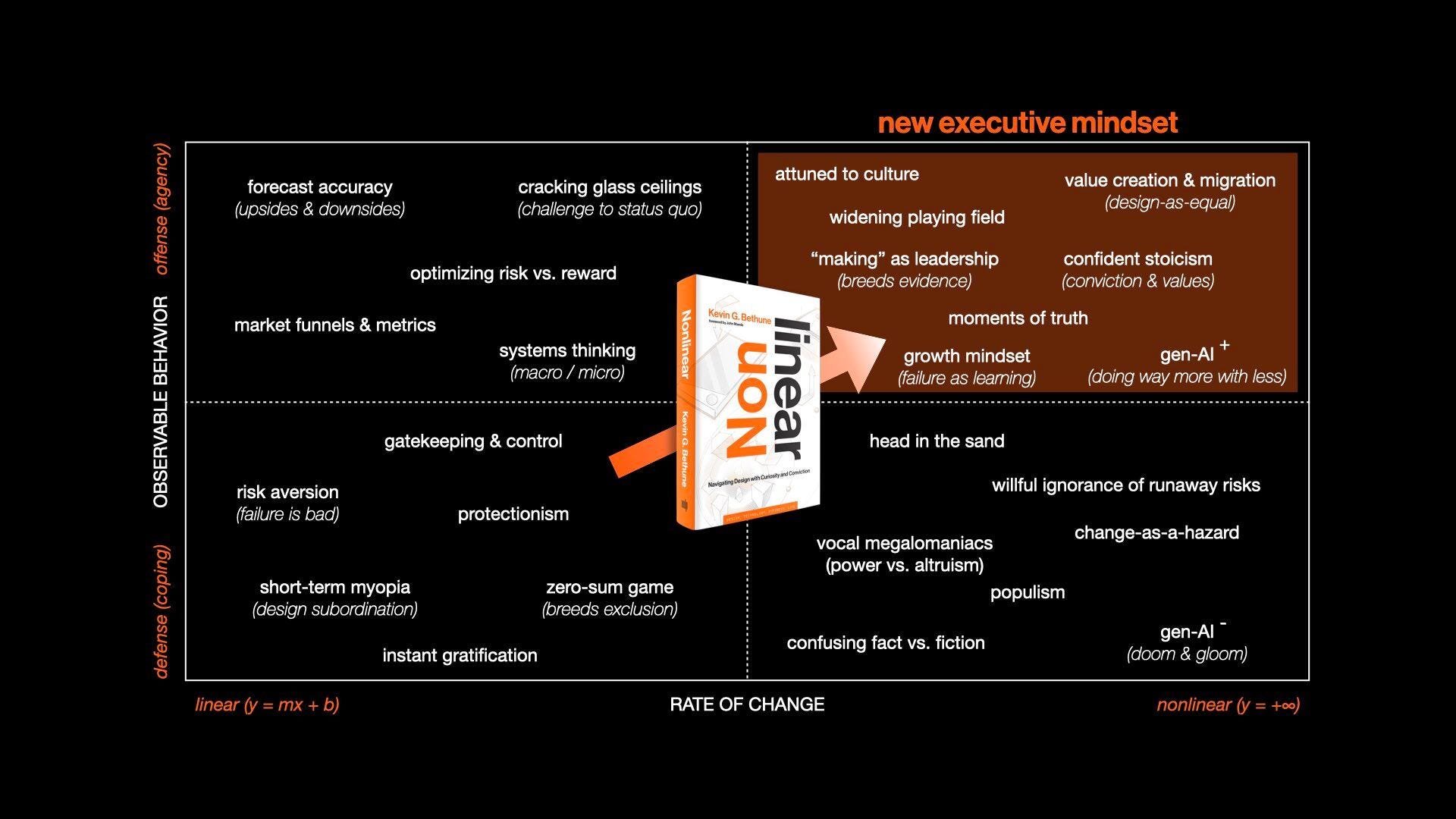
In my view, we’re either coping or finding ways to garner some agency (i.e., to play some offense). We’re also wading through a lot of very loud narratives and information about what the change means. Some rhetoric is constructive, but other voices choose to take advantage of the confusion by asserting a nefarious agenda. When change begins to "run away" in a nonlinear, exponential sense, then these behaviors further exacerbate. Sprinkle in generative AI, and we’re seeing messages rooted in disinformation and zero-sum thinking, or ... hopefully ... creative optimism if we push our imaginations.
When people ask me how I define design after leveraging it in my multidisciplinary journey, I often say, “design shapes the future.” This is not to favor design as doing it alone limits its impact. When combined with other disciplines that collaborate at parity, now we have something. Our collective creativity can shape better, more viable futures. In a world that says not much is possible in the face of these paradigms, creativity empowers us to sense-make our way to uncover new opportunities and craft new stories that posit solutions of impact.
By moving with an open aperture and a nonlinear intuition in understanding our creative choices, leadership starts to look differently too. As we choose to make each step, make something and hopefully learn new insights, we inform an evidence trail that will guide us toward our next destination. Through the accumulation of evidence, we can credibly understand what’s actually happening amidst the noise and use that substance to solidify our values and convictions. We can find our stoicism amidst choppy waters, and actually stand for something. That will take courage, but I'm hopeful.
Let’s defy convention. Let’s be nonlinear.
No posts
Comments
Nothing yet. Say the first thing.
Sign in to join the conversation.