
Most resistance fighters and revolutionaries have roots in oppression. Subjugation and cruelty form their view of the world, leading to a fire that transcends standard human wants. They need their childhood to mean something bigger. Their pain to be seen, and for good to win, even against a Goliath too arrogant to believe the poor would rise.
More rare among the fighters are people of privilege. People of wealth and status who benefit from Goliath’s power. Those people fascinate me.
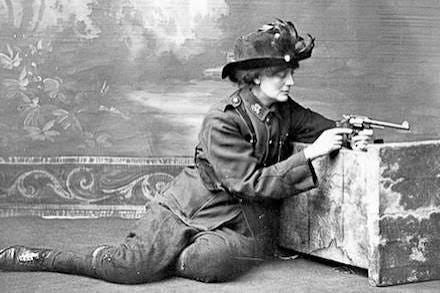
A privileged debutante who presented at court to Queen Victoria and discussed poetry with W. B. Yeats, Constance Gore-Booth was everything a good Anglo-Irish woman should be. She split her time between London and the family’s estate in County Sligo, dreaming of art school.
A girl growing up in this environment learns early how to hold perfectly rigid posture and carry herself with grace. How to write correspondence and quiet her voice. Opinions and resistance were treated like diseases.
But Constance wasn’t your average aristocrat.
She would become a revolutionary leader, progressive politician, labor activist, and founder of the Irish Citizens Army.
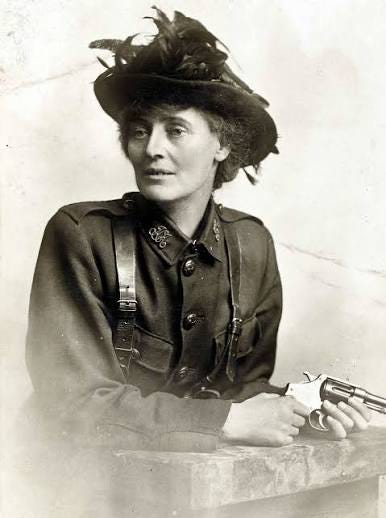
Constance watched rural poverty in Sligo as the Irish people struggled to recover after the Great Famine. When she was ten, another agricultural crisis hit farms, and Constance watched her father donate food to starving families. She understood from a young age how Irish workers faced devastation at the hands of English rule. How basic human needs teetered on devastation because the system abused them.
As a young woman, Constance enrolled in London’s Slade School of Art, where she first became politically active with the National Union of Women’s Suffrage Societies. While traveling in Paris, she met a Polish aristocrat, Casimir. When they married, Constance became Countess Constance Markievicz. Although her new husband came from nobility, there was no title of “count” in the Polish gentry, and he self-appointed the title to impress European circles.
Her new title and move to Dublin put her in the center of the city’s thriving art scene. Intellectuals and artists mingled with revolutionaries and Irish nationalists, introducing Constance to an ideology that turned her childhood sympathies for the poor into a simmering hunger for resistance.
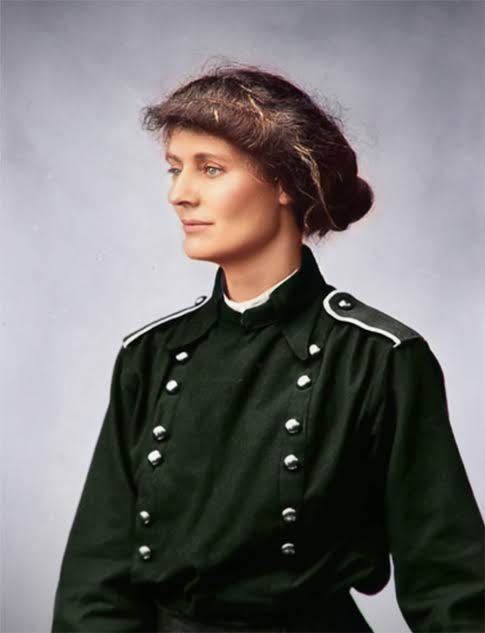
Her marriage didn’t last. They split amicably at the outset of WWI. Casimir went to fight for the Russian Army and settled in his native Poland, while Constance traveled deeper into the subversive fight for Irish independence. Her politics and ideology morphed into militant nationalism.
Longstanding oppression of the Irish people and their culture led to a militant uprising. Decades of colonial cruelty forced them to fight. Colonial forces dissolved the Irish Parliament in 1801. With English rule, penal laws stripped Catholics of legal and property rights. The Great Famine of 1845-1852 killed one million, and forced up to two million to flee the country. English rulers and landowners engineered this “famine” through evictions and stolen crops to send to Great Britain. When blight hit the potato crop—many families sole nutrition source—mass starvation spread across the country.
Constance radicalized, not just in ideology, but in methods.
She helped build and train resistance groups: Cumann na mBan (The Irish Woman’s Council), the Irish Citizen Army, and Fianna Éireann (the Fianna of Ireland).1
Constance took an active role in the resistance, and they had their eyes set on urban warfare.
The Easter Rising took place on April 24, 1916. Over one thousand insurgents strategically overtook key locations in Dublin, which English forces were unprepared for. They were busy fighting in WWI and never expected a group of nationalists to mount a legitimate fight. The insurgents overtook the Post Office, claiming the space as their headquarters. This group was small. They were a gritty group of schoolteachers, artists, and laborers. But they were organized and fierce.
Sadly, civilians were caught in the crossfire. Around five hundred people died—one as young as 22 months. The fighting lasted for six days. 2
The rising was a complicated fight. Many Irish loathed the English’s presence in their country, but others leaned in to their new role and collaborated with colonial leaders. Those businesses thrived. Everyday Irish were caught between wanting their culture and freedom, but not having enough power or ability to fight. This uprising didn’t have full support. Yet.
Constance was second in command during the siege. When they arrested her, she defiantly kissed her revolver.3 The English response was decisive. They held those for trial who seemed to help organize the insurrection: 190 men and 1 woman—Countess Markievicz. She remained unapologetic during her trial, where authorities sentenced her to death. In May 1916, British authorities executed 16 men for their involvement in the uprising (some accounts say 15).
This execution increased sympathy for the rebellion. The public memorialized them and celebrated their lives. The public viewed the British response as unnecessarily harsh. Public opinion on resistance was shifting. By 1918, the moderate Irish party was ousted by nationalist party Sinn Féin. 4
When it came to Constance, authorities feared the optics of executing a woman. She was given mercy and released from custody after one year.
She spent her subsequent years in and out of prison for seditious speeches and political agitation. In 1918, she became the first woman elected to the British Parliament, but as was her party’s stance, she never took her seat. They formed an Irish Parliament who met in secret, as their existence was illegal.5 She served as Minister of Labour from 1919 to 1921, making her Europe’s first female cabinet minister.
She bitterly opposed the Anglo-Irish Treaty. While 26 counties became a self-governing dominion, Northern Ireland remained under British rule, and citizens were required to swear loyalty to the Crown. Though independence didn’t come how she wanted, everything she’d built led to this moment.
Through letters to her sister while in prison, it’s obvious Constance regretted nothing. She believed she was put here to live just as she had. Fighting for Irish Independence, siding with workers, and giving away all her wealth. She died at 59, poor but proud of a life well lived. Hundreds of thousands lined the streets for her funeral, the woman who ran soup kitchens and sold jewels to feed starving families.
Some revolutionaries aren’t born into the cause. Some choose to let go of wealth and status in favor of something deeper.
Thank you for reading. I don’t monetize my substack and all thoughts are human-powered, written without AI. If you’d like to support my work, click the button below for options, or buy my book, which helps me bring you more stories of badass women in history.
https://www.wildernessireland.com/blog/powerful-irish-women-countess-markievicz/#who-was-constance-markievicz
https://www.bbc.com/news/uk-northern-ireland-35809718
https://www.bbc.co.uk/history/british/easterrising/profiles/po10.shtml
https://www.bbc.co.uk/history/british/easterrising/aftermath/af01.shtml
https://www.ucl.ac.uk/astrea/happy-chat-benches/constance-markievicz
https://www.bbc.com/news/uk-northern-ireland-35809718
Comments
Nothing yet. Say the first thing.
Sign in to join the conversation.