
This statement (from Alan Graham) comes from a person who actually works with the homeless, but his message is ignored by those who prefer politically-polarizing messages that protect their clan affiliation.
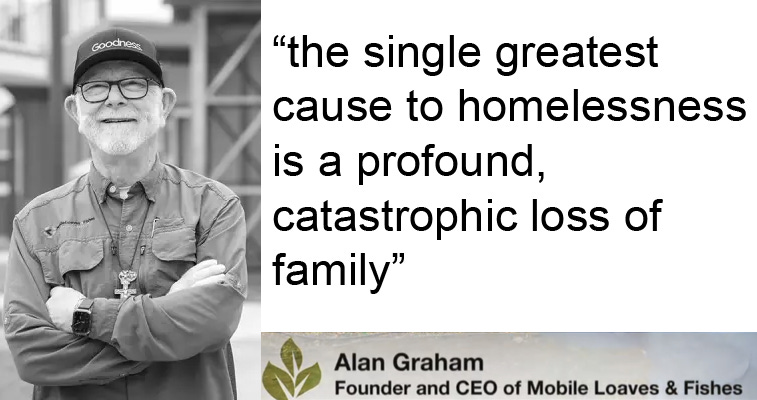
Eg: most people prefer to scapegoat "socialism" or "dem-run cities" or "capitalism," etc.
And I love Alan’s framing because it validates what 2/3 of we experienced within our family (where 2/3 of us ended up on the streets because we were abandoned by family).
But let's put family aside for a second and consider this:
Alan Graham's observation is powerful because he isn't just describing housing economics; he's describing the disappearance of the last person who would have caught you before you hit the pavement.
That doesn't mean housing costs, addiction, mental illness, wages, domestic violence, incarceration, disability, zoning, or public policy don't matter. Obviously they do.
Graham's formulation is too categorical if treated as an empirical claim about the single greatest cause of homelessness nationally, but that’s not what he’s saying.
His is an observation that reflects years intimately involved with people experiencing homelessness, and by that I mean he’s not a street journalist, although that perspective is also valuable.
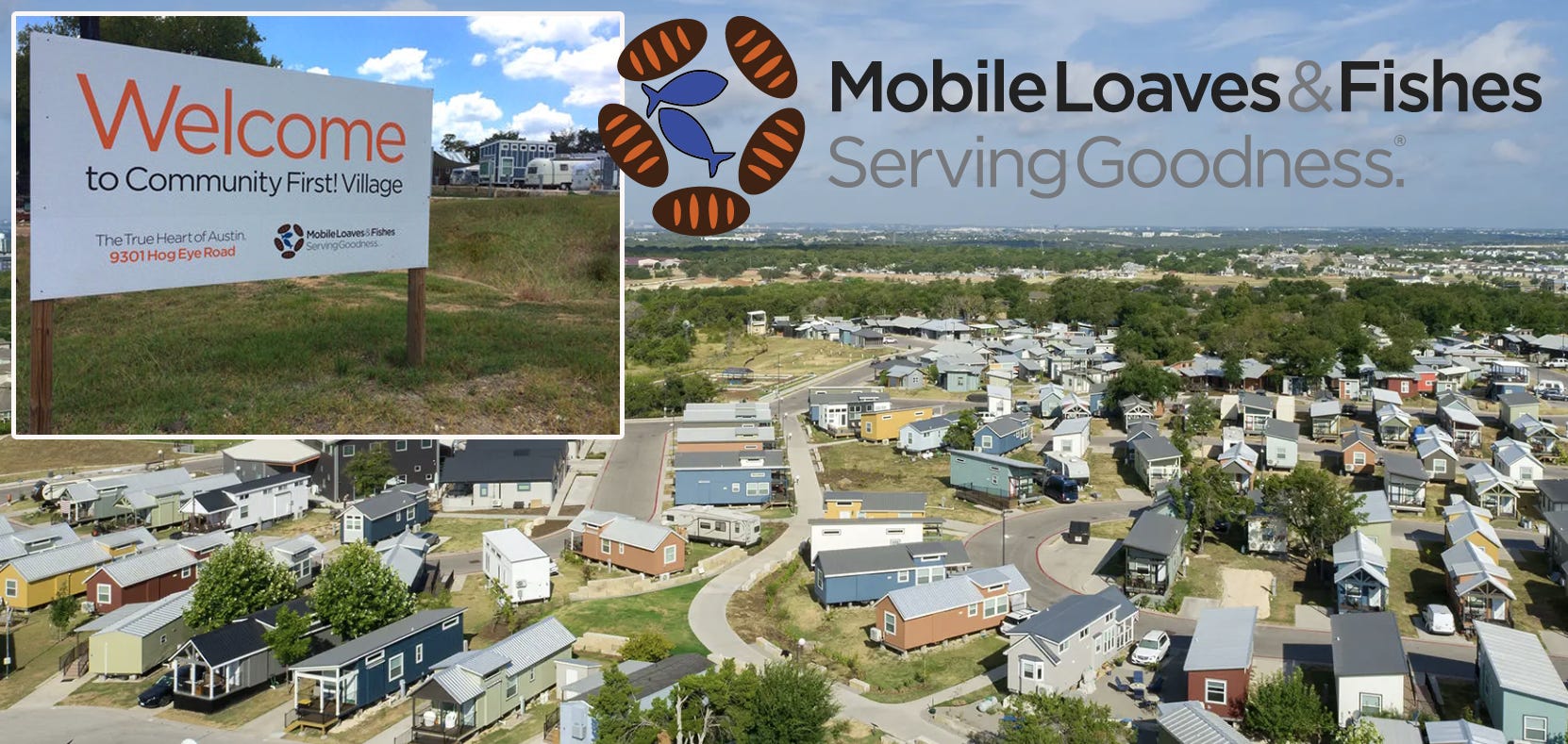
Alan offers homes to the homeless, and accompanies them as they transition into a post-homeless life, and he's pointing at something upstream that our political vocabulary has trouble seeing:
Lose your job, but your sister has a spare room
Get divorced, but Dad says come home for six months
Your car dies, but Uncle Mike has an old Corolla
Can't make rent, but Grandma covered $600
Have a babies too young, but your mother and your sister watches the kids while you work
Get sick, but somebody brings food and makes sure the electric bill gets paid.
None of those things appear in GDP as a social program, and they don't appear on anybody's balance sheet. Much of the time nobody even called it mutual aid.
For most of human history, family was capital, and not metaphorically; family provided housing, childcare, transportation, food, credit, labor, knowledge, connections, emergency liquidity and insurance.
We just didn't put dollar signs on it, and here's where it gets dangerous:
Someone remembers:
I was broke when I was 24 and I made it.
They forget:
I lived with Mom for eight months, Dad cosigned the truck, Grandma watched the kids, my brother got me the job and Aunt Susan loaned us the deposit.
Thirty years later, when the next generation needs the equivalent assistance:
Nobody helped me; I pulled myself up by my bootstraps.
Well, EVERYBODY in the family helped you, they just didn't invoice you.
And I’ll state up front that this is not the boomers’ fault.
People who had relied heavily upon family support as young adults immediately rejected an opportunity to reciprocate when it became their turn because they didn't want to get dragged down.
Of course, when they were young parents it didn't occur to them that their frequent requests for assistance within the family was "dragging other people down" because it was just part of the social order.
My dad’s folks took him in after his first divorce and my grandpa and grandma helped my dad purchase his existing home. My dad’s has never held a job that his father didn’t get for him, and my grandpa helped him with his small business - these are facts.
But my dad’s version of events is substantially different: he claims that he did it without anyone’s help, and that he pulled himself up by his bootstraps.
And my mother received substantial assistance from her family until the elders began to realize they were enabling her childish and irresponsible behavior, resulting in her losing custody of all three as soon as consequences caught up to her.
Today her story reflects significant narrative editing intended to protect her from accountability, even if it means editing her sons and her grandchildren out of her own life to protect “her truth” as the young people say.
But in the old days, mutual support was just something that grandparents and aunts and uncles did, and that was true until my folks became aunts, uncles, and grandparents.
This isn't "the boomers fault," although they are the convenient scapegoat. In truth, the issue cuts across generations.
Boomers participated in it, gen X participated in it, millennials participate in it. It has been taught as "the proper and responsible way to manage your money" in messages delivered by the wealthy about how to manage our estates.
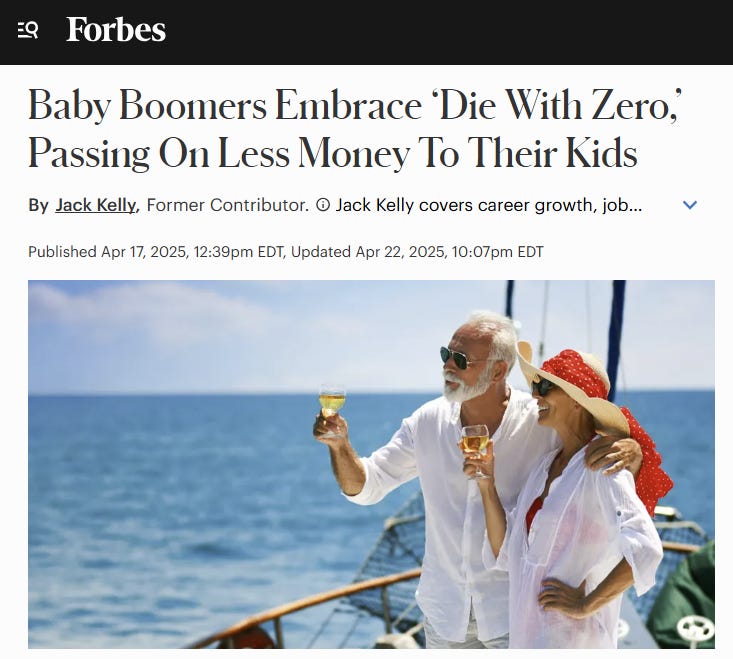
So now: wealthy people do it, poor people do it, conservatives do it, liberals do it, and then our politics provides beautifully convenient explanations that allow us to preserve the underlying behavior.
“The left” can explain homelessness intellectually, assigning blame to faceless institutions they perceive to be enemies of their “side”
“The right” can explain homelessness behaviorally, assigning fault to individuals to protect their “side”
Both perspectives can contain important truths, but neither explanation necessarily requires me to let my fucked-up nephew sleep in my spare bedroom.
Because that’s what it comes down to:
Despite pretty (but empty) statements of compassion in theory that are assigned to people without faces, many people believe that it's every man or woman for themselves.”
They don't have the time, money, or interest to help those who fall outside of their dominion, and I get it: with rising costs and an average pay that has barely budged for 50 years, people are barely keeping their noses above water.
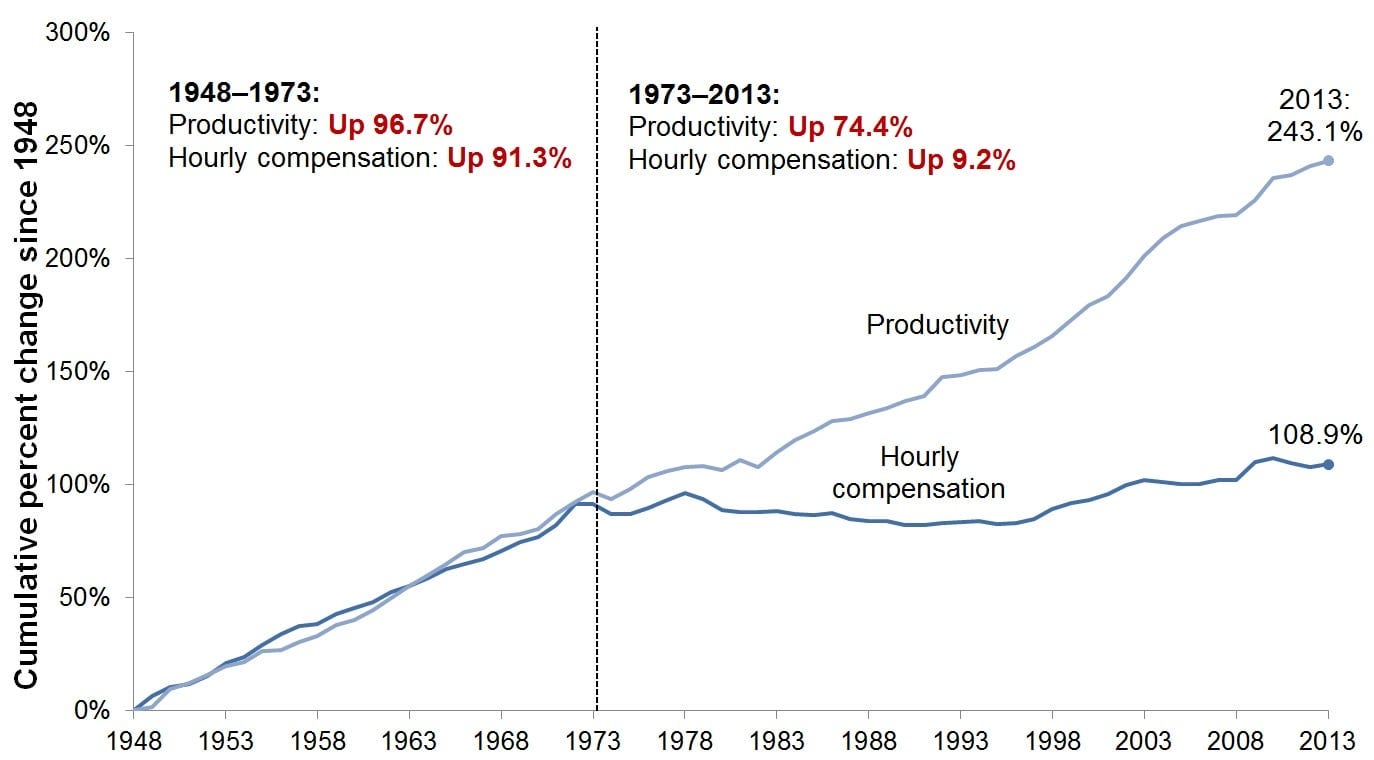
Those who "got out while the getting was good" have every good and logical reason to privately say "screw those kids" while publicly claiming they pulled themselves up by their bootstraps and did it all by themselves.
That the story itself is false doesn't matter.
People prefer stories that tell them what their itching ears want to hear, and are less interested in hearing truth that makes them feel uncomfortable.
For a long time: family helped family, but those values have washed away in favor of false stories of how they "pulled myself up by my bootstraps" that conveniently erase stories of mutual aid and assistance that got them up there in the first place.
In effect: the legacy of the older generations are erased as the younger generations claim victories they did not earn on their own.
In truth: the victories were collective wins, but this model isn’t replicable when false narratives are proposed to support the ethos of “every man and woman for themselves.”
There's a way to fix this, and it's not even that dramatic or difficult:
Consider what you might want if you found yourself homeless. Who would you want to help you protect your dignity as you faced your lowest moment?
Because if it can happen to me, it can absolutely happen to you, as I illustrate in the following article that talks about how my brother and I ended up on the streets:
It’s odd that the solution is “the golden rule.”
And it's odd that so many of these solutions return to little things I learned in church when I was a child.
And it’s odder-still that so many of these churches have adopted congregational policies that negate the old ways in favor of the new, placing a particular emphasis upon those who can afford to be there vs who might need it the most.
But not all churches, and not all boomers. Reality does not resolve into hard all-or-nothing positions, although it's convenient to believe otherwise.
The following is far more effective and grounding. Ask yourself:
And then ask:
Whom would you catch?
Those are uncomfortable questions because you can't outsource the entire problem to capitalism, socialism, Democrats, Republicans, landlords, drug addicts, zoning boards or San Francisco.
Not "the homeless," not "an electorate." not "a demographic," not "victims of capitalism," and not "a policy problem."
You.
You have nowhere to sleep tonight; who do you hope answers the phone?
I was locked from my home and my finances when I was 50. I called and was turned away.
I was turned away in the midst of a near-fatal medical emergency falsely reframed as mental illness and drug abuse by a woman planning her divorce, and by a family intent to bury an old story regarding child torture and abuse.
It worked: I ended up on the streets, although fortunately it only lasted a few weeks.
If it can happen to me, it can absolutely happen to you.
Now turn it around:
That's the Golden Rule stripped of abstraction, and fortunately for my children, my friend Mike answered the call and allowed me to sleep in his basement apartment.
It was in that same basement apartment that I outlined the 214 Alpha business model on a whiteboard in that same basement - the same business model we are using today, as I talk about in the following article":
From Grief to a Gift
·
June 15, 2025

I didn’t build all this because I wanted to be some tech founder; I built it because I was trying to save my family, and I failed.
In that same basement apartment I outlined the same business model I imagined might save my family, and as far as that goes: I failed. I failed to save my family.
But because I'm holding true to my family's old values and to my children, I succeeded in finding others who share my same "old time" values, enabling us to create a scaffolding that sustains and expands the halo of mutual benefit where it's needed.
And the best part of this story is that you don’t need a single dollar to unlock the halo of benefit that can immediately make your life better, as I outline in the following article:
No posts
Comments
Nothing yet. Say the first thing.
Sign in to join the conversation.