
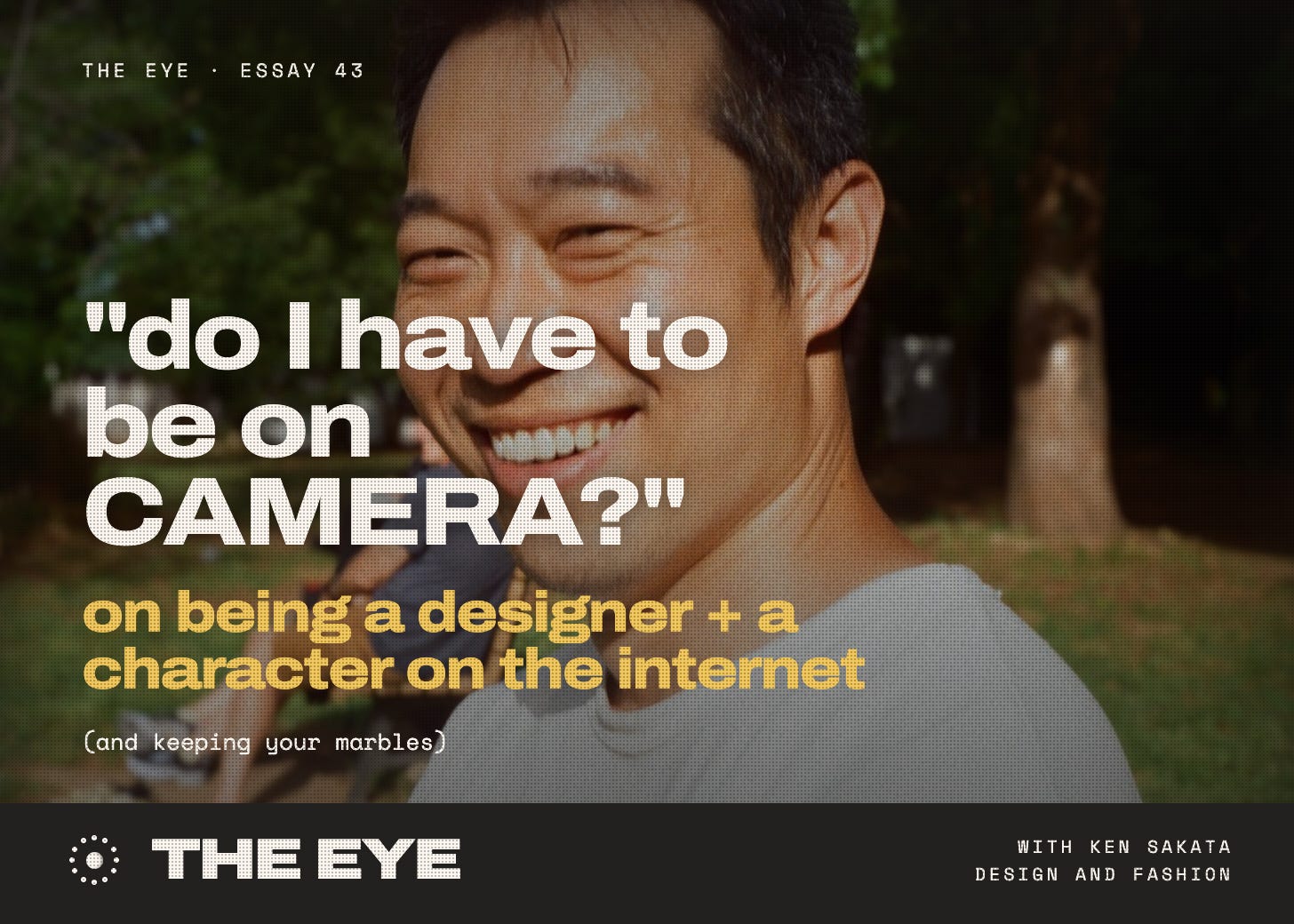
I was at Paris Fashion Week this summer, on-stage as part of a panel. We were speaking about the realities of running a design studio.
Nowadays, I get invited to speak fairly often. It’s mainly because I’m one of the handful of people who can speak to a certain experience of rising out of absolute obscurity and now, forcibly, against your will, insinuating myself into the algorithmic feed of complete strangers around the world. I’m pretty good at it.
After the talk, I was approached by a very enthusiastic member of the audience. She was courteous and said that she had viewed most, if not all of my videos and was very inspired by the journey I had taken. (I’m never comfortable with these interactions, because of the asymmetry of it all. They have spent a lot of time with ‘me’, and I am meeting them for the first time.)
She wanted to speak to me urgently about something that was happening to her in her life. She worked for XXXXXXX as a highly-paid XXXXXXXXXX (a really interesting and fulfilling job, by the sounds of it), but wanted to leave to become a fashion designer. She wanted me to give her the ‘final push’ to make up her mind, and to tell her she was going to be a success.
I could tell that she was 100% earnest. This sounded like madness. I wanted to tell her: any business as a founder/designer would most likely go under within a year. Even if it had initial success, the chances of it being an enduring one are almost certainly zero. Without fashion experience it would most likely be a creative failure too. Knowing nothing about her work, this was just the mathematics she was up against. They are as true for her as it is for me and anyone else.
So that’s what I told her.
This was not received well. It was in that instant I was supposed to realise that she had approached “Ken Sakata from the internet”. “Ken Sakata on the internet” is almost overwhelmingly positive. He speaks eloquently and concisely. He is confident and always has interesting things to say about ‘good design’, which obviously consumes him.
Instead, she got “Ken Sakata from real life”, tired and jet-lagged, obviously consumed with his own bullshit and his own problems, who had forgotten his role.
She tried to give me a second chance. “Surely, even if it’s financially dire, you must be so glad that you made that decision to leave medicine and become a designer. You must wake up every morning fulfilled?”
“I wake up every morning, and the first thing I think about is how I am running out of money. The last thing I think about before I go to sleep is how the studio is going to run without money.”
I could see the utter disappointment (maybe betrayal?) on her face. Fair.
So today we’re going to talk about putting yourself on the internet in short-form video clips and the downstream effects it can have on your life, how you interact with the world and how the world interacts with you.
I would not have a career if it wasn’t for short-form video. It is the only reason why you are subscribing to this newsletter. It is the only reason why I have a career designing clothes for other brands, as well as my own(!). I get to introduce myself at parties as a capital-D Designer, and it is not a lie. For that, I will always be thankful.
It remains the most efficient way to let people know about your talent or your ideas or your business. You get to do it for free and you get unlimited go’s at it. You can get jobs you never interviewed for, in countries you would never have been.
To be clear, I am not an advocate of algorithmic social media and how it is weighted towards human faces. I am also wary as to the unbelievable reach a novice designer can get way before he or she has the skill to back it up, as I was years ago. These are just ‘the times’.
I am not a supporter of the fact that you have to prostrate yourself in front of the internet, sacrificing your dignity and your privacy. It is ‘the times’, and I think the sooner that we accept the facts, the more meaningful a discussion we can have about how to deal with what happens after.
If you are at the stage where you are curious about or even considering doing this to yourself or your business, I have remarkably little to say. (I have already demonstrated my value as someone who gives life-changing advice.) But I would merely recommend you think about your positions on three ideas.
I present them as follows:
“ANONYMITY”
Martin Margiela was famously quite principled about being not being the focus of Maison Margiela. Since 1988, he never gave a formal interview, was never photographed for any magazine, and never took a bow after any of his fashion shows. He wanted the work to speak for itself, and he had hard and fast rules (to the point of it being contractual) about not appearing on camera.
This is an undeniably cool position to be in. Margiela was incredibly talented, and also lived in different times. He was afforded the opportunity to be appreciated via his objects first and his personality second, and as a person none at all. I do not have those same luxuries. I started my business in 2022 on TikTok. I had to be a face first, then a personality, and eventually, if you saw my face enough and bothered to click through enough links, judged by an object I designed.
In this business, in these times, I have to negotiate a different sort of anonymity. I speak exclusively about design. I don’t speak about my personal life, and I don’t speak about my life before design unless it pertains directly to the work.
Your mileage will vary. Many creators benefit from a no-holds-barred, messy overfamiliarisation with the viewer. When it comes time to convert viewers into customers, the audience might feel like they are buying from a family member or at least a roommate of sorts, someone who has been inside their house every day, three minutes at a time, for the last few years.
I have chosen not to do this, mostly because it is easier to navigate a life with boundaries. I find it very useful to separate Ken Sakata, the actual person from Ken Sakata the internet character, a persona with an on/off switch.
All critiques and adoration are abstracted from my true and real self. This is an honest way to live. I am nowhere near as bad or as good a designer as the internet thinks.
“CONTROL”
Try as you may to curate how you appear on the internet, it is not within your control even slightly. You will do well to think very deeply about this lack of control.
I have been taken out of context. My videos have been chopped up, maliciously edited and responded to without my knowledge. I have even been AI-dubbed to say things I have never said.
If someone loses their job and is feeling hopeless, Ken Sakata from Instagram popping on their feed to talk about expensive Japanese denim might seem insensitive and callous. (I have literally received this piece of feedback via email.)
These are wacky examples, but it is realistic to expect negative comments on every video that you do. To think about control is to consider your relationship with vanity. I think it is embarrassingly human to want to be liked, and to be liked the way that you want.
If given the choice, I would rather be correctly understood rather than liked but maybe this a bridge too far.
Being on the algorithmic internet is to insist on being an unexpected guest in hundreds and thousands of people’s homes. The response is not always positive.
As I intimate sometimes, I was a doctor in a previous career. In the hospital, it was not important to be liked at all. It was not even important to be correct. Every day was ego-death: endless apologising, endless grovelling to the senior doctors of another department in order to get your patients their blood tests, X-rays, and examinations on time. You did what you had to do for the job and to survive the day.
Fashion is like this, but instead of saving lives, you are selling T-shirts.
This is understandably quite unsexy for you. You had imagined that being in fashion was to travel the world, wear sexy things, and inspire people to be sexy like you, a sort of James Bond character. What you are, in fact, is Q, James Bond’s outfitter.
“But Q.. is not sexy at all!”
That’s correct.
“TRANSPARENCY”
Transparency has a slippery definition, but one thing that 9 out of 10 dentists agree on is that it is an incredibly good thing to be associated with. You will have to determine what to be transparent about.
Transparency comes out of a desire from the public not to be deceived. It’s a simple enough idea to grasp. On social media, this has been very poorly handled.
Many business owners have taken to a type of behind the scenes content. It will frequently involve itemising the production cost of a piece of clothing. Fabrics cost X, Taxation costs Y. This is to convince you of how little money they are actually making, or how hard it is to run a brand. Honestly who cares.
The fact that you do not know how to manage your production costs or that you are somehow still in business is of zero interest to the customer.
It is not a two-way street. You are always indebted for arriving unannounced and empty-handed, and your responsibility is to entertain or provide value to the person who is watching your video.
They want to know that the cool things you’ve said are (1) truly cool and (2) truly true. Is this Made in Japan? Here’s a photo of our stuff being made in Japan. Here’s why that’s important.
But just because you are indebted doesn’t mean that you have to reveal information about yourself that isn’t relevant. Yes, I have arrived on the zephyrs of the dark algorithmic gods, but it’s not cool to ask me ‘what sort of Asian’ I am.
Remember, you are Q, not James Bond. They have to know that there are three invisible bullets in the chamber, and the fourth trigger-press blows the gun up. Bond doesn’t care how expensive the gun was to make, and he doesn't ask Q questions that aren’t relevant for the mission.
I’m trying to be better at playing the Ken Sakata internet character. It shouldn’t be that hard. He believes everything I believe. He is passionate about all the things I’m passionate about. He is articulate and absurdly idealistic about the pursuit of good design. I am all of those things too.
I joke about the internet persona as being a spectramatic 9 year old who has cornered you at a party and is going to talk to you about wool gabardine or pilot pockets for the next 3 minutes. Sometimes I wish I could negotiate more common ground between him and myself, maybe in longer-form, maybe on YouTube. But then it would shift the goalposts from three minutes to 60 minutes, and we are still talking about abstraction.
I need to reflect on the absurd ways I have beaten the mathematical odds thus far and to be thankful. Better to concentrate on being a complete person to my loved ones and settle for the little helpful cameos on the internet for everyone else.
Comments
Nothing yet. Say the first thing.
Sign in to join the conversation.