
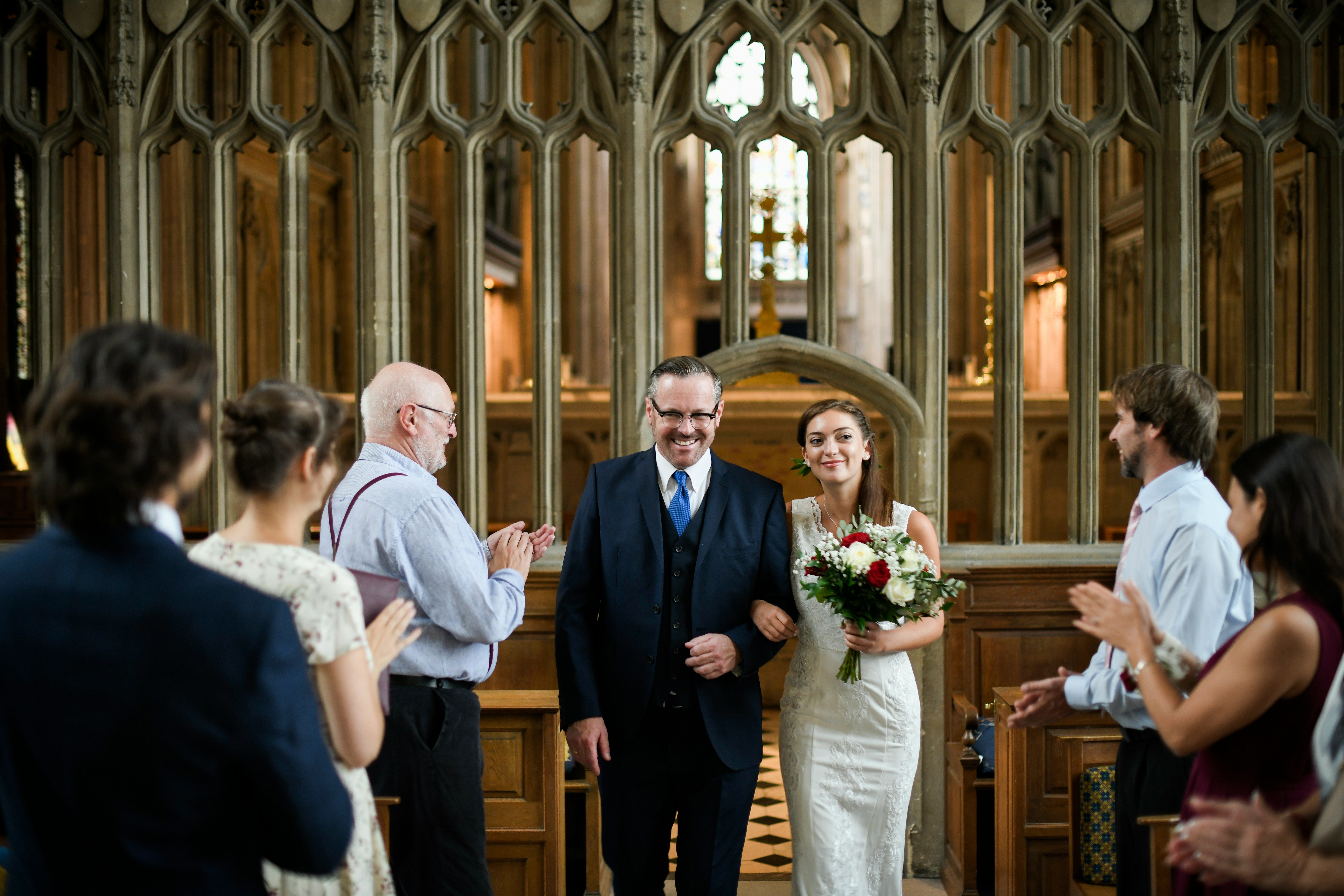
Growing up as a young’n in the Methodist tradition, our particular country parish had developed a tradition to end each worship service; everyone present would clasp hands together and form a circle around the sanctuary, and in unison we’d sing the 19th-century hymn written by Jeremiah Eames Rankin, “God Be With You Till We Meet Again,” and then, and then only, could the minister give the benediction.
For the faithful at that parish, ending each service by singing “God Be With You” was as essential to the Sunday worship experience as praying a corporate prayer of confession or receiving the Lord’s Supper.
Interestingly enough, nobody at that particular Methodist church could even remember who started this practice or when it started. They’d been closing out services like this for so many decades, the actual origin of the tradition had long been lost to the annals of history.
For all the years of my youth, there was not a single time that anyone ever questioned ending the service in that manner; nobody ever asked, “Why are we doing this? Can you show me where in the Bible it says to end a service this way?”
Everyone knew this was a local custom.
Even the most casual parishioner of our parish, the person who knew little to nothing about theology or Holy Scripture, understood that it was only our little country parish that had developed this unique way of ending each worship service.
Having been married into the Anglican Church circa three decades ago, and then transitioning into the Orthodox Church, what astounded me for quite some time was the manner in which certain relatives and acquaintances would vehemently attack the traditions of the Ancient Church as “not being Biblical.”
There was one instance that occurred nearly 30 years ago in which a relative who was seething with firebrands in his eyes told me to get my head “out of the Old Testament.”
“There’s nothing in the Old Testament for us Christians today! It’s just a bunch of traditions that no longer apply!” he said.
The irony, of course, is the very people who demand a chapter and verse from the Bible for every Orthodox Christian belief rarely ever apply the same voracity of criticism to their own particular tradition.
Like the Methodist church of my youth, there is not a Presbyterian, Baptist, Pentecostal, Lutheran, non-denominational, or fill-in-the-blank church that hasn’t adopted beliefs and practices that can’t be found between the pages of Holy Scripture.
Likewise, there is no church of those I listed, as well as the many others in the Protestant or Evangelical tradition, that hasn’t adopted theological beliefs that nobody in the ancient world would have agreed with.
Take, for instance, this recent Bible teaching within the Evangelical Protestant tradition that the Mother of God, the Blessed Virgin Mary, went on to have other children with her betrothed, Joseph, after the birth of Jesus.
Not only would nobody in the ancient Church adhere to such a teaching, the original Protestants themselves condemned such a belief as heresy!
John Calvin, Martin Luther, and even Ulrich Zwingli said that people who taught such a thing about the Mother of God “were of the devil”, and were deceivers at best, non-Christians at worst (I am not saying this, these are the words of the Protestant Reformers).
The sheer number of theological beliefs and new traditions that modern Western Christians have adopted are simply too long to list in this short space, but consider a few that no ancient Christian in the time of the Apostles would have recognized:
Clasping one’s hands together in prayer: A medieval tradition adopted a thousand years after Jesus.
Ending a prayer simply, “In Jesus’ name, amen.” Yes, we are to ‘pray to Jesus,’ but the ancient Church always understood prayer through Jesus was not merely saying particular words to end a prayer, but the manner in which we approach the Father through the Son, in the Holy Spirit. And so Christians have always begun and ended with, “in the name of the Father, Son, and Holy Spirit” in prayer, not “just Jesus.”
Clasping hands together with family to pray while sitting around a table: yet another medieval innovation.
The idea that salvation requires some kind of conversion experience. This is a far more recent tradition, largely originating in John Wesley’s Aldersgate experience and then crystallized in the 19th-century revivalistic movements.
Church services centered almost exclusively on the sermon. This is arguably one of the most radical changes to Western Christian worship, since in the ancient world the sacrifice, a shared meal between the faithful, was the absolute central component of Old Testament worship, which then became the Lord’s Supper, or Eucharist, which was the entire focus of every single worship service for 1500 years until various Protestants began moving towards the sermon as the focal point.
The phrase “accept Jesus as your personal Lord and Savior,” which is very common throughout Evangelicalism, but is not only nowhere to be found in their Bibles, it is nowhere found in Church history until the last hundred years or so.
One of the reasons I refuse to engage in the modern online world of “debate” is that everything I’ve seen on YouTube and other platforms for the past decade is not really what I’d say follows the classical concepts of debating, but is largely just people mocking each other and being uncharitable.
But even more to the point, if we can’t first be honest about our own presuppositions, then what value is there in debating theology and history?
If modern Western Christians cannot admit, (like the parishioners at the Methodist church of my youth were able to admit), that they have developed new traditions that are nowhere found in the Bible or church history, why would I entertain a debate where those very same people want to attack the Orthodox Christian traditions as not being found in the pages of Holy Scripture?
All Christians have traditions. Even modern Evangelicals, with their sound systems, rock bands, stage lighting, smoke machines, and the quiet-voiced pastor who speaks in a low tone as a piano gently plays in the background, drawing out emotions.
Everyone has traditions. The question is not whether we have traditions or not. The real question is whether or not our traditions preserve the Apostolic faith.
You see, for many of those who have found themselves attending Orthodox churches in recent years, what used to be their main objection, “The Orthodox Church believes things that aren’t in the Bible,” ended up becoming the very thing they criticized the church traditions they left for!
And suddenly, these people who used to argue against ancient Roman Catholicism or Orthodox Christianity, accusing them of ‘man-made traditions,’ realized that the very Protestant Reformed movement or Evangelical church they came from had introduced man-made traditions that no ancient Christian in the time of the Apostles would have ever recognized.
Tomorrow is the Feast of the Dormition, which is the celebration of when the Mother of God (Theotokos) fell asleep in death, followed by her bodily assumption into heaven.
In the ancient world, the Romans had laws that protected the bones (relics) of all people; regardless of whether the person who had died was a Roman citizen, a slave, or a tourist, it was against the law for anyone in the ancient Roman world to disturb the bones of the dead. This was largely owing to the belief that if the bones were disturbed, the spirit of the dead could haunt and harass the living.
Thus, whenever a Christian Saint was martyred or died, a shrine could be built for their relics and everyone in the ancient world left the shrine alone out of fear of being arrested.
Three hundred years after Jesus, when Saint Helen, the mother of Saint Constantine, came to the Holy Land, she found graves and shrines built over a myriad of saints, the relics of which she then brought back to Constantinople.
However, no shrine or grave had ever been built for the Mother of God, because the clear tradition that had been preserved for all those years from the time of her repose, was that she had been bodily assumed into heaven after her death.
Not a single Christian, from the time of Saint John the Beloved to the time of Constantine and Helen, ever taught anything else.
There is not a single tradition in any ancient thread of the faith that taught anything else other than the bodily assumption of the Theotokos.
Now, of course, it is not required that one believe this to be a follower of Christ.
Being a Christian is not about a checklist of beliefs on a test that one must pass.
Nonetheless, it is odd that for 1500 years Christians celebrated the bodily assumption of the Theotokos, and yet now, only the very ancient threads of Christianity still preserve this tradition.
Western Christians are more dutiful in celebrating American Thanksgiving, or European Boxing Day, than they are the Feast of the Dormition.
Birthdays, which were always a very pagan tradition, have been adopted wholesale by most Western Christians, yet celebrating Death Days, or “Feast Days,” which was always the practice of the Church, are practically non-existent in the traditions of most modern forms of Christianity.
This essay is not meant to rail against modernity, but merely to express my own observation that it is odd that, for all the online criticism and in-person attacks I’ve experienced toward our ancient faith, the very people who are so quick to condemn our traditions are the very ones who have invented brand-new ones.
And if you interested in celebrating or experiencing the ancient tradition regarding the Feast of the Dormition, I’m sure there is an ancient thread of Christianity nearby you that will be celebrating it tomorrow.
~ Kenneth
In both Wednesday’s essay and today’s, I've gone a bit longer than usual, and been a bit more expansive in my observations regarding various forms of modern Christianity.
Normally, my Substack follows two main themes; sharing my personal spiritual journey in Christ, and discussing various aspects of Church history.
I try to do my best in not being over critical toward other threads of Christianity, yet in discussing the spiritual journey or church history in a space devoted to my personal thoughts, I feel a bit more comfortable in sharing such criticisms, which I would normally never voice in a more professional setting such as a classroom.
The first verse of Psalm 1 begins with a negative,
“Blessed is the man who does not walk in the advice of the wicked; nor does he stand in the way of sinners; nor does he sit in the assembly of mockers.”
Though I'm not a theologian and don’t pretend to be one, I can’t help but think it is intentional on the part of the Psalmist that he begins the opening of that Psalm (as well as many others) with the negative.
As if to say, “I have something I want to teach you, but in order for me to convey this wisdom to you, I need to first tell you what is wrong with the world around you”.
Isn’t that what you and I realize about the world; there is something wrong with it.
Isn’t that what drives many people to attending a church for the first time, or returning to the church after years away from her?
After particular essays, such as Wednesday and today, I can’t help but be a little concerned that my prose sounded more negative. Yet after multiple rewrites, I keep coming back to the idea found in the Psalms; that sometimes in order to convey a truth that is positive, one must first examine the claims of others, i.e. the negative.
While the power of encouragement and positivity are something I definitely fully believe and support, it’s also important to be real with people. And being real means that at times we need to examine the claims of others in a negative context.
So therefore, I beg your pardon, anyone who feels I was overly critical of their particular thread of Christianity, I pray you understand my motive was not to be uncharitable or to try and convince you to leave your tradition.
As I expressed in the backstory of my own life growing up Methodist, I didn’t view the tradition of singing a hymn to close the service as being “evil” or '“wrong”. Yet we didn’t try to defend that tradition as being something other than what it was; a local custom.
At that Methodist church, we never told people our Sunday practice of ending with a hymn and holding hands together was ‘biblical’, and that other faiths were doing ‘unbiblical’ things on Sunday.
Thus, the mindset behind my last essay and this morning was simply to address the strange ironic tone of modernity which seeks to attack the Orthodox tradition as being ‘unbiblical’ yet which fails to analyze their own tradition with the same mindset.
Perhaps by understanding what we are doing, rather than everyone Becoming Orthodox, we will each be drawn toward each other in a greater spirit of love, as we each pursue Christ in our daily life.
Thanks for your support; whether you simply “like” these essays, share them with your friends, or if you have the financial means.
A great deal of time and energy goes into the work related to Becoming Orthodox, it has in many ways become a full time job, and while I would never put a price tag on something related to sharing my faith, I am greatly thankful for those who are able to help keep this little project going. Thank you.

No posts
Comments
Nothing yet. Say the first thing.
Sign in to join the conversation.