
My Monday morning (of last, last week at this point, sorry, I was sick) started off with a text from my aunt:
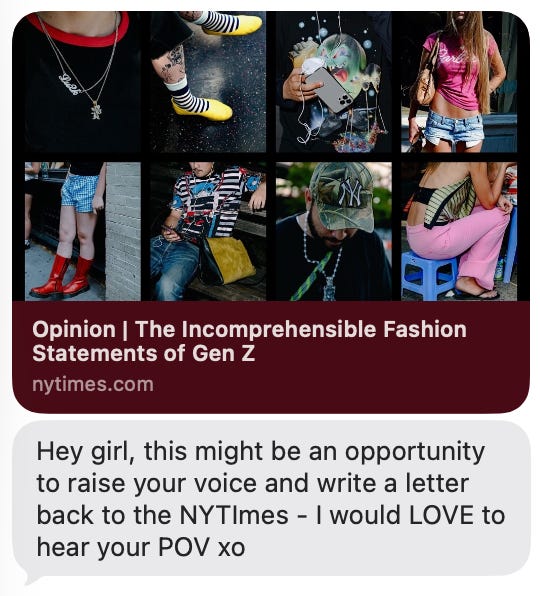
We all know the NYT Opinions section is a hotbed of questionable takes and controversial click-bait titles. See: “Did women ruin the workplace?” adjusted to the oh so much more savory (sarcasm), “Did liberal feminism ruin the workplace?” Euphemistic headlines that frame society’s failures as random isolated occurrences, rather than addressing the systemic root causes (people dead because of war, instead of civilians killed by xyz military.) Now, I’m no journalist. I don’t cover news (although it distresses me daily.) But I am well aware of the state of the world and fashion trends. So, when I started reading Morton’s piece and he started listing off the subcultures of his youth, I paid attention. But then, mere sentences after his introductory claim that his younger days at a street-fashion magazine taught him how to read a person’s tastes and preferences through a glance at their outfit, he wrote:
“These days I am a middle-aged man who works the door at a bar in Chicago that is reasonably popular with the youths, and I am routinely flummoxed by the sartorial flotsam that comes packing itself in. The other night a guy came in with a shoulder-length butt cut and his T-shirt tucked into his jeans. “Now there’s a dork,” I thought. I could’ve clocked him from down the block. But no. An hour later I went outside, and he was making out in the alley with a six-foot freaking supermodel — and she was goth. Or at least she was dressed like what I consider to be a goth; nowadays I don’t even know.
and I too was flummoxed. To me that sounds like peak 90s heartthrob (Leonardo DiCaprio was no Hollywood nerd,) but maybe Morton just did a bad job describing the outfit. For a piece on fashion, he doesn’t really describe much of it. He does seem to like defining the lines between groups, though.
He also writes, before later contradicting himself,
“In the 1990s recession I grew up in, there was no cheap fast fashion. Instead, American teenagers hit the thrift stores and rummaged through the available past. Social theorists like Dick Hebdige would refer to the overall picture as a bricolage (Kendall here, bricolage is defined as the, “construction (as of a sculpture or a structure of ideas) achieved by using whatever comes to hand”) of previous eras and subcultures of youth fashion: a grab-bag of old discarded styles shuffled into a new arrangement. While we youths knew what these new arrangements signified — an old dress shirt with mailman pants for the indie-rock kids, ’50s baby-doll dresses with boots for the riot girls — to an outside observer, I’m sure we all just looked crazy.”
We must address two points in this quote:
Thrift shopping. Gen Z is still digging through the racks at thrift stores. In fact, I’d argue, they are leading the charge. As RETAILBOSS writes, “The data shows something traditional retail executives failed to anticipate: 64% of Gen Z searches for items secondhand before buying new. Nearly half of younger consumers list secondhand as their first shopping destination for apparel, up 7 percentage points from 2022.” Secondhand has grown into a $61 billion market (within the US) according to ThredUp’s 2026 report. Globally? $257 billion, as of this year, and projected to reach $398 billion by 2030.
Secondly, the whole mismatched styling confusion. Fewer than sixty words later, Morton describes Gen Z’s pairings of peasant dresses with t-shirts, JNCO jeans with a blazer. I’m not sure how this is so drastically different from baby doll dresses and boots? Maybe, Morton, you just don’t know the cues anymore. Every generation has been known to confuse the one before it, and it sounds like he has hit a milestone in every adult’s life: sounding like your parents. Honestly, if I had to sum this entire opinion piece up in one clip, it would be this joke by comedian Geoffrey Asmus:
Not even a few paragraphs later he adds, “And for an era when people ask strangers online to rate their fits, it’s genuinely insane how poorly everyone’s clothing fits. High-waisted jeans bell out over women’s navels while flared or boot-fit cuffs clang around their calves; untucked shirts hang off the sides like paper-doll clothes; nobody’s wearing the right shoes.” And to that, I say, who set that system up!? Not the kids shopping, that’s for sure. They shop from thrift stores or fast fashion sites. Neither of which is tailored to the individual body of any shopper. Thrift store shopping is great, but unless these youths have tailoring budgets, it is hard to get clothing that fits perfectly. And this is even more of a problem with modern sizing and grading. Clothing is made to fit everyone, which in reality, means it fits pretty much no one. Sure, it’s passable, but armholes are wonky and bust darts are either too long or too short and sleeve caps and cross shoulders don’t have enough give (because they took out back pleats. Give them back.) and inseams are one size fits all and everything is made of plastic. As scale increases, fit decreases. So yeah, the cheap $40 dress your high schooler bought for homecoming probably won’t fit perfectly. You get what you pay for. And with limited budgets, sans tailoring, the result is inevitable: poorer fitting clothing than something you might have been able to find in the early iterations of Zara and Forever 21.
And now we approach my main issue with this entire article: It is hard to address this confusing state of dress, or undress, without addressing the why, something Morton barely breezes over. It is hard to discuss the trends of the youth without addressing the state of the world. We have seen time and time again the pendulum of fashion swing and loop back around according to political influences, wars, and social justice movements. Think the Lipstick effect, or the hemline index. The ease of the Roaring Twenties before the sad dip into the Great Depression. We are currently in that very pre-collapse era. Fashion of the 1920s was considered scandalous too. A woman’s knees, GASP! Short hair! Double gasp! Clothing has always shone a light onto the socioeconomic state of the world, and Gen Z is no exception.
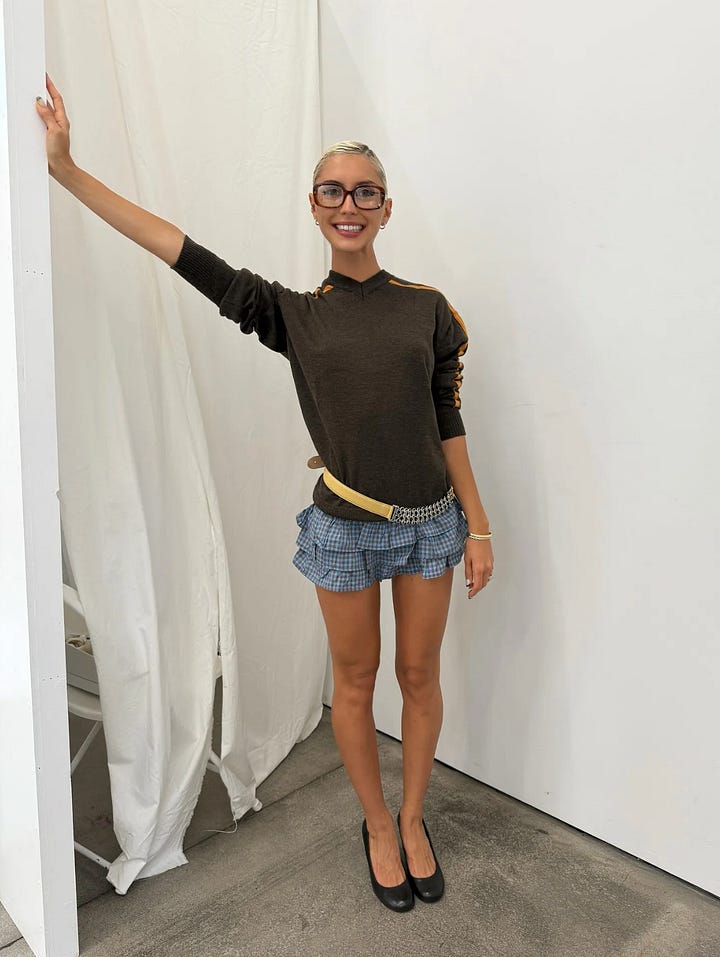
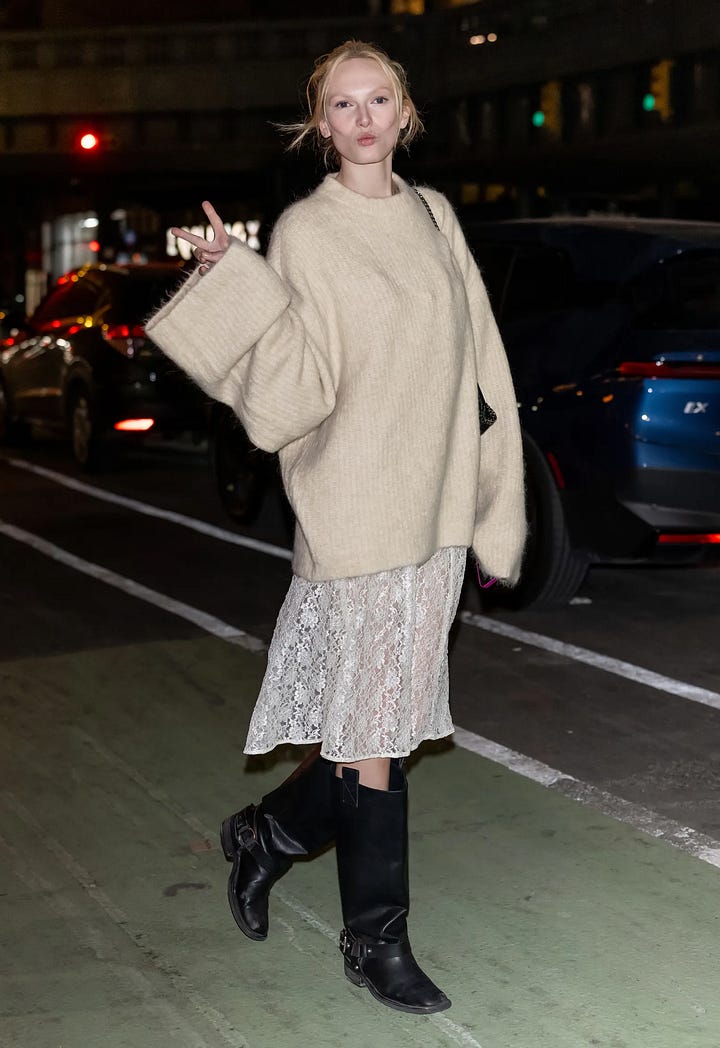
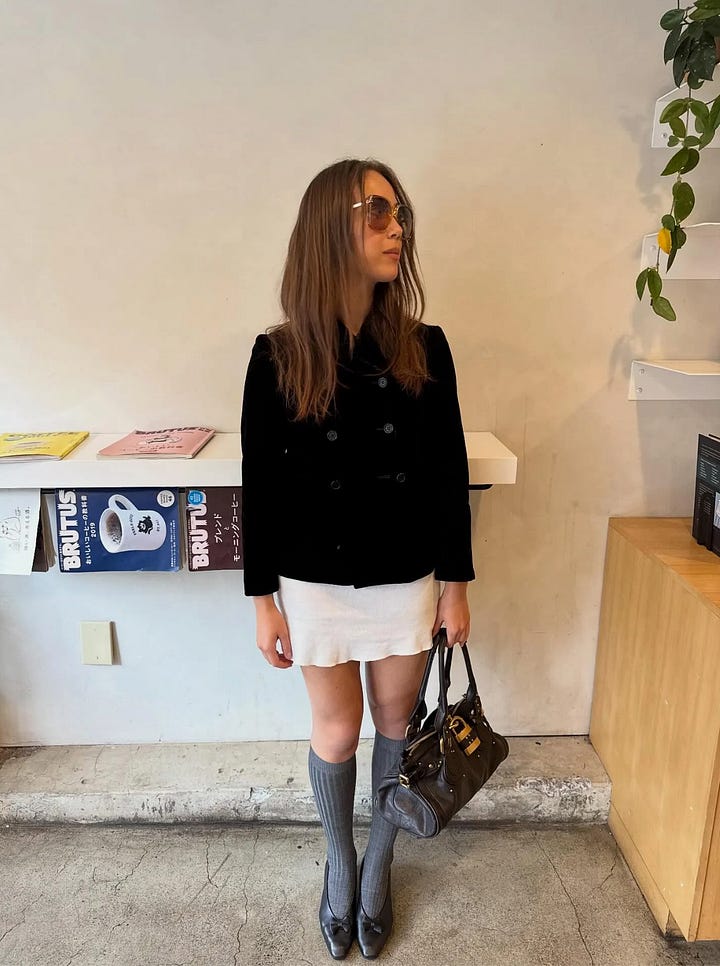
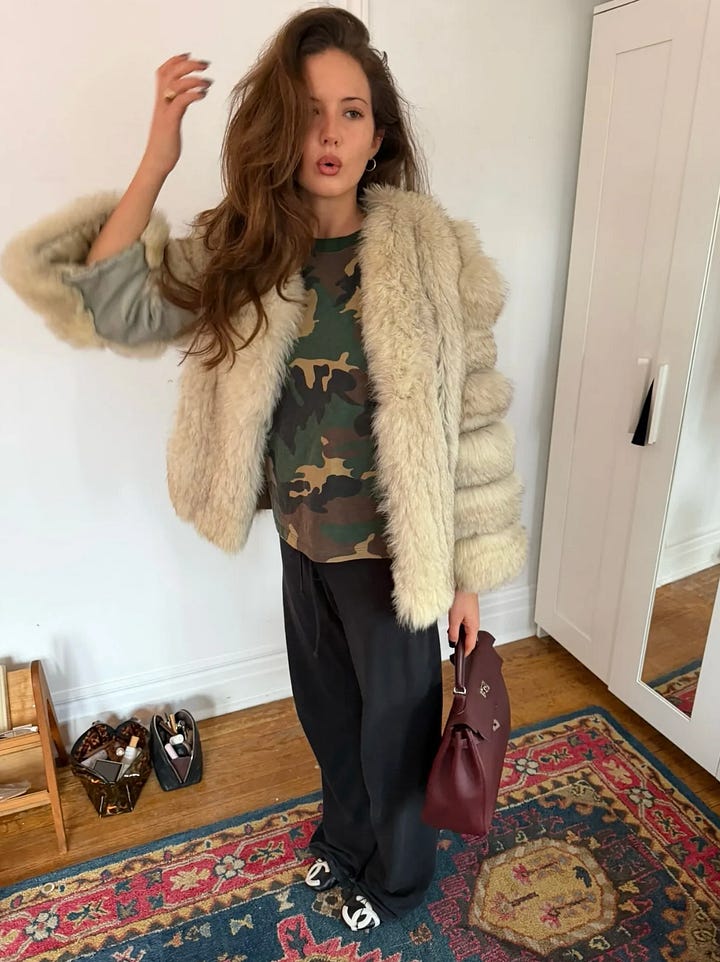
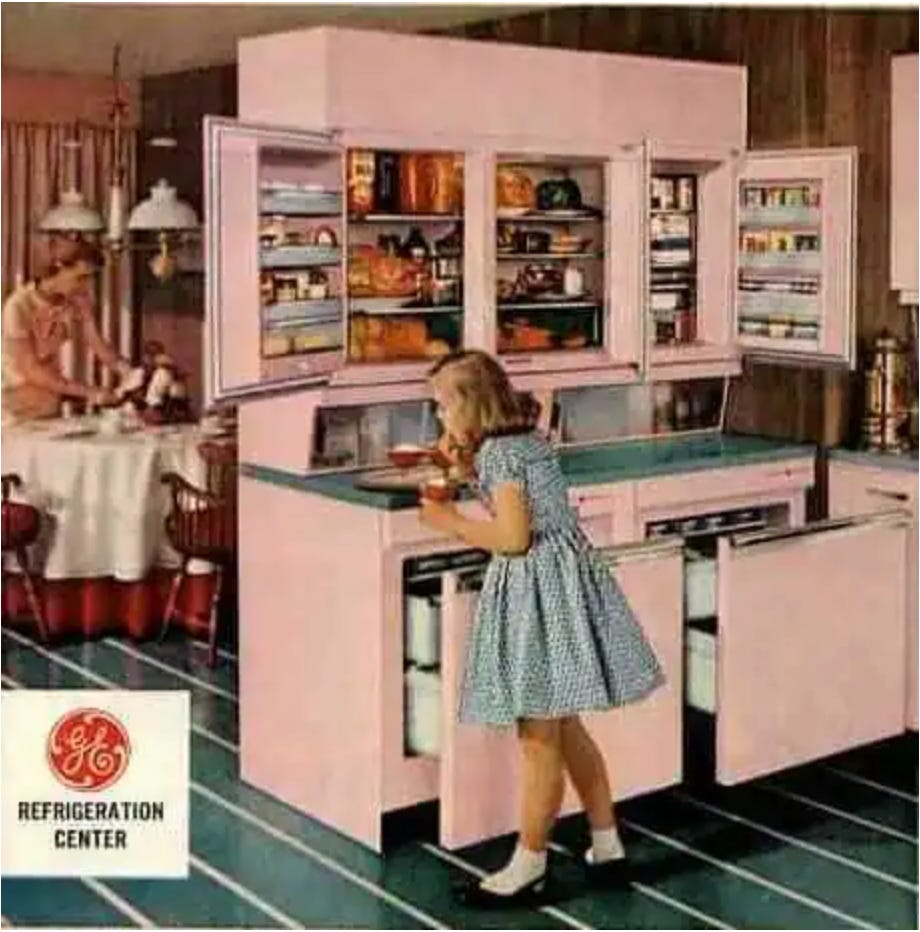
Everything is available to us, and yet none if it is ours. Cars require subscriptions. Nearly every computer program or software requires subscriptions - remember when you could just buy the Adobe suite!? (I do.) Our TV is subscription based. Our music used to be our music. (I miss when my friends made me mix tapes.) Instagram plus, anyone? We have everything, and own nothing. And anything we do own? Dependent on the whims of whatever feudal tech lord owns whichever given company. Toothbrushes require wifi now. As do fridges. As do vacuums (although RIP to Roomba, who knew you were such a threat to national security?? Die a hero or live long enough to be a villain.) Everything is built to give the illusion of increased productivity, when all we really want is for our products to last longer than three years. Fuck, and I say this with my whole entire chest, planned obsolescence. I will own a 1964 General Electric Americana refrigerator one day. But I digress, sorry for the tangent.
So in a world built on fleeting everything, it’s easy to understand why Gen Z refuses to define themselves by one singular look. And there are definitely still looks. We still have ravers and goths and “clean girls” and pilates princesses and Y2K street and grunge. I’ve been seeing a revival of heavy metal music and folk music and punk music and screamo music. But, while Gen Z males are in fact more conservative than the men of generations before them, Gen Z as a whole still leans much more towards progressiveness and open-mindedness. We don’t want rigid groups because, well, why would we? I’ve met so many cool people in New York from so many different walks of life with vastly different interests, and having such a wealth of perspective has, despite what conservatives think, made my life better. (Yes, for all those wondering, I am doing A-ok over here in the democratic socialist hell of filled potholes and community building activities and a balanced $12 billion inherited debt and lower crime rates and free childcare.)
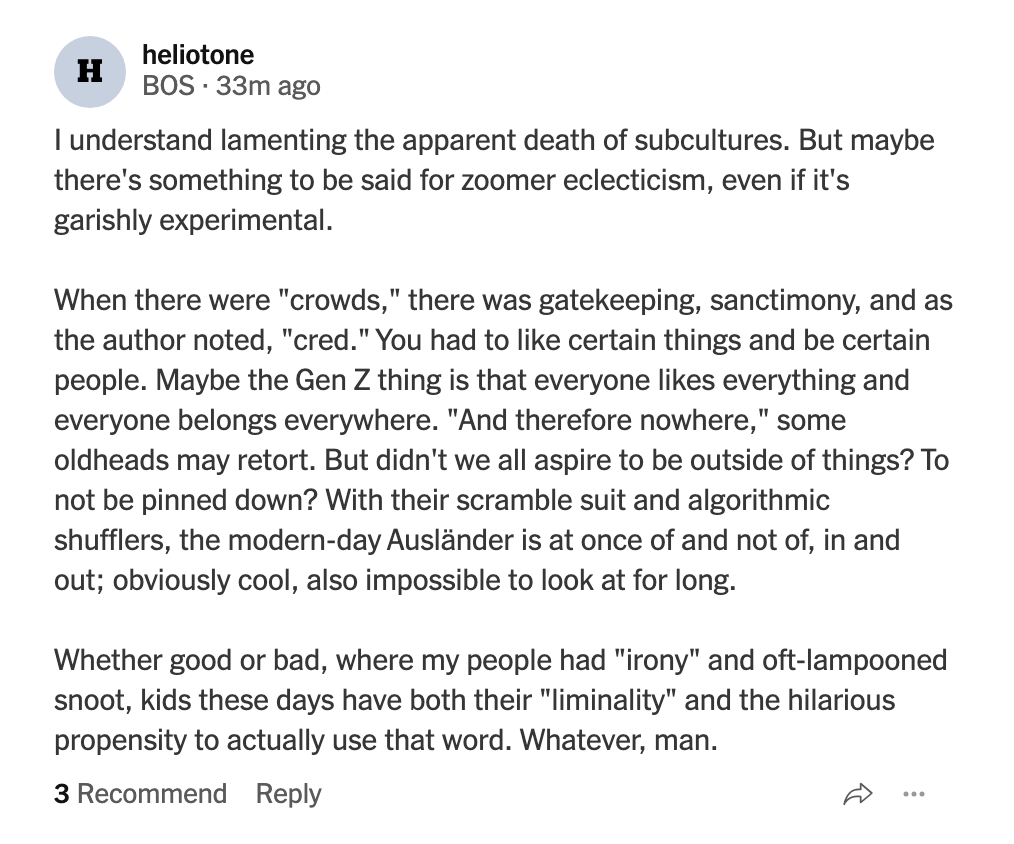
I especially love this comment:
Morton, waxing poetic about his screen-free youth, writes,
“It helped that there were only about 10 or so things you could be, although by the end of the ’90s, the things were multiplying. Punk begot crust punk, skate punk, hard core, post-hard core and third-wave ska (a lot of ska). Goth split into regular goth, Florida spooky kid and industrial, which split into dance industrial and rivet. Even theater kids branched off into opposing factions of performers and stage techs, each with its own discernible fashion cues. Here’s a helpful mnemonic for that one: If there’s a tie with no collar round the neck, you got yourself a tech.”
I think what he might be describing is simply people dressing to reflect their environments. Honestly, this entire article confused me. Why does the writer want such division? Maybe, just maybe, the homogenization of fashion trends into one giant trend is actually a way to get to know the people around you without making snap judgements! And that is assuming these trends are in fact completely homogenized. Which they are not! In fact, Gen Z LOVES a titled trend - think cottagecore, coquette, gorpcore, indie sleaze, e-girl, art hoe (although it seems to leave the hoe part up to interpretation), the 90s/Y2K revival, I could go on forever. They are happy to embrace ideas, but they like the world we live in where they don’t have to be and don’t want to be confined to that specific group. We contain multitudes. Let us. (Yeah, I’m technically Gen Z.)
To argue even further with the author, let us read the below statement:
“Indie-rock kids took up club music; metal heads threw a little rap in the mix. Everybody’s pants shrank. As the lines that divided tribe from tribe gave way in piecemeal fashion, everyone started blending and hybridizing into a single amorphous new thing. It was beautiful.”
You’ve read it? Great. Morton then immediately walks back his claim of a beautiful amorphous fashion monster just sentences later, saying how much he actually hates the blurring of these lines between subcultures and tribes, writing,
“But I think this whole business hurts more than the eyes. The subcultures of my youth were a sort of surrogate extended family. In a society jettisoning the type of organizations and communities that stitched it together over the 20th century, finding someone or a group of someones who were the same thing as you served as a bulwark against the fracturing sense of atomization. Making up a subculture every couple of months basically does the opposite, keeping you permanently aloof from the kids around you. I mean, half these things barely sound like groups of anything. What the hell is a performative matcha boy — some guy who drinks a thing? How’s that going to be your tribe?”
As we previously discussed, the kids like being able to move beyond the assumed morality of individual groups. Your family can, and honestly should, be a group that challenges you. Otherwise, we end up with the older generation of today: mad at everyone else that doesn’t conform to their ideals and standards, and constantly demanding respect. But I guess that’s just the true result of American exceptionalism and always being told you’re the best, baby.
Now, just for shits and giggles, let’s briefly jump on the most obvious bait within this excerpt. I’m not sure Morton understands exactly who this performative matcha boy is - he’s not real. He (probably) cannot hurt you. He is a caricature created by a very online sect of people, to mock the very concept of insincere try-hard behavior. No one is trying to be part of this so-called matcha boy tribe. In fact, people hate this man so much they have meme-d him to the point of killing him, so as not to be grouped in with him. He is our generation’s “hipster,” derogatory. As the kids say.
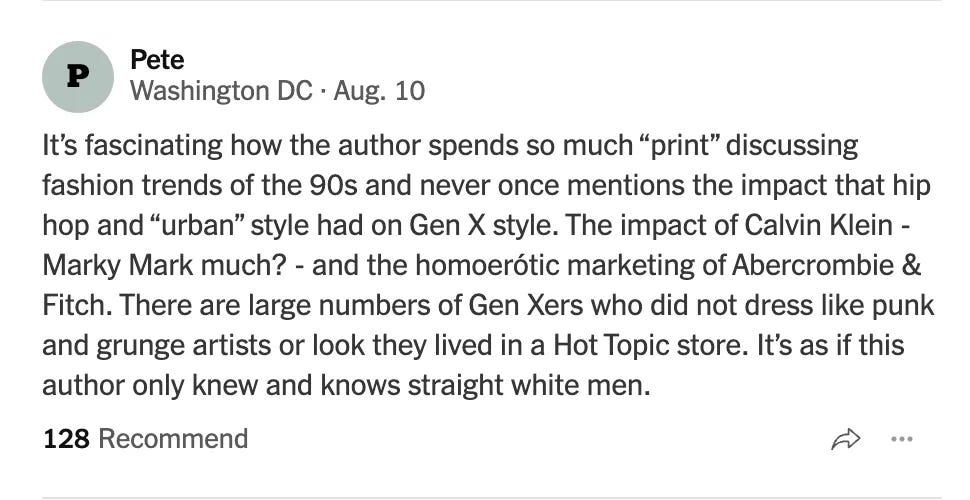
Let’s also not pretend that Morton, who is 43 years old, didn’t grow up during peak Millenial fashion - think galaxy leggings, slogan tees, and ugg boots. Owl necklace optional, but encouraged. Business casual in the club? As this one comment says: maybe Morton only really knows his own “group.” It would seem that he tried to avoid everyone else after writing, “Same hoodie but sleeves pushed up past the elbows? Watch out! That’s the universal signifier for meth.”
He says Gen Z has the performative Matcha Guy. Well, Millenials introduced Hipsters to the world, and look at the damage it did to the reputation of craft breweries and hamburger joints - think flannel shirt, man bun, and completely unnecessary beanies. Craft beers and $18 hamburgers and soulless industrial decor. Every generation has its subcultures and mainstream fashion. Maybe the author is just too old to know about it now.
Now, I’ll engage briefly with Morton’s idea that our current generation creates a new subculture between Monday and Friday, only to drop it by next Sunday. I don’t disagree with him. But, I do have thoughts that go beyond omg the kids have no perspective! No defining characteristics! We live in an online world. Which comes with an increasingly overwhelming amount of online slop - we are surrounded by a paralyzing amount of THINGS, and have produced an entire generation of children whose aspirations are to become another floating head on a screen. How is someone going to stand out among that?
We live in an attention economy. An entire generation of children is being raised to be engaging within the first two seconds of a video, or god forbid, they will vanish into the ether. They crave engagement - good or bad does not matter. If your brain is wired to constantly be “hooking” viewers, whether that be because you are too “out there” and have your personality amped up to 3,000, or because you are controversial and love to stir the pot, a fifteen year old brain can have a pretty hard time differentiating between online behaviors and offline reality. Meaning, they live by these rules of LOOK AT ME. And the easiest way to show up and gain attention if you aren’t being perceived through a screen? Clothing.
So while Gen Z is progressive socially, they are still shackled by the world they have grown up in. They may be open minded and blur the lines between the cliques of eras past, but they still live in a digital world. They have grown up shouldering the constant barrage of more more more content, so it is understandable that they feel the need to constantly keep up, whether that be with fashion trends or pop culture takes or GRWM videos. Everyone is always getting ready. To grow up in that way must have long term effects on the brain. Zuckerberg wouldn’t currently be in court over the mental and emotional toll that Meta has inflicted on the younger generations if everything was fine.
And so, it is increasingly difficult for the teenage brain to walk the line between real life acceptance and online morality police. Comment sections on TikTok are insane. There is no discussion, there is only attack. Opinions have been replaced with decidedly concrete facts, and requests for sources are responded to with vitriol and the question of “are you actually so stupid you can’t find it yourself?” God forbid someone back up a claim. Literal children are planting their very red flags firmly in comment sections (side note, when did it become cool and acceptable to say the r word again? Was I the only one with a “spread the word to end the word” campaign at my school?) and stitching videos with takes that realistically, do not require this much discourse. If every interaction threatens your view on reality, it is only logical that clothing would have to follow suit. The children are both incredibly opinionated and incredibly confused. It’s an impossible headspace to navigate as a teenager. My deepest sympathies to them. And so, as a result, fashion has indeed become a bit homogenized. They are looking to their online peers, and these online peers have flattened themselves to be as digestible as possible (influencers) while simultaneously being as controversial as possible (“personalities.”) And kids just want to be liked. So they follow suit. But they also want to stand out. It is an impossible dilemma, ergo ipso facto, the homogenization is that of confusion.
In real life, we are bombarded with ads and more ads and the constant promise of a sale so that you can finally live the life you deserve, if you just but one more thing. Everything is fast paced and based on virality and viewed through a digital lens. Our friends used to be the “influencers” in our lives. Many a photo was shared between group chats, debating the perfect going out top and skinny jean combo. Hair up or down? Shirt tucked or not? Our friends aren’t our influencers anymore - that role has been filled by the aloof, consumable smiley twenty-something who loves everything and seems to lack any real opinions, whose entire job is to curate the perfect life and sell product - I’m sorry to say it, but influencers are just walking advertisements, and kids are the product. The entire lifestyle of the influencer is mainly that of consumption - clothing, food, gadgets, workouts, facial treatments and tweakments and surgeries. Maybe there are fewer groups because there are fewer real creators. Everyone is a “creator,” but what is being created? Art? No, content. But back to my previous point: People have lost the art of the group chat fit check - now it’s all Pinterest and Tiktok and Instagram and ChatGPT. Just copy what your favorite creator is doing, and maybe you too can trade your privacy for a high rise apartment and a shit ton of Poppi in your fridge. (And I am not trying to hate on influencers. The reality is this is the world we live in, and have lived in for a long time - I have just reached a point in my adult life where I recognize that the majority of social media content is a thinly veiled attempt to generate sales of something. But get those checks girl, truly, and go see the world. All of it, not just the five star resorts.)
And I couldn’t talk about the internet of it all without addressing the fact that these apps are created to isolate us. They are addictive (see the aforementioned lawsuit.) They create an illusion of community, and all we have to show for it is another package at our door. So to shame an entire generation for not knowing their “group” is an incredibly reductive take on a world that is designed and engineered to isolate. So they use the tools they have - fashion. And the world is weird and scary, so maybe that’s what the fashion reflects.
There is an entire section of the internet dedicated to the phrase, “Job market so bad I started following my dreams.” This means exactly what it says. No one can get jobs, so why not take a risk on yourself anyway? What do you have to lose? Your job? Oh wait, there aren’t any. (yes, there are jobs. you know what I mean. let’s not get pedantic.) Billionaires are worried their billionaire children won’t be able to get jobs.
So, to sum up this rant and ramble in a digestible way that you can send to your grumpy grandfather who is upset about his granddaughter wearing a lace slip with his Carhartt, I don’t think the author understands the current landscape that Gen Z is living in.
They are, as a whole, broke. A study by Consumer Affairs shows that Gen Z “has 86% less purchasing power compared to baby boomers when they were in their 20s.” Fun! They are also both overstimulated and lonely, meaning, they are confused. Which presents as confusing fashion.
They are, despite what the media might show you, and depending on where you live, the most open minded generation yet. Meaning, they hate being put into narrow categories. They just want to live.
They are incredibly informed on the world around them - they know the climate is changing, they know the job market sucks, they know the state of the world rests in the hands of three very unstable men. So they are throwing their hands up, saying fuck it, and having fun while they still can. In fact, 70% of Gen Z's spending is discretionary. They like experiences. They like fashion. (They are also still young and a lot of them still live at home, so yeah, that’s a factor.) Why worry about buying a house when you can’t even really actually buy a house because you can’t buy home insurance because the insurance firms sure as hell know climate change is happening, and then you can’t buy a house without insurance. So I don’t know what the plan is there, but it’s looking bleak. Will there even be any houses to buy in 20 years? Who knows.
All of this to say - let the kids have fun. They don’t have much else going for them. And honestly? Maybe they just don’t care. Living in a world that is speed-running itself into extinction gives little hope to the generation that has to suffer the consequences. They have no idea what their future will look like. And so if they want to put a dress over jeans and Adidas mid-calf socks with their loafers, I say, more power to them. They’ll go out without the added pressure of the trivialities of, as Morton writes, “map[ping] an entire suite of personality traits onto a style with little knowledge of proper fashion.” Their sartorial minds are open, regardless of whether their dream job positions are.
And with that, ta-ta. Until next time,
K
Comments
Nothing yet. Say the first thing.
Sign in to join the conversation.