
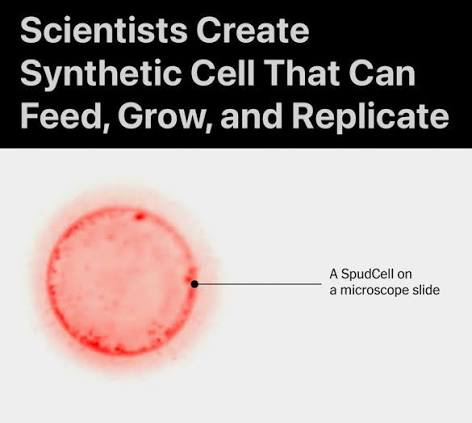
Researchers at the University of Minnesota have developed SpudCell, a synthetic cell capable of three behaviors closely associated with life: growing, dividing, and passing DNA to its offspring.
The achievement marks an important milestone in the effort to construct living systems entirely from non-living chemical components. Designed as a proof of principle, SpudCell demonstrates that some of the fundamental processes performed by natural cells can be recreated through chemistry.
This is not merely another laboratory curiosity. Synthetic cells could eventually transform biotechnology, medicine, manufacturing, and our understanding of how life itself began. They could also force society to confront difficult questions about where chemistry ends and life begins.

Scientists are not creating people in a laboratory—but when a synthetic cell can reproduce and transfer genetic information, a little Zager and Evans suddenly feels appropriate.
In the year 2525? Perhaps the future is arriving ahead of schedule.
Comments
Nothing yet. Say the first thing.
Sign in to join the conversation.