
I’m grateful that Dennis Rogers of Essential Exercise sent this placard to me this morning (February 17, 2026). It affords me the opportunity to illustrate the refinement of our verbiage as is presented in “Inroad… Weakness… Fatigue” in Exercise Parlance and in Reconfiguring the Real Objective (In Exercise).
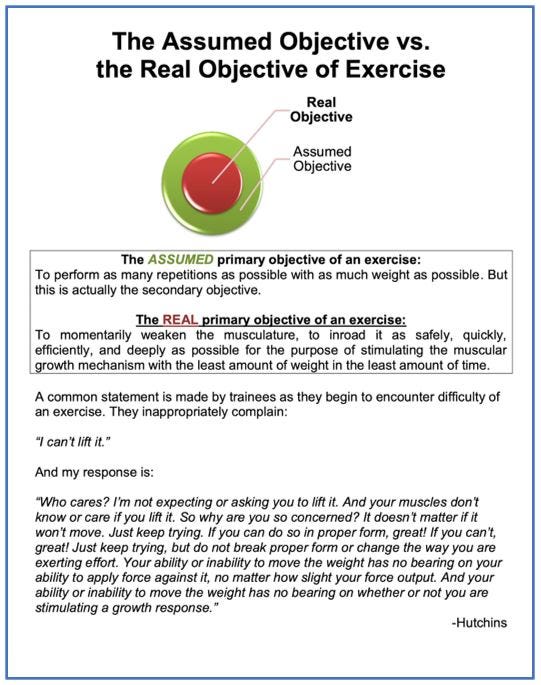
For almost all its messaging, the placard accurately expresses the words and intent of my writings about this subject, both in the 1992 edition of SuperSlow—The Ultimate Exercise as well as in the first volume of The Renaissance of Exercise (2011). [I am appalled to presently learn that the critically important discussion of the objective(s) of exercise is not listed in the table of contents in The Renaissance of Exercise although it is indeed to be found on page 36 of the hard-copy version and it is readily searched in the PDF version sold at baye.com.]
Like my earlier writings, the placard is not incorrect. It’s intent is faithful, however, the wording can be vastly improved with the insights advanced in my work with Gus Diamantopoulos (Transitioning from TSC to Feedback Statics) and then expanded upon in the previously mentioned two Substack articles.
Let’s see how to simplify this placard with the appreciation that simplification translates into improved comprehension and acceptance of the concept by the viewer—the purpose of the placard.
First… The placard refers to the objective(s) of exercise. We now use THE process. And the real process (inroad) is singular. There is only one. There is no primary or secondary process (or objective) [as far as we now formulate the concept].
There is, in a sense, another process, but it is not real. It is unreal (in all its possible meanings: not real, imagined, dreamlike, incongruous, etc.). We now call it the assumed process as opposed to its original expression, the assumed objective, as it is, accurately speaking, not an objective.
Second… We do not want to weaken the body, but we must fatigue it to initiate the strengthening process (a separate process by the body and not integral to the exercise process).
I note that I used weaken in the 1992 verbiage and changed it to fatigue in the 2011 verbiage. My verbiage was deliberately evolving in this expression although the complete reconfiguration of the argument would have to wait until the Transitioning… article appeared in 2019. Gus and I had been closely working, but more focused on equipment design in the years previous to 2019. And note: The evolution of the static equipment led to the linguistic evolution in this case.
[Some, who have recently argued with me about fatigue over weaken do not realize that, I too, was not sensitive to these particular contextual subtleties decades ago.]
Third… The diagram is misconceived. The real process (“real objective”), when properly oriented, is not to be considered to be inside the assumed process (“assumed objective”), although I’m confident that the real process (“real objective”) IS NORMALLY ASSUMED to be inside the assumed process (“assumed objective”). Moreover, the real is typically consumed by the assumed. In fact, this diagram represents, to me, exactly this common and inappropriate modus operandi that the novice begins with and is greatly hampered by:
It reminds me of a paramecium engulfing another microorganism. Josh Trentine says that it reminds him of the now-archaic Pacman after gobbling up a dot.
[I’m considering a T-Shirt designed to say: “Consumed by the Assumed.”]
With good instruction of a good student, the following mentality metamorphosis is intended. The novice begins with the original ill-conceived modus operandi (as shown above) wherein the real has been consumed by the assumed. The real, begins to grow within the assumed (likened to a fetus), then breaks out and away from the assumed and to eventually stand distinct from the assumed.

[I have considered several other ways to depict this. Others may be useful.]
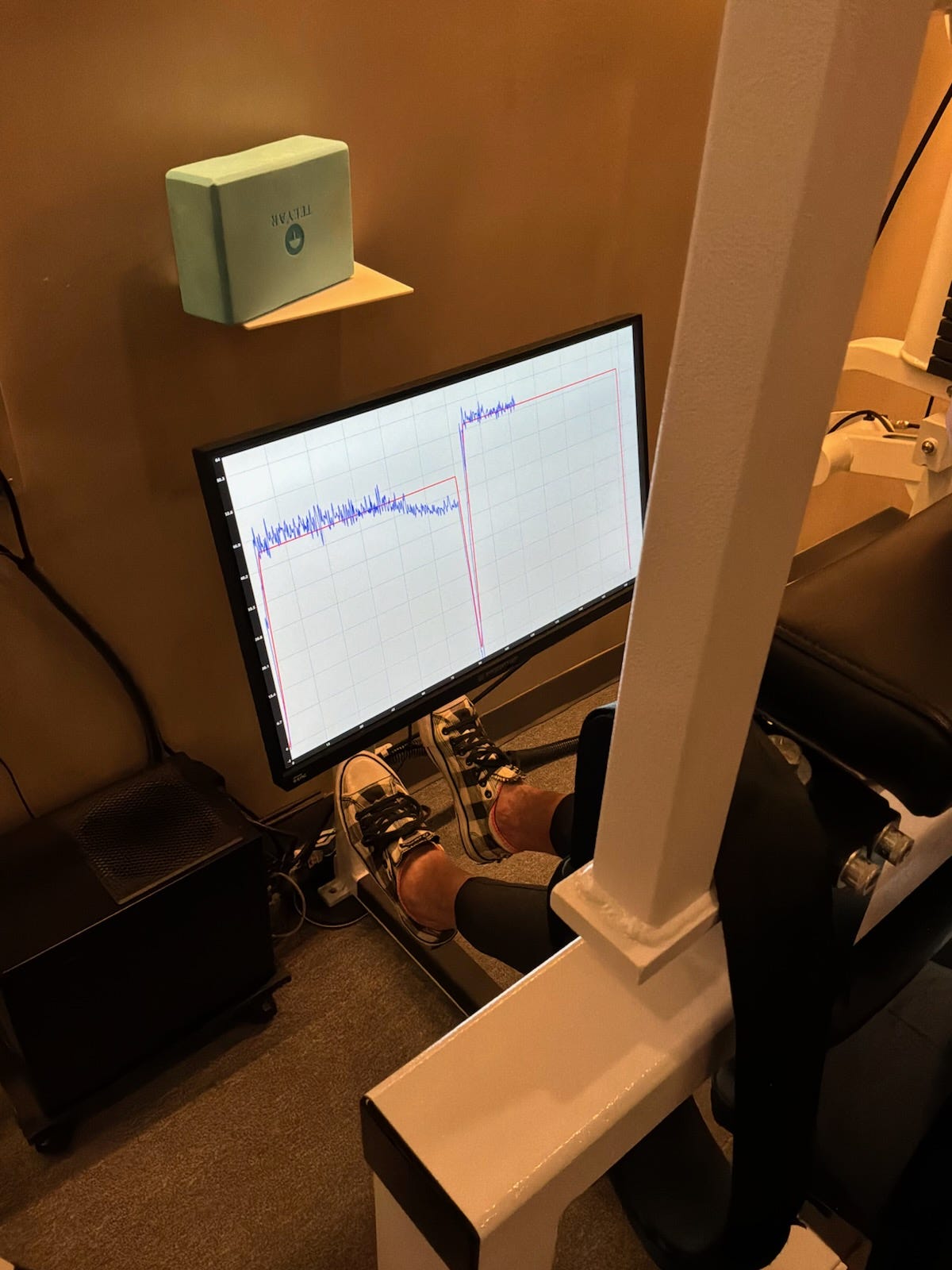
Following (somewhat related): A photograph sent to me yesterday from Gus. His description:
This subject is 74 years old and used to demonstrate horrid spikes and terrible on-offing. Her amplitude has dramatically improved [performing a static pulldown (after pullover) exercise, on a RenEx iPullover]. Her breathing is mellifluous, too.]
No posts
Comments
Nothing yet. Say the first thing.
Sign in to join the conversation.