
This is a photo from last month, when I was working on Figure 1 of my DETAP paper.
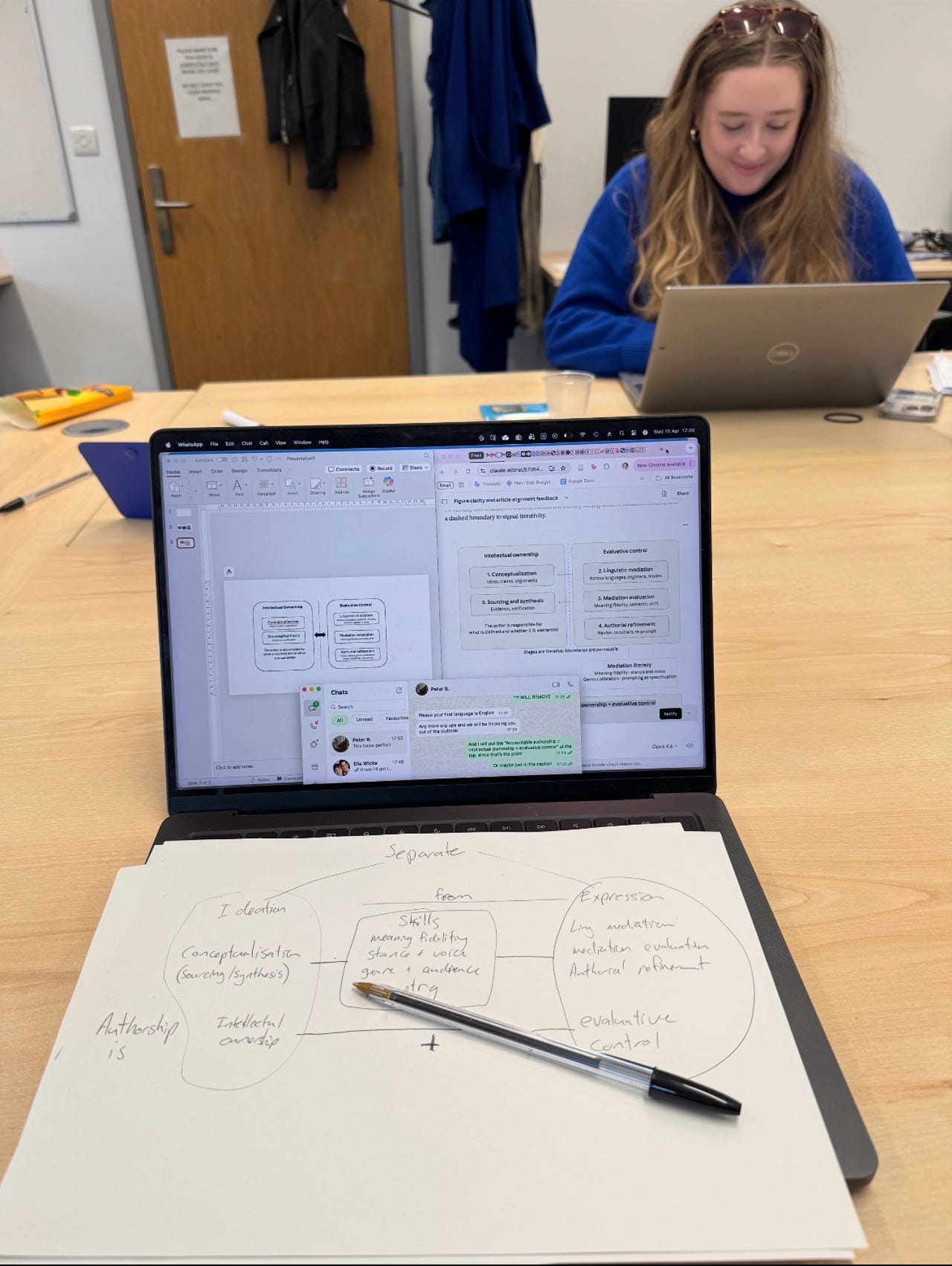
You can see: a piece of paper, a pen, PowerPoint, Claude, WhatsApp messages with two of my most patient and insightful collaborators, my wonderful colleague sitting opposite me, and behind the camera is the intense, hyperfixated energy of someone with ADHD trying to get the thing in her head into a form other people could actually understand.
This is not a picture of unaided academic writing.
But it is a picture of authentic academic writing.
“It’ll be like I made a cake and then put it inside your brain, and then you’ll know what I know.” – is a line from the wonderful Seiriol Davies’s musical How to Win Against History.
It is ridiculous and perfect. Because to me that is what academic writing essentially is: You have an idea of some sort, you develop an argument, a concept. Something that makes sense to you. You need to bake it so you can get your delicious idea into someone else’s head.
And writing up DETAP was a particularly strange experience of this, because I was writing about mediated writing while doing mediated writing. Theorising authorship while constantly making authorial decisions. Using AI while asking, again and again, what kind of AI use preserved my meaning and what kind distorted it. Constant meta-awareness.
It really hit me when I made Figure 1.
I had the rationale and model of DETAP in my head in absolute detail. I knew it back to front and I could explained it to anyone who asked. The problem was getting it out in a visual form that was clear and made sense.
The initial AI-generated versions of the image were awful. Overcomplicated and busy, like someone had tipped all their thoughts directly into an image generator without asking whether any of it would make sense to a human (which is kinda what happened).
So I went back to an actual piece of A4 paper. I drew circles and connections. Crossed things out. Physically moved words around. Then I went back to AI and asked Claude for suggestions. Used some of them, ignored a lot. I sent messages to people on WhatsApp for feedback. Asked Izzy sitting opposite me what she could understand and what didn’t make sense to her. Building it in PowerPoint as I went along. Iterating, whisking, mixing, icing, constantly checking whether the visual structure matched the idea in my head.
Figure 1 is mine not because I didn’t have any assistance to help me make it.
Figure 1 is mine because I am responsible for what it means.
I decided what belonged. I decided what distorted the model and what clarified it. I decided what to reject. I decided what finally carried the meaning I was trying to communicate.
And that is the core of DETAP.
DETAP stands for Digitally Enabled Translanguaging for Academic Purposes. I know it’s a very wordy name, and probably makes it sound more complicated than it is.
But the basic argument is that academic writing has never really been the unaided production of standard academic English. It has always been a mediated process of turning meaning into authorised academic form.
The term itself has a slightly accidental history. The first time I used it was in a webinar for BALEAP TELSIG and the EAP for Social Justice SIG in February 2024. After making my case, I had one slide where I basically said: maybe what people are doing now isn’t English for Academic Purposes, maybe it’s DETAP. Digitally Enabled Translanguaging for Academic Purposes.
Then I moved on and didn’t use the term again. But it was there, sitting on a YouTube channel for more than two years, as I went around speaking about the underlying concept in my talks and workshops, waiting for me to realise that Past Me had actually already named it.
Think of all the ways we make and develop meaning. Notes. Diagrams. Speech. Feedback. Reading. Drafts. Translanguaging. Dictionaries. Grammar tools. Reference managers. Supervisors. Friends. Colleagues. Editors. Reviewers. Coffee. Panic. Despair. Occasionally, Microsoft PowerPoint.
Now we also use AI.
That does not automatically make the writing fake or bad. Not everything you feed a pig is swill1. But using AI does not make writing good or easy either.
AI slop is not simply writing that AI has touched. It is writing where the digital mediation has flattened the meaning, genericised the voice, or detached the prose from a person who can stand behind it (oh no, I used an AI slop triad!). But even then, I try to be careful when judging someone’s writing. Poorly mediated writing may still contain something that someone genuinely wanted to say. Something they haven’t quite got the skill to get into the expected form. Something worth hearing (argh! not another one!).
The moral vocabulary used in this sphere feels so reductive and punitive to me. Cheating. Slop. Laziness. Shortcut. Outsourcing.
In writing DETAP did not outsource my judgement. I exercised it constantly.
Using AI well in writing does not mean turning your brain off. It can mean reading carefully. Comparing versions. Noticing when the argument has shifted. Catching overstatement. Removing the sentence that sounds impressive but isn’t quite true or doesn’t add any value. Realising that a suggested structure doesn’t flow. Knowing when human feedback will be more useful. Knowing when your own messy first thought was actually better and reinstating it.
This is not a story about replacing writing skill. It is a story about relocating it from unaided production to accountable supervision, evaluation, and refinement.
That matters to me personally because eleven years ago, I flunked out of a PhD. I didn’t realise then that ADHD was part of the story. I just knew that writing, in the institutional form required by academia, kept defeating me. My interest-based nervous system finds formal academic prose profoundly unstimulating. Getting started can be impossible.
That did not mean I lacked ideas. The ideas are the part I find interesting.
I have been working in a PhD-level role now for years. I get invited me to speak, teach, train, and I advise on institutional policies about AI and higher education. People seem to value those ideas. But until now, my ideas had not become the kind of academic object that counts in the publication system.
That is not because I could not write at all. I can write. The reason I can use AI in this process well is because I have developed the necessary skills to read, judge, reject, reshape, and refine writing. But the executive dysfunction that is part of my ADHD means I still have a barrier to writing which causes a bottleneck between my ideas and the page.
Developing DETAP with AI-assistance was still a writing process. Just not writing as it is traditionally imagined as solitary, linear, and unaided. Instead, it was thinking via interacting with my laptop though typing and talking, drawing, discussing with colleagues, comparing drafts, rejecting/editing/accepting AI phrasing suggestions, and gradually chipping out the form that carried the meaning I was trying to communicate.
DETAP is not just a theory I wrote about academic writing.
It is the explanation and justification of the method for how the paper came to exist.
This might be a personal story, but it is not only about me.
On the morning that DETAP was released as a preprint, I spent an hour with a PhD student with ADHD who had done the work. She had collected the data, thought about it deeply, and had original things to say. But she was stuck at the point of turning that knowledge into thesis prose.
A lot of the session was practical. How to use speech and AI tools responsibly and effectively to sort, structure, and rework ideas. How to move from unstructured thoughts and information into something more coherent.
But underneath that, the real issue was permission. Permission to believe that these were her ideas, that it was legitimate to get help expressing them, and that doing so did not mean surrendering authorship.
I see this over and over. People who have done genuine, original work, but are afraid that if they use tools to help express it, it somehow stops belonging to them.
That fear comes from a traditional model of academic writing. For a long time, it made sense to treat unaided prose production as central to academic participation, because if you could not produce the authorised form yourself, then there were limited ways to get your ideas into circulation. But that is no longer the world we are in.
I don’t think the question should be whether an AI tool was involved in the writing process. The better question is whether the writer remains answerable for the meaning. Can they explain it? Can they defend it? Can they tell when the wording has drifted from what they meant? Can they recognise when fluent prose is hiding a weak claim?
That is authorship under contemporary writing conditions. Not purity. Responsibility.
DETAP argues that academic writing should not be rooted in nostalgia for a world where the ability to produce pristine, unaided academic English was treated as evidence of better thinking. It wasn’t. It was evidence of particular kinds of access — to the language, to the form, to the educational histories that made standardised language feel natural and superior. And it is not the world our students, colleagues, or institutions are writing in now.
Academic writing is mediated and it always has been.
The question is whether we teach people how to mediate it well.
And yes, this blog post was written exactly the way I am describing. Notes. Thinking aloud and using speech-to-text. AI-mediated drafting. Revision. Rejection. Judgement. Discussions with people and with AI. A lot of my own judgement, formed through years of learning writing skills, now transferred to a new, better (for me) writing process.
That process was mediated.
But the meaning is mine. The responsibility is mine.
I am the author.
Credit to Alwyn Collinson for this absolute banger of a quip as I was in the middle of writing this (during a completely unrelated discussion).
No posts
Comments
Nothing yet. Say the first thing.
Sign in to join the conversation.