
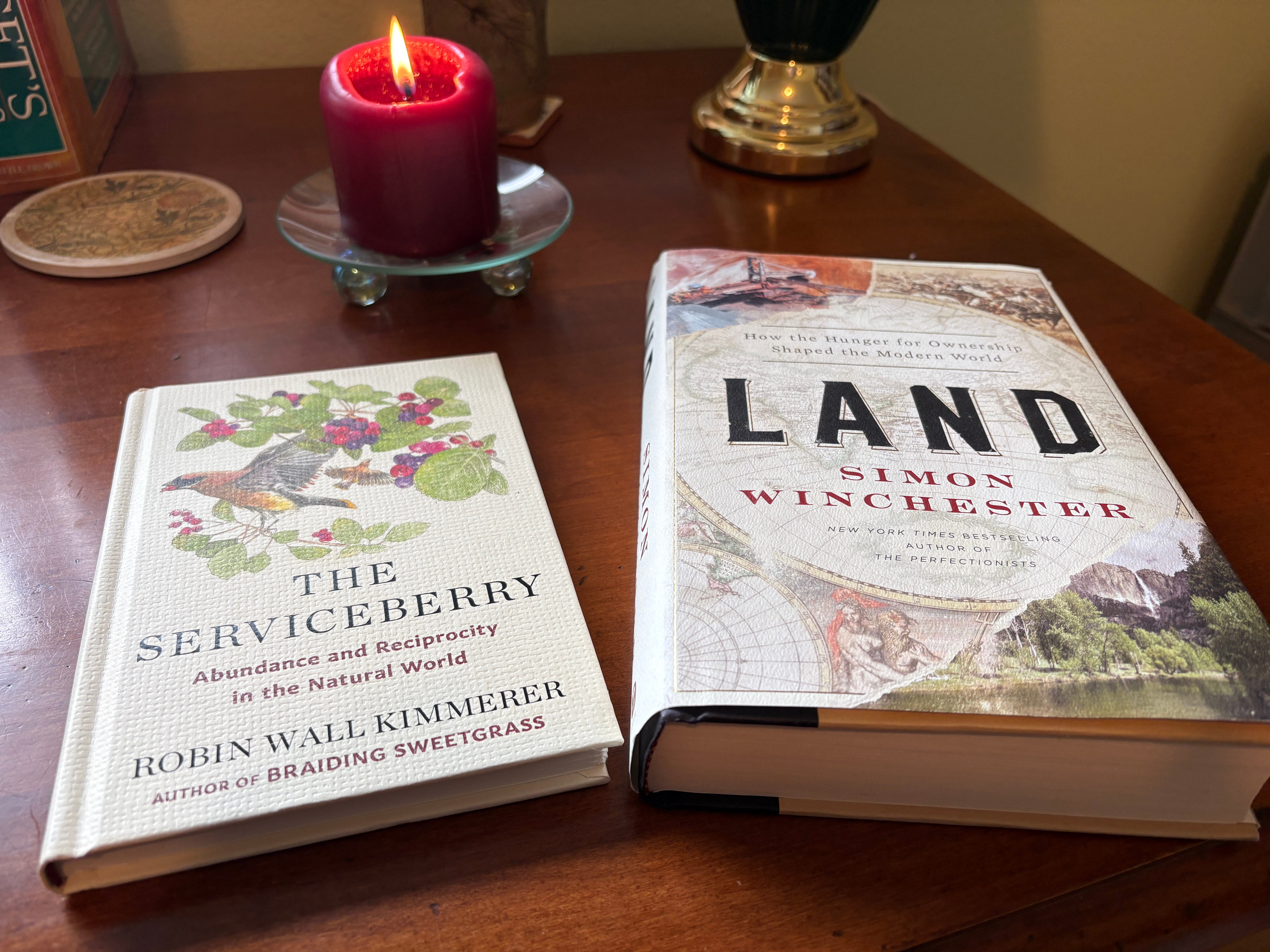
I read Robin Wall Kimmerer’s Serviceberry: Abundance and Reciprocity in the Natural World, expectant for the image or idea that would spark this month’s essay. I made notes throughout, alert for that shimmering moment. I read it again. The month trundled on.
My problem was one of abundance: this little book is rich with big ideas—ecological economics, sacred economics, gift economies, Indigenous ways of living in relationship with the Earth and all it contains. I am the kid, Serviceberry my candy store. The best I can do here is share a taste of the delights on offer.
While reading Serviceberry, I was also working my way through Land: How the Hunger for Ownership Shaped the Modern World. Though Simon Winchester didn’t approach it the way I’d expected, this survey of cultural attitudes and practices spans continents, as well as eras.
I understand the hunger to own land. I came of age in Northern Virginia where, from among the lives I imagined for myself, I selected as my career goal running a general store in the Blue Ridge mountains. Ultimately, my dream was to own one of those mountains. Or maybe a valley—I’d decide later.
Having a plot of land I could call home, could take refuge on if everything else fell apart promised a (pardon the pun) bedrock of security that I craved. During my childhood, it was a given that the moving van would return, and that it would always feel too soon.
Reading Winchester’s epilogue1 on a recent morning, awake too early, I realized my desire was nothing unusual.
“The near universally held belief that underpins almost all of the dealings with the land that I have described in this book can be summed up thus: land is the only thing on this earth that lasts… And yet, as we now know, this is not so.”
Continents pull apart. Hurricanes move land from one place to another. On a warming planet ice caps melt, raising sea levels and decreasing the reflectivity of Earth’s surface, which in turn allows more heat to reach the lower atmosphere making the ice melt faster.
Winchester wonders whether loss of land might convince those few owners of vast tracts of Earth’s surface (discussed earlier in the book) to consider sharing some of it.2
“[That outcome is] naively idealistic, one might reasonably say—and yet the mantra of those from whom we took the lands in the first place was, all too often, just that…. To all and each of these [Indigenous peoples], land was a commodity so precious and so life-giving that it was indeed to be shared by all, and owned by none.”
That last bit might seem to suggest that it is because of its value that land was shared in these cultures. But both Winchester and Kimmerer describe not a choice between holding land in common or divvying it up into privately owned plots, but rather, when living in reciprocal relationship with the creatures and systems of one’s only home, individual ownership of such gifts as marsh, forest, elk herd, and obsidian flow isn’t even on the table. “To a Matabele chief interviewed recently in Zimbabwe, the idea of buying land was just insane: You might as well buy the wind, he retorted.”3
Kimmerer invites us to become part of a gift economy (proceeds from sales of Serviceberry are donated to activities that support healing land and people), sharing examples of giving without receiving—or even expecting—an exchange of goods or cash. Reciprocity is a complex cycle. Go buy this short, beautiful book and learn why.
When my kids were young, the free-market economy was a sacred tenet of American capitalism and politics. It hit me one day that none of the work I did—parenting; writing, publishing, and teaching poetry; supporting a public school and a church in their community-building work—none of it was counted in the Gross Domestic Product. I don’t mean none of it counted.
No wonder GDP as a measure of the well-being of a populace never made sense to me. No wonder I felt insignificant at gatherings of my husband’s law firm, where the prestige of a client’s deal or lawsuit was measured in the number of dollars the client would spend on the project. No matter how much a brownfield reclamation and re-use might benefit a community, if development of a resort on pristine land would cost many millions more, the resort was obviously the more important of the two.
That was about the time I received my first payment for publishing a poem—$10, I think. Later on, I earned several hundred dollars teaching poetry in local schools through a program funded by pledges to kids who then ran around a track as many times as they could to bring the arts into their school days.
“In a gift economy, wealth is understood as having enough to share, and the practice for dealing with abundance is to give it away.”4 Scarcity, on the other hand, is fundamental to reaping profit in a capitalist economy powered by the law of supply and demand.
Kimmerer tells of a linguist who was learning from a hunter-gatherer tribe in the Brazilian rainforest. A hunter brought home a large kill, too much for his family to eat. But he didn’t dry or smoke the extra meat, to save for leaner times. When the linguist asked why, the hunter replied, “Store my meat? I store my meat in the belly of my brother.”5 In systems like his, “the currency in circulation is gratitude and connection rather than goods or money.”6
By that measure, I am wealthy beyond imagining.
Thanks for reading Mama Ephemera's Muddy Feet! This post is public so feel free to share it.
Simon Winchester, Land: How the Hunger for Ownership Shaped the Modern World (Harper, 2021), p. 397.
Robin Wall Kimmerer, Serviceberry: Abundance and Reciprocity in the Natural World (Scribner, 2024) p. 32.
Comments
Nothing yet. Say the first thing.
Sign in to join the conversation.