
Hi Everyone,
I came down with a respiratory infection this past week after returning from Heidelberg and Paris, so I could not keep up with the blog.
Here’s my two-for-one edition for weeks ten and eleven.
**
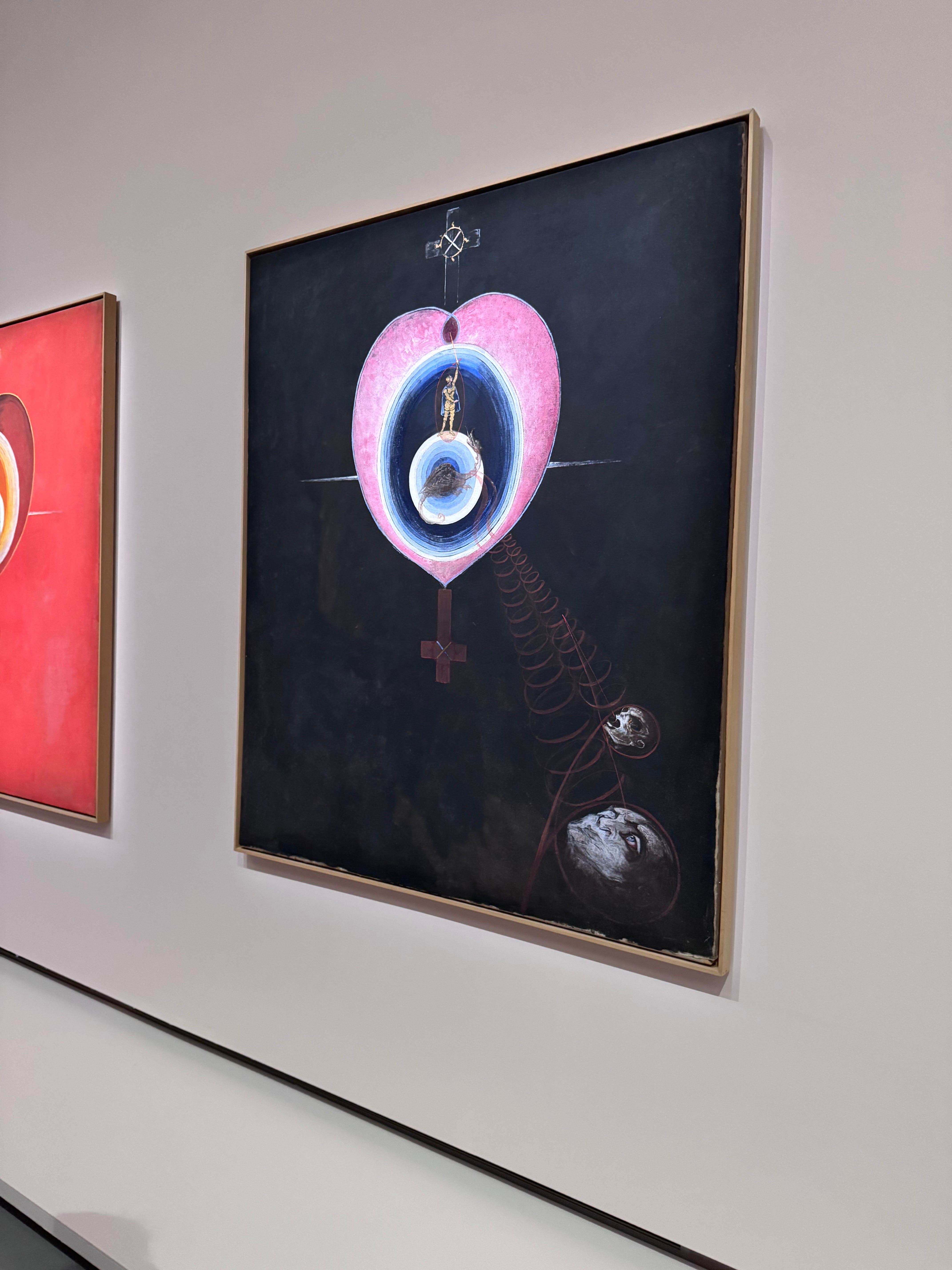
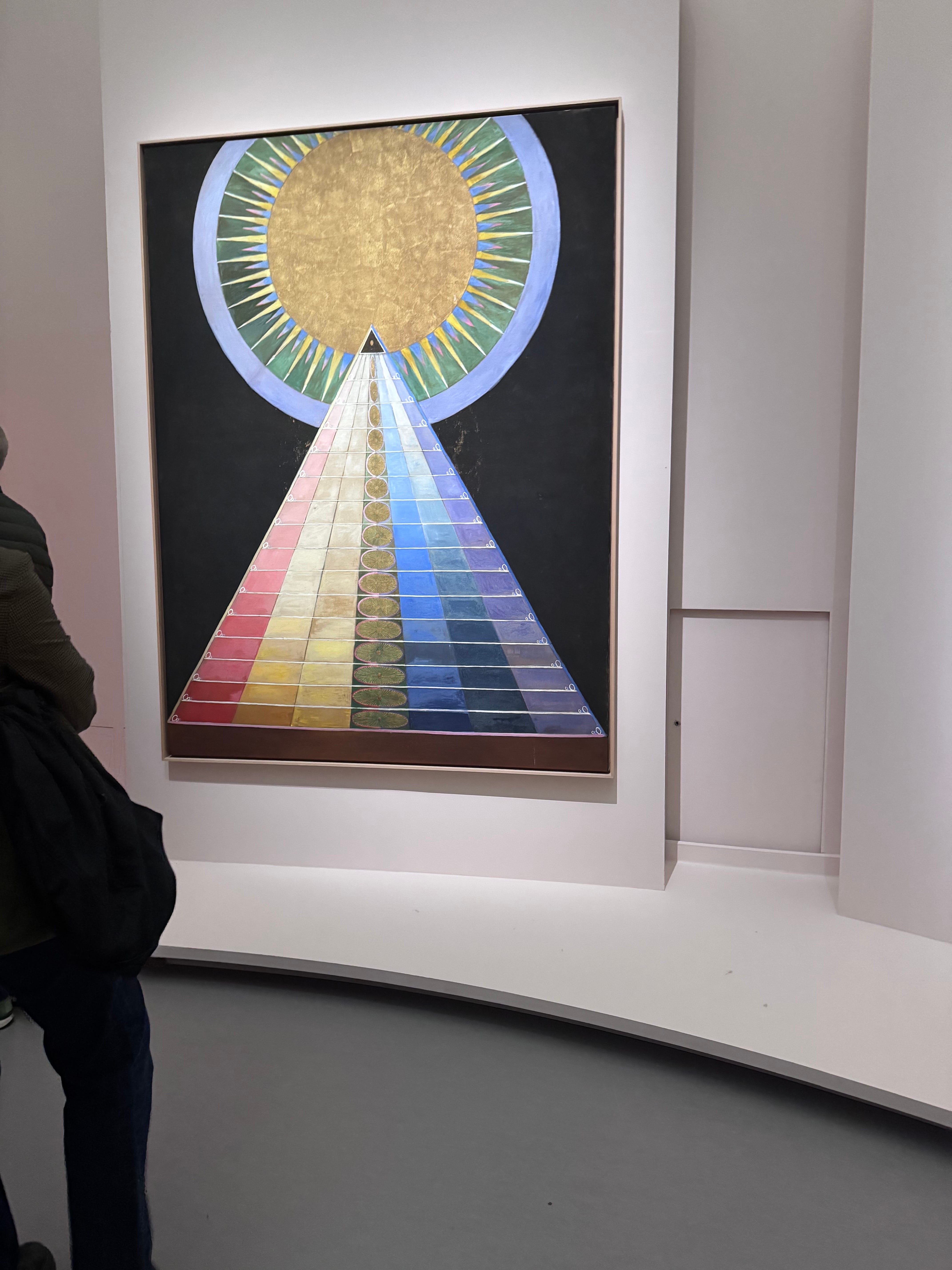
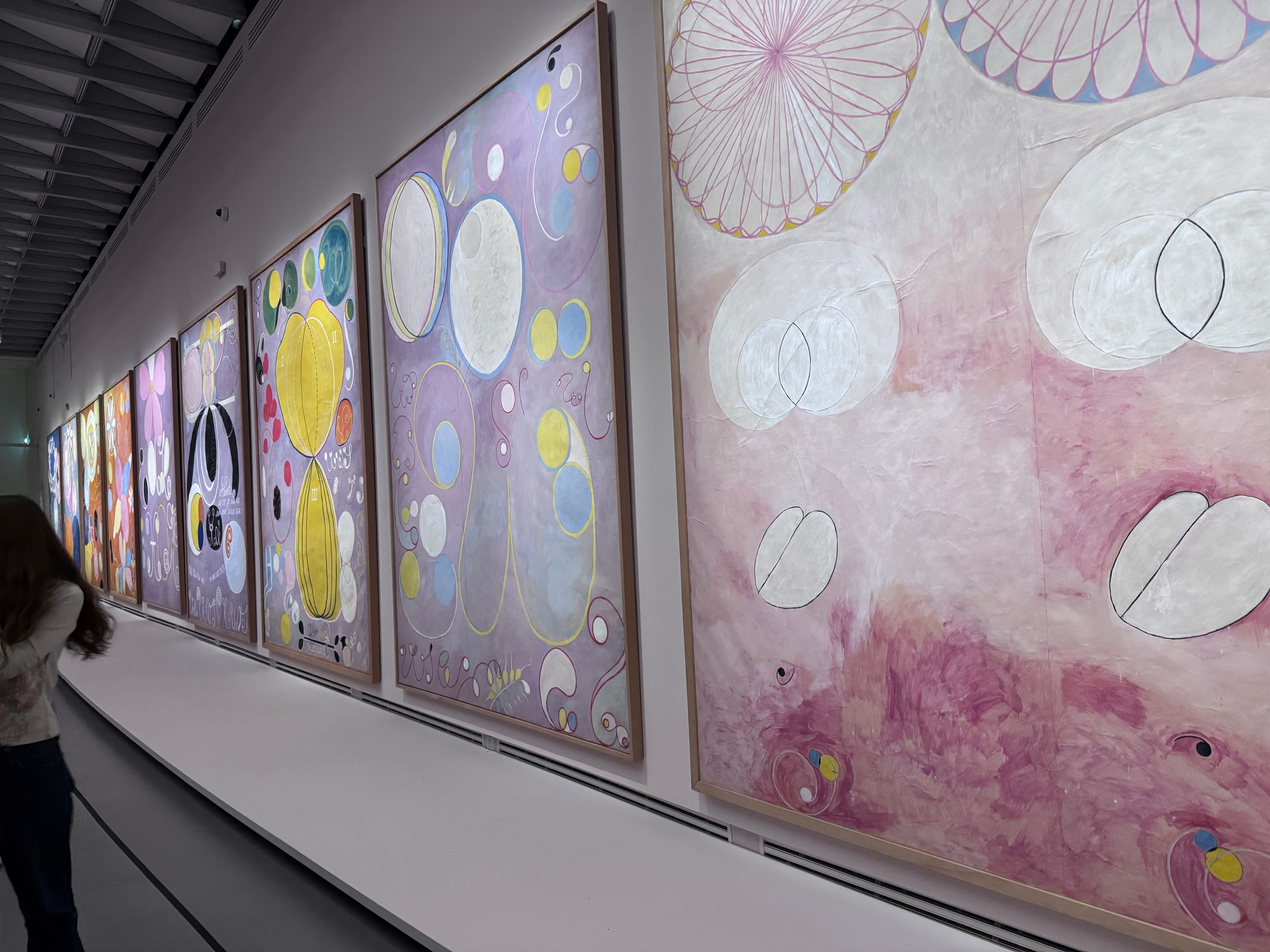
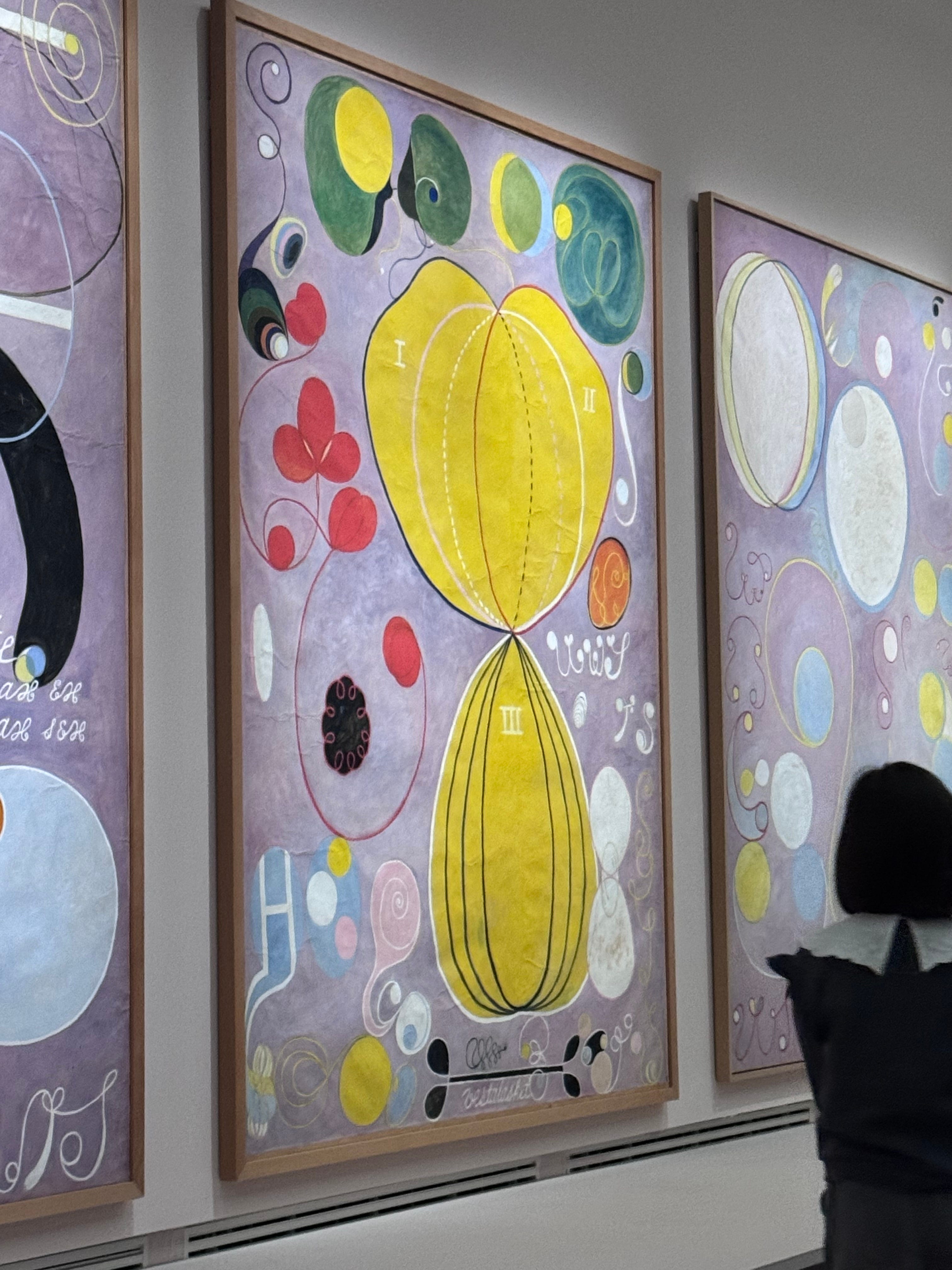
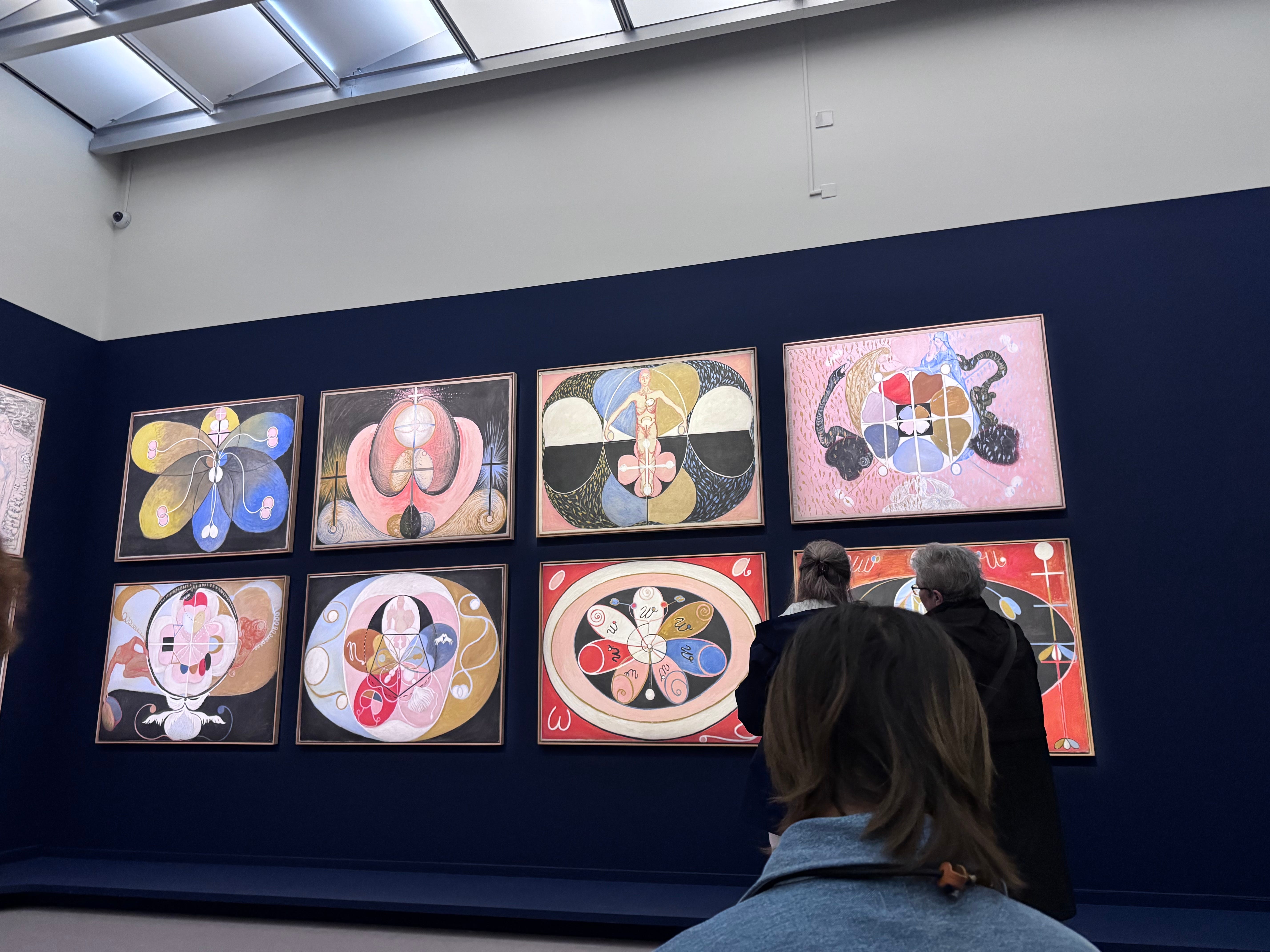
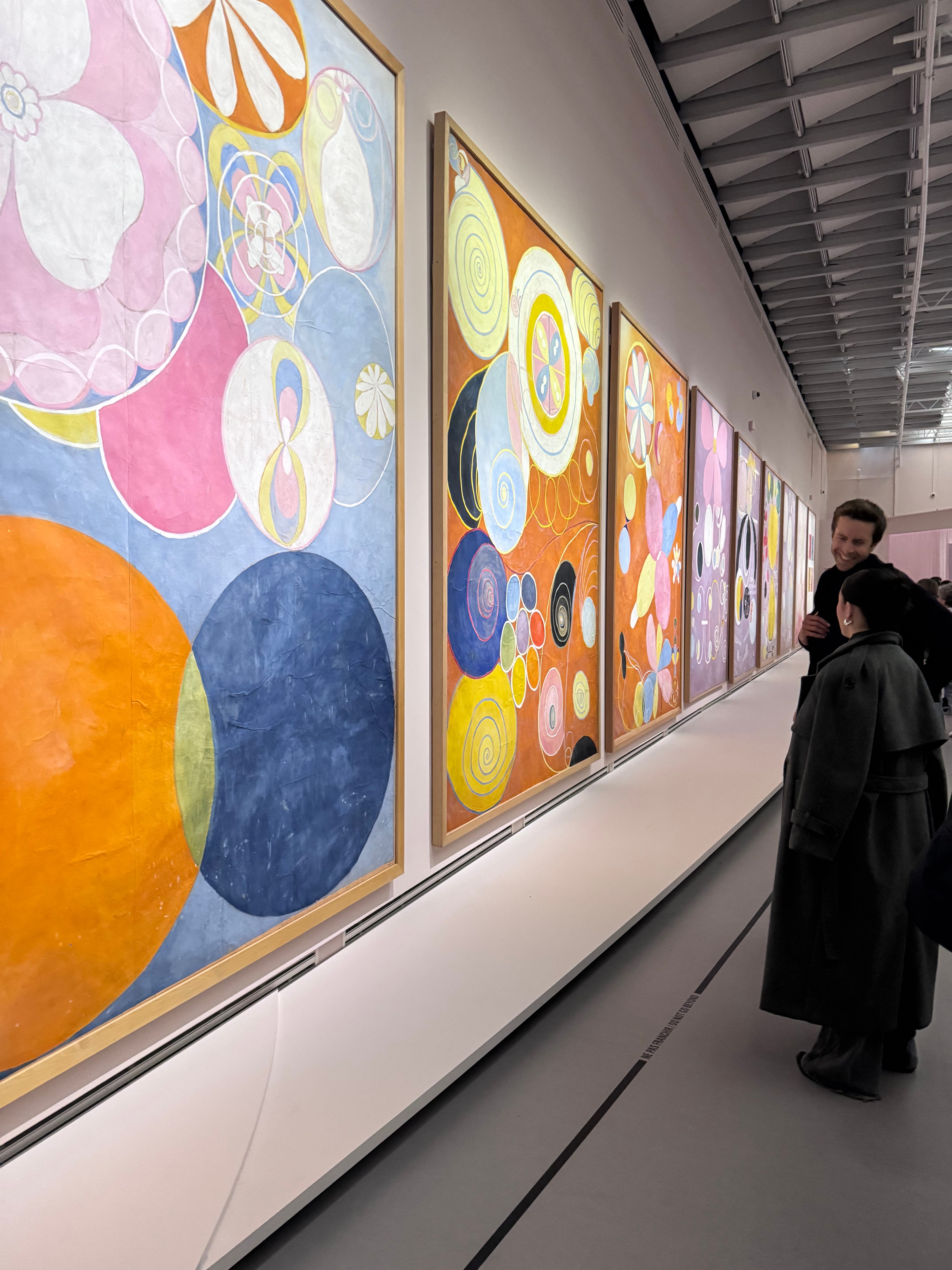
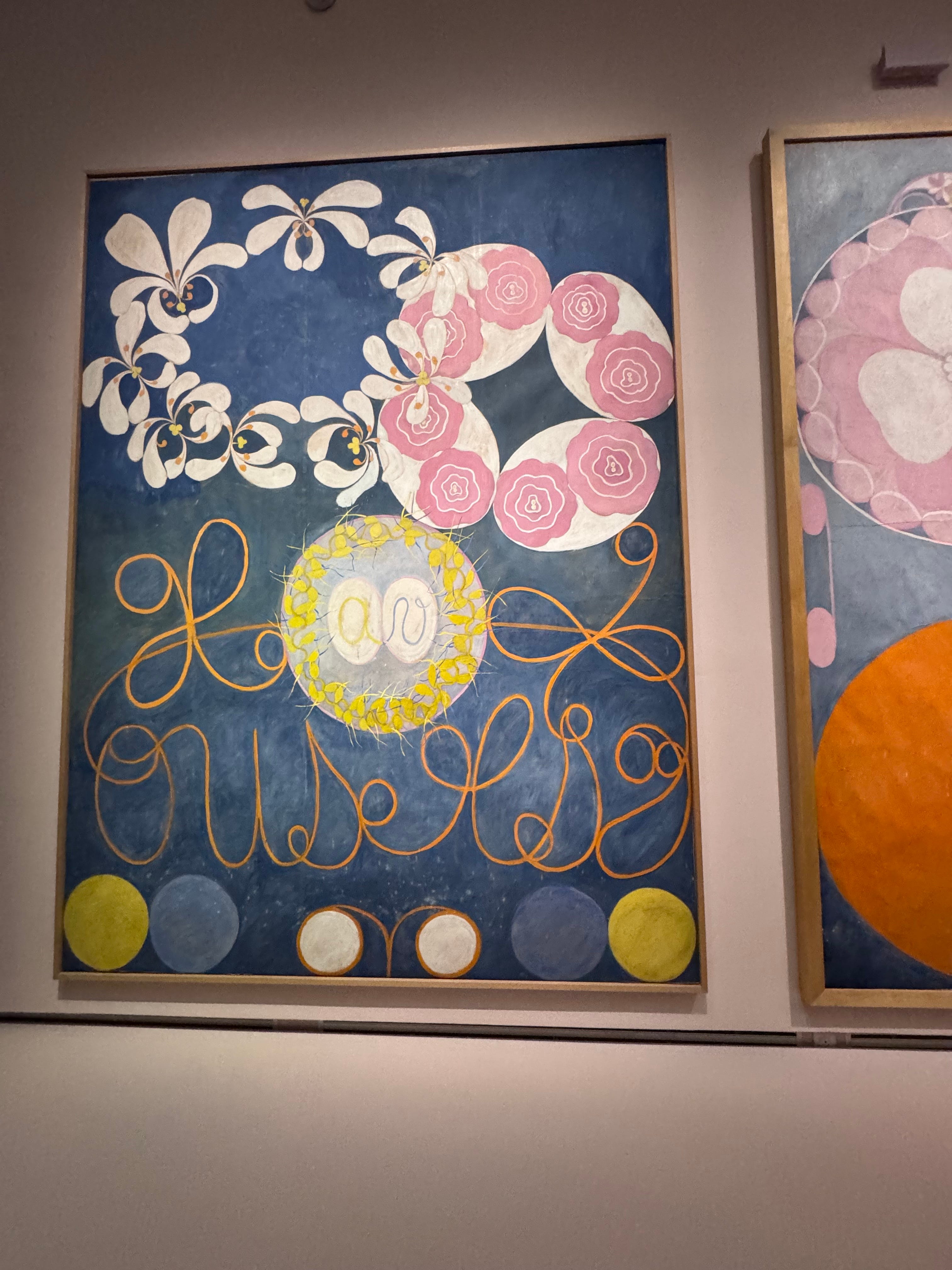
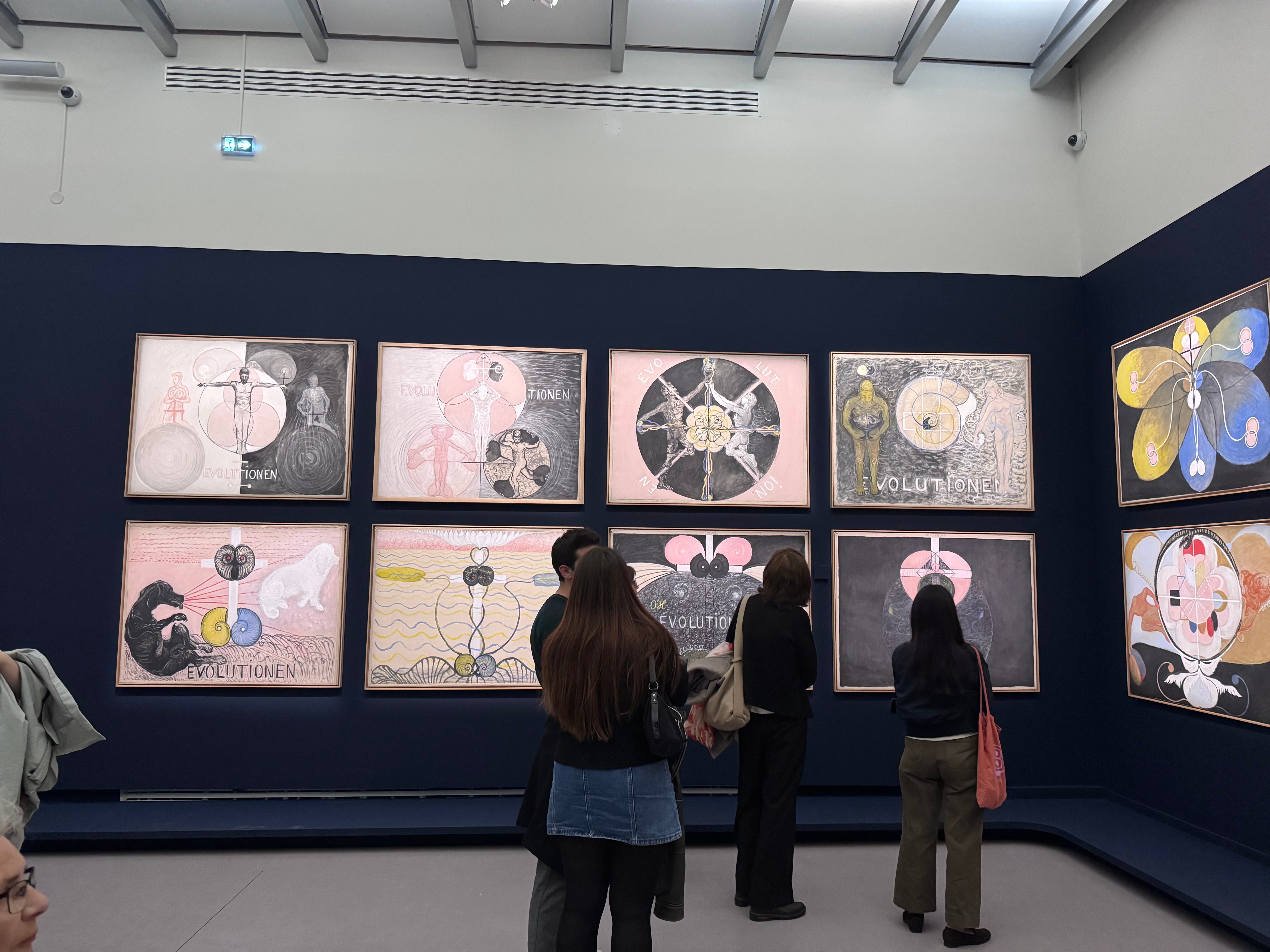
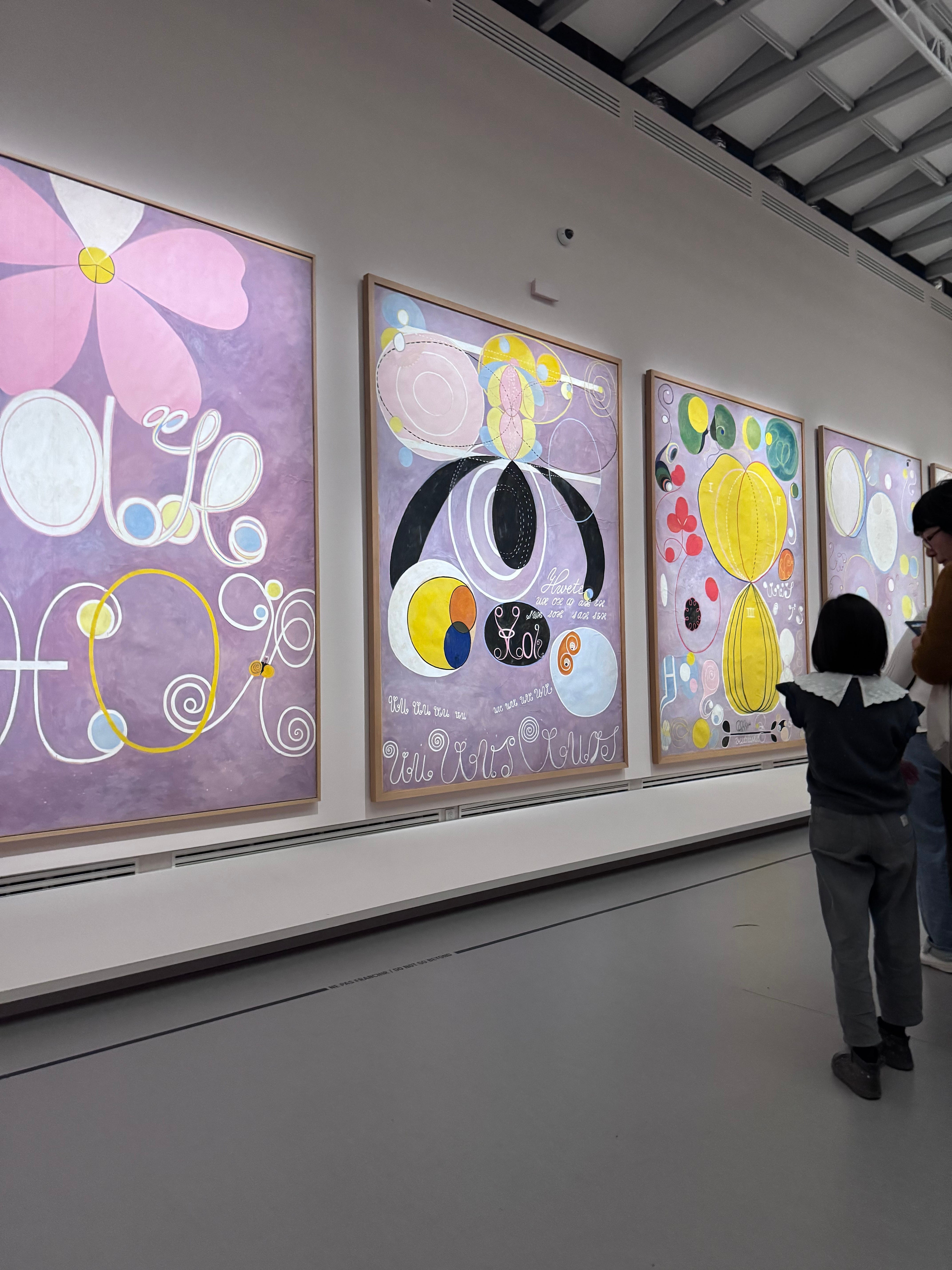
I’m sharing Hilma af Klint’s work (above) because her show at the Grand Palais in Paris recalibrated my brain. Just take a look at the vibrant colors—it’s hard to believe these paintings are between 80 and 100+ years old!
**
Lately, I’ve experienced a series of creative synchronicities, and after I detail them here, I would love to hear if anything like this has ever happened to you.
**
Hilma af Klint’s work predates the Abstract Art Movement, but she was not discovered until many years later because she stipulated that these Temple Paintings be withheld from public display until 20 years after her death.
Aside from the mysticism and the sheer size and exuberance on display, I was intrigued by af Klint’s rebellion against the strict Protestantism of Stockholm in the late 19th/early 20th century, and by her connection to the Fibonnaci sequence.
**
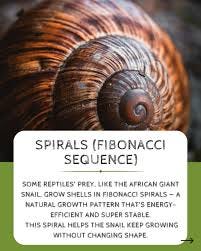
If you are not familiar with the Fibonnaci sequence or have forgotten the basics, I found this explanation on Mensa for Kids—it’s just the right speed for my kid brain.
**
And do you know what else adheres to the Fibonnaci Sequence?
Snails.
I thought I was done with snails after Week Six.
**
In 2021, I played the Telephone game for the first time, and wrote a poem about the Fibonnaci Sequence and COVID transmission.

In 2024, during another round of Telephone, I riffed off of Irene Febry’s art, which I am linking to here as it strikes me as redolent of af Klint.
Besides, I think it’s always worth linking to the Telephone game. There’s no inspiration like it if you are feeling creatively depleted.
**
I read somewhere that the writer, Jenny Offill’s, creative process includes wandering into a library or bookstore and pulling down random books just to see what she lands on—and, even more crucially, which of her finds resonate with her.
First, the information presents itself—in my case, the Fibonnaci sequence/the art of Hilma af Klint/snails.
Secondly, the artist has to feel the urge to engage with the material.
Before the garden snail attached to my front door during week six of this residency, I can tell you I had never given snails a single thought.
And also, I did not want to engage with them.
With spirals, yes.
The Fibonacci Sequence, yes.
Snails, no.
***
I have reached the final week of the Moulin à Nef residency, still unsure why I embarked on it. Certainly, there were surface reasons to do it. Time for concentrated study in another country, a semester abroad for a 50-something woman. How often does a person my age have a chance to live an alternate life for 2 1/2 months?
Not often.
**
So what has changed for me over the last eleven weeks? What did I get from this “semester abroad” experience?
I learned to drive in a foreign country.
I took Fellows to the market each week, and although I never became fluent in French, I went from being flabbergasted by their rapid-fire exchanges to occasional half-coherent interactions with locals.
I learned that I can be away from loved ones for extended periods and still remain close to them; in some cases, even closer than before I left.
I discovered some top-shelf yogurt and have zeroed in on the best cheese at the market (Brillat-Savarin—thanks, Nancy!).
I got to know many artists and noted that every creative person, no matter how successful, still has to wade through the present moment, struggle with their current project, and conquer fresh doubts and challenges anew each day.
I lived through several weekends on my own, and from those, I discovered that if you allow for boredom, art often happens.
I am halfway through a new novel!
I learned that wherever you are, there you are. I’m a solitary person. I like to read and write, and I don’t often choose to do anything else. This is true whether I’m home or ensconced in the French countryside. I wish I had morphed into an extroverted person, but I did not. I remained me. And that is more than OK; it’s a relief to acknowledge it. Expanding one’s horizons is useful, but learning to own and perhaps even lean into one’s own predilections is also a valid option.
Lastly, the residency helped me heal after a catastrophic book launch last June, when I published a poetry collection about my rape.
The book was meant to provide catharsis.
It did not.
**
The other day, Rebecca Solnit posted something on FB that resonated with me:
“Speaking of things people are silent about, I’ve been writing about violence against women for four decades, and most men are silent about it and about the larger, less recognized category of coercive control (most people mostly are, but most of the people who aren’t silent about it are women). It is the most pervasive violence on earth. It is in your neighborhood and likely in your police department and someone you know is a perpetrator and more than a few people you know are victims or survivors, but it takes place largely in private, and it’s so pervasive and enduring it’s almost never portrayed as a crisis or something that requires profound social change, and the sheer brutality is usually not visible the way other kinds of violence are. But it should be.”
I opened up about my book launch to the Women Who Submit Lit group recently, but I also want to reiterate what I gleaned from the experience here:
You will live through your parents, your friends, even your fellow writers, not reading, commenting on, reviewing, or even purchasing your book.
You will not live through silencing yourself.
Does it hurt when you write about assault, and you are met with silence?
Yes, it does. It feels shitty. Absolutely.
Would I take the book back? No way.
I have added to the conversation. I have said the words.
And I know my words reached a few people. My collection was recognized as a finalist for the Eyelands Prize and the Eric Hoffer Award. Judges read it.
Perhaps some of those judges were also survivors.
I want to get this message across once more, in the hope that if a survivor happens on this little blog post, they will have one more good reason not to retreat from this increasingly hostile world. The world might seem impervious to our stories, but there are plenty of people who need us. Write the words down and send them out like a love letter to other survivors. Toss your bottle into the ocean. It might take decades, but if someone struggling finds it, your words may well save their life.
**
Here’s a short snippet from the Moderna Museet in Stockholm about the esoteric symbology in af Klint’s work:
“It would be pointless to translate the symbols and letters in Hilma af Klint’s works into definite, unambiguous terms. They must always be seen in relation to the entire context. In her notebook Symboler, Bokstäver och Ord tillhörande Hilma af Klints målningar [Notes on Letters and Words pertaining to Works by Hilma af Klint], she attempts to clarify the complex meanings of the various signs. Here are a few general explanations:
The snail or spiral represents development or evolution.
The eyelet and the hook, blue and yellow, and the lily and the rose represent femininity and masculinity, respectively.
W stands for matter, while U stands for spirit.
The almond shape arising when two circles overlap is called the vesica piscis and is an ancient symbol for the development towards unity and completion.
The swan represents the ethereal in many mythologies and religions and stands for completion in the alchemical tradition.
In Christianity, the dove represents the holy spirit and love.”
**
As I was trying to make sense of my whole publishing debacle these past few months, I watched a show on Amazon Prime called “Off Campus.”
(If you don’t want spoilers, skim over this next section.)
The main character on this show is a college girl who was raped in high school. When we meet her, she is a songwriter who can no longer write lyrics. She has lost her words.
Then she meets this boy, and he helps her overcome the assault by being—you guessed it —the perfect guy—essentially a star athlete who loves music and is compassionate, yadayadayada….I mean, it was a “romance.”
The show was a good romp, and I enjoyed it, but the scenes that stuck with me revolved around her recovery. Essentially, the character had to share her story in order to get help. And she had to get help before she could start thriving again. Yes, she lost a few years post-assault to the silence that descended on her and robbed her of the music—but she did not lose decades like some of us. She was able to regain some semblance of normalcy in her life by remaining vulnerable and requesting aid.
It was beautiful to watch.
**
When I started opening up about my own rape a few years ago, many people told me their own stories. I heard from survivors themselves, but also from the parents of young women who had recently been raped.
I was raped in high school in 1984.
Recently, I heard about four high school rapes between 2015 and 2025.
Our stories are similar.
The rapes, without exception, all happened in social settings (parties).
The shame we all felt: similar.
The aftermath of the recent assaults followed the same trajectory: the victims considered reporting it and either decided not to, or were told they didn’t have enough evidence. Nobody wanted the story “out there,” i.e., in the community.
(Note here how allowing the Fibonacci sequence would have altered the outcome:
1 victim
1 perp
1 victim + 1 perp = 2.
1 victim + 1 perp + at least one adult = 3.
1 victim + 1 adult (parent?) + 1 police officer + 1 lab technician + 1 analyst = 5.
And from there, the sequence would have multiplied exponentially until 5, 8, 13, 21, 34, 55 (and on and on) people were aware of what had transpired.
**
Instead, this is what happened to my perpetrator and the four current-day perps:
None of the five perps faced charges.
The parents of the perps (when notified) protected their sons at all costs.
Two out of five of the perpetrators later killed themselves.
One currently suffers from a debilitating illness and, from what I have been told, career/college/all of that has stalled out.
I don’t have any intel on the other two perps aside from the fact that they never went to jail.
**
I recently finished Elizabeth Strout’s excellent novel, The Things We Never Say. One night after a party, the main character, Artie, asks his wife, Evie, “Why don’t people ever say anything real?”
Before she can answer, he realizes he already knows why:
“Because to say anything real was to say things that nobody wanted to know. Or if they wanted to know, they would not care in the right way. Or even understand. It was a private thing; to be alive.”
**
As if Hilma af Klint and the Telephone Project and the gastropod on my door weren’t enough Fibonacci/spiral/snail synchronicity, I was scrolling through TikTok (no judgment, please, I was sick) and came across a BookTokker who had read the Booker Longlist and was weighing in on her favorite selections.
Her top pick was a book that had not made the shortlist, called Endling by Maria Reva.
“Ukraine, 2022. Yeva is a loner and a maverick biologist who lives out of her mobile lab. She scours the country’s forests and valleys, trying and failing to breed rare snails while her relatives urge her to give up, settle down, and start a family.”
**
I’ll leave you here with Reva’s riveting description of the snails. I know “riveting” sounds like hyperbole, but perhaps there’s more to it than I realized. Perhaps snails have something to teach us.
“Snails! There had been a time when she would tell anyone who’d listen how amazing these creatures were.
How many gastropod species have evolved to live anywhere on the planet, from deserts to deep ocean trenches. How they have gills to live in water, or have lungs to live on land--some, like the apple snail, possess one of each, to withstand both monsoons and droughts.
How some species can survive extreme temperatures, unsuitable for human life, with their highly reflective cells and the insulating properties of their spirals. How they can create a mucus seal between shell aperture and rock to minimize water vapor evaporation and can stay dormant for years before rains wake them up.
How a snail can possess both male and female parts and reproduce solo.
How the giant Tritons can grow up to a foot and a half, while some types of dot snails can fit through the eye of a needle.
How they represented, for the Mesoamericans, joy and rebirth, the shape of their shells, the circle of life.”
Onward!
Kelly
PS:
This video is also worth watching. Enjoy!
**
Thanks to everyone at Moulin à Nef for a productive, life-affirming residency, especially:
Cheryl Fortier, Géraldine Chevallier, John Alexander, Dana Jones,
and all of the residents I met:
Olive Ayhens
Nancy Kline (Piore)
Charlotte Rodenberg
Christopher Edgar
Barbara Campisi
Pritha Bhattacharyya
Julia Scarborough
Katherine Lim
Marilyn Davidson
Emily Noelle Lambert
Becca Andrews
Colin Knight
Comments
Nothing yet. Say the first thing.
Sign in to join the conversation.