
Hello dear readers!
I’m excited to share that after a one year hiatus, I’m resuming the Grasshopper Sparrow Journals! If you are a newer subscriber and unfamiliar with this project, the Grasshopper Sparrow Journals is a nature journaling project that I started in 2024 to document bird life at Chicago's Park 566. Previously home to one of the largest steel mills in the U.S., Park 566 has become one of northeastern Illinois's premier spots for avian biodiversity—and the only location within Chicago city limits where Grasshopper Sparrows breed. I bird this park weekly all year round, and it’s one of my very favorite spots in Chicago. Now seems like the perfect time to start it back up, as the Grasshopper Sparrows should be back any day!
I’m also resuming this project because lately I’ve been feeling a strong urge to slow down and pay attention, especially when out birding. Though I tend to approach most of my walks at Park 566 with a “show up and see what happens” mindset, I find that approaching it from a nature journaling mindset further deepens the experience and dials up my curiosity. Rather than walking around to just see what birds I can find, I’m more likely to approach each encounter, even with very familiar birds, with fresh eyes and lots of questions—and it’s wonderful!
I’ve decided that how I’m approaching nature journaling in Park 566 this time around is going to be slightly different than it was in the past as well. The 2024 project was part of my Wild Wonder Nature Journaling Educator Certificate program, so I’d planned out my materials and approach to minimize the decisions I’d have to make each week and also to develop a cohesive journal by the end of the season. This year, I’m letting that go.

My natural inclination is to experiment with different media and different styles of expression, so that’s what this year’s nature journal is going to be: different formats, different media, whatever I’m most drawn to that day. And while I’m also hoping to do most of my journaling in the field, as this past Saturday proved, sometimes the conditions won’t allow for that. Near constant rain kept my pocket sketchbook and pencils safely tucked away yesterday morning, so instead, once I got home I sketched what I could from memory, then used a range of reference photos to fill in the details. This year’s journal will be a mix of field sketches, memory sketches, and sketches from reference. I’m excited to see what happens, and will be constantly reminding myself to focus on the process and not the outcome.
I hope you enjoy the first 2026 edition of the Grasshopper Sparrow Journals and that you will follow along for the rest of the season.
Happy Birding!
💛, Kelly
Conditions: 48 degrees Fahrenheit and raining, wind 4-8 mph, mostly from the S
As I turned my car onto Farrugut Drive just after dawn, I noted the large puddle extending all the way across the road in front of the bus station. The rain that had arrived overnight was still falling, and everything was wet and gray. My friend Dan Lory and I had pushed our regular meeting time up by about 30 minutes in hopes we’d find a break in the rain, but rain or not, we were going to bird.
As soon as I stepped out of my car, I was greeted by the sounds of birds. Golden-crowned Kinglets and Song Sparrows sang from the grove of trees to my right, and American Robins called out from the lawn across the road to my left. Down at the beach, a flock of about a hundred Double-crested Cormorants flew past. And there, up in a Honey Locust, was a Yellow-bellied Sapsucker. I’d seen them already at a few other sites around Chicago this spring, but this was my first of the season at Park 566.
It wouldn’t be my last.
Just a few minutes later, we found another further south in this same stand of trees. And then another. And another! At one spot, there were two on the same trunk, one above the other, one male, the other a female.
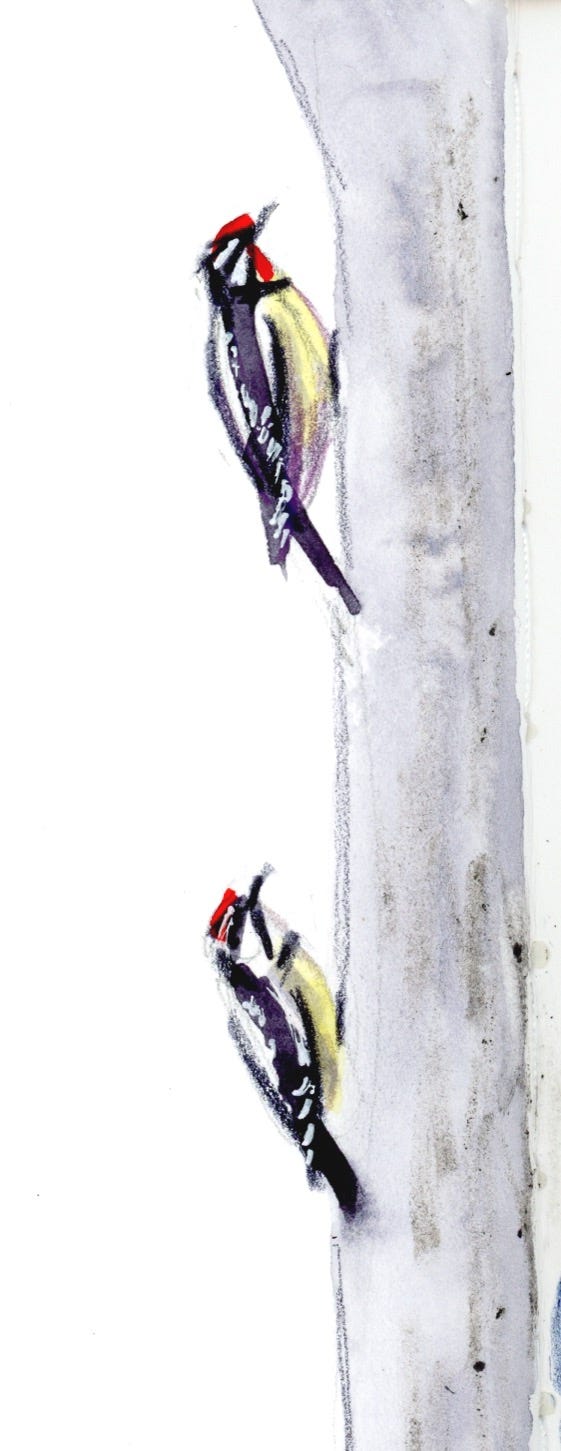
While most were seen foraging along the main trunks of the trees, others were perched and feeding out along the thin terminal branches, behaving more like Downy Woodpeckers than Yellow-bellied Sapsuckers. Looking for insects amongst the budding leaves perhaps? I wasn’t sure, but I’d never noticed Yellow-bellied Sapsuckers doing that before.
As we continued our soggy walk along the lakefront, dozens of Song Sparrows flitted ahead of us, some foraging along the ground, others perched up in the bushes or along the fence, filling the air with their song.
Amongst them and looking somewhat out of place was a large and chunky sparrow with a tan head, white belly, and black bib—a Harris’s Sparrow! This young individual had been hanging out at Park 566 for the past few weeks, but I hadn’t expected them to still be here. I guess they were content with what Park 566 had to offer.
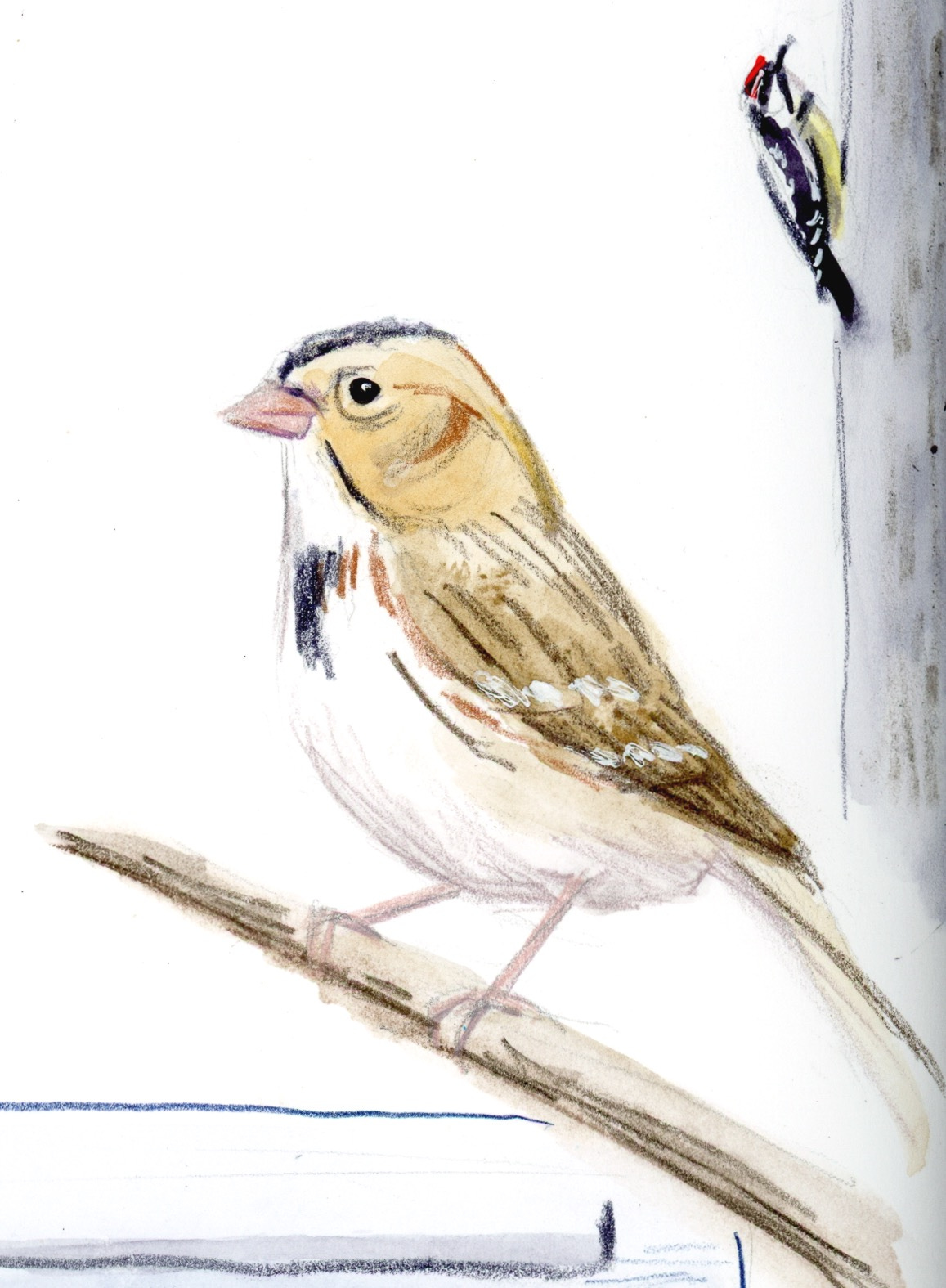
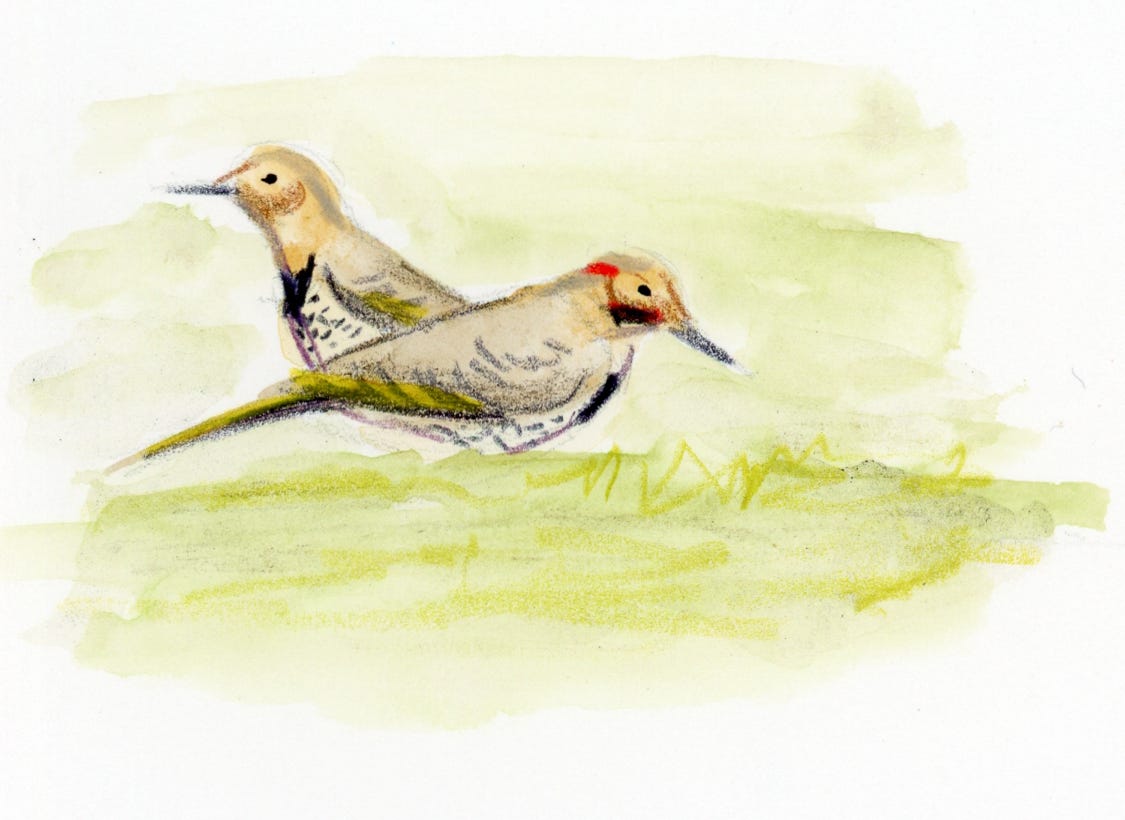
Also amongst the numerous Song Sparrows were a trio of Savannah Sparrows and a Swamp Sparrow, but there were no signs of the Fox Sparrows who’d passed through in previous weeks. American Tree Sparrows were present, but in much smaller numbers than the winter flocks. They’d started to head north, and I wondered if this would be the last week I’d see them at Park 566 until the fall. Northern Flickers were milling about in big numbers, some in the trees amongst the Sapsuckers, others foraging along the ground with the sparrows.
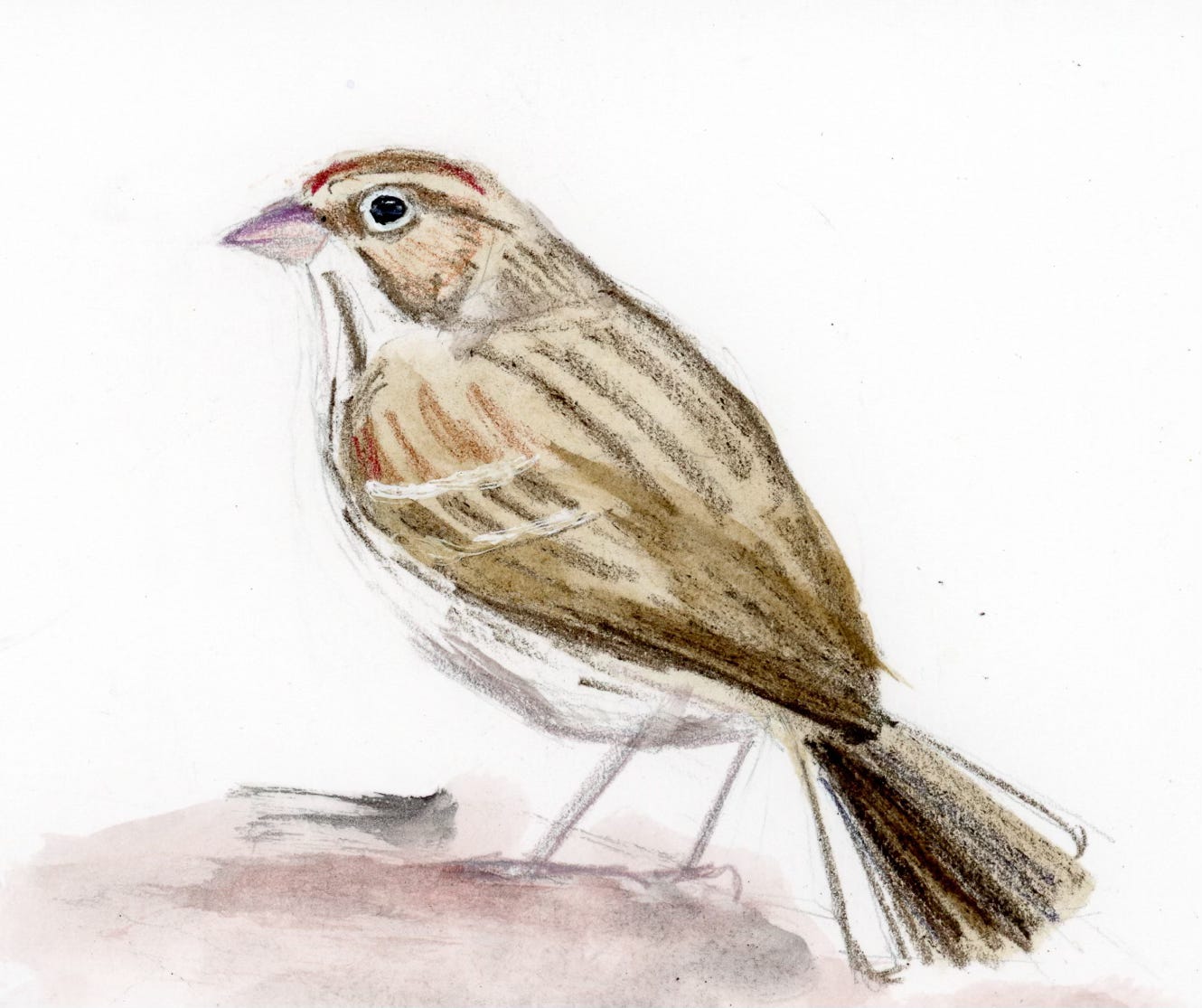
Just minutes after we rounded the bend at the mid point of the park, I noticed a sparrow on the ground that flashed white as it flushed ahead of us. While those white outer tail feathers recalled those of a Dark-eyed Junco, this bird was overall pale beige, not gray. I scanned about for a few minutes, and finally the bird came back into view. Yep, the distinctive white eye ring and pale streaking marked it out as a Vesper Sparrow, my first of the spring!
As we watched, the Vesper Sparrow intermittently flicked their tail while foraging on the ground, flashing those bright white tail feathers. Not only had I never noticed those white feathers before, I’d also never observed this particular behavior. Dan and I speculated on its function for a few minutes—was it to flush or distract insects, similar to how American Redstarts and Northern Mockingbirds use their tails? Or was it a predator defense, similar to that of the Dark-eyed Junco?
We continued on our way, and as we walked, Red-breasted Mergansers, Mallards, and Buffleheads flew past, some heading north, some heading south.
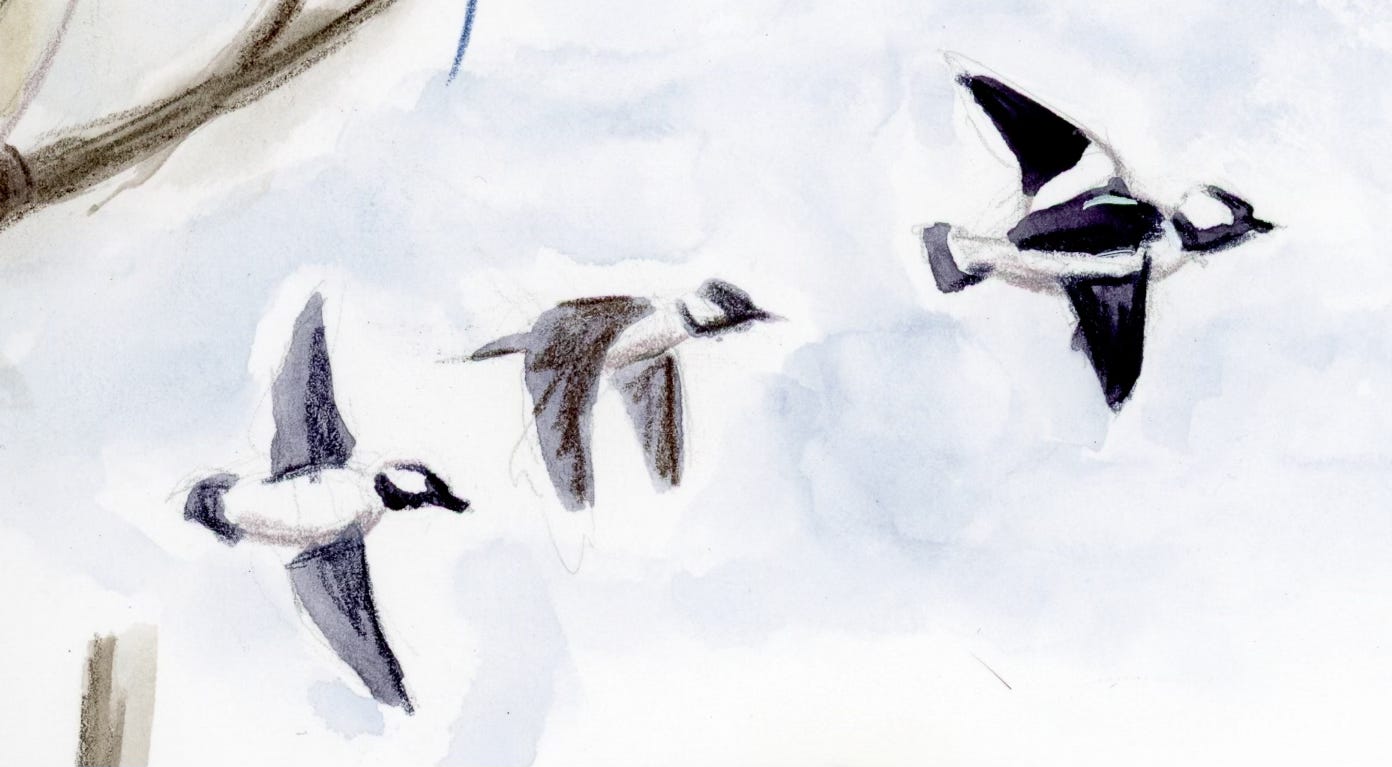
More groups of hundreds of Double-crested Cormorants streamed by, fluttering along the lake like so many skeins of dark ribbon.
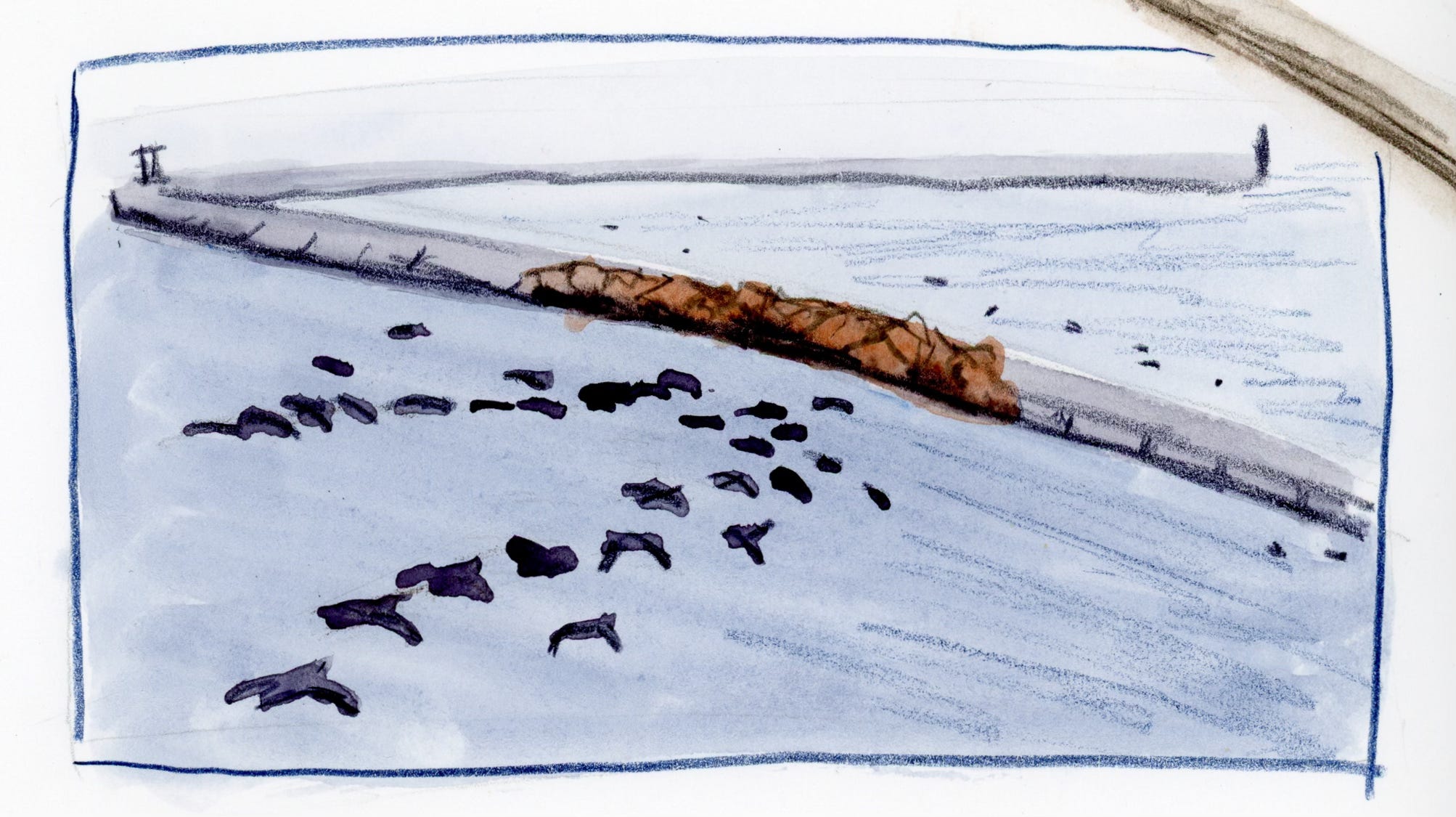
The rain stopped by the time we reached the slip that separates Park 566 from Steelworker’s Park, and it felt like such a gift! We could actually dry off our binoculars, and used their now clear lenses to scan the water for birds. There was the Long-tailed Duck, another regular, floating by the wall in nearly the same spot we saw her the previous week. Near her were a pair of Horned Grebes in almost full breeding plumage, and further out in the harbor was a Common Loon, whose distinctive profile set them apart from the more numerous Red-breasted Mergansers.
As we stood there facing south watching the loon, the wind suddenly shifted, and it felt warm. And not just a little warm—this wind felt like it was 20 degrees warmer than the surrounding air as it wound around my chilled fingers and binoculars. Weird, but also welcome, since I was chilled through from walking nearly 2 hours in the rain.
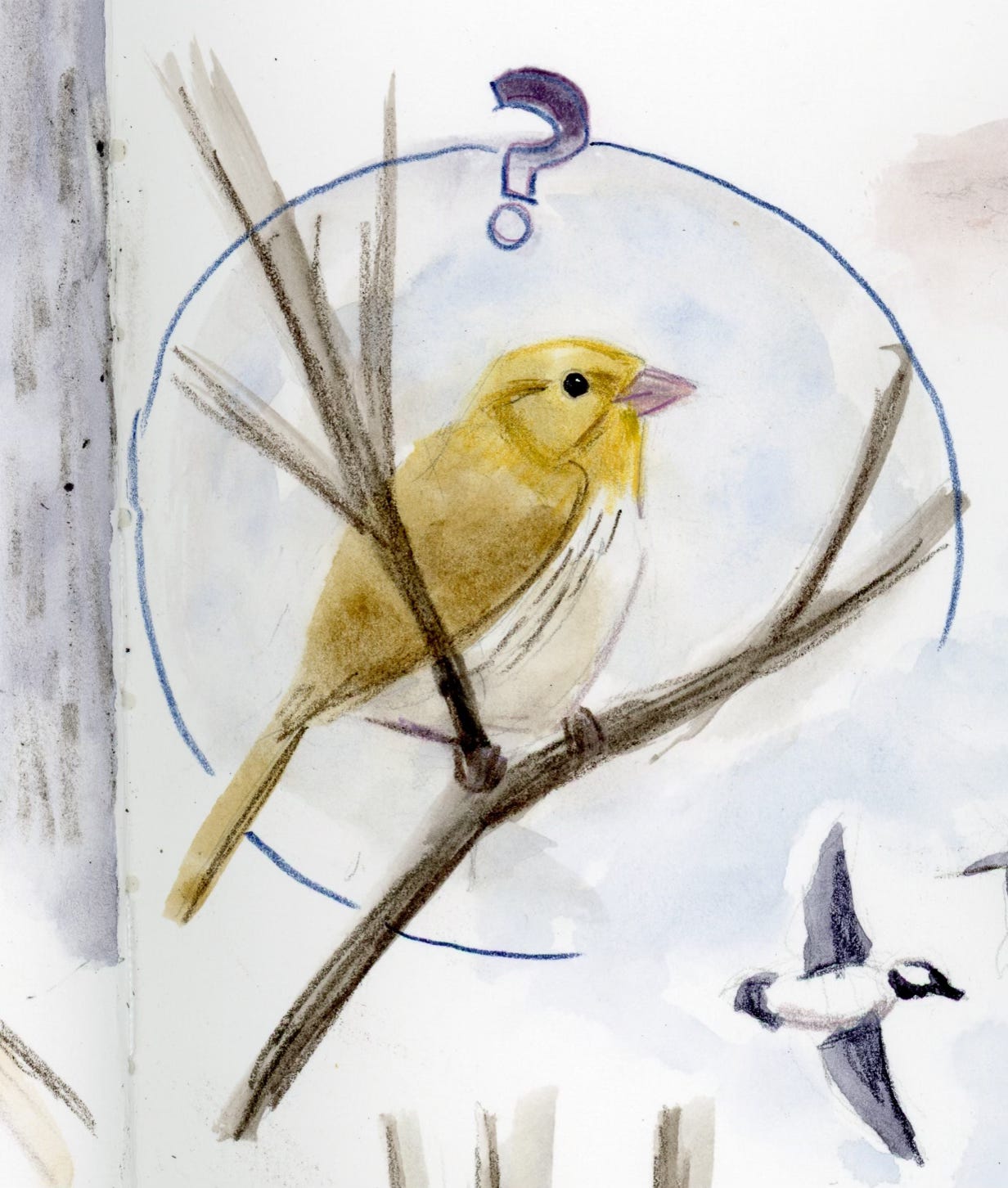
I soon realized, however, that this temperature change brought some unwelcome consequences. Warm air + cold binoculars = a whole lot of condensation, and I was now in a constant battle to keep my lenses clear of fog. The timing of this sudden warmup couldn’t have been more unfortunate—we’d now made it to a grove of sumacs chock full of sparrows, and amongst the Song, American Tree, and Field Sparrows was one that just looked different. All I gathered from my first two-second view was the bird lacked the darkly streaked face of a Song or Swamp Sparrow and also lacked the white eye ring of a Field or Vesper Sparrow. The mystery sparrow popped up again a few minutes later, and while this time I was able to get a three-second look, it was through completely fogged binoculars. My general impression was that the sparrow’s head looked overall yellow, it had fine dark streaking along its flanks, and a plain white breast. That’s all I got before it disappeared again. The yellowish head and streaked flanks were giving Henslow’s Sparrow vibes, and I wanted the bird to be a Henslow’s, which would be a park lifer for me, but it was possible it was a Savannah Sparrow too. Honestly, the state of my binoculars made a solid ID impossible, and the bird flew off, never to be relocated. “Oh well,” I told myself, “that bird will just have to remain a mystery!”
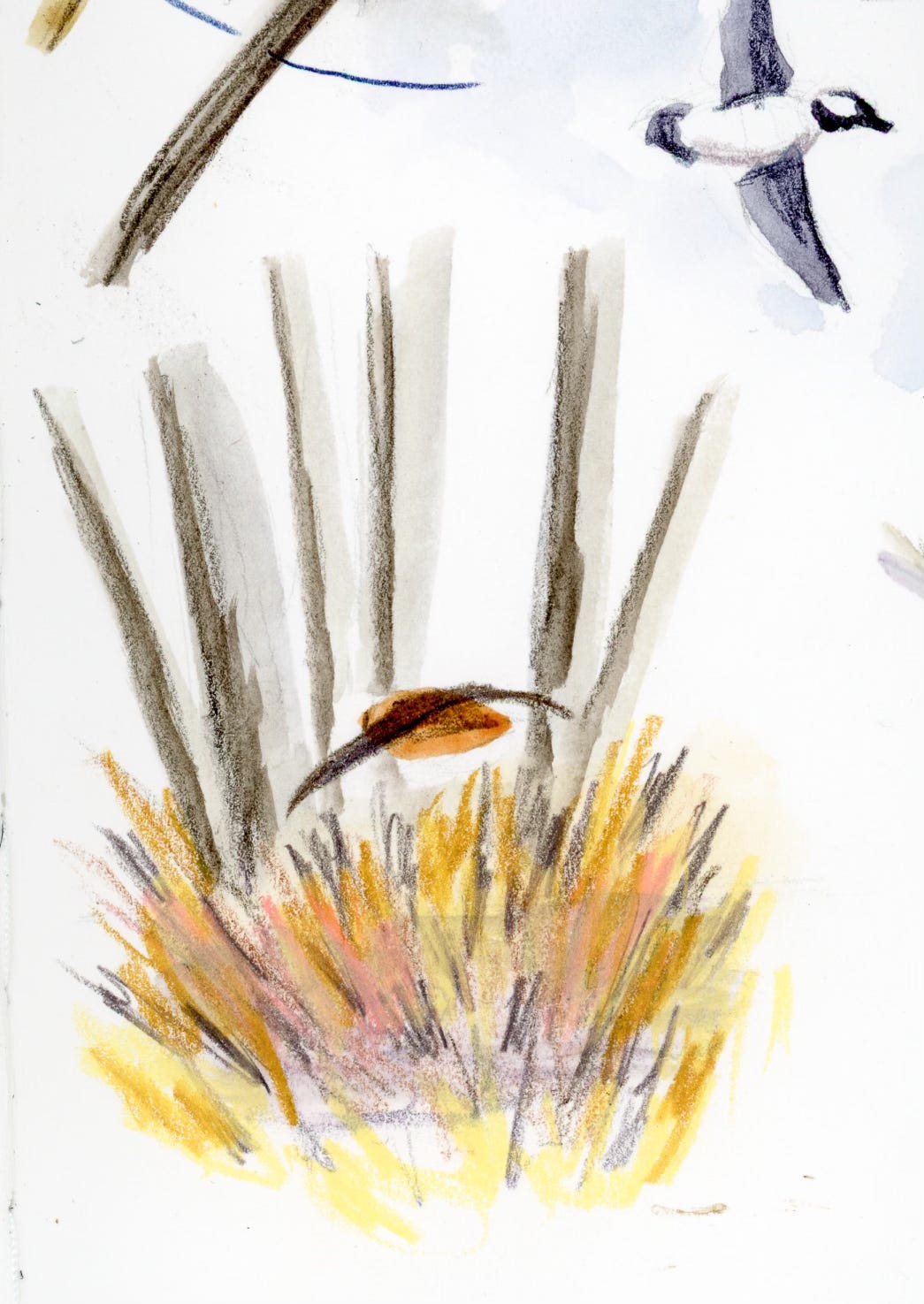
We continued our way back north, hugging the fence that separates Park 566 from the adjacent private property. We saw more Yellow-bellied Sapsuckers, heard Northern Flickers calling in between bouts of Eastern Meadowlark song, saw an American Kestrel get chased by Red-winged Blackbirds, and accidentally flushed an American Woodcock. This encounter was just like so many other daylight encounters with this species—a sudden whistle of wings and blur of cinnamon feathers which vanished as quickly and suddenly as it appeared.
Further along the fence we found a Yellow-rumped Warbler bopping around in the poplars. Dan soon spotted another warbler, one with a lemon yellow face, head and breast and dark gray wings with two white wingbars—a Pine Warbler! Pine Warblers are early and typically brief visitors to Chicago, and I usually see them in the spring at LaBagh Woods and Montrose Point, never here. This was a park lifer!
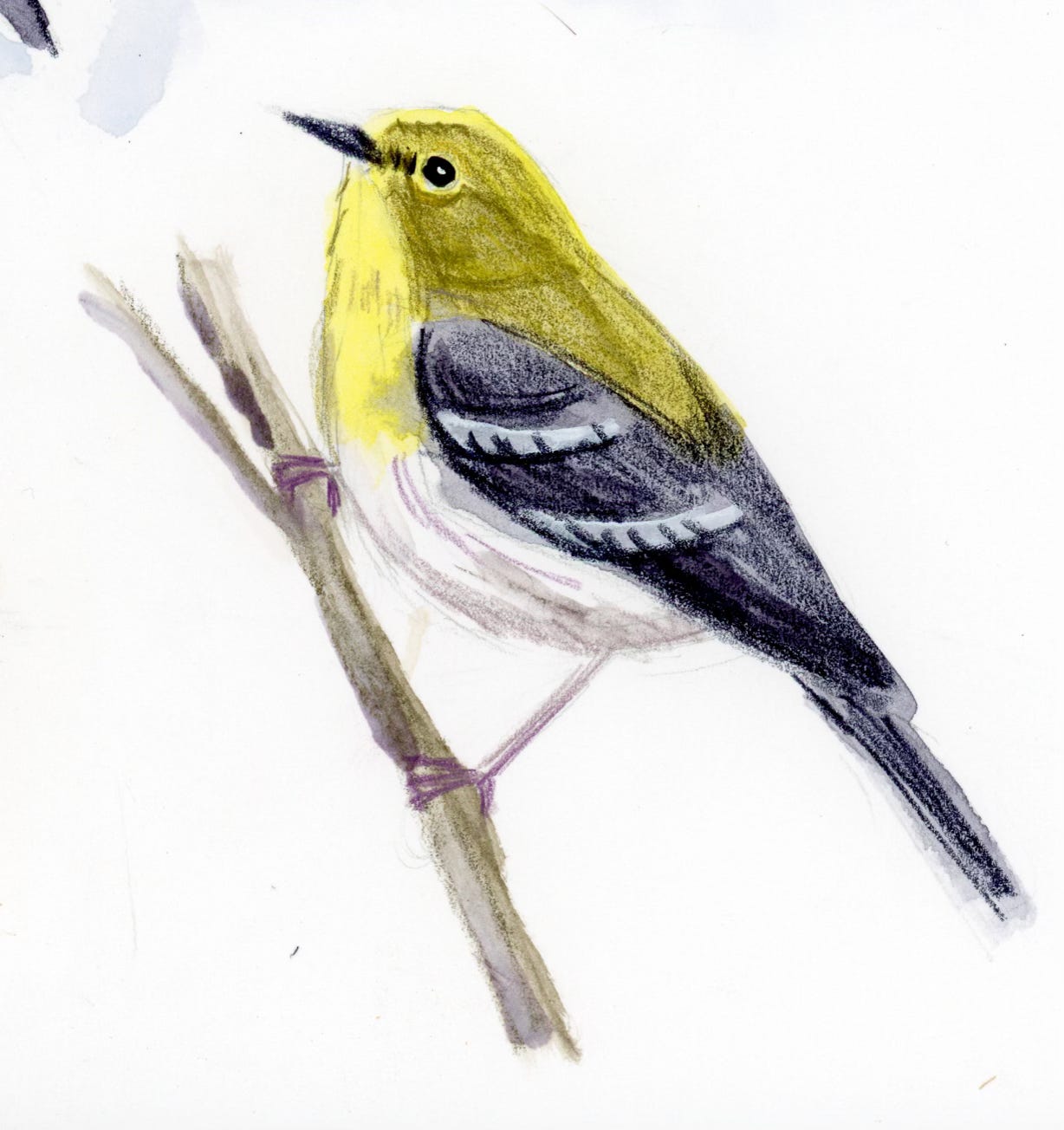
We admired the warblers for a few more minutes, then slowly made our way out of the park. While the rain had resumed and my feet were thoroughly soaked, my spirits were high, as they usually are after time spent with birds. The arrival of Yellow-bellied Sapsuckers and Vesper Sparrows is just the beginning—spring migration is heating up!
Thanks so much for reading! I’d love to know what birds are showing up near your home these days. Also, do you keep a nature journal, too, or are you thinking of starting one? Please share in the comments.
All media and writing by me, Kelly C. Ballantyne
Comments
Nothing yet. Say the first thing.
Sign in to join the conversation.