
— Sally Blount, Michael L. Nemmers Professor of Strategy
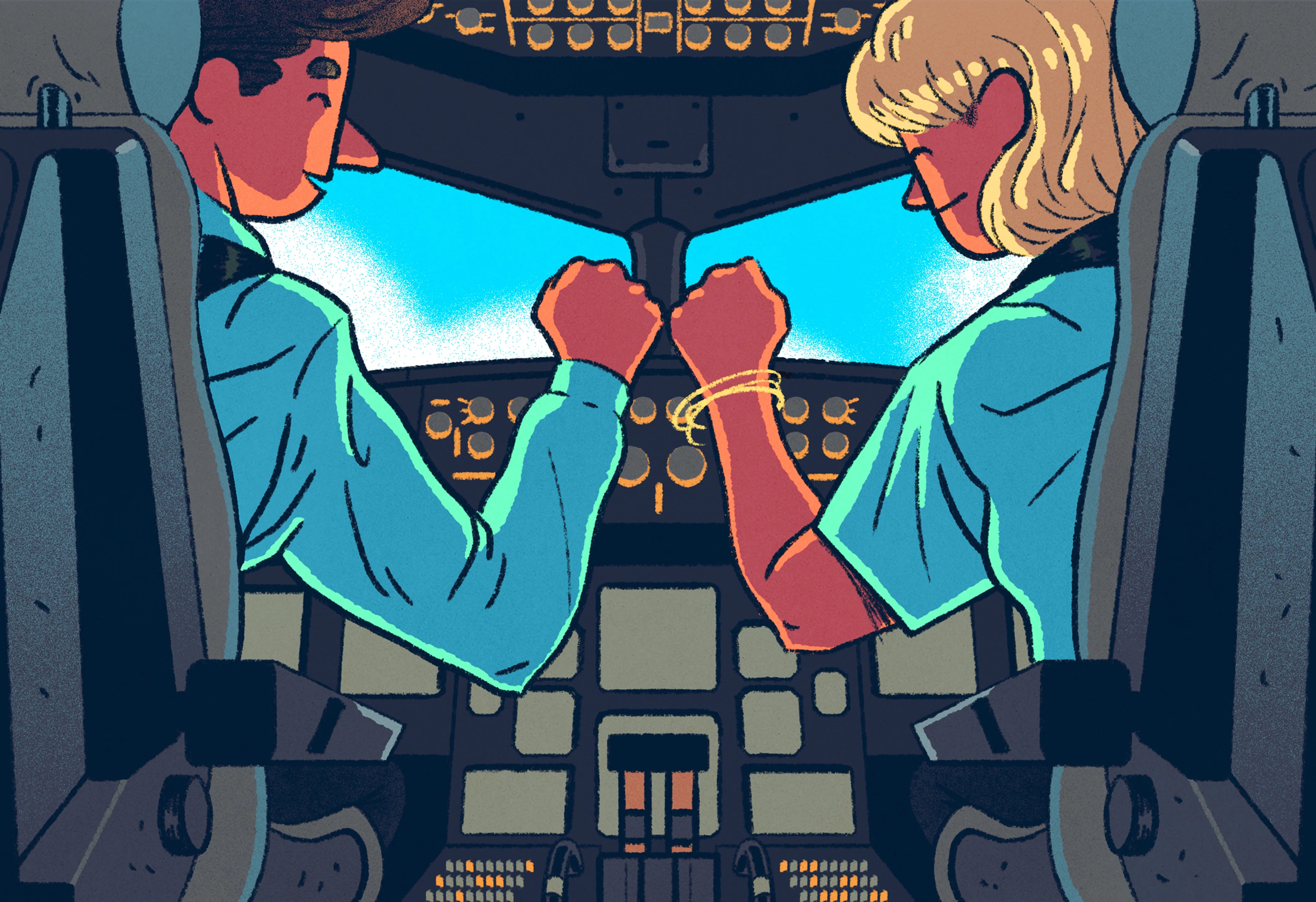
Art: Michael Meier
“Mayday, Mayday, Mayday.” It’s one of the most frightening phrases we could potentially hear as passengers on a flight.
Fortunately, few of us ever do. And that’s largely thanks to the coordinated efforts of the pilots managing tons of stimuli from aircraft gauges and readers while communicating with each other, air-traffic control, and the rest of the crew.
“Flying is one of the most complex and highest cognitive-load interactions that you can undertake in the workplace,” says Sally Blount, a professor of strategy and former dean of the Kellogg School of Management.
A crucial element for the success of flights and similarly high-stakes, intricate work involving teams is rapport—how harmoniously people get along and communicate. But “rapport” is a broad term, and it’s hard to define.
“We all know what it’s like to be on a team when you’re in flow or in the swing, as they say in rowing teams,” Blount says. “But what does that sense of flow or rapport really mean?” Psychologists have identified three underlying components in rapport: “interpersonal liking,” or how positively the people interacting together regard each other; “emotional positivity,” or how upbeat the emotional tenor is across the interaction; and “interpersonal coordination,” or how temporally in sync the people’s behaviors, language, and pace of communicating are.
Blount and her colleagues studied how all three aspects of rapport contribute to team performance on complex tasks, in the context of experienced pilots. The pilots trained in flight simulators—focusing on takeoffs and landings, the most cognitively challenging elements of a flight—and their performance was evaluated by aviation experts.
Across dozens of two-person flight crews, the researchers found that neither liking nor positivity was significantly predictive of the experts’ evaluations of crew performance. But interpersonal coordination did predict the pilot’s performance. The higher the pilots’ interpersonal coordination was, the better their performance was.
Interestingly, when liking and positivity were high, the pilots themselves thought they performed better, but that perception did not always translate into better expert evaluations. The tendency to associate more-positive interactions with better performance is common within teams, but it can be misleading and is a well-known contributor to groupthink, Blount says.
“What is critical in the cockpit is the ability to adapt and align your behavior to your partner’s, both physically or verbally, to create more complex and fluid communication,” she says.
Learn more from Blount in “A Key Ingredient for Making Teams Soar” at Kellogg Insight. #KelloggLeader #Leadership #Teamwork #HumanBehavior
Comments
Nothing yet. Say the first thing.
Sign in to join the conversation.