
From MPs, columnists and leader-writers, the cry goes out: Andy Burnham has no mandate to become prime minister; his plans for governing Britain should be tested in a full-scale leadership election.
Let us consider a different test: the validity of those two arguments.
First the mandate. Keir Starmer won a landslide victory less than two years ago. Did he have a clear democratic right to occupy 10 Downing Street that Burnham cannot claim?
The very word “mandate” has two different meanings, even if in practice they often overlap. The first is constitutional. At general elections we elect 650 MPs. not a prime minister. The right to rule flows from the parliamentary arithmetic. Starmer’s enjoyed a large initial mandate because more than 400 MPs supported him in 2024.
They don’t now. Starmer is going precisely because – as he admitted this morning – he no longer has the constitutionally defined mandate to remain prime minister. It looks as if Burnham will inherit that mandate, just as nine other postwar prime ministers have done without winning a general election. There is no constitutional case for blocking his path.
The second version of the mandate is that a general election reveals the popular will. The choice of prime minister does not appear on any ballot paper, but we all know that this is really what is at stake. This version of Starmer’s mandate is rooted in the public mood, not the constitutional fiction that the mandate resides with MPs.
Let us check the record. Starmer is the fourth party leader in the past half century to become PM at a general election. Ipsos (formerly MORI) has been monitoring the public mood throughout that period. Here is what voters thought of each leader as they faced the electorate, along with the election result.
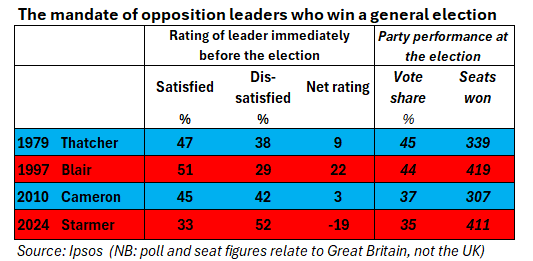
As those figures show – indeed the figures for every general election since the second world war show – that no victorious party has won an absolute majority. However, well over 40 per cent voted for the winning party in 1979 and 1997; and Margaret Thatcher and Tony Blair enjoyed positive satisfaction ratings. David Cameron’s net rating was only just positive, his party won less than 40 per cent of the vote – and he failed to win an overall majority in the House of Commons. In all three elections the popular will broadly matched the constitutional mandate.
Starmer’s figures are telling. His personal rating was strongly negative at the time of the 2024 election, and Labour won just 35 per cent of the Britain-wide vote. Yet Labour enjoyed a landslide victory almost as great as it did under Blair.
Here is a clear example of the two meanings of “mandate” diverging. The constitutional meaning plainly favours Starmer: we can’t argue with a majority of 172. But the other definition, the popular will, gave Starmer no mandate at all, beyond the obvious fact that most voters wanted to remove Rishi Sunak.
Which brings us back to the point that Starmer’s ONLY mandate was his constitutional position, and that has evaporated in recent weeks as Labour MPs turned against him.
So much for the “mandate” argument for Burnham facing a contest in order to establish his own mandate rather than enjoying a coronation. His constitutional right to be PM will be the same as Starmer’s. Yes, he will lack popular approval; but so did Starmer.
What about the second argument: that Burnham’s claim to become prime minister should be tested in a proper election, with the choice of at least one other candidate, a clash of ideas, and party members and the wider public able to see how he performs in the crucible of fierce debate?
It sounds like a great way to decide who should succeed Starmer. It’s the case for Wes Streeting challenging Burnham instead of pulling out of the race as he has done. However, there is something curious about every version of this argument that I have read in recent days. They all imply that a proper contest ensures victory for the candidate with the best ideas and the most convincing programme for government. But I have not read a single leading commentator explicitly making this instrumental case for a contested leadership election.
I think I know why. In order to claim that leadership contests benefit the most rigorous candidate with the most credible policies, you must believe that Liz Truss, Jeremy Corbyn and Iain Duncan Smith all deserved their victories. The advocates of a summer contest to choose Labour’s leader have been wise not make such ridiculous claims.
There is a reason for this. Elections – whether to choose a party leader or a government – are the worst times for serious debates about ideas. Contests are for winning. They are a time for confidence and certainty, for simple messages and sharp attacks, for emotional engagement with the electorate rather than closely argued economic and social theories. In short, successful election campaigns suppress the very essence of the ways the best ideas have emerged down through the centuries – through doubt, curiosity, trial and error, detailed propositions, objective and unemotional inspection of the evidence, a willingness to change one’s mind and so on. Serious ideas and contested elections simply don’t mix.
There are other arguments for Burnham being challenged for the leadership of the Labour Party. Choice is a great democratic virtue, not least at general elections when voters can remove failed governments. However, to say that regular elections are the indispensable cornerstone of any democracy is not the same as saying that election campaigns are times for serious debates about big ideas, or the credibility of rival programmes. Arguments are vital to the strength of an open society. Ideas rightly have immense power to shape our politics. We should cherish such arguments at all times, but accept that when election campaigns get underway, politicians have other priorities when deciding what to say.
We may, perhaps should, deplore this state of affairs. It would be wonderful if election campaigns, for party or national leadership, were times for respectful Socratic dialogue. But it is better to acknowledge the disappointing reality than pretend things are otherwise. We need other ways to test Burnham’s ability to govern Britain effectively.
Back to Starmer’s announcement this morning We are heading for our seventh prime minister in just over ten years. Let us consider the reasons the first six had to go:
David Cameron failed to win the Brexit referendum;
Theresa May failed to persuade her party to support her plan for Brexit;
Boris Johnson failed to tell the truth or obey the law;
Liz Truss failed to protect the public finances;
Rishi Sunak failed to revive the Tory corpse (he can’t be blamed for that, but it was a failure nonetheless);
Keir Starmer failed to translate his plan for winning power into a plan for running the country.
No, a record of seven occupants of 10 Downing Street in ten years is not ideal. But the solution is not fewer Prime Ministers but better ones.
No posts
Comments
Nothing yet. Say the first thing.
Sign in to join the conversation.