
Few ideas have been as influential in education as Bloom’s Taxonomy. Ask almost any teacher, instructional designer, or education professor to describe it, and they will likely sketch a pyramid like this:
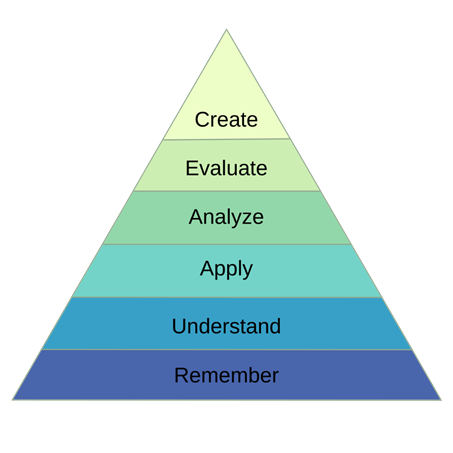
When I see a learning pyramid, my first reaction is GREAT! Creativity is at the top! When I see this pyramid in a classroom, I think it’s a sign that the teacher values creativity. I’ll bet you’re more likely to see this pyramid in an art class than in a math class.
At the bottom of the pyramid are lower-order skills such as remembering. The image implies that they’re not as important. But the science of learning suggests that remembering is just as important as the higher levels, as you’ll learn from my interview with cognitive psychologist Dr. Henry Roediger on The Science of Learning. His book Make It Stick also shows that remembering and deep learning don’t have to be opposed. In effective learning, they join together.
A more subtle error with the pyramid is that it implies that the lower level is more fundamental. The hidden message is that you have to master the lower levels before you’re ready for the higher levels. This assumption kills creativity in schools, because if you insist that students learn the lower levels first, what happens is that they never get to creativity. But there’s no evidence that you have to memorize before you’re ready to analyze, evaluate, or create.
You don’t have to master the lower levels before you’re ready to create.
The original 1956 publication presenting Bloom’s six-level taxonomy doesn’t describe it as a pyramid. So where did the pyramid come from? If you’re an education researcher or a teacher, you might be familiar with the “revised” Bloom’s taxonomy, published in 2001, by Dr. Lorin Anderson and several other psychologists. Maybe their book was the origin of the pyramid? Nope; it’s not in that book, either.
I found a 2018 journal article that tracks down the completely non-scientific history of where the pyramid image came from (hint: it’s over 150 years ago). I tell that story below the paywall. Here’s the science showing that it’s wrong.
Dr. Anderson was the first co-author of the book that presented the “revised” Bloom’s taxonomy to the world. In 2018, he wrote this blog post trashing the pyramid image and everything associated with it. If you read the entire post, you can tell that Anderson really, really dislikes the learning pyramid image. Here’s a quick version of what he said:
The triangle doesn’t appear anywhere in Bloom’s publications or in the Revised Taxonomy.
The triangle image is wrong. It misrepresents the research. Specifically, types of knowledge are not sequenced from bottom to top. You don’t have to learn the lower levels first. The higher levels are not based on the lower levels.
You don’t have to master the basics before you’re ready to be creative.
It’s nice to see creativity on top, but the risk is that creativity turns out to be a nice-to-have, something that gets left out while we focus on the more fundamental, lower-level knowledge and skills.
In episode 4 of The Science of Learning podcast, I interview Dr. Henry Roediger, the cognitive psychologist who co-authored Make It Stick, a best-seller filled with advice for how to study and learn more effectively.
Our conversation touched on one of the most important issues in the science of learning: levels of knowledge and levels of understanding. Dr. Roediger is a memory researcher, and a lot of memory research has focused on the lowest level of Bloom’s Taxonomy. After all, that level is called Remember. But in our interview, Roediger argues that memory is about more than just the lowest level of the pyramid. His book Make It Stick has quite a bit about learning for deeper understanding. Dr. Agarwal’s research shows that in the most effective learning, students learn across all levels of the taxonomy together—not bottom to top or top to bottom.
This is one of the biggest challenges facing the learning sciences: How can we teach lower-level and higher-level knowledge together? Learners need both. You can’t be creative without knowing and remembering a lot of things. But if you try to remember things without applying and creating with those things, you forget them quickly and you fail to understand those things.
Effective learning takes place across all levels of Bloom’s taxonomy.
I tell the real story below the paywall. I’ll also explain how we know that Abraham Maslow never used a pyramid for his hierarchy of needs, either.
Also below the paywall, I’ll tell you where this myth comes from:
People generally remember*
10% of what they read
20% of what they hear
30% of what they see
50% of what they hear & see
70% of what they say
90% of what they say as they do a thing
*note: unsupported by evidence. Keep reading for the original source of these fake facts
Comments
Nothing yet. Say the first thing.
Sign in to join the conversation.