
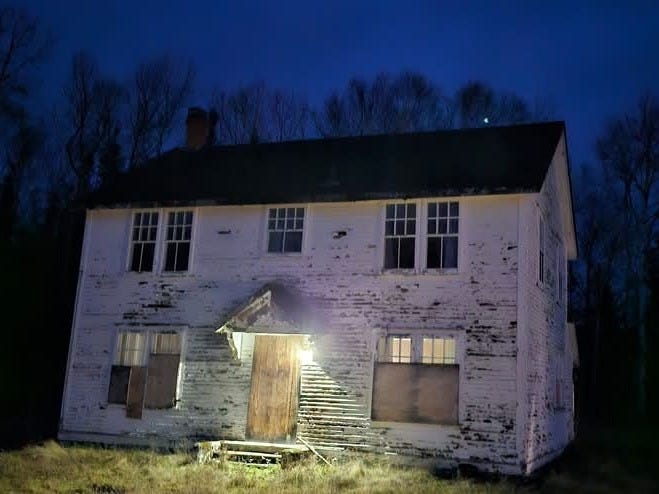
This is Part 3 of the story.
For a prelude to this story, listen to S2E1 of the Brewing Fiction Podcast for an ‘interview’ with the protagonist Grace Wight.
Though the places in this story are real, I have taken liberty with some of the details to fit the story. All other names and details are fiction.
Grace drove back to St. John’s through a rainstorm that turned the highway into a blur of gray. She stopped twice, once to be sick in a gas station bathroom and once to sit in her car in a parking lot and cry until her throat ached.
When she got home, she counted the items in her apartment that were exactly where she’d left them. Sixteen things. Sixteen was not a prime number, but it would have to do.
Then she opened her laptop and began to write.
It took her four days to finish the article. She wrote about Sam Pedersen, Martha and Mark MacLeod. She wrote about John Warren Smith’s suicide and the two unnamed workers who’d disappeared into history. She included every detail she could verify: construction records, death certificates, and interview transcripts. She left in the parts she couldn’t verify but labeled them clearly as oral history, family stories, and local legend.
She did not write about seeing Martha’s ghost. She did not write about the vision of Sam’s death, about how it had felt to drown in concrete, to feel it harden around her. Those details would make her sound crazy, and she needed people to believe the rest.
She titled it “The Ghost Light of Deer Lake: The Untold Story of Main Dam’s Construction.”
First, she pitched it to The Atlantic. They passed within three hours. “Compelling narrative, but insufficient documentation for the central claims,” was the response she got.
She tried The Guardian next. They took a week to respond. “We appreciate the submission, but we’re unable to fact-check the allegations about the 1925 incident.”
CBC’s investigative unit was more encouraging. They kept it for two weeks before an editor called her personally.
“Grace, this is powerful stuff. But without physical evidence or contemporary documentation of the death, we can’t run it as journalism. We’d be opening ourselves to legal action from MacLeod’s descendants, and frankly, we’d have trouble defending the story.”
“His descendants?” Grace had said, incredulous. “The man’s been dead for fifty years.”
“Doesn’t matter. Defamation of the dead is still actionable in some cases. I’m sorry.”
The Telegram was her last hope. They were local and they knew Deer Lake. She guessed they’d understand the importance of telling what truly happened. She sent the pitch to three different editors.
They all said no.
The final rejection came from Bill Moss, a senior editor she’d worked with before. He took her for coffee and told her gently, over a Tim Hortons dark roast, that it wasn’t about the quality of her writing.
“It’s about proof, Grace. You’ve got oral history and circumstantial evidence. That’s not enough. If you had remains, or if you had contemporary newspaper accounts, or even if you had official accident reports, we could run with it. But right now? It’s a ghost story. And we’re a newspaper, not a magazine about the paranormal.”
Grace had stared at her coffee cup, at the way the fluorescent lights reflected off the brown surface.
“So what do I do?”
“You could try a podcast. Or a blog. Somewhere you’re not bound by journalistic standards.” He’d paused. “Or you could keep digging. Find something concrete. No pun intended.”
But Grace was tired of digging. She was tired of chasing ghosts and stories nobody seemed to want to hear.
She went home and saved the article to a folder labeled “Unpublished.” She closed her laptop.
She went to the window and looked out onto the rain-washed street. She thought about Martha waiting by her window, for a son who would never come home. And she thought about how some stories were too true to be believable.
Three weeks passed.
Grace took other assignments. She wrote about coastal erosion, fishing quotas, and the debate over snowmobile trails in Gros Morne. She interviewed people, recorded facts, and wrote articles that editors actually wanted to publish. She tried not to think about Main Dam and the Pedersens.
But every night, when she tried to sleep, she felt it: the cold weight of concrete, the scraping thickness of it sliding down her throat. She’d wake up gasping, her hands clawing at her neck, convinced she was drowning.
She stopped sleeping more than four hours a night.
On a Tuesday evening in late October, Grace was at her kitchen table editing a piece about healthcare in rural communities when someone knocked on her door. Grace lived on the third floor of an old building on Water Street. You needed to be buzzed in, but she hadn’t buzzed anyone in.
She looked through the peephole and saw nothing but the worn carpet in the empty hallway. She opened the door.
Martha Pedersen stood in the hallway.
She was almost solid this time, or as solid as a ghost could be. She wore the same dark dress and the same tired expression. But something was different. The desperate hope was gone from her eyes. In its place was something that looked almost like peace.
“Hello, Grace,” Martha said softly, her lips unmoving.
Grace’s hand tightened on the doorknob. The last words she had said to Martha came rushing back, “Yes. I’ll tell everyone. I promise.”
“I tried,” Grace said, her voice breaking. “I wrote the story. I tried to tell everyone, but they won’t publish it. I’m sorry. I’m so sorry.”
Martha smiled, but it was the saddest smile Grace had ever seen. “I know. I’ve been watching.”
“Then you know I failed.”
Martha stepped forward, and Grace noticed that her feet didn’t quite touch the carpet.
“No. You believed in him. That’s more than anyone’s done in ninety years.”
“But nobody else will know. Nobody else will believe it.”
“Some will,” Martha said. “The people who need to know. The people who’ve always felt something was wrong about that dam. Those who’ve always wondered about the light in the window. They’ll hear about your story. Stories like this spread, Grace. They spread the way truth does, even when nobody wants to print it.”
From behind Martha, another figure emerged from the shadows at the end of the hall.
Sam Pedersen looked exactly as he had in the vision. Nineteen years old, with smooth hands and scared eyes. But the fear was fading now, replaced by something like wonder.
“Ma?” he said.
Martha turned, and the sound that came from her was beyond tears, beyond grief, and beyond anything Grace had words for. She reached out and Sam took her hand. Their fingers locked together like puzzle pieces.
“My boy,” Martha whispered. “My beautiful boy. I’ve been waiting for you.”
“I know, Ma. I know you have.” Sam looked at Grace over his mother’s shoulder. “Thank you. For trying to tell them what happened. For trying to make them remember.”
Grace wiped at her eyes. “I wish I could have done more. I should have found a way to prove it.”
“You can’t always prove what people don’t want to believe,” Sam said. “But you tried. That matters more than you think.”
Martha was crying now, soundless tears finally able to slide down her translucent cheeks. She cupped Sam’s face in her hands the way mothers do. The way Grace’s own mother had done a thousand times.
“Can you leave now?” Grace asked. “Are you finally free?”
“I think so,” Martha said. She looked around the hallway as if seeing it for the first time. “I don’t feel stuck anymore. I don’t feel like I’m waiting. I think... I think we can go now.”
“Where will you go?”
Martha smiled. “Wherever we’re supposed to be. Wherever folks go when they’re done waiting.”
They started to fade then, both of them, their edges blurring into the shadows. But before they disappeared completely, Martha looked back at Grace one last time.
“Tell Sam’s son,” she said. “If you can find him. Tell him everything. Tell him Samuel loved him and his mother. Tell him he would have come back if he could.”
“I will,” Grace promised.
And then they were gone.
Grace stood in her doorway for a long time, staring at the empty hallway. The light fixture flickered. Somewhere in the building, a door closed, bringing her back to the ordinary sounds of the ordinary world.
She went back inside and sat at her kitchen table. She opened her laptop and pulled up the unpublished article. She read through it once, then twice, making small edits. Then she opened her blog, the one she’d started years ago and barely maintained. She pasted the article in, and wrote this preface:
The following story was rejected by every publication I submitted it to. They said it lacked proof. They said it was too much like a ghost story. Maybe they’re right. But I’m publishing it here because some stories need to be told whether anyone believes them or not. This is the story of Sam Pedersen, who died building Main Dam in 1925, and his mother Martha, who waited for him until the day she died. This is the story of the Ghost Light.
Make of it what you will.
She hit publish.
Within a week, the blog post had been shared hundreds of times, mostly by people from Deer Lake and the surrounding areas. People commented with their own stories, their own memories of the bunkhouse, of the light that never went out, and of the feeling they got when they visited the dam. A woman in Corner Brook said her grandfather had worked on the dam and had always refused to talk about it. He would leave the room if anyone mentioned MacLeod’s name.
Two months later, Grace got a phone call from a woman named Clara Templeton at the Waterford Hospital archives in St. John’s.
“Ms. Wight? I’m calling about your blog post. The one about Martha Pedersen.”
Grace sat up straighter.
“Yes?”
“After I read your story, I looked into Martha’s files. We unsealed them last month as part of a research project on historical asylum records. I thought you’d want to know something.”
“I’m listening.”
“Martha Pedersen had a visitor in 1932, about a year before she died. A young woman named E. Ryan. The visiting log lists her as ‘daughter-in-law.’”
Grace’s breath caught. “Ellie.”
“That would be my guess. And Ms. Wight? She brought a child with her. A boy about seven years old.”
Grace closed her eyes and computed. Seven years old in 1932. Born in 1925, around the time Sam died.
“His son!”
“The archivist’s notes say that Martha became very agitated during the visit,” Clara continued. “The doctors decided it best to not let her see the boy. She kept insisting that ‘Samuel’s boy’ needed to know the truth about his father. That he was a good man who died working. The visit ended with the young woman promising to tell the child his father’s name and that he’d been a good man.”
“Is there any record of what happened to them? To Ellie and the boy?”
“I’m still looking. But I wanted you to know.”
After they hung up, Grace sat at her desk and cried. Not the desperate, frightened tears from the bunkhouse, but something quieter. Something that felt almost like relief.
That night, she opened a new document and titled it: “The Light.”
Because the thing about stories was this: once you started telling them, you couldn’t stop. You owed it to the dead. You owed it to the forgotten. You owed it to the ghosts who’d been waiting.
Grace began to type.
To be continued…
| Keith M. Leonard © 2026. All rights reserved. |
No posts
Comments
Nothing yet. Say the first thing.
Sign in to join the conversation.