
This is Part 1 of a 4 part story.
For a prelude to this story, listen to S2E1 of the Brewing Fiction Podcast for an ‘interview’ with the protagonist Grace Wight.
Though the places in this story are real, I have taken liberty with some of the details to fit the story. All other names and details are fiction.
Grace Wight counted the items in her messenger bag for the third time that morning. A yellow notepad with a pen clipped to the spiral, digital recorder with fresh batteries, her fully charged phone, pepper spray (expired but probably still effective), a protein bar (peanut-free because of her allergy), and her grandmother’s rosary, even though she hadn’t been to church since 2003. She tapped each item with her index finger as she counted, a habit that had driven her ex-husband crazy. But it kept her anxiety at a manageable level.
“Seven items,” she said aloud to her rental car’s empty interior. “Seven is a prime number. Prime numbers are lucky.”
Of course, she had no proof for that, but Grace liked the idea that they might be.
The highway from Corner Brook to Deer Lake cut through rolling hills. Vibrant yellow, red and orange leaves trees painted the hillsides the colour of Autumn. Grace had the heat cranked despite it being mid-September. She was always cold, a lingering gift from the anemia she’d battled in her twenties. The radio played nothing but commercials and the host’s poor sense of humour, so she’d switched it off an hour ago. Now there was only the hum of tires and her own thoughts, which were never quiet.
She’d been working on the Main Dam story for three months. What started as a straightforward piece about Newfoundland’s hydroelectric history had metastasized into something darker.
An elderly engineer named Harold Penney, eighty-six years old with eyes as sharp as cut glass, had mentioned it almost casually over coffee at a Tim Hortons in Stephenville.
“Sometimes the dam pounds,” he’d said, stirring sugar into his cup. He looked at Grace over his black framed glasses. “From the inside.”
Grace had written it down: ‘Dam pounds from…inside?’ Then she’d underlined it twice.
“I call it a whispering fracture.”
“Whispering Fracture?” she repeated, not understanding what that meant.
It’s when microcracks form deep within the concrete matrix. Sometimes it’s caused by rebar corrosion, and other times from a freeze-thaw cycle.”
“Uh-huh,” Grace said, noting the term for future study.
Harold looked at her with those sharp eyes. “That’s what I tell myself. But I don’t really believe it, Missy.” Then he spoke quieter, looking around as if he was about to tell a secret.
“There’s an old bunkhouse out there. Near the dam. Still got power running to it from the main line. One light burning day and night. Folks call it the Ghost Light.”
He’d paused and stirred his coffee some more.
“Some people say they see a woman in the window.”
Grace had felt something shift in her chest when he said that. Not fear as much as recognition. The sense that she’d just been handed a thread. And if she pulled it, a whole spool of forgotten tragedy might unravel.
That was three months ago.
Since then, she’d interviewed seventeen people. She’d also read through archives at the provincial library and examined construction records that were maddeningly incomplete. The official story of Main Dam’s construction was pristine. Completed ahead of schedule in 1925 with no significant accidents recorded. It was a triumph of engineering that brought electricity to western Newfoundland, and powered the pulp mill in Corner Brook.
But Grace had learned long ago that official stories were like fresh paint over water damage. If you scratched the surface, you’d find rot underneath.
That rot’s name was Mark MacLeod.
MacLeod had been the project superintendent. He was described in contemporary accounts as “efficient,” “no-nonsense,” and “results-oriented.” Those were the words people used when they meant someone was a bastard but got things done. Grace had found his photograph in a 1924 edition of the Evening Telegram. He was a thick-necked man with a walrus mustache and eyes that showed his arrogance.
He died in 1975, fifty years after the dam’s completion, of natural causes. He was ninety-two.
The young man he’d buried in concrete had died at nineteen. His name was Sam Pedersen.
She’d found Sam’s story the way she found most true stories: by talking to people.
Just like Harold Penney, Margaret Thornhill, a ninety-one year old with a clear mind, even as her body failed her, had her own story. She was living in a care home in Pasadena. Her grandmother had been a cook at the construction camp.
“They hired men off the books,” Margaret told Grace, her voice soft but firm. “Always paid with cash. And never recorded a name. It was MacLeod who arranged it. He always hired the desperate, and always for the dangerous work. My nan said he preyed on them.”
“Boys like Sam Pedersen?” Grace asked.
Margaret nodded, though her eyes had gone distant. “My nan never forgot the name. She said his mother waited for him every night in that bunkhouse. Sat by the window, watching and waiting. She waited till the day they took her away to the Waterford Asylum.”
Grace had requested Martha Pedersen’s medical records from the Waterford Hospital in St. John’s, but they were sealed.
“Patient privacy laws,” she was told.
“For someone who has been dead for nearly a century?”
“Ma’am, I don’t make the rules. Blame the gov’ment,” the receptionist said.
Grace was able to find the death certificate of Martha Pedersen. She died 1932, with the cause of death listed as “heart failure.” An attached note stated she’d been institutionalized for “melancholia and delusions.”
“Delusions that her son was still alive,” Grace said to nobody.
Grace took her foot from the gas and looked at the Power Station to her right on the Trans Canada Highway before exiting into Deer Lake.
She saw the Tim Hortons sign and nodded. “I need a coffee and to pee. And perhaps someone can give me directions to Main Dam.”
The woman behind the counter, maybe sixty with grey hair in a practical cut, rang up her coffee and sandwich, and looked at the notepad visible in Grace’s bag.
“Are you a reporter, Sweety?”
Grace had learned not to lie at a young age. “Yes. Investigating the history of Main Dam.”
“Main Dam? There’s not much to see there,” she said.
“I’m more interested in the old bunkhouse. The one with the light.”
Now the woman’s face went blank. “Don’t know what you mean.”
“The Ghost Light,” Grace pressed gently. “I’ve heard—”
“Whatever you heard, it’s just stories. I’ve lived here all my life, and I have heard ‘em all. Ghost stories told to keep the kids from going up there to spawn, if you know what I mean?” the woman said.
Grace looked away. She knew.
The woman handed her the coffee and change. “Drive on through town until you get to Flex Fitness. Take the next left onto Gate House Road, a quick left onto Middle Road and then right onto Main Dam Road. Follow it to the old rail tracks and then on to the Dam.”
Grace scribbled the directions onto her notepad. “Flex Fitness, Gate House, Middle and Main Dam. Got it.”
“Sounds like you do, Sweety,” the woman said before she disappeared into the kitchen.
“Thanks!” Grace shouted, and left. In the parking lot, she sat in the car and counted her breaths. Four in, hold four, and four out, until the anxiety spike passed. People didn’t want to talk about the Ghost Light. Which meant it was real. Or at least, real enough to scare them.
Grace found her way to the nearest hotel. As she ate, she searched the internet for a tour company. She found three and called each one, but was disappointed when they all refused to take her. But one response was more than disappointing, and it ran through her mind until she fell to sleep.
“You’ll want to go there in the daylight.”
The next morning, Grace drove to the Tim Hortons drive thru. She read the directions one last time as she waited for her coffee and muffin.
The dam road was gravel, winding through spruce and fir, the trees pressing close on both sides. Grace’s rental car juddered over potholes and exposed roots. She’d rented a sedan, not an SUV, because she’d thought she’d only be driving to interviews in towns. Now she regretted it.
Fifty minutes in and there it was: Main Dam.
It was bigger than she’d expected. A massive concrete wall spanning the narrow gorge, holding back Grand Lake like a clenched fist. The water on the upstream side was dark and still. On the downstream side, a trickle of water fell in a white ribbon to the rocks below.
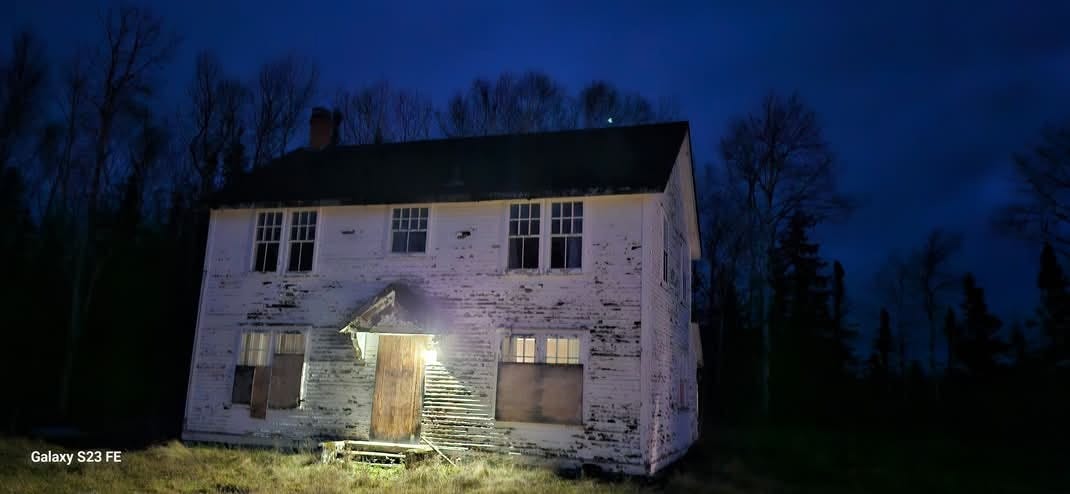
And there, clinging to the hillside about two hundred meters from the dam itself, was the bunkhouse. White paint peeled from the siding, but to Grace’s surprise, all the windows were unbroken. Two windows faced the dam, and in one of them—
Grace’s breath caught.
A light was burning, visible even in daylight, glowing yellow-white in the window like a watchful eye.
Grace parked the car on a flat area and got out slowly. The air was cold and smelled like pine resin and water, and underneath that, something else. Something that reminded her of father’s old garage: oil and machinery.
Grace shouldered her messenger bag and started toward the bunkhouse.
The ground was uneven, covered in dead needles and half-hidden rocks. She nearly twisted her ankle twice. As she got closer to the building, she could see details. The door hung crooked on its hinges. There were gaps in the siding where animals could get in. And graffiti was spray-painted on one wall in faded orange: STAY OUT.
Grace stopped about ten feet from the door. Her pulse was loud in her ears.
“This is stupid,” she said. “Coming out here alone. What if something happens?”
She heard her sensible voice speak then. “Geez, Grace. Get a grip.”
“It’s just a story. That’s all,” she told herself. “An old building with a light still connected to the power grid.”
She took out her phone and snapped several photos. Then she approached the door. It opened before she could touch it. Not violently, but a slow inward swing, the hinges groaning like an old man’s knees.
Grace’s hand went to the pepper spray in her bag.
“Hello? Anyone there?”
Nobody answered. But from inside came a smell of mildew and dust, and something sweeter.
She stepped up to the threshold and looked in.
The interior was a single empty room, except for debris: broken furniture, a lot of beer cans, and a rusted bed frame shoved into one corner. The light came from a bare bulb hanging from the ceiling by a cord. It was the only thing in the room that looked new, or at least maintained. No dust on the bulb. No cobwebs on the cord.
Then in the far corner, near the window—
Grace blinked. For a second, she could have sworn she saw someone sitting there. A woman in a dark dress, her face turned toward the window, hands folded in her lap.
But when Grace looked again, there was nothing but shadows.
“Hello?” Grace called again, her voice smaller than she wanted it to be.
The door swung shut behind her, as if moved by a careful and invisible hand. The latch clicked softly.
Grace whirled, her heart hammering. “Okay. Okay, that’s—” She grabbed the door handle and pulled. It opened easily. She could see her rental car thirty meters away, the reassuring sight of the ordinary world.
“Wind, probably,” she said with a shaky laugh.
She turned back to the room and saw the woman.
This time there was no mistaking it. She sat in the corner by the window, solid as stone. An older woman, sixty or so, wearing a dark dress that looked like something from the 1920s. Her hair was gray and pulled back in a bun. Her face was deeply lined, carved by decades of worry, but her eyes were clear and fixed on Grace with an expression of desperate hope.
“Are you—” the woman started to say.
And then she was gone. Not fading, but instantly gone, like a light switching off.
Grace stood frozen, every nerve in her body screaming to run. But she didn’t run. She’d spent forty-three years learning to function through fear, and she was good at it now. She made herself breathe, and count. Four in, hold four, and four out.
She hadn’t slept well in three days. Too much coffee and too many stories of dead boys swirling in her head.
“That can make you see things that aren’t there,” she said, but there was little confidence in her voice.
Then she remembered her camera. She fumbled her phone out and pulled up the photos she’d just taken. She zoomed in on the one showing the window. And there, barely visible but definitely present, was a shape in the glass. A woman’s silhouette, sitting by the window.
“Holy shit,” Grace whispered. “Holy shit, holy shit, holy—”
Something moved behind her.
She spun and saw nothing, but she felt it: a presence in the room with her. The air temperature dropped so fast that her breath came out in a visible cloud. The light bulb overhead flickered once, twice—
And then something hit her. Not a physical blow. It was like being doused in freezing water. A force passed through her, and for one terrible moment Grace wasn’t herself anymore.
She was Sam.
To be continued…
| Keith M. Leonard © 2026. All rights reserved. |
Comments
Nothing yet. Say the first thing.
Sign in to join the conversation.