
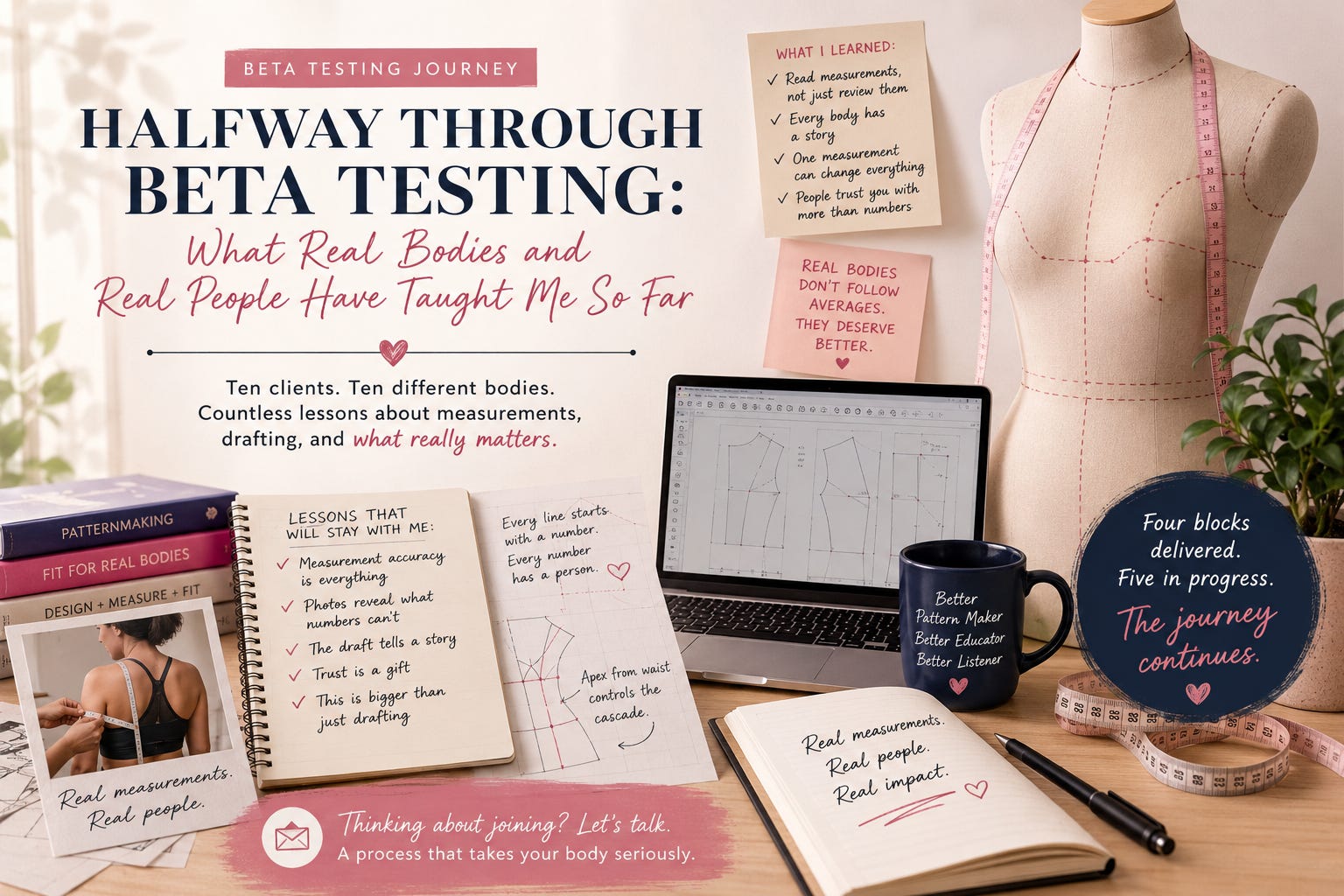
Five months ago I opened 10 spots for beta testing my custom parametric blocks service.
I thought I knew what I was getting into.
I was wrong, in the best possible way.
I’m halfway through now. Four sets of blocks delivered. Five
more in progress. And I’ve learned more from these 10 clients than from any book, course, or drafting system I’ve ever studied.
Here’s what the journey has taught me so far.
I thought beta testing would teach me about drafting.
It taught me about measurements.
I thought the hard part would be building parametric blocks in Seamly2D.
The hard part was getting accurate measurements from people measuring themselves, often alone, sometimes with a well-meaning partner who wasn’t confident, sometimes with a phone propped against a wall.
The most technically precise drafting system in the world is only as accurate as the measurements you feed it.
That’s the lesson I didn’t expect. And it’s changed everything about how I approach this service.
Every body has a story the measurements don’t tell.
One client has evolving scoliosis. Her body shifts slightly every time she looks in the mirror. Standard patterns have never worked for her. They never will. But parametric blocks drafted from her actual asymmetrical measurements, and updated as her body changes, might be the closest thing to a solution she’s ever had.
Another client is short-waisted with a hip level of 4 inches from her waist. I assumed that was wrong. It wasn’t. Her body simply doesn’t follow the standard 7-9 inch assumption and neither do most real bodies.
Another had natural body asymmetry that required me to draft a full front skirt piece and a full back skirt piece separately, instead of the standard half-piece cut on fold. Cutting on fold assumes symmetry. Her body doesn’t have it.
Standard patterns are drafted for a body that exists in a spreadsheet. Real bodies exist in the world, with asymmetries, proportions, and variations that no average can capture.
Before this beta testing phase, I reviewed measurements. Now I read them.
There’s a difference.
Reviewing asks: is this number plausible?
Reading asks: do these numbers together tell a consistent story about the same body?
One client’s measurements revealed five separate discrepancies before I drafted a single line:
A bust point that differed between her chart and her photo
An across shoulder that seemed too wide
A shoulder seam that seemed too long
A back neck height producing impossible geometry
An apex from waist placing the armhole 2 inches too deep
None of these were visible individually. They only appeared when I compared measurements against each other.
Plausible individually doesn’t mean correct collectively.
Another client discovered something I’d already suspected from her photos but hadn’t wanted to raise again: her protruding abdomen was pushing her elastic forward every time she moved, making it impossible for the elastic to sit at her true natural waist. That one observation explained months of measurement inconsistency in a single sentence.
Sometimes the best thing you can do is give a client space to discover what you already suspect. Their own discovery is more powerful than your correction.
The draft itself is evidence.
When a back bodice block looks like a rectangle from shoulder to armhole instead of showing the natural taper of a real body, that’s not just an aesthetic problem. It’s the block telling you the measurements were wrong before you even make a toile.
I’ve learned to read the shape of a draft the way an experienced quilter reads the seam allowance in a photo. Not by measuring. By looking.
Every skill that looks like intuition is actually pattern recognition built from years of looking closely at the same thing.
I’ve also learned that in the Chris Sartorial system, one measurement does more work than any other: the apex from waist. It determines the bust level line. The bust level line determines the armhole depth. The back armhole determines the front armhole. The front armhole determines the side bust dart.
One measurement. A cascade through the entire bodice.
Getting one measurement wrong doesn’t just affect one piece. It ripples through everything connected to it.
This is the part I didn’t expect to write.
I expected to learn about bodies. I didn’t expect to be moved by people.
One client worked on her sizing project while sitting in a hospital waiting room, her husband undergoing a PET scan. She didn’t mention it as an excuse. She mentioned it in passing, in a cheerful note about being productive wherever she found herself.
Another went through multiple rounds of measurements, multiple emails, multiple photos, a husband doing his best without a single complaint. When she finally identified the source of the problem herself, she apologized for holding me up.
She wasn’t holding me up. She was teaching me.
Another client tried three different payment platforms over several weeks before one finally worked. She never lost patience. She never lost interest. She just kept trying.
Another was so concerned about the risks of doing business internationally that she asked me to confirm I was real, to verify my books existed, to reassure her that her payment would be safe. Her caution was completely reasonable. And when she finally paid, she left me my first ever 5-star review, before she’d even received anything.
Trust, once given, is one of the most generous things a person can offer.
Another client’s experience with a payment platform left her worried she’d been scammed, not by me, but by the platform itself. She offered to give up her spot rather than put me through any more difficulty on her behalf. I spent time researching her situation to reassure her that her money wasn’t lost.
She wasn’t putting me through difficulty. She was trusting me to help. That deserved my best effort in return.
The measurement guide is being updated. Again. Based on what real clients discovered when they tried to use it.
Photos are now required, not optional. They’ve caught discrepancies that measurements alone never would have revealed.
I’m considering video measurement sessions. Working through measurements together in real time would catch errors before they become drafting problems, and give clients more confidence in their own numbers.
Payment options have expanded. I now offer Remitly, LemFi, and Gumroad, because what works for one client doesn’t work for another, and payment friction costs momentum.
A system that only works for the easy cases isn’t a system. It’s a starting point.
My belief that foundations matter.
That parametric blocks are worth the effort.
That real bodies deserve better than standard assumptions.
That learning in public, sharing the mistakes, the discrepancies, the back-and-forth, builds more trust than a polished launch ever could.
And that the people who trust you with their bodies, their measurements, their time, and their patience are not just customers.
They’re collaborators. And they deserve your best.
Four blocks delivered. Five in progress.
Every set different. Every client a new lesson.
I’m not done yet. But I’m already a better pattern maker, a better educator, and a better listener than I was when I started.
That’s what beta testing is for.
I still have clients in progress, so the beta phase isn’t officially closed yet.
But if you’ve been thinking about joining and wondering whether this service is right for your body, I hope this post gives you a clearer picture of what it actually involves.
Not just drafting. A process that takes your body seriously.
If you’re interested, reach out via DM (direct message) and let’s talk.
Comments
Nothing yet. Say the first thing.
Sign in to join the conversation.