
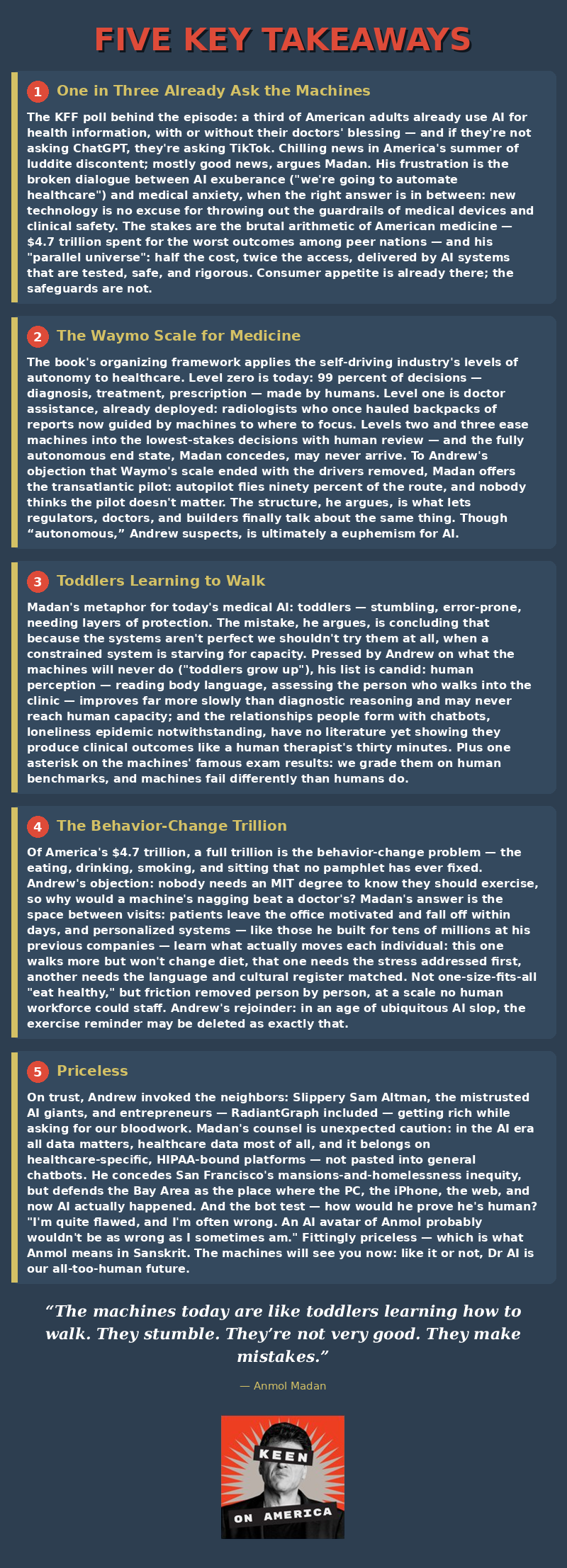
“The machines today are like toddlers learning how to walk. They stumble. They’re not very good. They make mistakes.” — Anmol Madan
One in three American adults are already using AI for health information — with or without their doctors’ permission. The machines, in other words, are already seeing us. This will chill some Americans in our summer of luddite discontent. For others, however, like the San Francisco-based medical tech entrepreneur Anmol Madan, the appearance of doctor AI in our lives is mostly good news.
In his new book, The Machines Will See You Now, Madan lays out what he calls a “human roadmap” to “autonomous health care.” I’m not entirely sure what he means by “human” in a Blade Runner-style world where machine and man are quickly merging. But by “autonomous,” which I suspect is a euphemism, Madan means artificial intelligence.
What worries Madan about our current moment is the broken dialogue over AI. On the one hand, we have tech utopians promising a totally automated healthcare industry. Then we have an anxious establishment struggling to change America’s archaic and often dysfunctional medical system. And, of course, American consumers (if that’s the right word) who are already using ChatGPT or, more troublingly, TikTok, as their doctor.
America spends $4.7 trillion on a healthcare industry which compares poorly with the medical systems of other wealthy countries. Madan’s “parallel universe,” he promises, would cost half as much and double access. The machines will see you now. Like it or not, Dr AI is our all-too-human future.
Comments
Nothing yet. Say the first thing.
Sign in to join the conversation.