
I want to talk today about Paul Schrader and his uncanny yet methodical approach to writing screenplays. To the uninitiated, Paul Schrader is a legendary screenwriter and director who wrote Taxi Driver, Raging Bull, The Card Counter and is co-credited for The Last Temptation of Christ. He’s also directed American Gigolo, Mishima and very recently Oh, Canada and First Reformed.
The reason I’ve chosen him in particular is because he self-learnt screenwriting. And especially despises books on screenwriting. The whole 3-act structure and its ilk. So, if I’m self-learning screenwriting, it pays dividends to borrow from someone who was in my shoes 50 or so years ago.
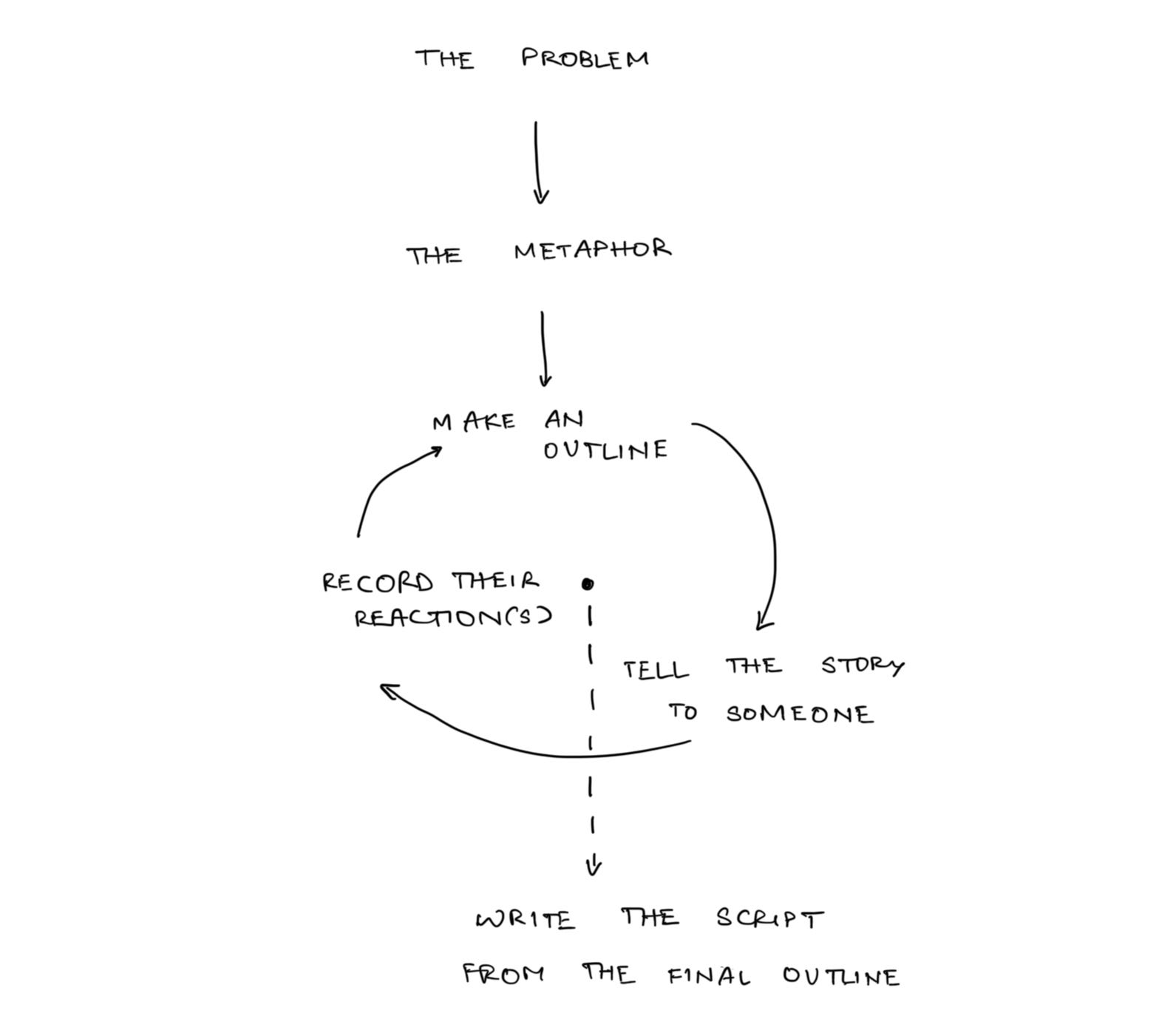
The whole thing is captured in painful brevity below.
Screenwriting is a dirty laundry business. No one is interested in your clean linens.
- Paul Schrader
The kernel of a great screenplay is the Problem. And that’s gotta start with the screenwriter. What are your burning problems? What keeps you up at night? The screenwriter must make the world their audience and paint their most intimate problems. Art is functional. It’s not just for aesthetics. There is utility in it by endeavouring to do it. Using the screenplay as a method to address and write about your problems gives you an outlet for them. For Schrader, to understand art, to do art, you must begin with yourself. *You are the raw material*.
This method is even used by other greats without them explicitly acknowledging it so. Take Alfonso Cuarón for instance. He worked on an arthouse personal project before Gravity and it fell apart. No financing whatsoever. He found himself broke then. Adrift. Out of place. In an interview, he said, “I just feel I have to go through all this stuff … I just want to put my feet back on the Earth”. Then he took that feeling and it gave us Gravity. His problem was being adrift. The metaphor he used was that of an astronaut being lost in space.
It’s two wires. The problem and the metaphor. And they have to get close enough for a spark to jump across. And if they’re too far apart, there’ll be no spark. And if they’re on top of each other, there’s no spark.
- Paul Schrader
With a problem in mind, Schrader looks for metaphors. Not stories. This I think is the key difference. Most writers with a problem or a conflict in mind would try and wrap that within a story. Here, Schrader goes in another direction. Instead of looking for plots, characters and structure, look for metaphors. The story blossoms when you define the right metaphor. And this metaphor makes or breaks the story.
The best example is Taxi Driver, the metaphor for loneliness is this taxicab. You’re surrounded by people but end up completely alone. Travis Bickle is the stand-in for Schader in his life at that time. A lone man wading through the sludge of the city.
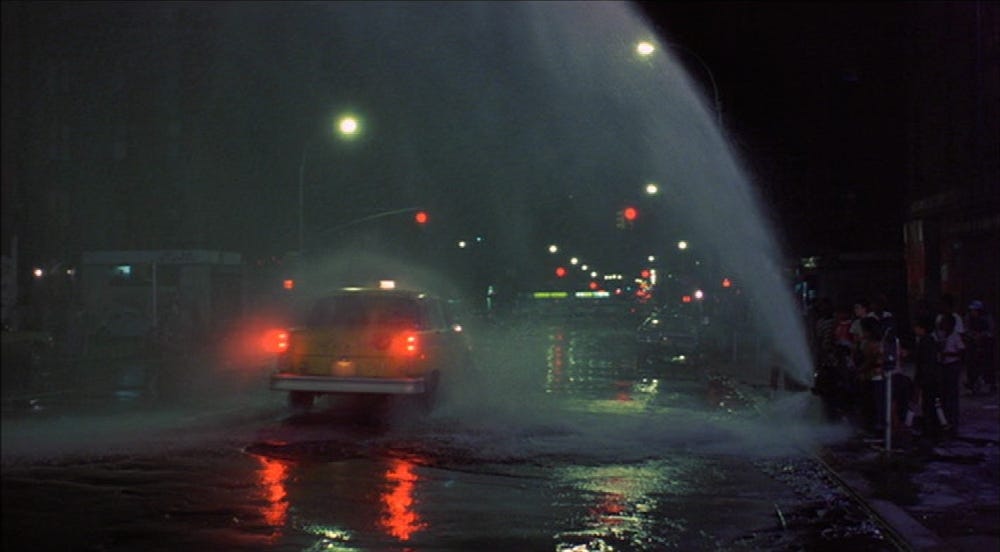
Writing the screenplay exorcised the problem for Schrader. Defining the metaphor became the outlet. Once again, *you are the raw material*.
Another great example is District 9, Neil Bloomkamp’s debut film. It’s a sci-fi movie about a sickly bunch of aliens that are confined to live in slums. The aliens are mistreated and looked down upon by the humans. Bloomkamp, a South African, didn’t just come up with this story out of thin air. He based it on his experience living in an apartheid-ridden South Africa. His problem was xenophobia. His metaphor was alien segregation.
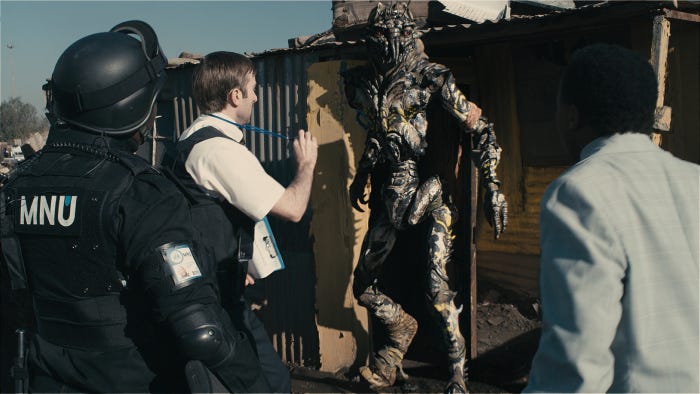
All the greats have metaphors. Frankenstein, Heart of Darkness, Gravity, Jurassic Park, etc. But the metaphor is what the audience sees. They don’t see the problem. They don’t hear the problem. No one says the problem outright. That would break the spell. The wires cannot touch.
So the lesson here is to look for metaphors rather than look for plots.
Stories should not be written. They should be told.
- Paul Schrader
In the BAFTA series, he makes the distinction above. His philosophy is that of oral tradition. The story is born in your mind but is made in your words. So buy a friend some coffee, and sit down with them. Tell them the story you are planning out. Make it different each time. Get a feel for it. Try out something exotic. Throw a turn in there. Make it up as you go along. Get your heart racing. The oral tradition is something we’ve had for centuries. But with literature, it's taken a back seat. Cinema and screenwriting is a revival of that tradition in a new medium. After all, the screenplay isn’t meant to be read, it's meant to be told. To be seen.
You should be able to tell a story and come to a certain junction. Then get up go to the bathroom, come back, and start a new conversation. If then, they don’t ask you what happened to that story. You know you’re in trouble.
- Paul Schrader
Now after you tell that someone your story, you gotta see how they react. Are they engrossed? Are they bored? Are they paying attention to the details? If you left and came back, would they ask about it? These are questions you must answer to get to one of 2 outcomes.
They’re bored of it and the story has no scope. Well, yay, you’ve saved yourself months of writing pains.
They like it and you keep refining until you’ve got no more add. WELLLL, YAYYYY, you’ve got yourself something somewhat ready to be a script.
Now what exists between the script and the oral tradition is the outline. This is something else special that Schrader does.
What is the outline ?
The outline is a list of “keyframes” of your story. These “keyframes” are major moments or defining points in the story. There are no story-agnostic criteria for keyframes. You have to define them yourself.
The whole point of telling the story to people is to get a feel for it. To understand where it wants to go. The outline keeps track of that. After you tell the story to someone and you understand the direction, you gotta make the outline. And then tell the story again to someone else. And repeat this process again and again.
Once you’ve got a final outline, you’ve gotta flush it out into a script. Once again, Schrader has something unique that he does here. For every part of the outline, he will note how many pages it will take and the page no. in the final script it should end on. Here’s an outline of The Last Temptation of Christ. You can see in the column on the side, he’s got the page count for the keyframe and a cumulative page count for the whole script.
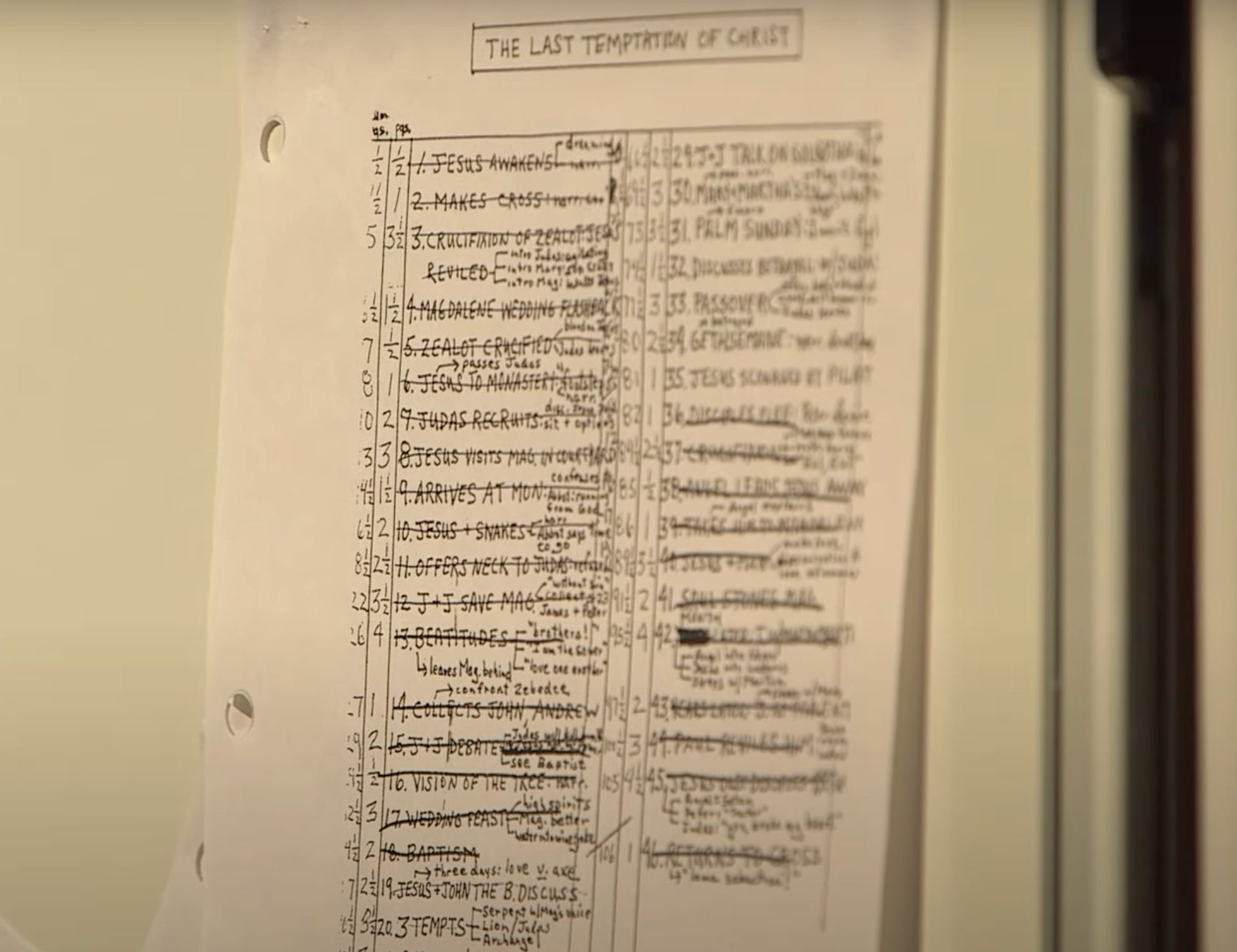
Just like how long-distance runners look at mile markers or assign places as mental markers, Schrader assigns mile markers in his script. In his words, he would rather have a 70-page script that needs to go to 100 than have a 150-page script that needs to go to 100. So he paces himself using the outline as a benchmark. If he goes over, he’d need to find out what’s going on.
I will say though, that he makes no remark on how he does dialogue or character structure so we’ll have to try and fail at that ourselves. But this outline itself is already the skeleton of the script that originated from you. The rest of it is salad dressing.
Cinema does not owe anything to literature. Or to drama. Or painting. Cinema is way more similar to music. It's an art that flows in time, that is also an abstract language, that flows with themes.
- Alfonso Cuarón
Like Cuarón and Schrader, I’ve come to understand that cinema is closer to the oral tradition than it is to literature. Unlike books or paintings where you can get absorbed into a world that makes no ask of time. Cinema and music are stories with temporality. You can’t write a screenplay to be read, it has to be seen.
I’ve learned an immeasurable amount from these two and even though every writer has to cultivate their own style, we can surely borrow from one another. The Metaphor and The Outline are going to be the springboard for many more screenplays I write.
Taxi Driver
Raging Bull
American Gigolo
First Reformed
District 9
Gravity
Roma
10 Screenwriting Tips from Paul Schrader - Writer of Taxi Driver
I made a commitment to post every month. I’m currently behind on March, April and May. So this entry is for March, although I’m writing it now in June. I have been hideously behind my publishing schedule and I plan and doing copious amounts of writing this summer to catch up. Ideas floating around in my head but creativity needs a deadline.
Comments
Nothing yet. Say the first thing.
Sign in to join the conversation.