
I’m once again trying to figure out what’s going on in Lewis’s Desire as Belief papers (One, Two). The problem is that every time I look, I find another thing to be more perplexing.
In the second paper, Lewis notes that the theory of value he attributes to the anti-Humean is rather different from the theory of decision he’d defended in Causal Decision Theory. Here is the defence:
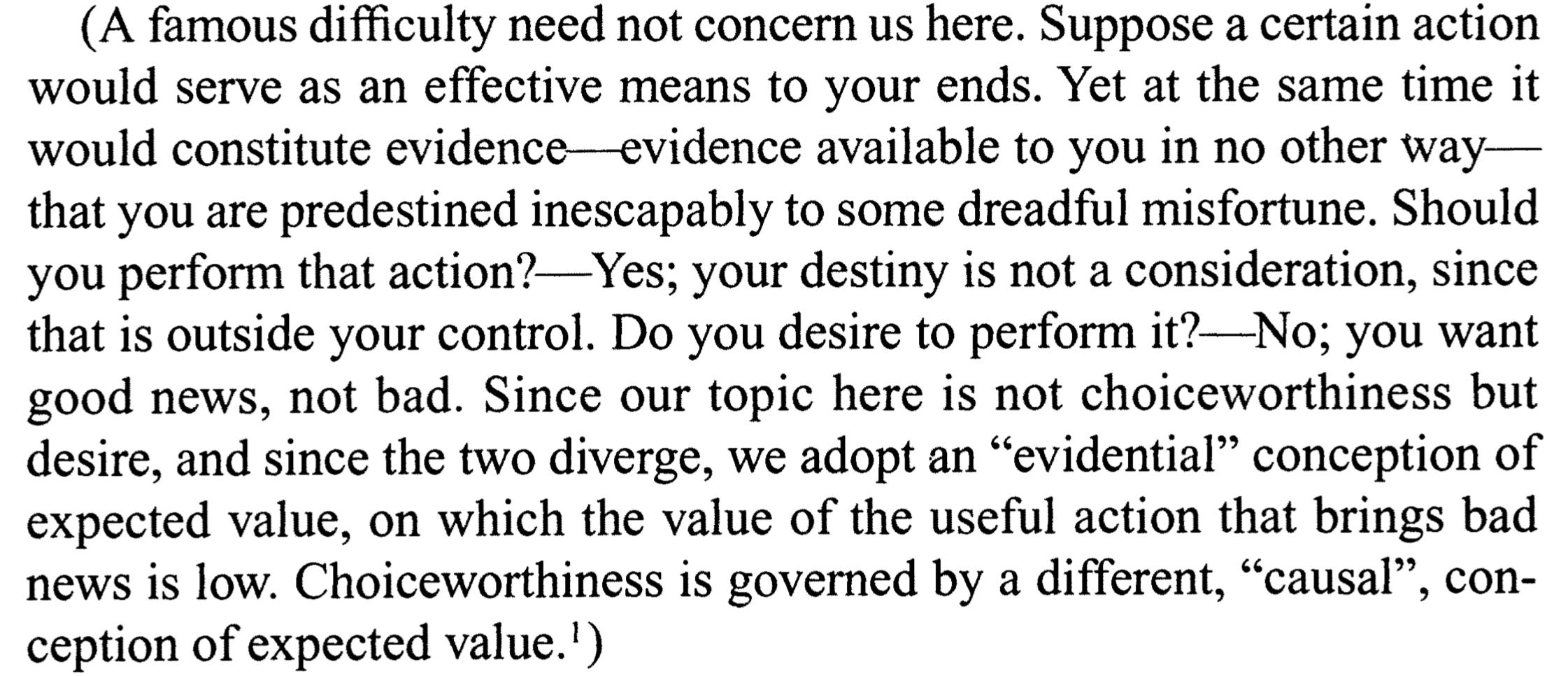
This is a very strange view. To understand it, it helps to have a variant on Newcomb’s Problem. Rosencrantz is about to play Newcomb’s Problem—the demon has already made the prediction—and Guildenstern wants what is best for Rosencrantz. As I read him, Lewis is committed to the following claims. If everyone is rational then,
Rosencrantz takes two boxes.
Guildenstern desires that Rosencrantz takes one box.
Rosencrantz desires that Rosencrantz takes one box.
I’m a causal decision theorist, of a kind, so I endorse 1.
I can sort of see the case for 2. After all, Guildenstern wants Rosencrantz to be rich, and taking one box means that Rosencrantz will be rich.
But there is a case against as well. Guildenstern wants Rosencrantz to get as much money as possible. Whatever the demon has predicted, Rosencrantz will get more money by taking two boxes than taking one. So Guildenstern hopes Rosencrantz will take two boxes and get more money. That argument feels more or less as convincing to me as the dominance argument for Rosencrantz taking two boxes, and I’m not 100% sure why Lewis thinks the argument for Rosencrantz taking two boxes works, and this argument for Guildenstern hoping he takes two boxes fails.
But set that aside, because claim 3 here is the really weird one, and one I don’t think is consistent with the rest of what Lewis says about belief and desire.
Think about Rosencrantz, about to make his decision. According to Lewis, he desires that he choose one box. Moreover, he knows that by saying “one”, he can choose one box. But yet he should not, he cannot if he is rational, say “one”. This looks like perfectly rational Rosencrantz violates a fairly basic principle of means-end rationality.
Well, maybe Lewis is happy to give up the connection between desire and action that I’ve been presupposing (and calling a ‘basic principle’). Except no, he’s clearly committed to that as well. Go back to the example that starts the first of the Desire as Belief papers.
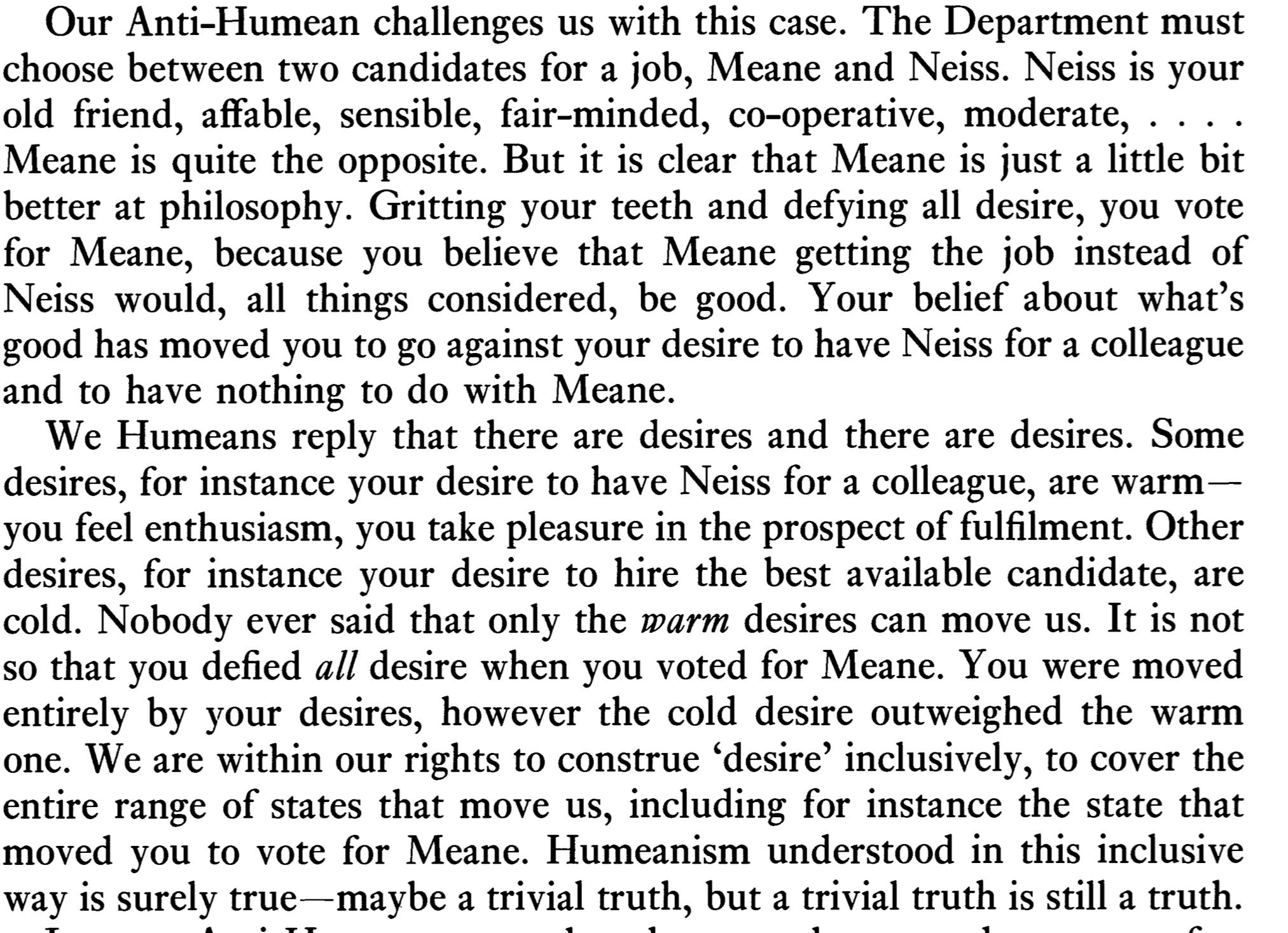
When rational Rosencrantz chooses two boxes, Lewis’s Humeanism implies that Rosencrantz must have had a desire to say “two” rather than “one”.
So I think Lewis has written himself into a corner here. He is committed to:
CDT is the right measure of choice-worthiness.
EDT is the right measure of desirability.
Choices are the results of beliefs and desires interacting in a familiar way.
But you can’t have all three.
I’ve gone via the case of Guildenstern because I think that’s part of the motivation; he wants the result that friends can, in some sense, hope that you take one box. But the way he’s got that has led to the result that Rosencrantz’s own actions are not related to his beliefs and desires in a Humean way.
Ultimately, I think the formalism here is too constraining for what Lewis wants. The following combination of views seems coherent to me (even if I don’t think they are all true). If Rosencrantz is rational then:
He takes both boxes, because that will get an extra $1000.
He desires to take both boxes, because that will get an extra $1000.
He desires that the world is such that he takes one box, because then he’ll be a millionaire not a thousandaire.
If we distinguish desire claims with an infinitival complement from desire claims with a propositional complement, we can make sense of all this. But Lewis thinks that desires are all propositional attitudes, so he doesn’t have the space to distinguish 2 and 3.
No posts
Comments
Nothing yet. Say the first thing.
Sign in to join the conversation.