
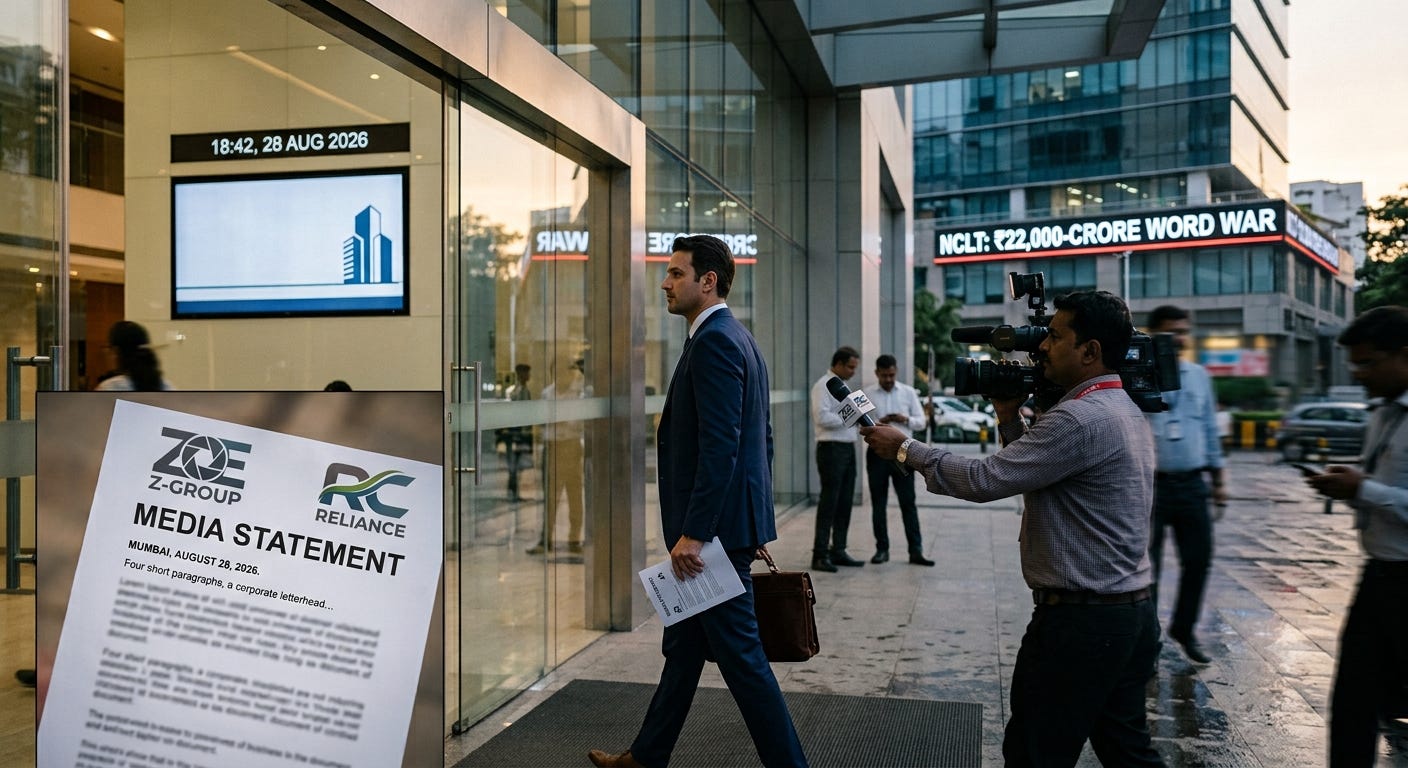
Reliance’s one-page reply to Zee’s founder, issued 28 August 2026, is the shortest document in this story. What led to it isn’t.
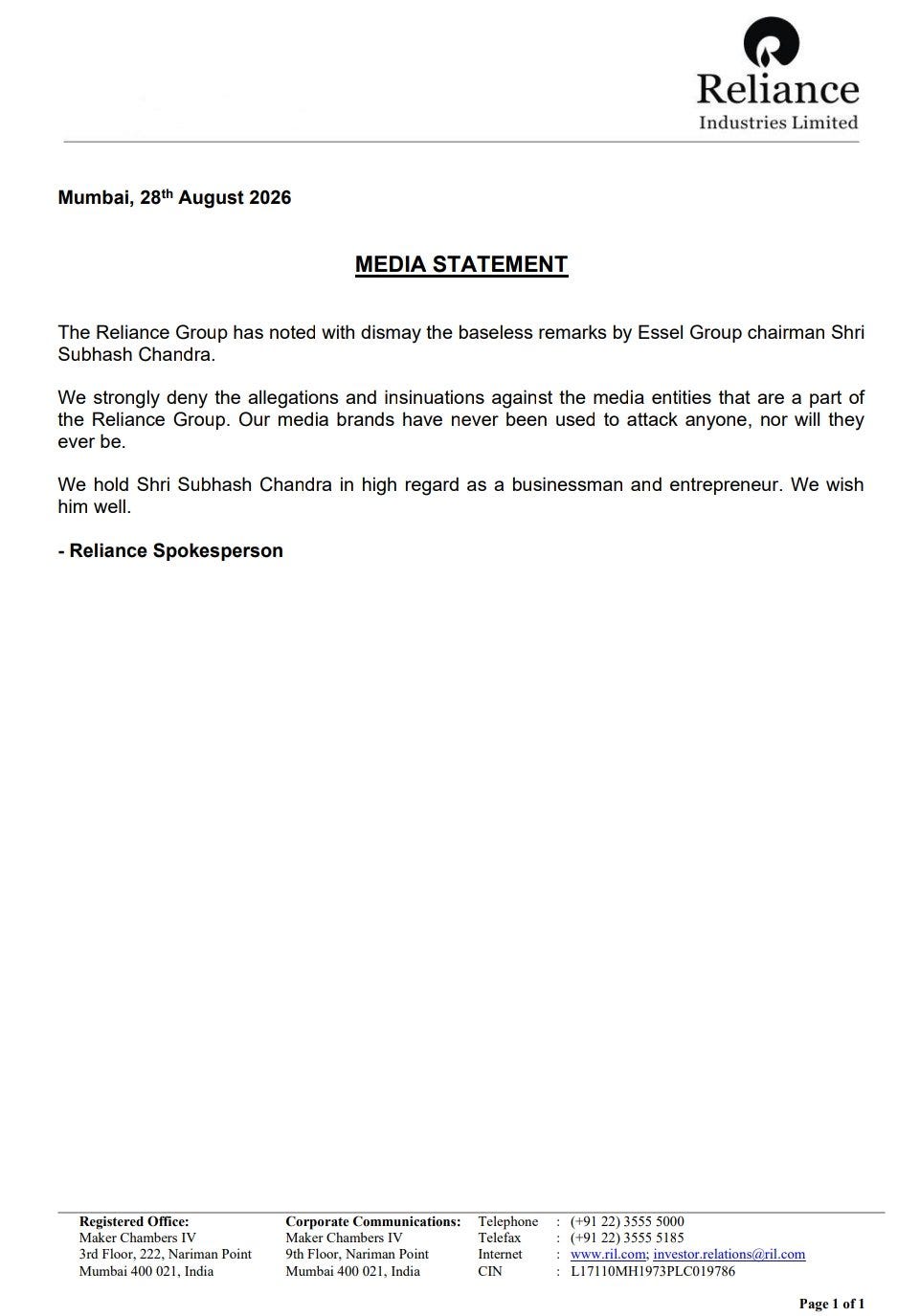
Mumbai, 28 August 2026. Four short paragraphs, a corporate letterhead, and a closing line better suited to a condolence card than a rebuttal: an expression of high regard for Subhash Chandra as a businessman and entrepreneur, and a wish that he do well. That is how Reliance Industries chose to end a statement headed, in plain block capitals, MEDIA STATEMENT, and opened, two paragraphs earlier, by expressing dismay.
In between sits a flat denial: Reliance’s media entities, the statement says, “have never been used to attack anyone, nor will they ever be.” It does not name Chandra’s specific allegations or reproduce what he actually said. It is, instead, a rejection, filed the same day with the BSE and the NSE, of remarks the statement dismisses as unfounded.
To understand why India’s largest private company felt the need to issue a formal, exchange-filed denial to a 76-year-old media baron nursing what is left of his television empire, you have to walk back three days, and through a number that has been doing most of the damage: ₹22,006.57 crore.
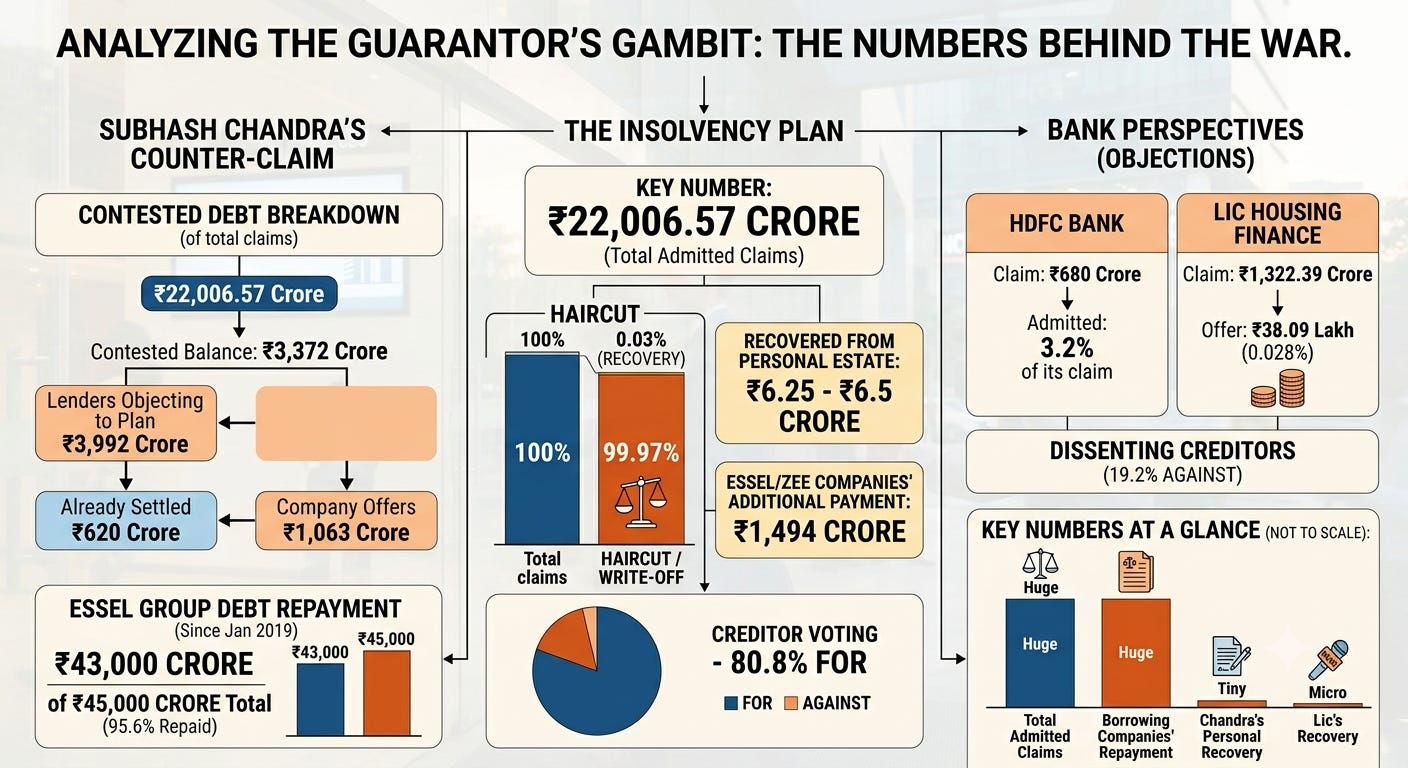
On Wednesday, 26 August, the Delhi bench of the National Company Law Tribunal approved a repayment plan in Subhash Chandra’s personal-insolvency proceedings. The bench itself had been unable to agree. Two members split, and a third, Judicial Member Nilesh Sharma, was brought in to break the tie. He came down in Chandra’s favour, rejected the objections of dissenting creditors, and cleared a plan under which Chandra would pay, against admitted claims of ₹22,006.57 crore, ₹6.25 crore to creditors plus a further ₹25 lakh toward the costs of the insolvency process itself, a combined ₹6.5 crore, which is why the figure turns up as one number or the other depending on which part of the payout a given outlet is quoting. Do the division either way, and the recovery works out to roughly 0.03 per cent: a haircut, in the industry’s own bloodless idiom, of 99.97 per cent. Separately, and this detail tends to get lost in the headline number, the Essel/Zee-linked companies for whom Chandra had stood as guarantor were assessed to pay a further ₹1,494 crore of their own. The plan cleared with 80.8 per cent of creditors, by voting share, in favour.
Numbers like that do not stay contained in a tribunal order. By Thursday they were on every business channel, generally compressed into a single, arithmetically tidy but substantively contested line: Subhash Chandra had settled a ₹22,000-crore debt for ₹6.5 crore.
The first formal pushback came not from Chandra but from his creditors. HDFC Bank said on Thursday that it had voted against the plan and was exploring an appeal to the National Company Law Appellate Tribunal, noting that only 3.2 per cent of its ₹680-crore claim had been admitted in the process. LIC Housing Finance went further, calling the settlement terms “unviable and unlawful” and pointing out that against its own admitted claim of ₹1,322.39 crore, the plan offered it precisely ₹38.09 lakh, about 0.028 per cent of what it was owed. LIC Housing said it would also explore intervention through the National Housing Bank. Both lenders’ objections turn on the same underlying grievance: that the plan treats a corporate guarantor’s collapse as though the guarantee had simply evaporated, rather than as a liability that a group owing tens of thousands of crores ought still to be answering for.
The case itself began with a single, comparatively modest default: Vivek Infracon, an Essel-linked company, failed to repay a ₹170-crore loan from the then Indiabulls Housing Finance, for which Chandra had stood personal guarantor. That one default was enough to open personal-insolvency proceedings against him, at which point every other lender holding a Chandra guarantee filed its own claim, and the number climbed from ₹170 crore to ₹22,006.57 crore within the same process. What started as one lender’s petition has become, after years of litigation, a test of how India’s personal-guarantor insolvency framework treats the promoters of failed conglomerates.
Chandra did not wait long. In a video statement aired on Zee News, and a formal press release put out through his office on Friday (the same day, as it turned out, that Reliance issued its own), he rejected the ₹22,000-crore framing point by point, in a register closer to open letter than legal brief.
He addressed Mukesh Ambani directly, invoking the memory of Ambani’s father in the same breath: he said he had learned composure from watching Dhirubhai Ambani, and that unlike Mukesh, he had “nothing to lose.” He said he had telephoned Ambani and, getting no response, written to him; he accused Ambani’s network of running a campaign against him, and specifically named CNBC-TV18 (a channel that sits, via Network18, inside the Reliance media stable) as the source of the ₹22,000-crore figure he says has been misreported as a personal loan rather than a personal guarantee. He also laid blame on an unnamed Congress MP for amplifying the number for political ends, while insisting he had sought no favour from the government. Chandra himself currently holds no political office. He represented Haryana in the Rajya Sabha from 2 August 2016 to 1 August 2022, not as a BJP member but as an independent candidate backed by BJP legislators in the state assembly, and lost a further bid, again as a BJP-backed independent, from Rajasthan later that same year.
Stripped of the theatre, his factual claim is narrower and more checkable than the headline suggests. Chandra says he never personally borrowed a rupee from any of the objecting lenders; his exposure arose entirely from personal guarantees extended for loans taken by Essel Group companies. Of the roughly ₹22,000 crore in admitted claims, he says only ₹3,992 crore is being pursued by the lenders who objected to his plan, of which ₹620 crore has already been settled and a further ₹1,063 crore has been offered by the borrowing companies themselves, leaving a genuinely contested balance of about ₹3,372 crore. He also points to the borrowing companies’ own repayment record: against roughly ₹45,000 crore in outstanding debt as of January 2019, he says, they have since repaid close to ₹43,000 crore.
None of that makes the ₹22,000-crore figure a fabrication: it is the tribunal’s own admitted-claims total, and it appears in the order Chandra is disputing. What it does is separate two different questions that television debate tends to collapse into one: how much did the companies owe, and how much can be recovered from Chandra personally, as a guarantor of last resort with, on his own account, almost nothing left. Those are not the same number, and conflating them is where his complaint about inaccurate coverage has some real purchase, even if the underlying scale of the group’s default is not in doubt.
A personal guarantee, in the bank’s paperwork, is a promise that creates no wealth of its own. It simply stands behind someone else’s borrowing, worth nothing until the day the borrowing fails and the guarantor is called upon to make good on a promise he can no longer keep. In the same week, Indian television has been carrying a second promise, just as untested: an assurance, from a network owned by the man being accused, that its channels have never once been turned against a rival. Both promises ask to be taken on faith until called in. Neither, this week, quite was.
Chandra’s office also moved to knock down a more technical allegation: that some of the companies which voted in favour of the repayment plan were affiliated with the Essel Group, and should therefore not have been allowed to vote as independent creditors. His office’s response was specific rather than rhetorical: it said the entities in question had belonged to his brother, Jawahar Goel, whose business interests were separated from Subhash Chandra’s in 2008-09 through a family arrangement disclosed at the time to the stock exchanges and the regulator, and that under the Insolvency and Bankruptcy Code’s own definition of an “associate entity,” companies separated that long ago do not qualify. It is the kind of defence that is either straightforwardly true or straightforwardly checkable against sixteen-year-old exchange filings. Tellingly, it is the one part of Chandra’s Friday statement that nobody on the other side has yet tried to contest.
Readers who assumed the NCLT’s writ runs only over companies and LLPs have a reasonable excuse: for the Code’s first three years, it did. The Insolvency and Bankruptcy Code arrived in 2016 with Part II, the corporate insolvency and liquidation machinery everyone knows. Part III, covering individuals and partnership firms, sat mostly unused. The Code splits individuals into three classes for a staggered rollout: personal guarantors to corporate debtors, partnership and proprietorship firms, and everyone else. To date only the first class has actually been switched on, by a notification dated 15 November 2019 that fixed 1 December 2019 as the date personal-guarantor provisions would take effect. The wider individual-insolvency regime, the one meant eventually to reach ordinary people and small firms, remains dormant seven years on.
What was switched on, though, is not cosmetic. Section 60 of the Code sends a personal guarantor’s insolvency case to the same NCLT bench handling the underlying company’s insolvency, with appeals running to the NCLAT exactly as they would from a corporate order, which is why HDFC Bank and LIC Housing Finance are headed to the same appellate forum a liquidating company would use. The process itself, an interim moratorium, a resolution professional’s report on the guarantor’s affairs, a repayment plan put to a creditor vote, converts, if the plan fails or isn’t proposed, into a bankruptcy order under which the guarantor’s own estate, not the company’s, vests in a trustee for distribution to creditors, short of a narrow list of protected assets. It is built, in other words, to reach a natural person’s pocket even after the corporate pocket he once guaranteed has nothing left in it.
Two Supreme Court rulings mark the edges of that reach, and both bear directly on this case. Lalit Kumar Jain v. Union of India (2021) upheld the 2019 notification and held that approval of a resolution plan for the corporate debtor does not automatically discharge its guarantor: the guarantee is a separate obligation, surviving the company’s own settlement. That is the legal basis on which LIC Housing Finance can correctly say Chandra’s personal plan leaves the underlying corporate liabilities and security untouched. Dilip B. Jiwrajka v. Union of India, decided on 9 November 2023, went the other way down the same road: it upheld the guarantor-insolvency process itself against a due-process challenge from more than two hundred guarantors, Anil Ambani among them, who argued they were entitled to be heard before a resolution professional was even appointed. The Court disagreed, in a ruling widely read as holding that the Code exists to protect the debt rather than the debtor.
That framing found an unlikely champion this week in Vijay Mallya, the fugitive former liquor baron whose Kingfisher Airlines guarantees have made him India’s most recognisable debt defaulter. Reacting to the order on X, Mallya congratulated Chandra directly, noting that the government has told Parliament that roughly ₹14,100 crore has already been recovered from him against a judgment debt of ₹6,203 crore, and signing off with “no media questions.” The comparison is pointed rather than idle. Mallya’s recoveries have come almost entirely through the Fugitive Economic Offenders Act and enforcement-directorate confiscation, a criminal and punitive track triggered by his declared-offender status, and one that did not exist in its current form when he left India in 2016. Chandra’s ₹22,000 crore is being resolved entirely inside the civil track this section has just described: no criminal declaration, no confiscation, a tribunal-sanctioned settlement, and a rival conglomerate publicly wishing him well. Two guarantors, comparably steep shortfalls, two different arms of the state deciding how each gets treated: that is the double standard Mallya says he is pointing at.
Which brings the argument back to where HDFC Bank and LIC Housing Finance will actually have to fight it on appeal. The question is not whether the Code reaches a personal guarantor’s own assets: Lalit Kumar Jain settles that it does, and the bankruptcy fallback built into the process exists for no other purpose. The real question is whether ₹6.5 crore reflects what Chandra’s assets, and his disclosed net worth, actually are. Every stage of the process described above, the resolution professional’s report on the guarantor’s affairs, the tribunal’s assessment of the creditor vote, the bankruptcy route that opens if a plan fails, assumes an accurate account of what a guarantor personally owns. Whether that account was accurate in Chandra’s case is the same question this piece raises again below, in the gap between his ₹39.08-crore parliamentary declaration and the ₹45,888-crore net worth a bank once certified. It has simply moved from being a complaint about media coverage to being the actual ground on which two of India’s largest lenders now intend to fight.
The Reliance statement is more notable for what it declines to say than for what it says. It does not reproduce Chandra’s allegations, does not name CNBC-TV18, and does not engage with the ₹22,000-crore arithmetic at all. It denies the insinuation that Reliance’s media brands were turned against him, without addressing the coverage that provoked the insinuation in the first place. That is not necessarily evasive; it may simply be that Reliance’s lawyers judged the narrower ground the safer one to defend. But it does mean the statement settles nothing about whether CNBC-TV18’s reporting on the NCLT order was fair, sloppy, or somewhere in between. That is a question Reliance was uniquely placed to answer, and chose not to.
The restraint of the closing line, the expressed regard for Chandra as a businessman, the wish that he do well, is its own small tell. This is not the language companies use for strangers. Reliance and the Chandra family have a decade of tangled history behind them: in February-March 2021, Invesco (then ZEEL’s largest shareholder, and at war with the Chandra family over governance) brokered direct talks between Reliance’s representatives and Chandra’s son, Punit Goenka, then Zee’s managing director, for what Reliance itself later described as “a broad proposal for merger of our media properties with Zee at fair valuations.” That proposal was dropped by October 2021, with Reliance publicly denying any wish to dislodge the Chandra family from Zee’s management. Zee instead pursued a merger with Sony’s Indian arm, a deal that collapsed in acrimony in early 2024. Whatever Chandra means, three years later, by his fresh charge that Ambani once tried to take over Zee, it is not an allegation invented from nothing; it is a real, documented episode being reheated for a new argument.
It also fits a pattern that is entirely Chandra’s own. In 2024, when the Sony-Zee merger fell apart, he accused then-SEBI chairperson Madhabi Puri Buch, by name, of corruption and personal vindictiveness, and of scuttling the deal single-handedly; SEBI never accepted the charge, and it was never independently established. The through-line across both episodes is consistent: a business reversal, followed by a named, public accusation against whichever individual or institution Chandra holds responsible, delivered with theatrical flourish rather than documentary proof. That does not make either allegation false. It does mean readers of this week’s letter to Ambani would do well to remember that Chandra has run this play before.
Equally, Reliance is not a passive bystander with clean hands to spare. Its media footprint has grown enormous precisely in the years this rivalry has simmered, and a company that size does not get to plead innocence by press release alone when a rival accuses it of using its channels as a weapon. The denial may well be true. It is also, inescapably, self-interested, which is precisely why Reliance chose to make it through lawyers and a stock-exchange filing rather than through the very channels being accused.
Step back from the letter and the rebuttal, and the more durable story here has little to do with either man personally. It is about who owns the room in which such letters get read out.
Reliance’s media holdings did not begin with this week’s headlines. In 2014, the company took effective control of Network18 for roughly ₹4,000 crore, absorbing what was then one of India’s larger independent news operations and, with it, the stable that would come to house CNBC-TV18. A decade on, that position has multiplied several times over. In November 2024, Reliance’s entertainment arm, Viacom18, merged with Disney’s Star India in an $8.5-billion deal that created a single entity, JioStar, in which Reliance holds an effective 63 per cent. JioStar now runs more than a hundred television channels, the JioHotstar streaming platform, and the broadcast rights to the Indian Premier League and most marquee international cricket, alongside Network18’s own news operation, CNBC-TV18 among them.
Chandra is not the only Indian media promoter to have watched a rival conglomerate become his channel’s owner, or near-owner. Gautam Adani’s group took a controlling stake of nearly 65 per cent in New Delhi Television in December 2022, placing one of the country’s more recognised independent news brands under an industrial house with regulatory dependencies of its own. India has no cross-media ownership law of the kind France or Germany use to cap how much of a market a single owner may hold: France limits a proprietor to 30 per cent of national newspaper circulation, and Germany caps any one company’s television audience share at 30 per cent. Competition law, on the two occasions it has been asked to examine Reliance’s media consolidation, cleared both: the 2014 Network18 takeover and the 2024 JioStar merger.
None of this proves Reliance’s channels covered Chandra’s case unfairly, and its denial that they were turned against him may be entirely accurate. But it does explain why the dispute was always going to land somewhere odd: a ₹22,000-crore personal guarantee, argued partly before a tribunal and partly on channels a share of which belong to one of the two men doing the arguing.
Chandra’s arithmetic, however carefully laid out, has not gone unchallenged by people with no stake in either side of this fight. Ashvin Parekh, managing partner of Ashvin Parekh Advisory Services, told CNBC-TV18 that reframing the dispute as a ₹3,992-crore matter does not make the underlying ₹22,000-crore loss disappear: “there is still loss to be accounted for,” in his words. He separately faulted the lending banks for having failed, over years, to track how far the value behind those guarantees had eroded. Anoop Rawat, who heads restructuring and insolvency at Shardul Amarchand Mangaldas, raised a distinct concern, not about Chandra’s numbers but about how the tribunal itself arrived at its decision in a case this contested.
Rawat’s question already has an answer on record, and it complicates both sides of the argument. The tribunal was explicit that it had not ruled on whether ₹6.5 crore was a fair price for ₹22,006 crore of claims. Its job, as it framed the question, was narrower: whether creditors had validly approved the plan by the majority the law requires, and whether the tribunal had sufficient statutory ground to override that vote. Letting dissenting lenders chase their full original claims outside the approved plan, the bench reasoned, would defeat the Code’s collective scheme and treat similarly placed creditors unequally. It also reasoned, in the alternative, that pushing Chandra into full personal bankruptcy might recover even less for creditors than the negotiated plan does: a debtor with next to nothing to seize yields little more in liquidation than in a settlement. Whether that reasoning survives is exactly what HDFC Bank and LIC Housing Finance intend to test at the NCLAT. The tribunal’s actual finding is narrower than the headline number suggests: not that ₹6.5 crore was enough, only that the law gave it no clear basis to say it wasn’t.
And there is one discrepancy in Chandra’s own account that his Friday statement did not resolve, and that deserves more scrutiny than the ₹22,000-crore headline it was meant to displace. In his 2016 disclosure to the Rajya Sabha, Chandra declared total assets of ₹39.08 crore. A year later, in 2017, a bank is reported to have accepted a personal net-worth certificate valuing him at ₹45,888 crore, good enough to extend credit against his guarantee. Chandra’s own statement this week cites the first figure to attack the credibility of the second, but a gap of that size, arising within a single year, between a sworn parliamentary declaration and a document that satisfied a lender’s due diligence, is not a media distortion. It is a question about how India’s banks price the guarantees of the promoters they lend against, and it will outlast this week’s press statements whichever way the NCLAT rules.
None of what has been exchanged this week (Chandra’s letter, Reliance’s denial, the competing notes about associate entities and asset declarations) resolves the case. That will happen, if it happens at all, before the NCLAT, where HDFC Bank and LIC Housing Finance are headed with objections that go to the plan’s viability rather than its optics. Nor does anything said this week explain how a bank came to certify a net worth forty times its later parliamentary disclosure, or whether the ₹1,494 crore the borrowing companies are supposed to pay, and the further ₹1,063 crore Chandra says they have offered, will actually reach the lenders’ accounts rather than joining the long list of Indian insolvency promises made on paper and settled, if at all, in instalments over years.
What this week has produced, instead, is a template for how two of India’s most recognisable business names now choose to fight: not in a courtroom filing first, but in a press statement, aimed less at the tribunal than at the television audience the tribunal’s order was already dominating. Subhash Chandra, who built an empire on being able to put his own case directly to camera, used that instinct one more time, only this time the camera belonged, in significant part, to the man he was accusing. Reliance answered in kind, on its own letterhead, in four paragraphs that managed to deny everything and concede nothing. Between them sits a genuine and unresolved question about guarantees, about valuations, about who still owes what to whom, temporarily buried under the more satisfying spectacle of two very rich men addressing each other by first name. It will resurface. NCLAT appeals take their time; the numbers, in the meantime, are not going anywhere.
This piece reviews and analyses publicly available tribunal orders, statements, and news reporting concerning ongoing insolvency proceedings and public remarks made by both parties. It does not allege, state, or imply wrongdoing, illegality, dishonesty, or bad faith on the part of Reliance Industries Limited, Dr Subhash Chandra, Mukesh Ambani, or any individual, company, or institution named in it. Claims and counter-claims described here are attributed to the parties or the reports that carried them, remain contested, and should be read as such. Figures relating to admitted claims, settlement amounts, and asset valuations are drawn from tribunal orders and public reporting available at the time of writing and remain subject to the outcome of the pending NCLAT appeals.
Comments
Nothing yet. Say the first thing.
Sign in to join the conversation.