
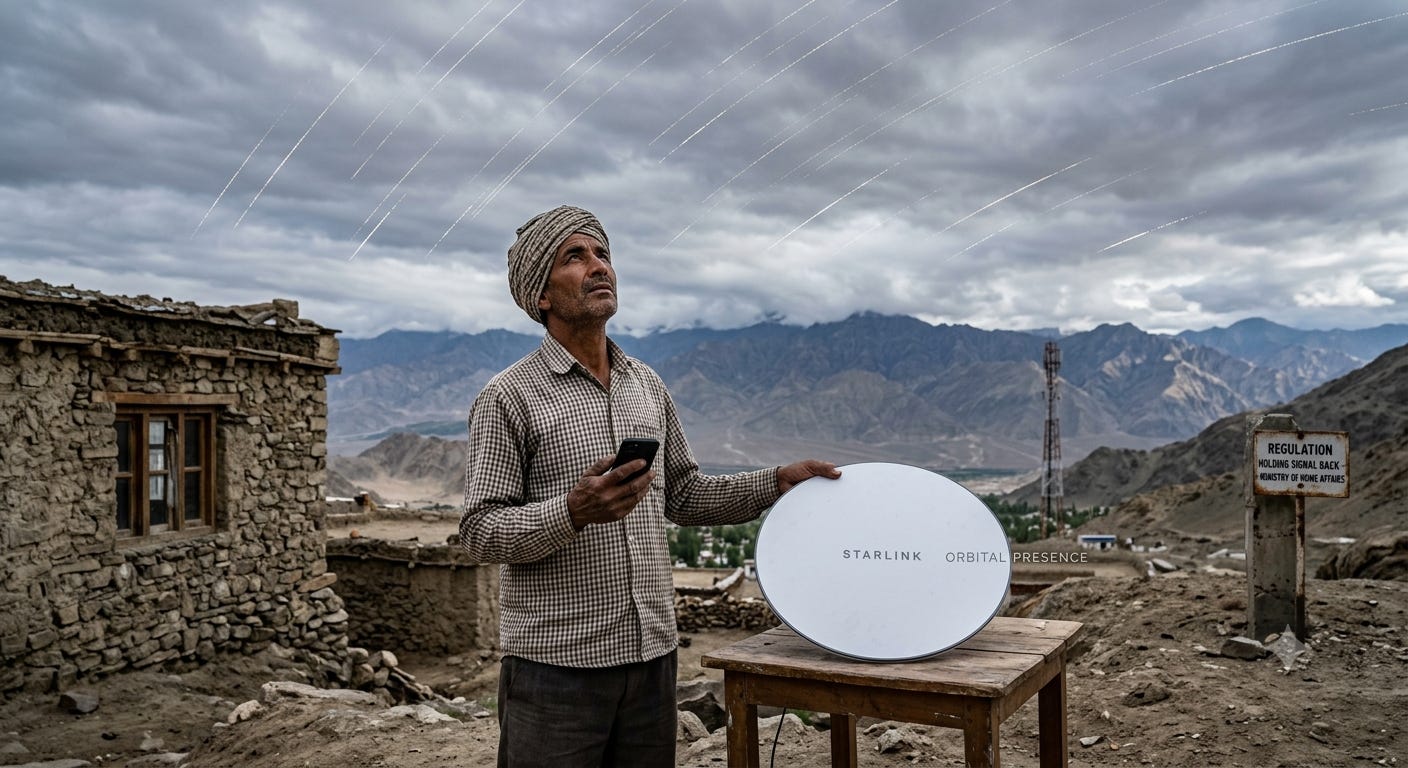
Twelve thousand two hundred and seventy-eight Starlink satellites, the tally as of the last public count, pass over Indian soil roughly every ninety minutes, in every twenty-four-hour cycle, whether over Leh or Lakshadweep, over the Rann of Kutch or the char lands of the Brahmaputra. Not one of them, as of this writing, is permitted to put a signal on an ordinary Indian desk. That gap, between orbital presence and terrestrial permission, is the subject of this piece, and it has now stretched across two Prime Ministerial engagements with Elon Musk, three telecom ministers’ worth of reassurance, and the better part of four years since SpaceX first sought entry.
Musk himself, quote tweeting on X only hours before this piece went to press, put the public-interest case in exactly nine words fewer than officialdom ever manages: “Starlink would help the least served in India, especially in rural areas.” It is difficult to argue with the sentence. It is rather easier to argue with the four years it has taken to test it.
Set down in order, the dates read as progress; set end to end, they read as something closer to a holding pattern.
Bharti Airtel signed with SpaceX on 11 March 2025 to distribute Starlink hardware through its retail network. Reliance Jio followed the very next day, a scramble that this Chronicle noted at the time signalled less genuine competitive urgency than a shared determination not to be left outside whatever gate eventually opened. IN-SPACe granted Starlink’s Gen-1 constellation authorisation on 8 July 2025, the “final regulatory hurdle,” as the wire copy of the day had it, valid five years or the operational life of the constellation, whichever came first. DoT spectrum clearance followed that autumn. By September 2025, SpaceX was separately building out Direct-to-Cell capability worldwide on newly acquired S-band spectrum, a technology this Chronicle flagged as the one that would eventually let an ordinary Indian phone, not a dish, not a router, just the handset in a farmer’s pocket, see a satellite as one more distant tower.
And then, in June 2026, the file stopped moving. Security agencies under the Ministry of Home Affairs withheld the final clearances after reports that Starlink terminals had surfaced in the Iran conflict despite the service holding no licence there, a discomfort, reportedly, less about Starlink’s technology than about New Delhi’s confidence in its ability to compel a foreign private operator’s compliance during a crisis not of India’s choosing. Just this week, Starlink has reapplied to IN-SPACe for its far larger Gen-2 constellation, nearly 30,000 satellites, including Direct-to-Device connectivity, the earlier Gen-2 bid having been turned down in 2025 over technical and spectrum-band non-compliance. Jio-SES and Eutelsat OneWeb sit in the identical queue, licensed but unlaunched, spectrum allocation and pricing the last locked doors on all three.
None of this would matter as urgently as it does were India’s terrestrial network actually closing the gap on its own timeline. It is not, and the government’s own data says so. As of May 2026, 11,256 of India’s listed villages remained without 4G coverage of any kind. India carried 1.093 billion internet subscriptions in March 2026, yet only 440.87 million of those were rural, a rural subscription density of 48.31 per hundred against an urban 126.80, a gap that has not meaningfully narrowed in years of headline “digital India” announcements. BharatNet, the fibre backbone meant to carry broadband to every Gram Panchayat, has laid over 850,000 route-kilometres and declared some 221,000 Panchayats “service-ready,” a phrase doing a great deal of quiet work, because Points of Presence were reported actually operational at only 80,472 of them as of June 2026. Roughly two in every three service-ready Panchayats, that is to say, are ready in name and unconnected in fact.
The Telecom Ministry’s own explanation for the residual gap is candid, to its credit: difficult terrain, low commercial viability, infrastructure constraints. Read plainly, that is an admission that fibre-and-tower economics will never reach the last several thousand villages on ordinary commercial logic, not because the state has failed to try, but because the terrain itself refuses the model.
This is not an abstraction to anyone who has served in the districts, and I make no apology for saying so from that vantage. A tower cannot be trenched into a Himalayan spur that a landslide takes out twice a monsoon. A fibre run does not survive a flood in the Brahmaputra char lands or the swamps of the Sundarbans, where the land itself relocates between seasons. A garrison on a forward post, a fishing hamlet on an island chain accessible only by weather-dependent ferry, a desert outpost in the Thar where the nearest tower is a day’s drive, these are precisely the geographies where a satellite constellation, agnostic to terrain because it never touches it, does what a century of terrestrial telecom economics structurally cannot. Direct-to-device connectivity carries a further, more urgent promise: it does not require a farmer to own a dish, only a phone that already exists in his pocket, staying alive on signal after the nearest tower has gone dark in a cyclone or an earthquake, precisely the moment official communication matters most and terrestrial infrastructure is least reliable.
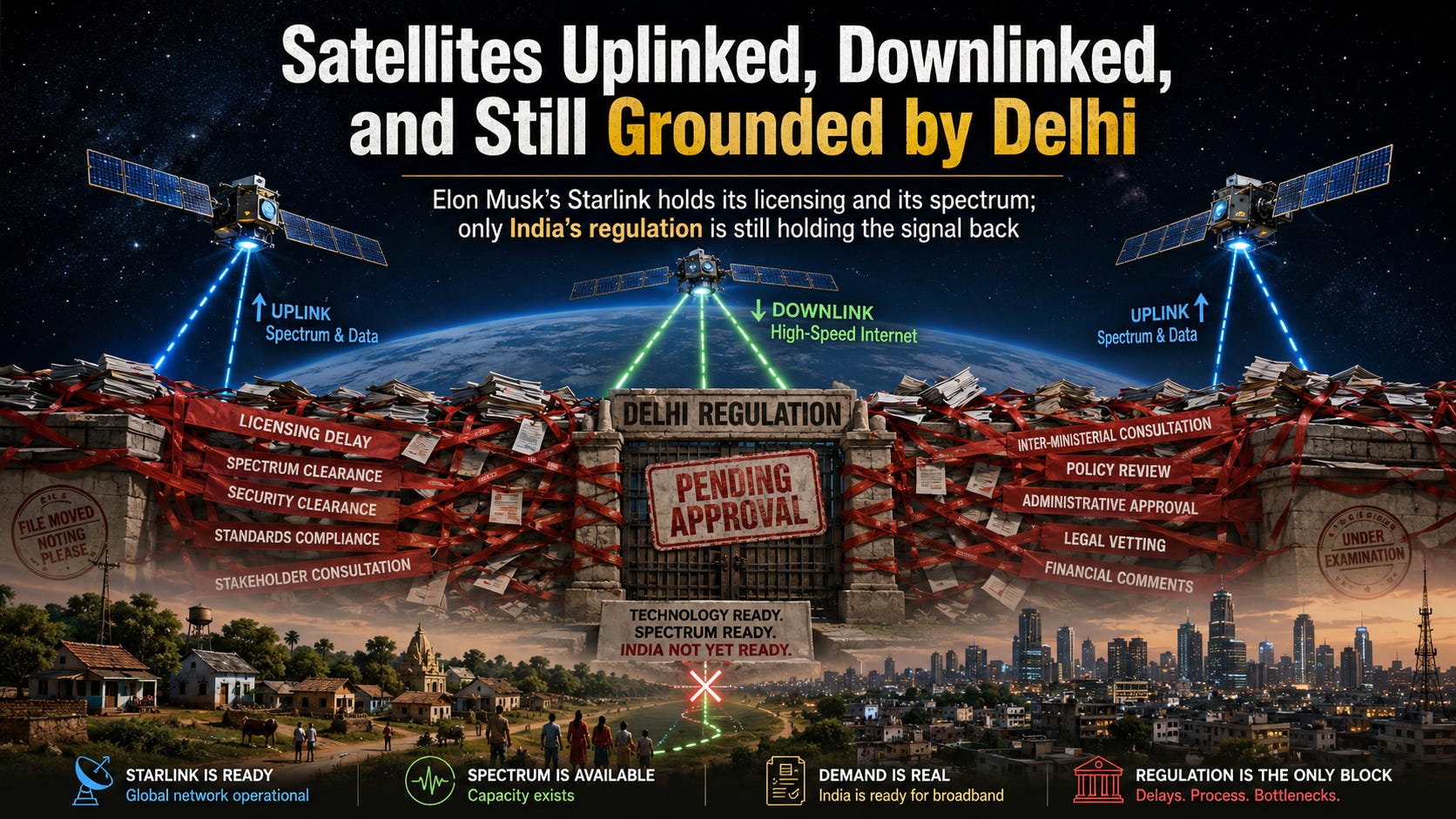
None of this is an argument for waving through 30,000 satellites without security architecture worth the name. The Home Ministry’s caution after the Iran episode is not unreasonable on its face, and a foreign-controlled constellation with the ability to activate or deactivate coverage inside Indian territory at a company’s discretion is a legitimate sovereignty question, not a manufactured one. But there is a difference between building that architecture, audit rights, lawful-intercept parity, terminal registration, geofencing enforceable by India rather than requested of SpaceX, and simply sitting on the file. Building it is diligence; sitting on it for a fourth year is a policy failure of its own, borne not by SpaceX’s shareholders but by the 11,256 villages still waiting for a signal that is, quite literally, already passing overhead.
India is neither the first country to weigh this question nor likely to be the last. Starlink is live and commercially licensed across more than a hundred countries and territories, effectively the whole of Europe barring Russia and Belarus, and treated across most of the advanced world as ordinary telecom infrastructure subject to routine licensing rather than indefinite security review. China is the instructive case here, not the cautionary one: Beijing has not tried to negotiate Starlink into submission file by file, it has simply built two sovereign rival constellations of its own, Guowang and Qianfan, precisely so the security question never has to be litigated at all. That is a legitimate, if expensive, policy choice, and it is not evidence that India must choose between unrestricted access and indefinite freeze. If the world’s most security-conscious major power on foreign digital infrastructure has answered the sovereignty question through parallel capacity rather than policy paralysis, India, with the requisite safeguards actually built in rather than merely promised, has no structural reason it cannot do the same.
Satellite broadband is not fighting Jio, Airtel and Vi for the same finite spectrum pool, whatever assumption has quietly shaped bureaucratic caution inside India’s telecom establishment. The physics says why. Starlink’s user-terminal links run in the Ku- and Ka-bands, frequencies in the 10.7–14.5 GHz and 17.7–30 GHz ranges for downlink and uplink respectively, while India’s terrestrial mobile networks operate in entirely separate, much lower IMT bands below 6 GHz. These are not overlapping allocations up for the same auction; they are different neighbourhoods of the spectrum chart altogether, which is precisely why the DoT’s 2025 decision to assign rather than auction satellite spectrum drew so little genuine objection from the telcos themselves, whatever noise was made in public. The Direct-to-Cell layer, riding on newly acquired S-band MSS spectrum, is a further, separate allocation again. Nobody’s licensed spectrum is being eaten into; the zero-sum framing behind much of the caution on this file is simply a category error.
What remains, once that error is cleared away, is a straightforward deregulatory choice. India has, over the past decade, shown itself capable of exactly this kind of move: the UPI build-out, the E20 ethanol rollout, the FCRA and telecom-tariff liberalisations this Chronicle has tracked in earlier pieces all rested on the same premise, that the state’s job is to set the guardrails and then get out of the way of adoption. Publish the security-compliance framework Starlink must meet, put a hard clock on the Gen-2 and Direct-to-Device applications now sitting with IN-SPACe, and let commercial rollout begin on a timetable measured in weeks rather than the further years this file has already consumed. The satellites are already there, on a ninety-minute orbit, spectrum-clean and uncontested. The only thing still orbiting, unresolved, is the decision.
Comments
Nothing yet. Say the first thing.
Sign in to join the conversation.