
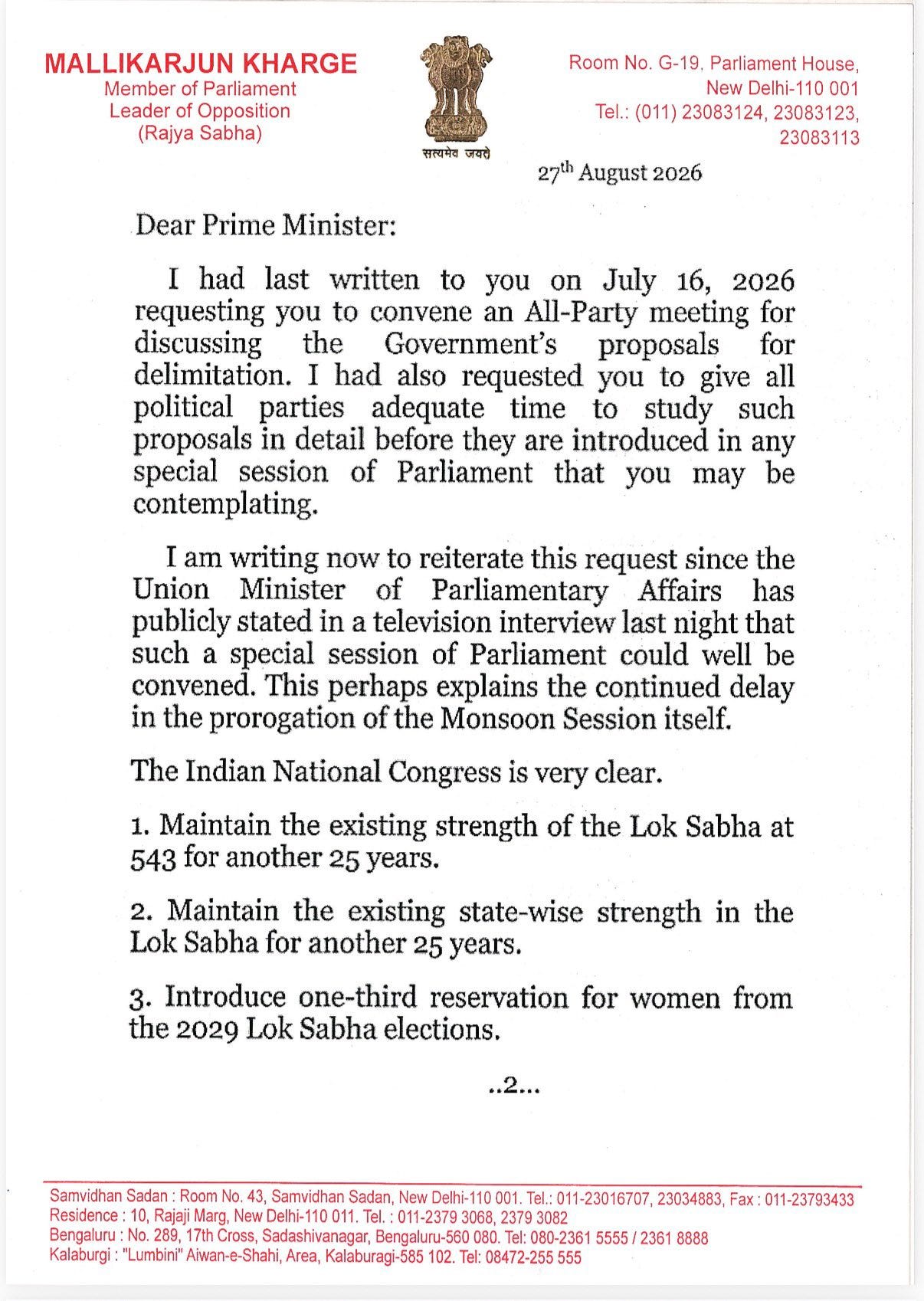
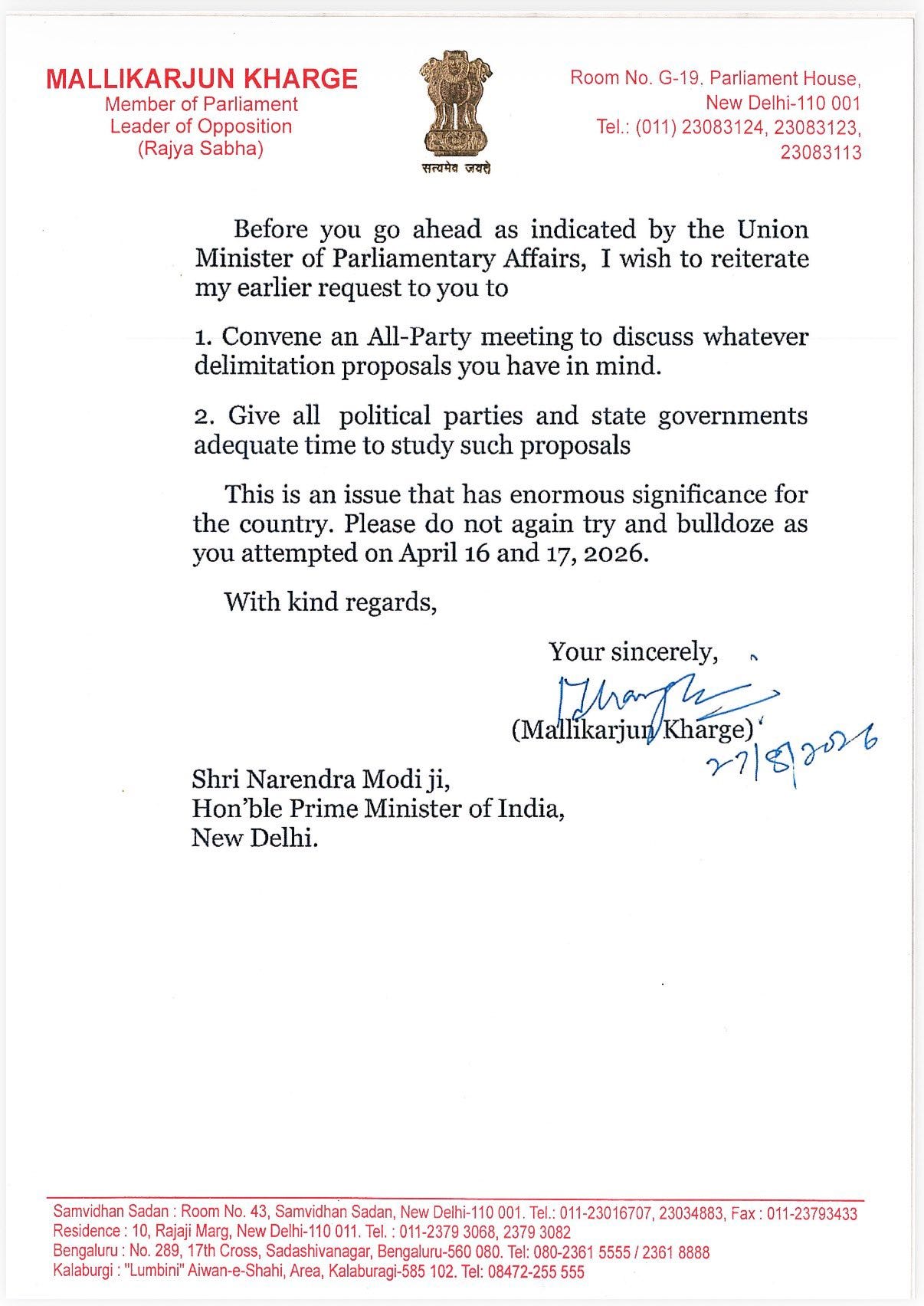
Mallikarjun Kharge, the Congress President, wrote to the Prime Minister on 27 August 2026 — a two-page letter, on his Leader of Opposition (Rajya Sabha) letterhead, composed in his dual capacity as Congress President and as Leader of Opposition in the Rajya Sabha, and flagged as a reiteration of a request first made on 16 July. The occasion for writing again, the letter explains, was a television interview the previous night in which the Union Minister of Parliamentary Affairs indicated that a special session of Parliament “could well be convened” — which, Kharge adds drily, would also explain why the Monsoon Session has still not been prorogued. Congress’s position, laid out in three numbered points, reads almost like a memorandum: maintain Lok Sabha strength at 543 for another 25 years; maintain the existing state-wise distribution of that strength for another 25 years; introduce one-third reservation for women from the 2029 Lok Sabha election.
Three lines — and what they add up to is considerably more interesting, and more self-interested, than the language of consultation and constitutional propriety in which they arrive.
Points one and two look like a single ask stated twice. They are not. The first freezes the total — 543, not 850, not any other number, for another quarter-century. The second freezes the distribution of that total — Uttar Pradesh stays at 80, Tamil Nadu at 39, Punjab at 13, and every other state exactly where the Constitution (42nd Amendment) Act, 1976 put it on 1971 population figures, a freeze extended twice more, in 2001 and 2003, to run “until the first Census taken after the year 2026.”
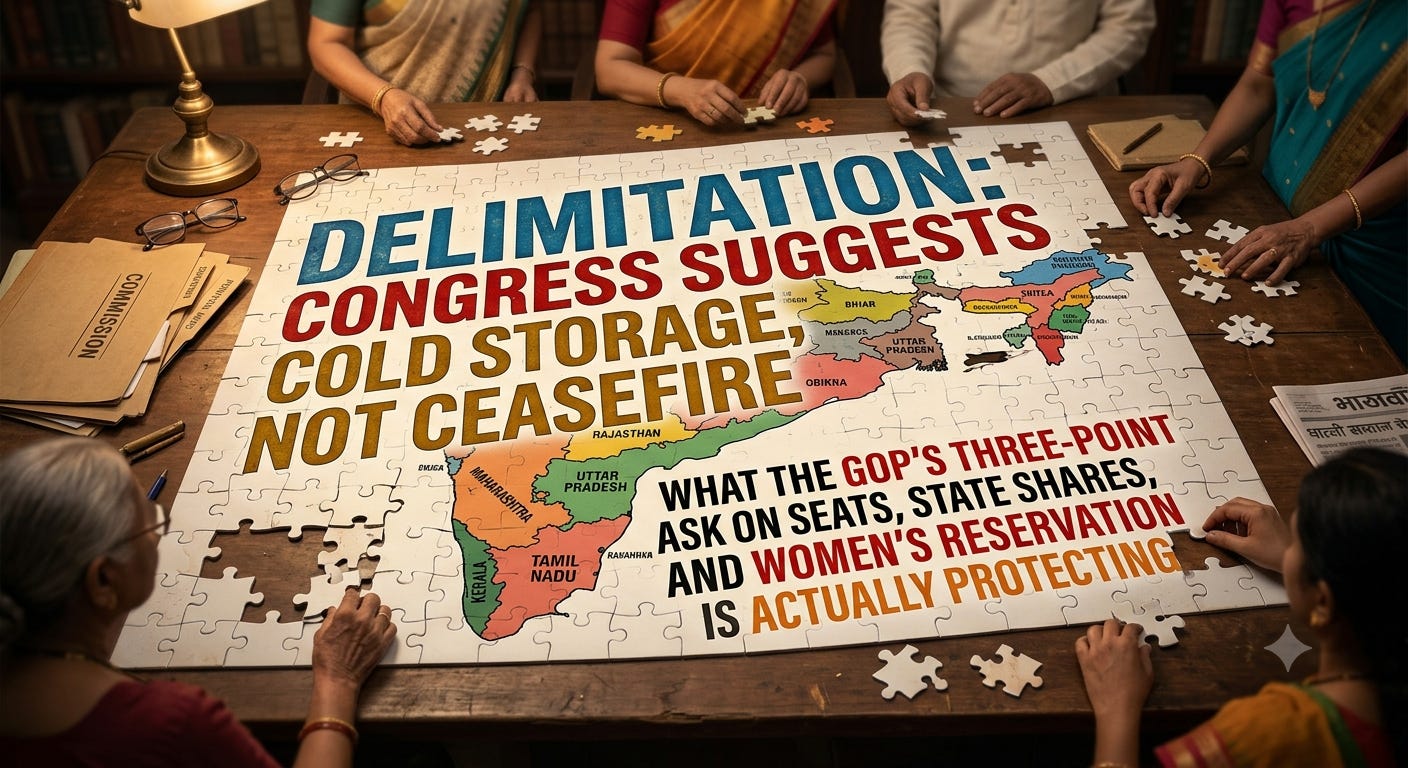
Put the two freezes together and there is very little cartography left for anyone to attempt. If the total cannot grow, and no state’s share within that total can move, the only redrawing left available to a future Delimitation Commission is internal — constituency boundaries reshuffled inside each state’s existing quota, exactly as the Kuldip Singh Commission did between 2002 and 2008 on 2001 Census data, without altering a single state’s seat total by even one. Picture it as a jigsaw puzzle in which the frame is nailed down in advance — the total picture, and every state’s own panel within that picture, fixed before a single piece is touched. Only the interior pieces move: the individual constituencies within each state’s Lok Sabha quota, and, in parallel, within each state’s own Vidhan Sabha quota, since Article 170 runs on the identical freeze logic as Article 82. In substance, Congress is asking for the 2002-model delimitation, and nothing more ambitious, replicated at both the national and the state level: boundaries redrawn, totals untouched, frame undisturbed. Everything in the government’s withdrawn package that went beyond that — the expansion to 850, the 2011-census basis, the Fifth Schedule ranges this column argued for in these pages on 21 April — is, on Congress’s own terms, off the table before the conversation even opens.
Point three only works because points one and two hold everything else still. One-third reservation for women “from the 2029 Lok Sabha elections,” on Congress’s own wording, cannot mean carving out new women-only constituencies — a frozen 543-seat House has no room to create a seat for anyone. It can only mean what the original design of the Constitution (106th Amendment) Act, 2023 already contemplated: rotation, on the model already used for Scheduled Caste and Scheduled Tribe seats. A defined share of existing constituencies is designated reserved for women each cycle, sitting members in those seats lose them to the reservation, and the rotation shifts again the next time round. Congress’s letter names only the Lok Sabha, but Article 334A was never confined to Parliament in the first place — the same one-third rotation is written into every State Legislative Assembly as well, which keeps the jigsaw identical at both levels: the interior pieces of each Vidhan Sabha reshuffle exactly as the Lok Sabha’s do, one-third rotating into reservation for women at each cycle, while the frame — the state’s Assembly total, and its Lok Sabha total — stays exactly where it was. No new boundaries, no new total, no new state-wise number to argue about, at either level. It is, in that narrow sense, the cheapest possible route to the 106th Amendment’s promise — it costs the ruling dispensation nothing in seat count, and it costs Congress nothing in southern seat-share. Only the names on some 181 Lok Sabha seats, and a proportionate share of every Vidhan Sabha’s seats, change with each rotation; everybody’s arithmetic stays exactly where it was.
The more delicate part is worth being precise about. Congress has boxed itself into 543 rather than proposing some middle figure — 650, say, or 700 — as a compromise, because any revision to the total number of Lok Sabha seats reopens Article 81(2)(a), which requires that seats be allotted to states “so far as practicable” in proportion to population. There is no way to add fifty seats, or a hundred, without answering whose population, measured when. The withdrawn 131st Amendment tried to answer that by freezing the basis at 2011 — an answer this column has already examined at length, and found imperfect. But 2011 is itself only a stopgap; the more seats added, the harder it becomes, politically as much as legally, to keep avoiding a reckoning against real, current population — the very reckoning Article 82’s freeze was built to postpone in the first place.
Congress’s three points sidestep that arithmetic altogether by refusing to touch the total. Keep it at 543, and Article 81(2)(a) never has to be re-litigated, because nothing new is being allotted to anybody. It is a tidier constitutional position than it looks at first reading — and considerably harder to argue against on process grounds, since “give parties time to study the proposals” and “do not bulldoze” are, taken at face value, unobjectionable asks from any Leader of Opposition.
Process language should not, however, obscure what the status quo being defended actually is. On the seats-per-elector arithmetic this column has set out before, a Lok Sabha seat in Uttar Pradesh today represents roughly 30 lakh people; in Tamil Nadu, roughly 20 to 21 lakh; in Kerala, roughly 19 lakh. That gap exists precisely because the 1971 freeze rewarded the states that slowed their population growth through family planning by leaving their seat count untouched while their population share shrank beneath it — southern voters ended up, as an unplanned dividend of demographic success and legislative inertia, with considerably more voice per head than their northern counterparts.
Set the three live scenarios side by side. Scenario one is the frozen status quo Congress is now asking to extend for another 25 years — the most favourable of the three for southern seat-weight, for the reason just given. Scenario two was the withdrawn Bill’s own offer: an 815-seat House apportioned on 2011 figures, under which Tamil Nadu would still have gained seats in absolute terms (39 to roughly 57, on this column’s own April calculation) even as its proportional share edged down slightly. Scenario three is what happens with no Bill at all, once the freeze lapses on its own terms sometime between 2029 and 2031 and the next Delimitation Commission apportions on whatever the actual post-2026 Census shows — the scenario in which, as this column argued in April, Tamil Nadu could see its seat count fall outright for the first time since Independence.
Congress’s letter goes further than opposing the specific Bill withdrawn on 17 April. It refuses to move even to the milder of the two alternatives — scenario two, which still delivered the south a net gain in seats — in favour of holding the line at scenario one, indefinitely. That is a perfectly coherent position for a party to take. It is also, transparently, the position of a coalition whose southern flank has the most to lose from any recalculation, however generously structured, and the most to keep by simply declining to recalculate at all.
Kharge’s letter asks the Prime Minister not to “bulldoze” again, as he characterises the events of 16 and 17 April 2026. Fair enough, as far as consultative process goes — nobody serious argues that a constitutional amendment touching the seat-weight of every state in the Union should be pushed through a 48-hour special session without an All-Party meeting first. But it would be a mistake to read the three-point letter as principally a plea for process. It is a request to place the entire question in cold storage for another generation — not a ceasefire pending negotiation, but a freezer with the thermostat set for 25 years, inside which the south’s current, demographically earned overrepresentation stays exactly where it is, women’s reservation arrives by rotating existing seats rather than creating new ones, and Article 81(2)(a) never has to answer a single hard question about whose population counts, and when.
There is a legitimate case for slow, careful constitutional change of this magnitude. There is also a less flattering description of a status quo that happens to suit, rather precisely, the party asking for it to be preserved. Both can be true of the same letter. (My New Indian Express Op-Ed)
KBS Sidhu, IAS (retd.), served as Special Chief Secretary to the Government of Punjab. He is the Founder-Editor of The KBS Chronicle (kbssidhu.substack.com) and writes on constitutional law, Punjab politics, and public governance.
Comments
Nothing yet. Say the first thing.
Sign in to join the conversation.