
Note: My reviews of Michael Robert Liska’s Alice, or the Wild Girl for The Los Angeles Review and of Ali Smith’s Glyph for Los Angeles Review of Books.
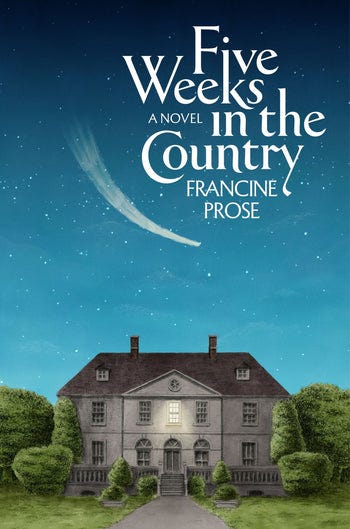
Five Weeks in the Country. By Francine Prose. New York: Harper, 2026. 304 pp. $30.
The septuagenarian American author Francine Prose has written over twenty novels, and ten nonfiction books on subjects including Caravaggio, Anne Frank, Sicily, and gluttony. She reviews books, mostly novels, for The New York Times and The New York Review of Books, and she is writer-in-residence at Bard College. Her novel Blue Angel was a finalist for the National Book Award, and she has been given all sorts of other prizes and grants. Prose, from the outset, is to be distinguished from poetry, and the word of course has more of a professional ring, more of a sturdy, practical quality. A fine name for a novelist, one would think, but unfortunately, Prose’s professionalism has produced something not just steady and solid but distinctly lacking in poetry, a novel which will have to be called prosy. It is titled Five Weeks in the Country, and it recreates Hans Christian Andersen’s disastrous stay, in the spring of 1857, at Gad’s Hill, Charles Dickens’ house in Kent. Prose has made a few fictional adjustments, but has reprinted real letters and striven for verisimilitude. She tells the story first from the perspective of the Dickens children who speak in a first person plural, then a third person limited to their father, then back in the first for Hans Christian Andersen’s version of the story. Then she has, as “Part Four”, two short letters, and “Part Five” is a short story called “Tears of the Comet”, fictionally written by Andersen, really by her, and based partly on his foregoing experiences.
The novel is actually slightly more interesting in summary than in the reading. In “Part One”, the nine children tell us that they feel deprived of the love their father used to show them, sense that he works too hard and is a hypocrite, and are troubled by the disdain he feels for their mother. The Dickens myth, that of a very sensitive man who was as kind to children as he is compassionate to them in his fiction, and which no one has believed in for a long time anyway, is not to be indulged for a moment by this novel. Once shifted over to his perspective, we learn that he has indeed stopped loving his children, that he resents his wife’s sickness and her parents’ haughtiness, and works relentlessly as a distraction from all this, but also that he is afraid that people will find out about his time in the blacking factory and his father’s in the debtor’s prison. That does for Dickens. There is no hint of humor in the man as represented here, no examples of his rhetorical gifts, or of his powers of observation and imagination. One can see, in reading Prose’s review of Donna Tartt’s The Goldfinch for the NYRB that she admires Dickens the writer, but Five Weeks in the Country, concerned with his theatrical ventures and his embarrassing infidelities, each practically related to the other, has no time for admiration on the author’s part.
Hans Christian Andersen though, in Prose’s imagining, has an odd, nearly reverential feeling for the younger but more famous writer. A confirmed bachelor of sorts, Andersen has been living in hotels and with friends, and is very impressed with Dickens’ large brood in his large second home in the country. Dickens’ celebrity and association with royalty is also appealing to Andersen for its unlikelihood and its quality of the fairytale. In the children’s view, Andersen is an eccentric, in Dickens’, a nuisance whose affection is uncouth, and in his own, which we are eventually treated to in his expansive first person narration, he is sensitive, misunderstood, and basically too good for this world. If there was any winking or framing by which Prose intended to make this picture ironic, this reader missed it. Andersen, whose abilities with the English language are wildly expanded or limited according to to the needs of the story, is as irritating a narrator as he is a houseguest. He explains away his gluttony, desecration of the Dickens garden, and the odd demands he makes of his hosts, sometimes with a cultural difference, sometimes a special medical problem. His fear of dogs is even explained to be the result of a traumatic experience. The sentimental succeeds the cynical: though Andersen, like everyone else, knows that Dickens is a bit of a fraud, he sees his performance in a play cowritten with Wilkie Collins, The Frozen Deep, and tells us that Dickens “plumbed the depths of the human spirit to show us our better natures.” Without exactly disagreeing, one can still utterly reject this cant. Evil may be as banal as this, but goodness is surely not.
Historical and literary curiosity are not enough to sustain a good novel if the author is not at least intermittently thrilled by the material, and Prose, if she was ever much interested, seems to have eventually been treating Five Weeks in the Country as a tedious assignment. Either that, or her careful, well-practiced craft has overly straitened or muffled her materials. One does not sense much conviction behind the defense Andersen makes for himself, nor of his admiration of Dickens, apparently felt despite the disappointment of the real man behind the books. Prose will have Andersen insist, in a slightly anachronistic way, on something that all writers running out of things to say eventually insist on, which is the familiar guff about the importance of language and storytelling. This is what it was like for him to forget his English in company with the Dickens family:
There was so much in my heart, so much I longed to tell them. It was a waking nightmare for a storyteller like myself. Nothing seemed possible to say; nothing seemed worth saying. Without language, I had no humor, no personality, no history.
Language might be enough to get through dinner and have a pleasant time, but in a novel it must be more than a cymbal tinkled without any mistakes. Five Weeks in the Country has a few historical tidbits for us to enjoy, but almost no personality, and as a result, little humor. The veteran Prose cannot be faulted, not really, but she can’t be credited with much either. Maybe this fiction business is trickier than anyone realizes.
No posts
Comments
Nothing yet. Say the first thing.
Sign in to join the conversation.