
One of the things I enjoy most is discovering ideas that quietly rearrange the way I think.
Recently, I was listening to a radio interview with a mathematician who is also a musician. She shared something that sounded completely wrong.
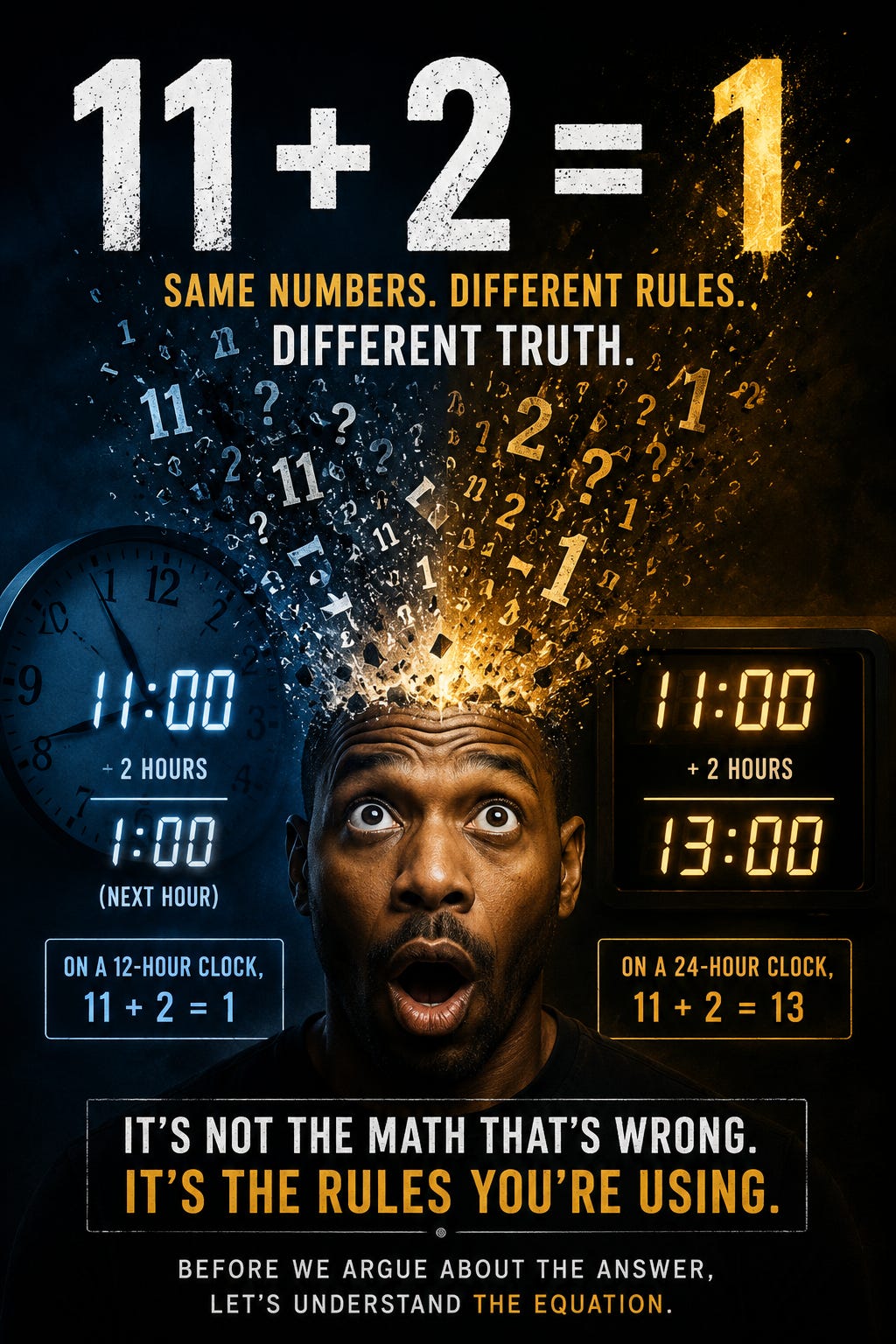
Eleven plus two equals one.
I laughed. I didn’t think she had made a mistake because I knew there had to be something I was missing in my understanding.
Then she explained.
If it’s 11 o’clock and two hours pass, it’s 1 o’clock. On a 24-hour clock, that’s 13:00.
On a 12-hour clock, it’s 1:00.
Same moment. Different system. Different rules.
Nothing about mathematics had changed.
The context had. Suddenly, an impossible equation made perfect sense.
The more I thought about it, the more I realized this wasn’t really a lesson about math.
It was a lesson about people.
I’ve spent years watching intelligent, thoughtful people disagree sometimes about politics, parenting, religion, race, leadership, education, or relationships.
For a long time coming up, I assumed people were arguing because one side had the facts and the other didn’t.
Sometimes that’s true, but I’ve become less convinced that facts are the only thing we’re arguing about.
More often than we realize, we’re operating from different frameworks, which include different assumptions, histories, experiences, definitions of fairness, understandings of justice, and about what success even looks like.
We’re using different rule books.
A lawyer may approach a problem through constitutional principles, while an economist may immediately think about incentives.
An engineer may see systems, a historian may ask how we got here, a psychologist may wonder what experiences shaped the behavior, or a parent may see the world through the eyes of their child.
They’re all looking at the same situation, but they’re just solving a different equation.
That doesn’t mean every answer deserves equal credibility.
There are still better and worse arguments, better and worse evidence.
It does mean that before we decide someone is irrational, it’s worth asking a different question.
What rules are they using?
That question has changed the way I listen.
It doesn’t mean I suddenly agree with everyone, which is quite far from the truth.
There are ideas I still believe are unsupported by evidence.
There are positions I think cause harm.
Curiosity isn’t the same as abandoning discernment.
Curiosity does invite me to understand before I evaluate.
To ask, “Help me understand how you arrived there.” Instead of, “How could anyone possibly believe that?”
Those are very different conversations.
This idea has become especially important in a time when disagreement feels almost inevitable.
Organizations, families, and communities wrestle with it.
We often assume we’re debating the answer when sometimes we’re debating the assumptions that produced the answer.
That distinction matters and it should slow us down to create room for humility.
It reminds us that understanding another person’s framework isn’t the same as endorsing it.
It’s simply the beginning of a better conversation.
Reading Brené Brown introduced me to John Keats’ idea of negative capability—the willingness to remain in uncertainty without rushing toward easy certainty.
She also introduced me to Adam Grant’s distinction between mental horsepower and mental dexterity.
The more I’ve reflected on those ideas, the more they seem connected.
Negative capability creates space for uncertainty.
Mental dexterity helps us remain flexible enough to learn within it.
Understanding another person’s framework is one way we practice both.
That’s one of the reasons Djembe has become so meaningful to me.
People often assume it’s about storytelling.
Or having thoughtful conversations. It is but underneath those prompts is something deeper.
Every conversation invites us to discover the invisible rules another person has been living by.
There are the family stories, disappointments, victories and losses, which includes the communities that shaped them.
The experiences that taught them what to trust, what to fear, and what to value.
Those things don’t excuse every conclusion.
But they do explain far more than we often realize.
I’ve come to believe that one of the greatest acts of curiosity isn’t asking, “Who’s right?”
It’s asking, “What experiences made this make sense to you?”
Sometimes the answer will change my mind. Sometimes it won’t.
Almost every time, it changes my understanding.
And maybe that’s one of the lessons hidden inside a simple math problem.
Sometimes the equation isn’t wrong, but we simply haven’t understood the rules.
Every one of us is solving for something.
The question is whether we’re curious enough to understand the equation someone else has been living all along.
Stay curious. Build trust.
— Kazique
If this conversation challenged your thinking, I’d love for you to stick around.
Join a growing community exploring curiosity, courage, trust, belonging, leadership, psychology, AI, and what it means to be fully human.
Subscribe for weekly essays and Notes, or Upgrade for exclusive audio experiences, courses, and resources.
No posts
Comments
Nothing yet. Say the first thing.
Sign in to join the conversation.