
Welcome back to The Curious Life.
Lately, I’ve been thinking a lot about work.
Not just my own work, my children’s work, and friends who are sending out résumés and wondering if anyone is actually hiring.
Former colleagues trying to decide whether to learn another AI tool, go back to school, pivot careers, or simply hold on to the job they already have.
There is a quiet uncertainty in the air.
The economy feels unsettled.
The job market feels like it’s changing beneath our feet.
And for many people, the question isn’t, “How do I get ahead?”
It’s much simpler.
“How do I avoid being left behind?”
That question stayed with me.
Not because I have all the answers.
Because I don’t think any of us do.
Over the past two years, we’ve heard extraordinary predictions about artificial intelligence.
White-collar jobs would disappear.
Entry-level positions would become obsolete.
Entire professions would be transformed almost overnight.
Many organizations believed it.
Some announced layoffs while announcing their AI strategies in the very same breath.
The assumption seemed obvious.
If AI can do the work, why keep paying people?
Then something unexpected happened.
Some of those same organizations quietly began hiring people back.
That made me pause, because our expectations might have failed despite AI doing exactly what it was designed to do.
Every technological revolution changes work. History tells us that much, but history also tells us something else.
Change almost never happens the way we expect.
When word processors replaced typewriters, we didn’t eliminate office professionals.
We changed how office work was done.
When the internet became part of everyday life, organizations didn’t suddenly stop needing people.
People learned new skills.
New jobs emerged. Old jobs evolved. Technology and people adapted together.
Recently, I listened to several economists discussing AI, and they made an observation that felt both obvious and profound.
The previous technological revolutions gave people time to learn alongside the technology.
This one often assumed the learning had already happened.
That makes me wonder if the biggest mistake wasn’t believing AI would change work.
It probably will.
The bigger mistake may have been believing we already knew how.
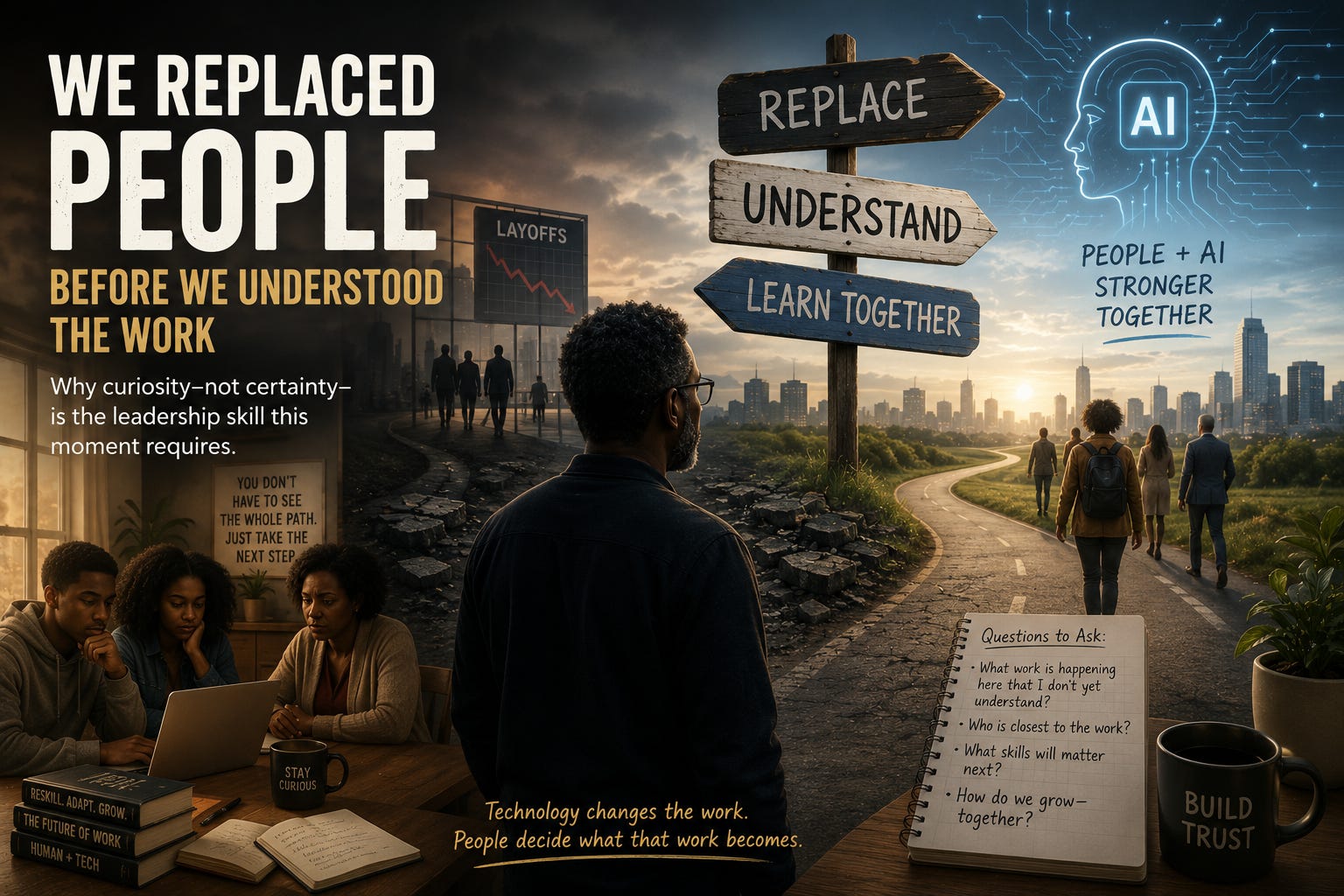
Curiosity asks, “What will people and technology become together?”
Certainty asks, “What can we replace today?”
Those are very different leadership questions.
One begins with learning. The other begins with conclusions.
I also wonder what happens when leaders make sweeping decisions without fully understanding the work they’re changing.
Who gets consulted?
Whose expertise counts?
Who bears the consequences if those assumptions are wrong?
Those aren’t just technology questions.
They’re inclusion questions, because it isn’t only about who gets hired.
It’s also about whose knowledge is respected when important decisions are made.
The frontline employee, customer service representative, administrative professional, teacher, nurse, junior analyst, and the people closest to the work often understand its complexity better than anyone else.
Yet they’re frequently the last people asked how technology might change it.
When organizations overlook that lived expertise, they don’t just risk making poor business decisions.
They risk sending a deeper message: Your experience wasn’t worth understanding before we decided you were replaceable.
That erodes belonging.
People don’t feel valued when their knowledge is ignored. They feel expendable.
None of this makes me pessimistic about AI.
I use it almost every day. It has made me more productive and challenged my thinking.
It has become one of the most valuable tools in my work.
But that’s just it. It’s a tool.
Like the word processor, internet, search engines before it.
The future probably isn’t AI replacing people quite how we might think or imagine.
It’s people learning new ways to work with AI.
As I think about my children, my friends, and so many others trying to navigate this changing economy, I keep coming back to the same thought.
Perhaps our greatest advantage won’t be knowing exactly where the future is headed.
Perhaps it will be staying curious enough to keep learning when none of us can see the whole path.
Because every industrial revolution rewards people who adapt and every generation eventually discovers the same truth.
Technology changes the work.
But people decide what that work becomes.
Stay curious. Build trust.
— Kazique
If this conversation challenged your thinking, I’d love for you to stick around.
Join a growing community exploring curiosity, courage, trust, belonging, leadership, psychology, AI, and what it means to be fully human.
Subscribe for weekly essays and Notes, or Upgrade for exclusive audio experiences, courses, and resources.
No posts
Comments
Nothing yet. Say the first thing.
Sign in to join the conversation.