

A confession: for most of my time at Watershed, I wasn’t thinking about climate change and emissions strictly in the sense of mitigating natural disasters. I enjoyed working in climate tech, among other reasons, because I had the opportunity to think more deeply about how climate change will exacerbate a wide variety of conflicts throughout the world. In fact, I now fully believe that—besides threatening our basic needs—climate change will also make our world substantially more violent, and I don’t think we talk about that enough.
I was strolling through DC on Sunday listening to “The new war in Sudan,” an episode of the Today Explained podcast by Vox, when something piqued my interest. In the April 2023 episode, Robert Guest (of The Economist) spoke about his firm belief that the Sudanese conflict was not alone in its complexity and horror—that he believes wars are becoming longer, more common, and more complex.
The episode itself is really informative and I would highly recommend it, but the short version is that Guest cites four reasons:
Increased foreign meddling, which has led to complexity
A culture of impunity and criminality
Read: Russia (and other nations) violating international agreements with seemingly little pushback
Climate change
Religious extremism
I could write a whole post on each of these points (and a much more informed writer could probably write a 500-page book on each as well), but this coincided particularly well with two things I’ve also been thinking about recently: 1) a not insignificant amount of recent conflict modeling work has focused on modeling climate risks as an additional forecasting force and 2) Deepmind is making weather forecasting easier and, dare I say, revolutionizing the field.
First, some context. Here are some examples of conflicts commonly cited as being exacerbated by climate change:
Darfur conflict in Sudan (2003-): scarce resources, environmental degradation
Syrian Civil War (2011-): drought, crop failure, mass migration
Lake Chad Basin Conflict (2009-): shrinking water reserves lead to competition over resources
Somali Civil War (1991-): droughts
Libyan Civil War (2011-): drought
Yemen Civil War (2014-): drought
ISIS Invasion of Iraq in 2014: droughts, flooding, and strong winds caused significant economic turmoil. The resulting poverty was exploited by ISIS in recruitment.
The Sahel desert in Africa (Mali, 2012-): droughts are getting more and more frequent, with at least some unrest in Mali being attributed to this
As seen in the list above and the image below, North Africa, Central Africa, and Central Asia are at exceptional risk due to existing ethnic divides and heightened risk for anthropogenic climate change (see paper).
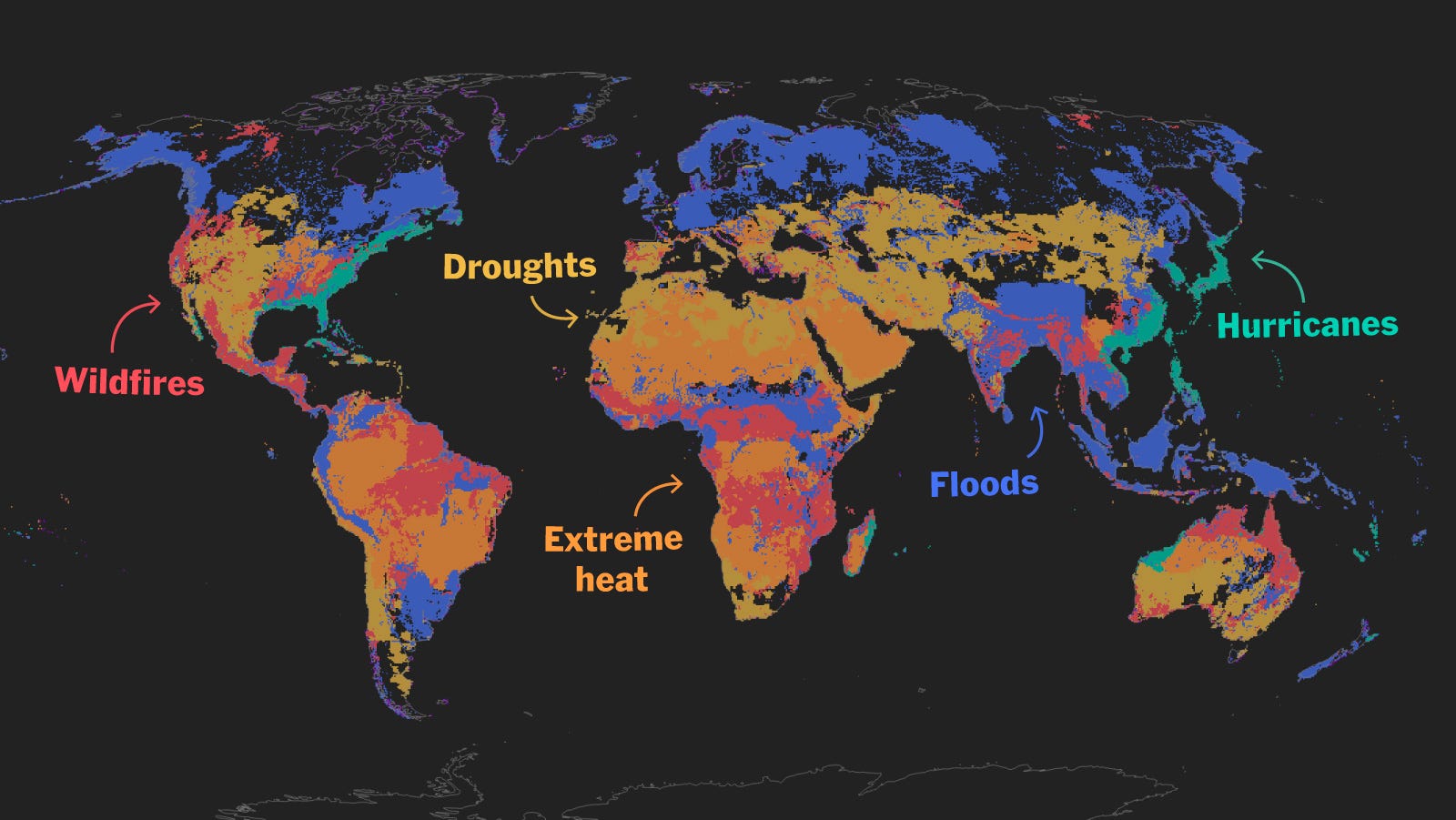
Image source: The New York Times
A closer look: Though every country has challenges of its own unique nature, the Syrian civil war is commonly cited as a potent example of the political and social consequences of climate change in a somewhat unstable state. After a devastating drought from 2006 to 2011 threatened the livelihoods of rural farmers (who were mostly Sunni Muslims), millions fled to cities like Damascus and Aleppo for work. This put a heavy strain on city infrastructure and resources and only served to inflame tensions between the rural Sunnis/minority Kurds/Druze and the Alawite-dominated government (Alawites practice a branch of Shia Islam), which was seen as unsympathetic and unresponsive to the plight of the rural populations. The resulting combination of high unemployment, food insecurity, and poverty did not overlay well onto existing ethnic tensions and sectarian divisions (not to mention the authoritarian government’s unhelpful crackdowns and attempts at repression). Also, Arab Spring.
This NPR article talks a bit about Syria and the Sahel.
With that context, I wanted to take a closer look at the weight this holds on the global governance psyche. Though climate risks are never the sole cause of civil conflicts, they serve very clearly as a “threat multiplier” (a term about climate change coined in 2007 by the Center for Naval Analyses).
Sidebar: Though most popular under the Obama administration, the term also curiously served as a way to unite bipartisan stakeholders during the Trump admin, doing so under the guise of dealing with a “threat multiplier” as opposed to what it really was—climate change (source here from the Council of Strategic Risks).
The US government, obviously, knows this and has set up, in recent years, a think tank called The Center for Climate and Security (2011). It partners closely with organizations like the International Military Council on Climate and Security and the Climate and Security Advisory Group. The Department of Defense and Department of Homeland Security are also clearly thinking about this—every few years, one (or both) of them will publish musings on climate change and national security, but I’m not sure what actions they’ve taken, if any, on this.
On the international stage, the United Nations Security Council has held a few forums on this topic: first in 2007 and then two more in 2015 and 2017. The fourth iteration was titled “Climate Change, Peace, and Security” and was held this past June (2023).
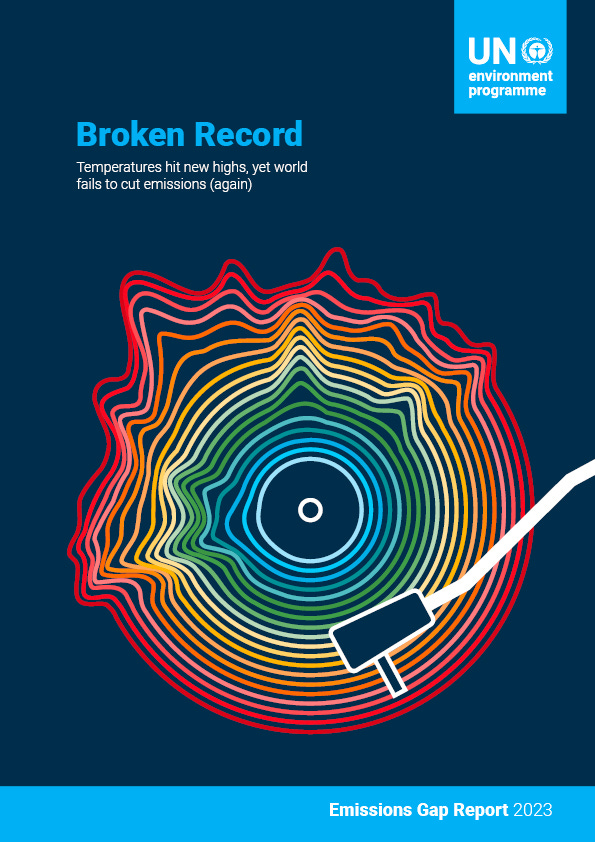
Side note: Yesterday, the UN released their emissions report for 2023, which noted that current actions put us at a 2.5-2.9°C temperature rise above pre-industrial levels in just this century. Is it not heartbreaking that the report is literally titled Broken Record?
My take is this: for any research—in this case, conflict modeling—to meaningfully improve, there has to be either new data or a new method. Improved weather forecasting and climate modeling provide an incredible opportunity for more data, both in collection and in prediction. A lot of people have expressed similar beliefs and I’ll do a deeper dive into climate in the conflict modeling space later (too many thoughts and papers on this).
As I alluded to above, a couple of advancements have started to shake up weather forecasting in the last year or so. Earlier this week, I happened upon this WIRED article, which details how Deepmind’s GraphCast software achieved 90% accuracy on atmospheric measures, beating the current, standard models. (Technical aside: their algorithm uses graph neural networks with three broad steps: encoder, processor, and decoder. The nodes in their GNNs represent a set of atmospheric conditions in a particular location.)
The main intrigue here is that GraphCast is so accurate and fast (it runs on a laptop and spits out a forecast in under one minute). The software cannot really accurately speak to anything beyond a week or so into the future, but all progress in predictive work is incredibly encouraging.
More broadly, between April 2022 and June 2023, a series of papers like this one from companies like NVIDIA, Deepmind, and Huawei, heralded rapid progress in deep learning and ML-based weather forecasting tools (source here). Now, there seem to be new improvements being released by various researchers every few months.
Though I recognize that there is general political appetite for and government buy-in on this particular issue, I still don’t think it’s enough. I worry a lot about the nasty cycle that climate change will introduce into the already horrific, complex, and violent landscape of armed conflicts. Countries are very often cited as being more susceptible to climate change as wars rage (see this article about catastrophic floods in Libya). It isn’t a far stretch of the imagination to fear the brutal reinforcement cycle: 1) natural disaster weakens already brittle state institutions or exacerbates the triggers for civil war 2) a conflict breaks out or is intensified 3) states become even weaker and more susceptible to climate effects and/or sometimes engage in even more emissive activities (like the burning of oil fields in the 1991 Gulf War). Rinse and repeat.
At the same time, though, I’m confident that the increased access we have to satellite, temperature, weather, and atmospheric data and the incremental research advancements in climate forecasting have to mean something for conflict modeling and its associated policy implications. We have more data, science, and computing power than ever. Also, as much as I wish it wasn’t true, I will admit that framing climate change as a “threat multiplier” might bring in otherwise unwilling stakeholders, strengthening the chances of success in policy proposals. Bringing the very real and very violent externalities of climate change to the forefront of the conversation can only do us more good on the world stage. So, as a UN report so aptly states, though the world’s climate will never again be as forgiving as it is right now, let’s not resort to defeatism—it simply is not an option.
No posts
Comments
Nothing yet. Say the first thing.
Sign in to join the conversation.