
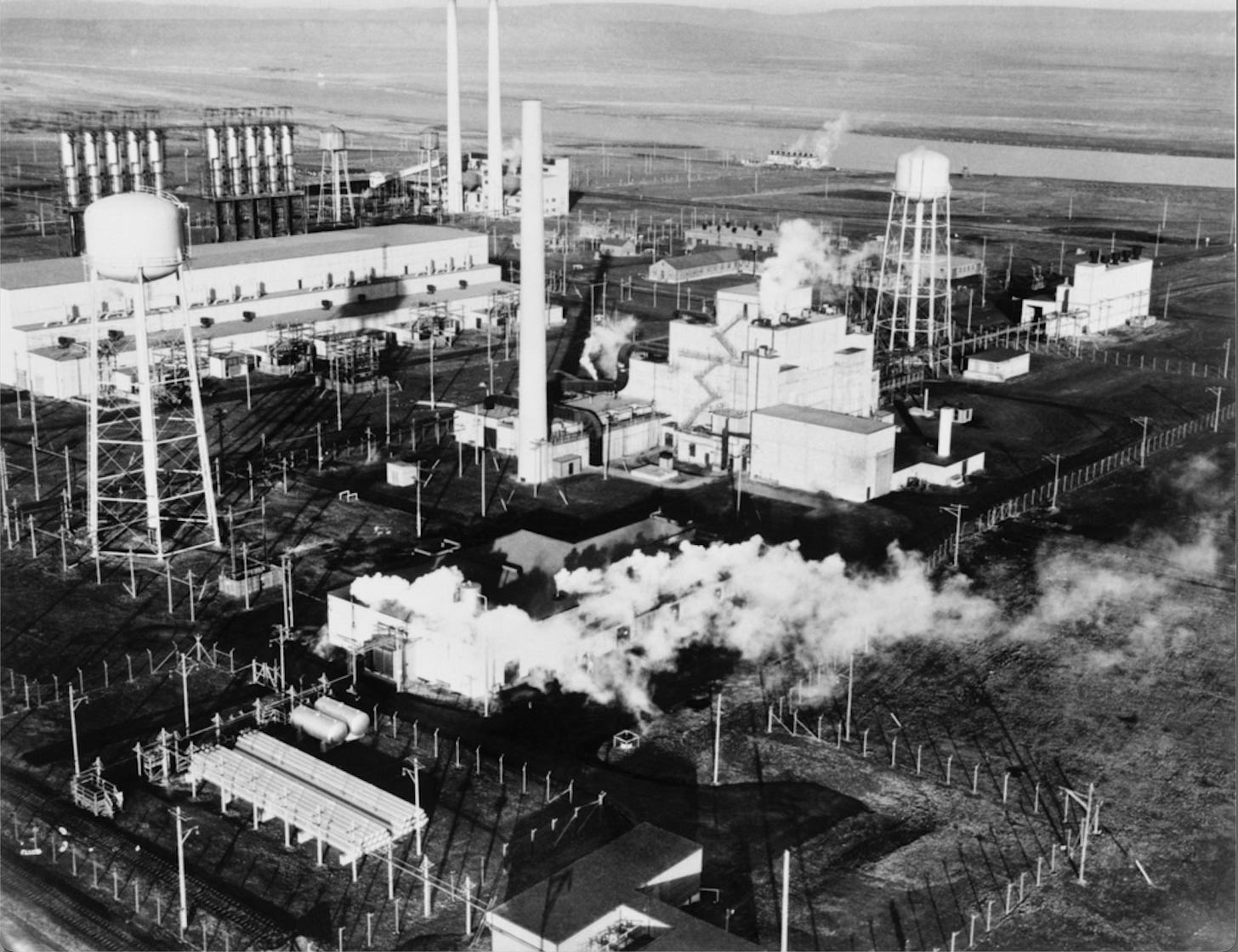
Before my research was published last year, neither American nor Japanese historians recognized that the Hanford Engineering Works (HEW) in southern Washington was the target of a persistent, intentional Japanese attack during the final year of World War II. This operation involved "Fu-Go" high-altitude balloons, a secret weapon developed by the Japanese Imperial Army’s Noborito Research Institute. Supporting the effort were several senior members of Japan’s infamous biological warfare department, Unit 731.
Established in 1942, the Hanford project consisted of some 600 square miles bordering the Columbia River northwest of Richland and Pasco, Washington. Previous studies of Japan’s Fu-Go attack either ignored the balloon assault on Hanford, or claimed that only a few balloons had flown by or into the Hanford complex. As documented below, there were many dozens of such balloons, which carried incendiary bombs and in some cases possibly biological agents, flying over or landing in Hanford. The assault was a matter of much concern for defense and HEW officials.
The Hanford Engineering Works was the site where the world’s first large-scale nuclear reactors were constructed. As part of the U.S. Manhattan Project’s urgent effort to develop atomic weapons, HEW extracted plutonium—the fissile material used in the Trinity test, the first atomic bomb detonation on July 16, 1945, in New Mexico. The same facility also supplied the plutonium that powered “Fat Man,” the bomb dropped on Nagasaki, Japan, on August 9, 1945.1
All told, the U.S. spent over $2 billion (in 1945 dollars) to, among other things, build three secret cities to house the scientists and workers for the atom bomb project: Los Alamos, New Mexico; Oak Ridge, Tennessee, and Hanford Camp, Washington, otherwise known at the time by their code names, Site Y, Site X, and Site W, respectively.
The Manhattan Project was top secret. Even the thousands of workers and technicians who were recruited to work at Manhattan Project sites did not know the ultimate aim of their work. Military police patrolled all areas. Access to the sites was regulated and carefully watched. The U.S. press was recruited to voluntarily participate in newspaper censorship surrounding the facilities. The same kind of voluntary censorship by the press was also used to stifle contemporary reports of the Fu-Go balloon attacks.
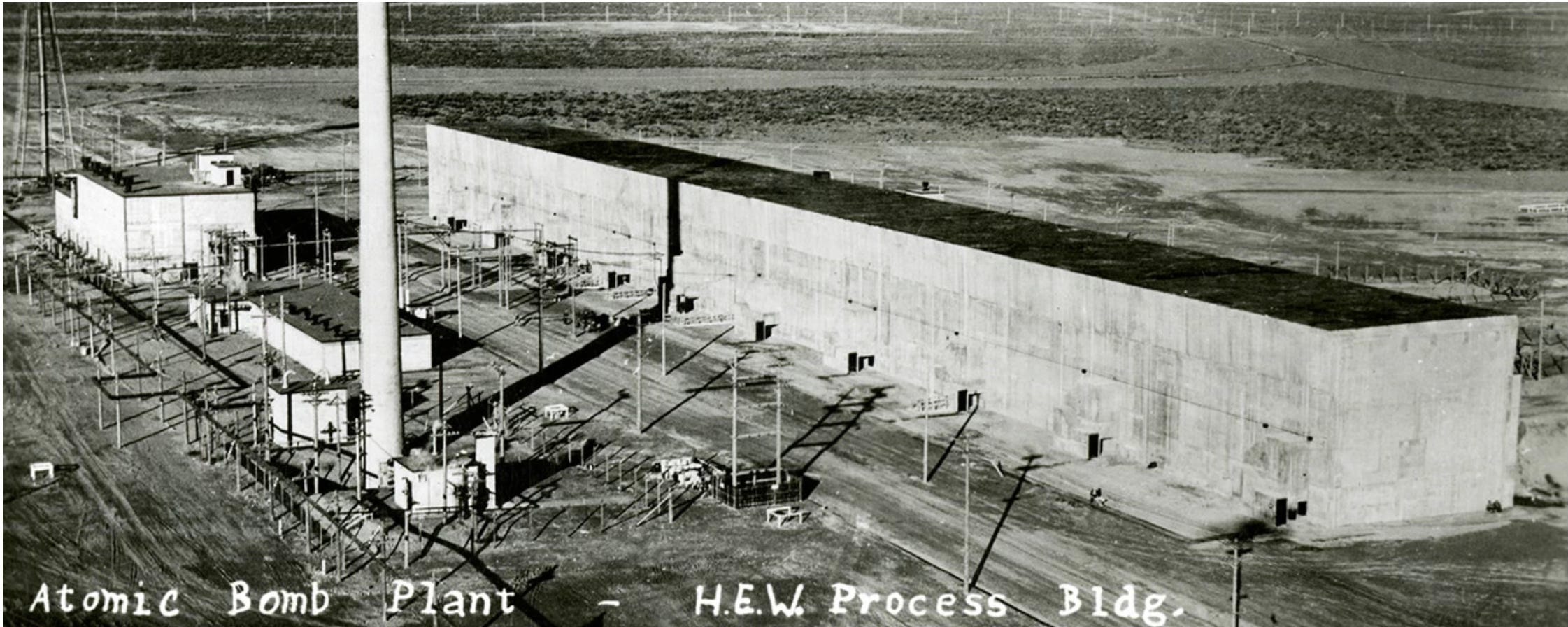
In this article, I will consider how Japanese intelligence agents, utilizing open source materials — primarily U.S. newspapers — could have quite easily determined that something very big and very special was being organized at Hanford. They could have done this by steady perusal of the major newspapers in the Pacific Northwest.
Ken Kotati’s 2009 study, Japanese Intelligence in World War II, is one of the few authoritative books to have been published in English on Imperial Japan’s intelligence efforts. According to Kotani, Japan’s intelligence services had few human intelligence sources in the United States.
“The information sources of these [U.S.] activities were mainly analysis of newspapers and journals — except for SIGINT [Signals Intelligence], most of the information collected against the United States was based on such open sources” (Kotati, Japanese Intelligence, pg. 56, material in brackets added).
As a summary of some of the information in his book, in 2009 Kotani wrote an essay for Japan’s Ministry of Defense (MOD) “think tank,” the National Institute for Defense Studies (NIDS). The essay, “Japanese Intelligence in WWII: Successes and Failures,” also described the “information gathering” activities used by Imperial Japan’s Army and Navy, each of which had their own intelligence apparatus.
According to Kotani, besides open source perusal of newspapers and journals, Japanese intelligence also utilized agent “observation, interviews with important people, purchasing of information, human source intelligence and spy photos.” When they could, they also relied on “radio interception and [radio] signals theft.”
Even so, a chart titled “Number of Items of Intelligence and Data Gathered Between 1 October 1944 and 10 July 1945,” broken down by intelligence source, clearly demonstrates the overwhelming predominance of open-source intelligence (OSINT) in Japanese wartime collection efforts during this period. [The chart is available at Kotani, “Successes and Failures,” pg. 5.]
Out of a total of 1,484 intelligence items gathered by the 1st Operations Department of the Imperial Japanese Navy, 879 items, or nearly 60% of all items came from “open source” intelligence, primarily “magazines, newspapers and broadcasts.” Kotani elaborated: “During the war, the information section of Domei News Agency gathered the news on every country around the world daily, translated it, consolidated it and reported it to the military as hostile intelligence.” [Kotani, “Successes and Failures,” pg. 8.] It is not clear how many news sources were utilized, but they included at least the primary national newspapers, magazines and wire services.2
A full list of OSINT materials used is precluded partly by the significant fact that at the close of the Second World War, according to the website on Military Archives held by NIDS/MOD, the bulk of Japan’s military documents “were destroyed by the military at the surrender of Japan in World War II, and the rest were scattered.”
The document destruction included materials related to the Imperial Army’s Fu-Go campaign.
On 15 August [the same day Emperor Hirohito announced the surrender of Japan], Army Affairs Section ordered the destruction of all materials pertaining to the military’s ‘special research.’ First on the list was the Noborito Research Institute and its balloon bomb program. Also listed was the Kwantung Army’s Unit 731, which had conducted lethal experiments on captives to develop biological weapons. (Stephen C. Mercado, The Shadow Warriors of Nagano: A History of the Imperial Japanese Army’s Elite Intelligence School, Potomac Books, 2002, p. 176. Kindle Edition, material in brackets added.)
The Manhattan Project, the United States’ $2.2 billion crash program3 to develop the atomic bomb, was shrouded in extreme secrecy, with extraordinary measures taken to protect its classified nature. Yet, as historian Alex Wellerstein notes on his blog Restricted Data: A Nuclear History Blog, “Even during the Manhattan Project, there were copious leaks. Some small, some huge.”
Wellerstein, a professor of science and technology studies at the Stevens Institute of Technology and a leading scholar on nuclear weapons history, has written how despite the project’s intense security apparatus, significant disclosures occurred throughout the war.
Wellerstein described one of the most egregious security breaches in a 2013 article:
During World War II, the United States had a program of voluntary press censorship, coordinated by the Office of Censorship. It was, as stated, voluntary: there were no fines or threats attached to it, just stern official rebuke. It lacked “teeth”….
The worst violation came in March 1944. John Raper, a reporter for the Cleveland Press, while on vacation in New Mexico, somehow stumbled upon one of the biggest, most secret stories of the day. [Bold emphases in original]
Raper’s article was entitled, “Forbidden City: Uncle Sam’s Mystery Town Directed by ‘2nd Einstein.’” Wellerstein reproduces the entire article at his website. The entire Cleveland Press article can be read in its original form at a clipping I made at Newspapers.com.
The then-74 year old Raper had been working for the Cleveland Press since 1899. It’s not clear that his article was ever reproduced at any other newspaper, but its notoriety merited mention in the Encyclopedia of Cleveland History. The article doesn’t appear to have been picked up by the wire services either, which, in any case, were adhering to government censorship policies at the time.
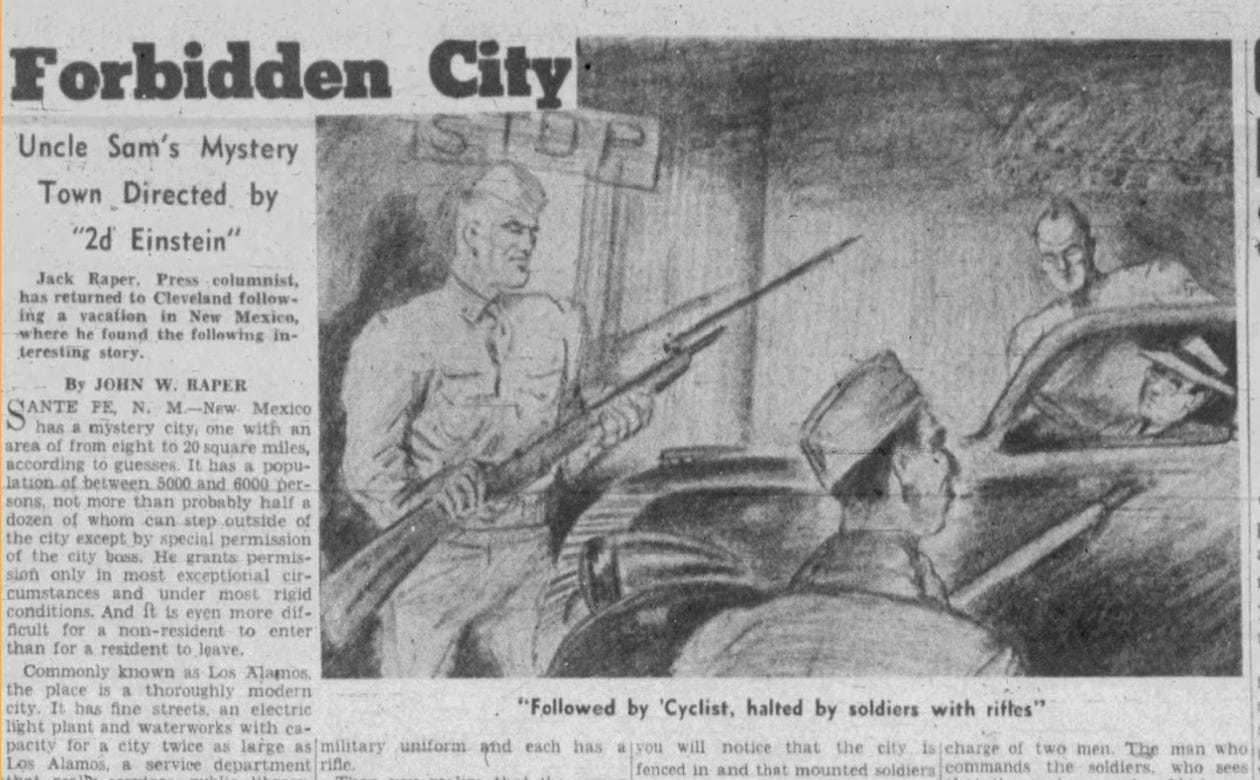
Imagine, however, what a Japanese intelligence agent would have thought when he read Raper’s description of Los Alamos, “a mystery city, one with an area from eight to 20 square miles…. [with] a population of between 5000 and 6000 persons, not more than probably half a dozen of whom can step outside of the city except by special permission of the city boss.”
Raper clearly stated, “the owner of this strange city is Uncle Sam….” A “Col. Somebody” was said to command the soldiers in the area, as well as being in charge of keeping the services of the city working. But “the Mr. Big of the city is a college professor, Dr. J. Robert Oppenheimer, called ‘the Second Einstein’ by the newspapers of the west coast.” Elsewhere in the article, Oppenheimer was described as an “eminent physicist.”
According to Raper, “It is the work of Prof. Oppenheimer and the hundreds of men and women in his laboratories and shops that makes Los Alamos such a carefully guarded city.” Residents were obliged “to remain there for the duration,” and “many of them don’t know much more about what is being done than you do.”
In fact, many people worked at Manhattan Project sites for only a few months. For that matter, Hanford had trouble obtaining and keeping enough workers. One Florida newspaper even issued an October 1944 editorial complaining that HEW was stealing necessary workers from elsewhere in the country.
According to Raper, some people speculated that the secret work at Los Alamos concerned chemical weapons. Others believed that the work centered on “ordnance and explosives.” Raper said that those who believed the latter “argue that it accounts for the number of mechanics working on the production of a single device and there are others who will tell you tremendous explosions have been heard.”
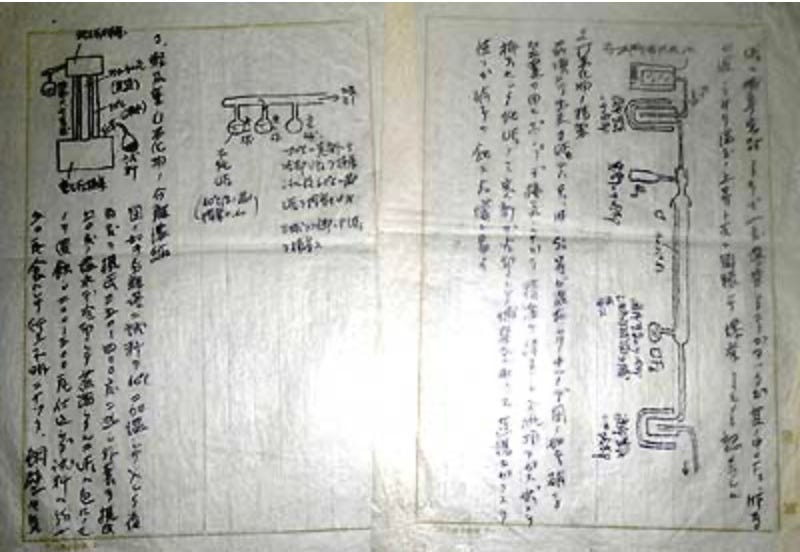
Japan certainly was aware of the theoretical potential of making an atom bomb, and even had their own underfunded atomic program for a while during the war. (For more on Japan’s nuclear bomb project, see this article published at a Hiroshima news site.) It’s not clear to me that Japanese intelligence agencies were told to be on the lookout for an allied project that was also working on an atomic bomb, but it makes sense that they would have been.
As Wellerstein concluded, “if I were a spy thinking about nuclear weapons, I would find [the material in Raper’s article] a pretty interesting combination of things, and worth following up on” (bold text in original).
I think, when readers complete this article, they can say the same thing about Hanford Engineering Works.
Did the Raper article have anything to do with Fu-Go balloons that flew over or near Los Alamos sometime in early 1945? This is a hypothesis I explored in an article in September 2025.
In any case, my earlier reporting, based on a declassified “Confidential” 1950 FBI Memo from Director J. Edgar Hoover to the Assistant Chief of Staff, Military Intelligence, at the Pentagon, demonstrates that the landing of Fu-Go balloons in New Mexico during the war remains censored, or otherwise unreported, in all other histories on the subject. One high-level government consultant thought some of these balloons had carried bubonic plague.
Raper’s Los Alamos article was not the only security leak in relation to the Manhattan Project. I found some fairly egregious leaks in the nation’s press surrounding the existence of the Hanford Engineering Works. Not only were there exposé articles on Hanford similar to the one Raper wrote on Los Alamos, but from the very beginning of the establishment of the Hanford site there were a plethora of articles that pointed to the secret nature of the work done there that would have raised an intelligence agent’s eyebrow.
As early as April 23, 1943, an article in the Spokane Chronicle quoted Bonneville power plant administrator Paul Raver to the effect that a contract for 800 kilowatts of power had been signed with a “new industrial plant,” Hanford Engineering Works, forerunner of an eventual agreement to supply 140,000 kilowatts (140 MW or megawatts) for the Hanford plant. Raver refused to give any more details.
140 MW was no ordinary industrial power draw. It was a strategic-level demand, typical only of select wartime operations like aluminum smelting, large-scale chemical production, or—most tellingly—uranium enrichment and plutonium production, both of which remained completely hidden from public knowledge.
Suspicious, a spy might think. Something to monitor at the very least. The Chronicle article was openly all about meeting “war industry needs.” Then, a little over a week later, on May 2, 1943, a small article put out by the Associated Press (AP) wire service described a “government project in north Benton country in central Washington.” It was a “purely military project…. known as the Hanford engineering project,” AP reported. Moreover, AP disclosed that the project was “under the direction of Lieutenant Colonel F. T. Matthias.”
Not only did this small article help connect the dots with the Bonneville power article the month before, it revealed that Hanford Engineering Works was a “military project,” and provided the name of the military official in charge! So much for secrecy. Yet this would not be the worst of the revelations.
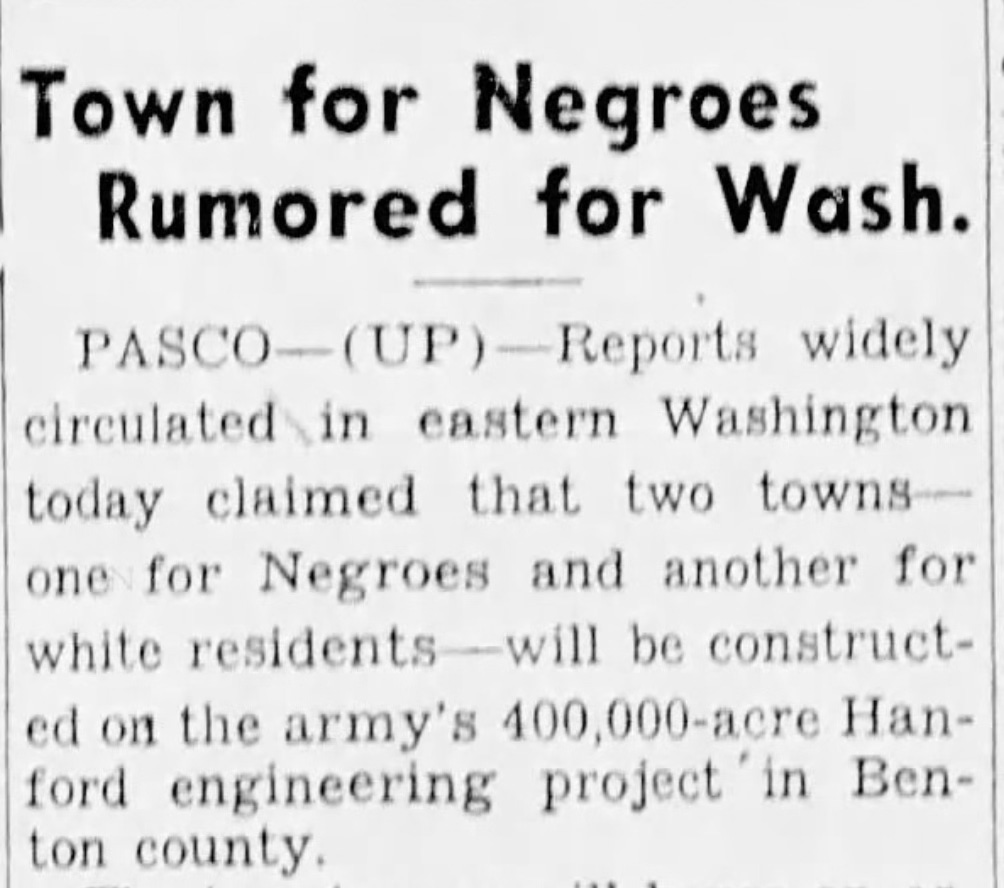
The Hanford project was birthed in controversy. The day after the May 2 AP article, the United Press (UP) wire service reported that existing towns nearby were being evacuated by the military, and that two new towns were being built “on the army’s 400,000-acre Hanford engineering project”— “one for negroes and another for white residents.” Altogether, the two segregated towns would house some “15,000 workers needed for the huge project.”
The issue of race segregation in Hanford housing would cause a big protest. While there was plenty of racial discrimination in Washington State in the 1940s, it was not a “Jim Crow” state.
In addition, the UP article explained that new housing was also being “acquired” in the nearby town of Pasco, where “engineers, construction foremen and skilled workers” would be housed. It seems that the workforce was segregated by both race and by class, or level of employee skill, education and authority.
The issue of racial segregation, not only in housing, but at mess halls, bus transportation, etc., was addressed at a meeting of the northwest chapter of the NAACP on February 13, 1944. The next day, an article in the Spokane Chronicle (pg. 13) reported that the meeting had approved a resolution condemning the “alleged” segregation practices. Seattle attorney John Prim “was named chairman of the committee to file protests.” Prim “was the first African American to serve as deputy prosecuting attorney for King County and the first African American judge in the state.”
According to an article by Dr. Robert Bauman, “Jim Crow in the Tri-Cities, 1943–1950,”4 published in an abridged format online, the NAACP elevated the struggle against racial segregation and discrimination at the Hanford Engineering Works to a matter of national significance.
HEW was run jointly by the Army and federal contractor E. I. du Pont de Nemours and Company. Thurgood Marshall, then “special counsel at NAACP headquarters in New York… wrote state and federal officials demanding an end to segregated buses,” Bauman wrote. “Four months later, DuPont stopped the practice.”
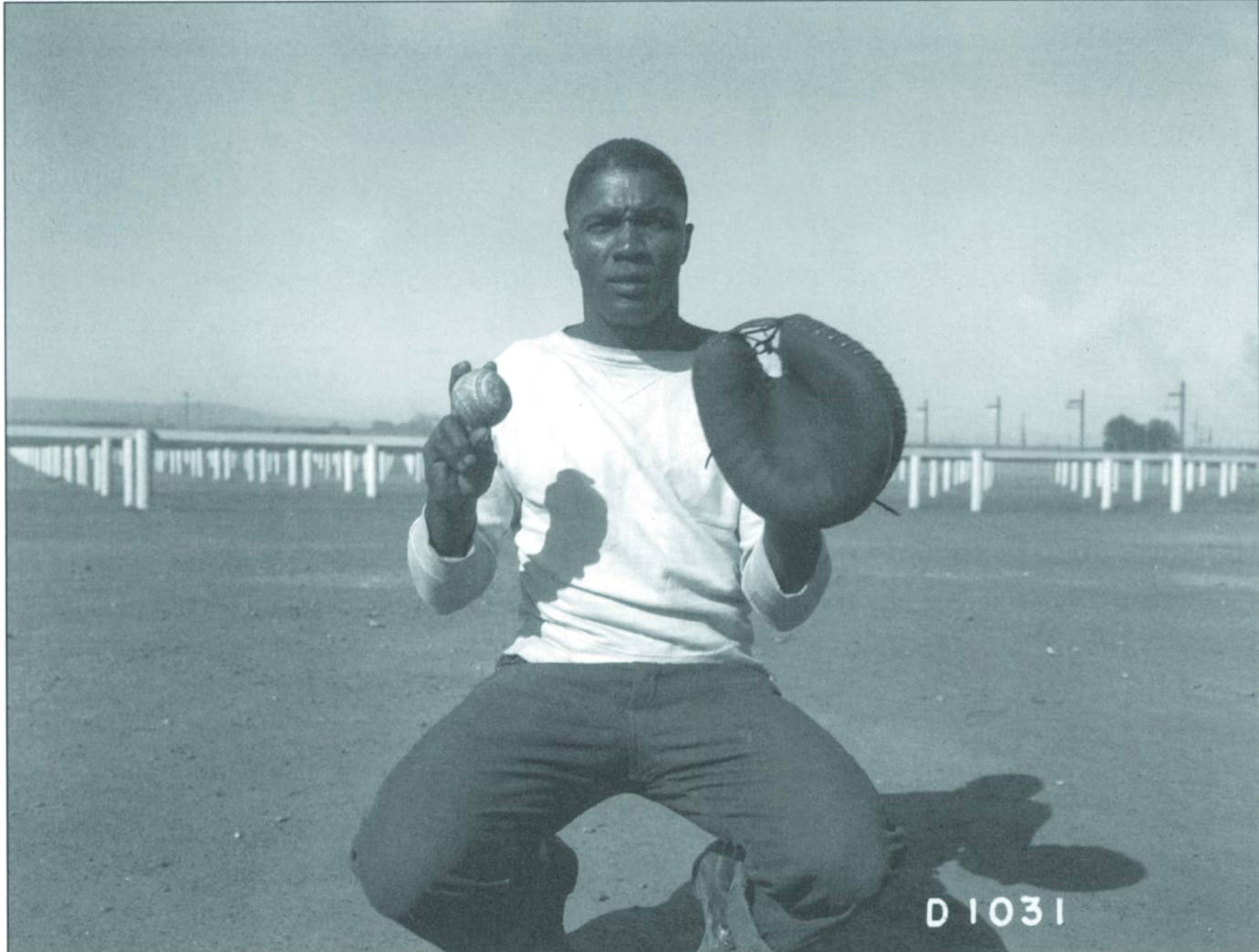
U.S. Army Major R.F. Ebbs, identified as HEW’s “project executive officer,” sent a letter to the meeting’s attendees. Ebbs — who we shall come across later on in this article — alibied the segregation policy. The Spokane Chronicle reported Ebbs’ argument that “separate busses [sic] and other facilities had been provided for Negroes at the request of the Negro leaders at the project.” As the controversy dragged on, no “Negro leaders” at HEW requesting the separation of races were ever identified by name. No doubt there was a lot of mistrust between blacks and the Army in southern Washington.
Meanwhile, an article in the May 3, 1943 issue of The Coeur d’Alene Press explained that those individuals “who formerly lived on the acres taken over by the army, some 1200 people” were “being evacuated” from their homes in the HEW area. [Warning: The following sentence includes a racist term often used during this period]. Referencing the recent incarceration of Japanese living in the United States, particularly the West Coast, the news article said many evacuees “protested they were being treated ‘worse than the Japs who were given train fare, food and living quarters.’”
In the months to come, there were many, many articles about the legal wrangling and tribulations of the Hanford site evacuees, as numerous lawsuits over the government land takeovers wound their way through the courts. In one example, a May 22, 1943 article in the Spokane Chronicle stated that the federal district court for eastern Washington would be litigating the “land condemnation suits involving the Richmond section of the Hanford engineering project” for at least another year.
Nearly four months later, on November 4, 1943, the Courier-Herald, a newspaper in Kennewick, Washington, claimed the “final chapter in the evacuation of residents from the area occupied by the Hanford Engineering Works….”
The article quoted G.R. Gochnour, who had been handling the sale of Frank Wilson’s cattle ranch “northeast of Prosser,” who “estimated that during the year he will have disposed of about $1,000,000 worth of property, much of it from the dispossessed farmers along the Hanford project.”
Issues surrounding racial segregation, including protests against it, labor problems and the animus and legal battles of those displaced by the construction of HEW would continued to surface in the press for the duration of the war. In the process, despite censorship over exactly what was being constructed or manufactured at Hanford, much “open source” information that could inform an “enemy” intelligence agency leaked out. If the Imperial Japanese Army was looking for targets for their balloon attacks on the United States, the mysterious Hanford project would have seemed a promising target.
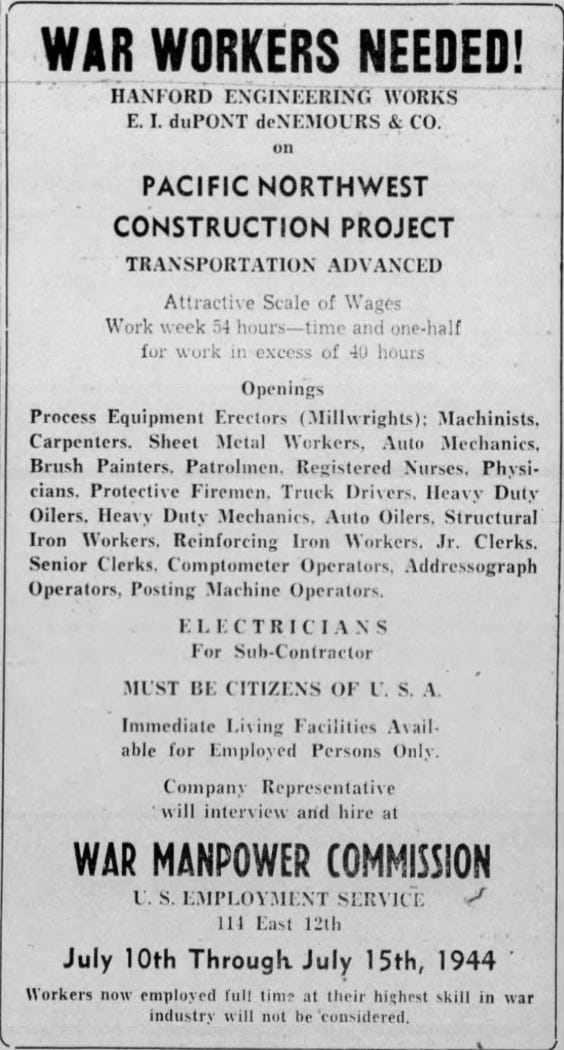
If the articles mentioned above were the sum total of the revelations concerning HEW, then perhaps my thesis about targeting would seem somewhat tenuous. But there were a lot more examples over the months to come.
Newspaper readers could not escape the fact that the HEW project was big, really big. A May 6, 1943 article in the Spokane Chronicle (page 3) quoted the head of the mining division of the local branch of the War Production Board (WPB): “When the Hanford Engineering Works project in Benton County gets fully under way, we’re going to need every scrap of construction machinery we can dig up in this area.”
A huge project like HEW meant increasing demand for electrical power, as has been already noted. A front page article in the May 8, 1943 edition of the Spokesman Review noted that the Bonneville Power Administration planned to massively expand water storage and increase energy output by a factor of six.
The importance of the HEW project in all this was explained at the very end of the article. The Hanford project already was expected to use up “nearly half as much power as Grand Coulee [Dam] is now sending over its newly finished circuits.” The paper admitted HEW’s power needs were “an important factor in the greatly increased demand.”
The Hanford expansion also put a stress on local infrastructure, such as roads and schools. All of this made its way into the newspapers, often as small local stories. For instance, one May 1943 article in Sunnyside, Washington’s paper, the Daily Sun-News (page 1), described plans for road improvements and a new bus service to operate between the town and HEW.
The roads inside the Hanford site itself — some 600 square miles or more — were to be transferred from the relevant counties with title going to the War Department. An attorney testified in court that the government road takeover was necessary “to prevent unauthorized persons from gaining knowledge of ‘a very secret military mission,’” while also relieving the country from expanded maintenance for “the roads which are going to pieces under heavy truck travel.”
Travel on the roads was getting dangerous. A truck accident on June 22, 1943 revealed the cargo of one truck consisted of “Heavy drums of wire, bundles of iron pipe, and other parcels addressed to the Hanford engineering project….”
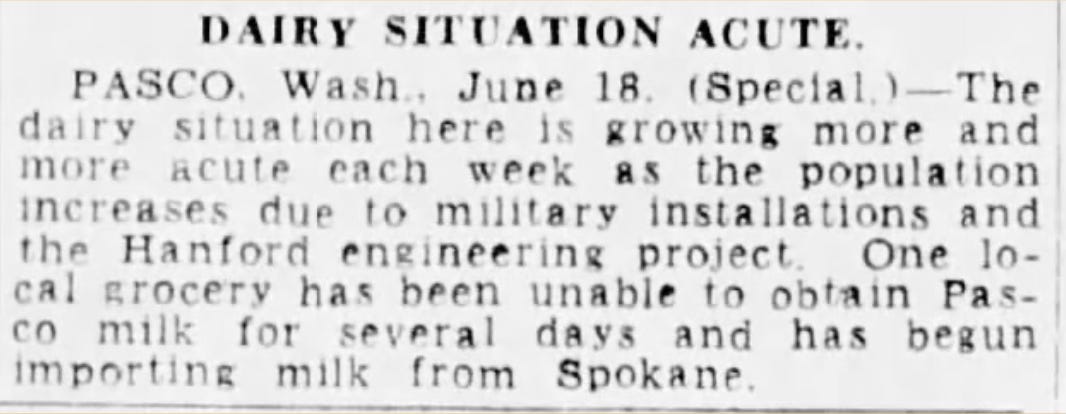
Other situations involved food shortages. The article screenshot below, from page 6 of the June 18, 1943 edition of the Spokane Daily Chronicle, describes a milk shortage due to the population increases from HEW and other “military installations.”
With the influx of workers came also their families, at least in some cases. More children meant more pressure upon existing schools. A June 10, 1943 article in the Spokane Chronicle (page 15) reported plans to consolidate a number of school districts in the new town of Hanford, and other nearby towns, “all within the area recently taken over by the government for the Hanford Engineering Project.”
By the fall semester of 1943, the new consolidated school district had to implement double shifts to accommodate all students (from 8:00 am to 1:00 pm, and 1:00 pm to 5:30pm). This was needed, according to a press report on September 7, “because of the influx of population due to the Hanford engineering project.”
The influx of new workers also caused a housing shortage. Workers took to placing classified ads for housing situations, as this linked example shows. Meanwhile, the government control over the area increased. A July 28, 1943 article in the Spokane Chronicle (page 5) reported that the Army had taken over the “lines and properties of the Columbia River Telephone company in the Hanford Engineering Works area.” The Army offered the company $45,525 in compensation.
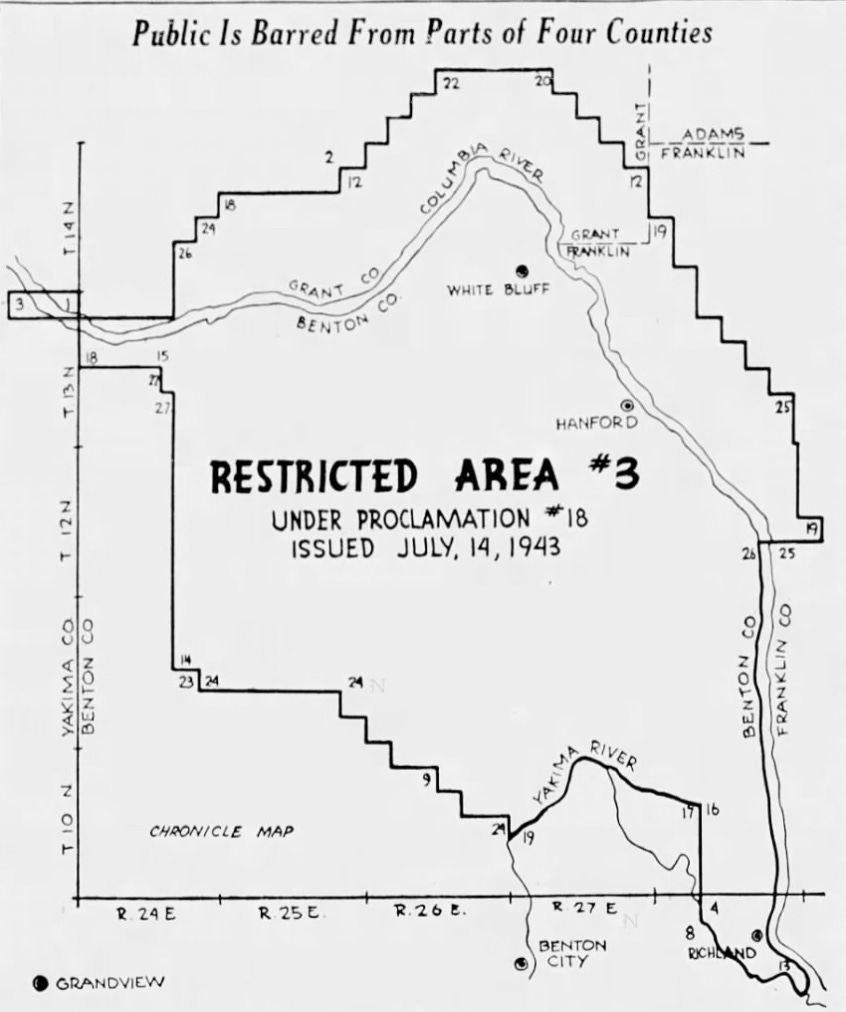
Only two weeks earlier, the area around Hanford had been sealed off. On July 14, Lieutenant General J.L. DeWitt, of Western Defense Command, headquartered in San Francisco’s Presidio, proclaimed a “total exclusion area” in Hanford. As reported by the Spokane Chronicle on July 29 (page 13):
“No person,” says the order, “shall have the right or shall be permitted to enter, remain in or leave” except with permission of the district army engineer.
Any person violating the restrictions will be subject to criminal penalties....
The new restricted zone is known as No. 3.
A map of “Restricted Area # 3” was published by the same paper on August 13, 1943 (page 6), as reproduced below, and showed exactly where the the restricted zone and the new town of Hanford was located:
Seventeen months after the order to establish “Restricted Area #3,” Hanford’s Officer-in-Charge, Colonel Franklin Matthias (the same Col. Matthias who was identified in the May 2, 1943 AP article mentioned earlier) was writing in his diary. In the diary entry for January 12, 1945, Matthias described how his local counter-intelligence chief was looking into sources “independent” of normal intelligence channels to learn more about the “balloons which had been landing in this area.” This was two months earlier than all the histories describing the Fu-Go attacks claim any balloons alighted at or near Hanford!
Besides the balloons, there were also reports about unidentified planes heard flying over the military reservation at Hanford Engineering Works. The sudden and mysterious appearance of planes and balloons meant to Hanford top officials that the site was getting a lot of unwanted attention from someone, and attention was something they did not want.
The balloons, as we know now, came from Japan, and I’ve written elsewhere about how the number of balloons that flew directly over or came down inside HEW meant that the government project had been specifically targeted by the Japanese. (We still don’t know where the planes came from, but one could speculate that they, too, represented a foreign intelligence-gathering operation.)
Years later, Walter O. Simon, Hanford’s first operations manager, told historian S.L. Sanger in a 1986 interview what he remembered about the Japanese balloon attack.
“I want to mention something else, the Japanese balloon bombs.... They were a real worry. Everybody at the plant was always looking up because of the statistical chance of one falling. I remember seeing 40 at one time going over. The Navy planes at Pasco chased them regularly but they had poor luck. Matthias and I went over to prod them about getting better protection. They never managed to shoot one down, although a number came down on the project, but away from the buildings. [p. 155]5
Why would the Japanese military target Hanford? Perhaps because newspaper reports kept touting its military importance and the need for secrecy. Sometimes the nature of the complex leaked out in the most unlikely fashion.
One example was a small article on page 8 of Salt Lake City’s Deseret News, dated December 2, 1943. The article was about a “farewell dance” planned for workers from the Utah Ordnance Plant, which was shutting down. The article mentioned that some of the workers were being “transferred” to Hanford Engineering Works, “a DuPont plant near Pasco, Wash. Future activities of this plant, now under construction, are such a secret that it has been nicknamed the ‘hush hush plant,’” Deseret News reported.
Consider also this February 12, 1944 article in The Spokesman-Review (page 9), “Hanford Secrecy of Major Import.”
Major R.F. Ebbs, army engineer, told school directors of Benton and Franklin counties today that every individual some day will be proud of his contribution to the war effort when the nature of the Hanford engineering works can be revealed.
“This is a very classified project, and this area has the highest classification restriction of any area in the United States”….
Secrecy “from all citizens” was necessary “to keep knowledge from the enemy,” the paper reported, summarizing Ebbs’ discussion.
The same article also revealed that the Army had taken over “thousands of acres of orchard lands” in the area, and had arranged for prison labor to be trucked in to “cultivate and harvest crops.” Ebbs allowed that there had been some difficulties. “The project has worked a hardship on the residents of Richland and the neighboring towns, with the relocation of families and higher taxes….”
It wasn’t only families that had been displaced. Even the dead could not escape the upheaval over the consolidation of the secret work at Hanford. A May 1944 article in Spokane Chronicle (page 15) described the necessity of relocating 177 graves from the old town of White Bluffs, “at government expense,” to make way for work at HEW.
The revelations concerning Hanford continued. On September 25, 1944, around the time I suspect target lists for Japan’s Fu-Go attacks were being finalized, a Minnesota paper, The Winona Daily News, published an astonishing exposé on the Hanford plant.
Headlined, “Workers Sought Here for ‘Secret’ Project on Coast,” the news article emphasized the “revolutionary” nature of the work taking place at Hanford. The source was Stanley S. Hammer, the “Winona area director of the War Manpower commission [WMC].”
The Winona paper said that Hammer had emphasized that “serious labor shortages” were “delaying the manufacture of certain materials of war urgently needed by our fighting forces both in Europe and the Pacific….”
“Notably among these,” said Mr. Hammer, “is the gigantic project at Pasco, Wash., being constructed by the Hanford Engineering Works for the E.I. duPont Company, the product of which is so ‘hush hush’ that not more than three persons in the entire United States know the whole story. It is said the product of this plant is so revolutionary that its use by our armed forces will help to shorten the war by months.
“Hundreds of laborers, sheet metal workers, steamfitters, plumbers, steamfitter combination welders and other construction men are needed to rush the job through to completion,” added Mr. Hammer. “The WMC has been charged with the responsiblity of supplying the necessary labor for this project, which carries a high national priority on manpower. All offices of the U.S. Employment service have been assigned definite quotas to fill and we must see that our area meets its quota.”
While Hammer had flipped the relationship between DuPont and HEW — it was DuPont who worked for the government’s HEW, not the other way around — the extraordinary secrecy about a “revolutionary” “product” to shorten the war was sure, if intercepted as part of an OSINT review, to pique the interest of Japanese military planners considering a balloon air assault on the United States.
The idea that such a balloon attack could reasonably reach the Hanford area, and hope, with multiple balloon attacks, to cause some damage (as indeed it did), is fully described in my earlier article, “Fu-Go Reconsidered: Japan’s WW2 Balloon Offensive, Unit 731, and the Manhattan Project.”
According to the article, “Plutonium Production,” at The Manhattan Project website at the U.S. Department of Energy, “Uranium isotope separation and plutonium production provided the two paths that led to an atomic bomb. Not existing naturally in any significant quantities, plutonium had to be made. The industrial-scale production of plutonium required nuclear reactors, initially called piles…. The refining process produced uranium metal for the plutonium process. The metal was fabricated into fuel slugs that, for the production reactors, were sealed in aluminum cans…. To build a working plutonium bomb, the plutonium needed to be chemically separated from the other materials. DuPont selected a process developed by the Met Lab in which the slugs were dissolved in acid, and then the plutonium was precipitated out by adding bismuth phosphate. The process first was used on an industrial scale at the X-10 chemical separation plant, which was located next to the X-10 reactor.”
“According to the navy’s ‘Situation Estimate Document,’ the open source information in this period can be confirmed as including Reuters, AP, UP, Life, Time, News Chronicle, the New York Times, The New York Herald Tribune, U.S. Central broadcasts, Hong Kong broadcasts, and the military magazines of each nation.” [Kotani, “Successes and Failures,” pg. 8.] The source here is the Imperial Japanese Navy. The Army likely had its own sources. In any case, the list here cannot be considered definitive.
This is in 1943-45 dollars, estimated to be equivalent to $30 billion dollars today.
Dr. Bauman’s article was first published by the University of Washington in The Pacific Northwest Quarterly, Vol. 96, No. 3 (Summer, 2005), pp. 124–131.
The transcript of Walter Simon’s interview is available online. See Walter O. Simon, interview by S. L. Sanger, Atomic Heritage Foundation, “Voices of the Manhattan Project,” “Walter Simon’s Interview,” Wilmington, Delaware, September 12, 1986, https://ahf.nuclearmuseum.org/voices/oral-histories/walter-simons-interview/
Permission to reproduce the oral history material reproduced in this article for the Walter O. Simon interview, part of the “Voices of the Manhattan Project” at the National Museum for Nuclear Science & History, was kindly granted by the Atomic Heritage Foundation. I personally wish to acknowledge the kindness of Cynthia C. Kelly, President of the Atomic Heritage Foundation, and journalist and oral historian, S.L. Sanger in obtaining permission to quote from the “Voices” project, an amazing resource for historians and citizens alike.
Comments
Nothing yet. Say the first thing.
Sign in to join the conversation.