
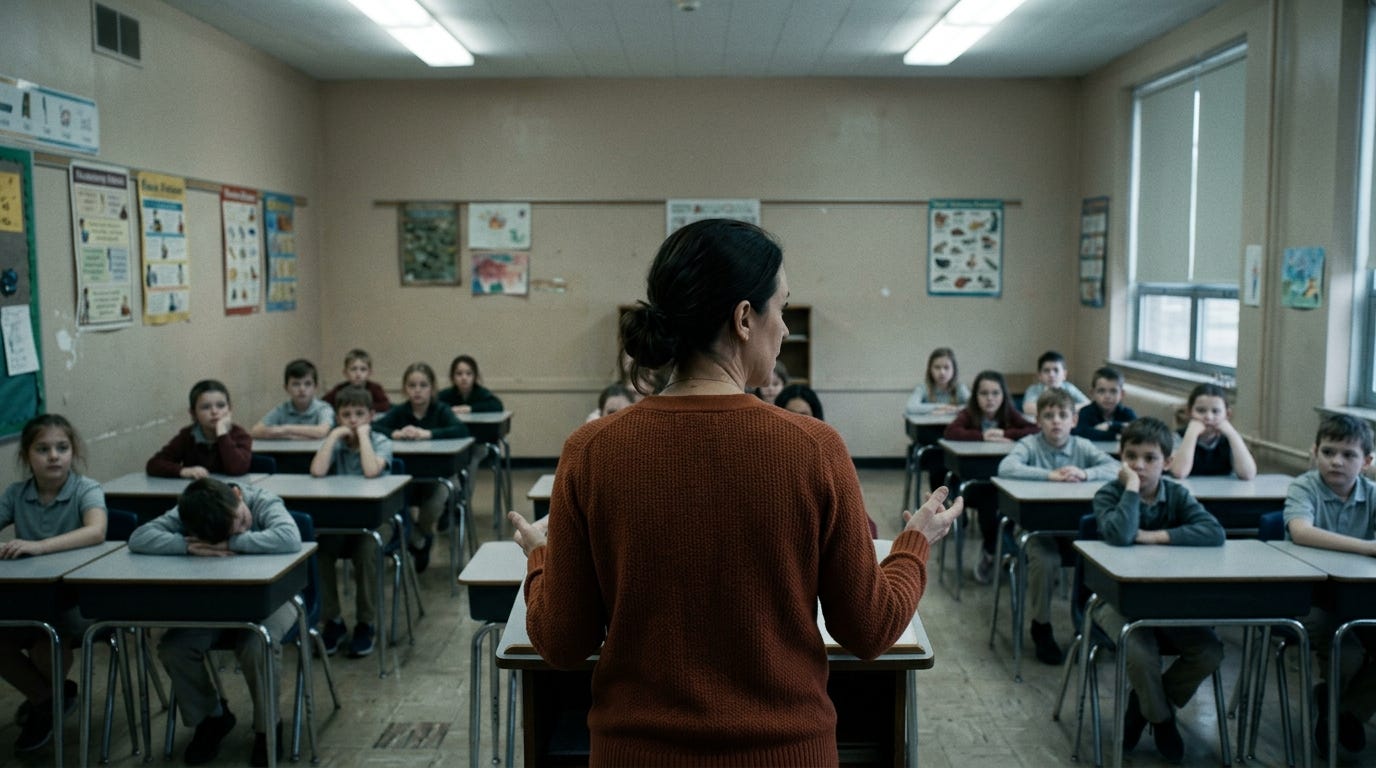
You became a teacher because you believed something about children. You believed they were curious, capable, and worth protecting. You believed that what happened in your classroom mattered, that your presence in their lives could make a difference, even a small one, even on the worst days.
Then the years passed and something changed. The mandates piled up. The standardized tests crowded out the lessons you had actually planned to teach. You watched children you had come to love shrink under the weight of a system that measured their worth in percentile points and compliance scores. You began spending your evenings recovering from the day rather than preparing for the next one.
You called it burnout.
Education philosopher Doris Santoro has a different name for it. That word is demoralization. Burnout is an energy problem. Demoralization is a values problem. If you are burned out, rest helps. If you have been demoralized, no amount of rest will restore the sense that your work means something, because your suffering comes from being asked daily to do things that violate your understanding of what education is supposed to be for.
The teachers experiencing demoralization most deeply are the ones who refused to give up on children. When you see this, you see everything differently. You start to understand your own suffering more clearly. You start to understand the institution that produced it.
Santoro spent years studying teachers who were leaving a profession they had entered with great love and high intention. What she found challenged the most common explanation for teacher attrition.
A burned-out teacher has run out of resources. Given rest, recovery, and renewed support, they can return to work they love. A demoralized teacher has something different happening entirely. They have been required, day after day, to act against their own values. That requirement erodes the sense that anything they do in the classroom is genuinely good for the children they came to serve.
Santoro’s case studies make this concrete. “Gina,” a Teacher of the Year recipient in her research, was not tired. She was ashamed. The instruction the system required her to deliver was, in her own professional judgment, harmful to children. She had spent weeks developing thoughtful, individualized learning objectives only to be told by administration that all faculty would use identical ones. She described the experience as a slow dismantling of everything she had believed teaching was for.
“The people who were really damaged were the people who were already invested and caring and dedicated.”
— Doris Santoro, Demoralized: Why Teachers Leave the Profession They Love and How They Can Stay (2018)
The teachers suffering most are the ones who feel every day the full distance between what they know education should be and what the system requires them to do. Their suffering is evidence of an accurate diagnosis, proof that their professional conscience is working correctly. They have not failed. They have been paying attention.
Before going further, I want to address something directly. Maybe your response to what you have just read is something like: “But my classroom is different. My children know I love them. I work extra hard to make sure every child feels seen and cared for.”
You’re right. Your love is real. The extra hours, the handwritten notes, the memory of each child’s particular sensitivity and particular gift: all of that is real, and it means a lot to the children in your classroom.
This is also true: a child who feels genuinely loved by their teacher and is simultaneously required to sit inside a system that grades, ranks, surveils, and shames them does not experience those two realities as canceling each other out. They experience both, together, combined, and it is extraordinarily disorientating to their developing sense of safety and trust.
A teacher’s love does not dissolve the structural harm. In many cases, it makes that harm more confusing. The child cannot reconcile the warmth of the person in front of them with what that person is required to do to them every nine weeks when the testing window opens or when grades are due.
No matter how much you love the children in your classroom, you are still required to administer the same standardized tests, assign the same grades, enforce the same attendance policies, and submit to the same accountability systems as every other teacher in the building. The system makes no exceptions for love.
Have you thought about this piece of the pie?
The standardized testing industry generates billions of dollars in annual revenue. Nearly 80 percent of educators report feeling moderate or large pressure to have students perform well on standardized tests.¹ The labor that produces that pressure, and that shapes entire school years around preparing children for those assessments, is largely teachers.
What does that labor actually produce for children? UC Davis researcher Megan Welsh found that teachers who prioritized intensive test prep saw no better results than those who taught more broadly.² The tests measure something, but what they measure most reliably is a child’s socioeconomic background. Research on value-added evaluation models found that out-of-school factors account for 60 percent of the variance in student scores, while teacher influence accounts for only 1 to 14 percent.³
The teachers most exhausted by testing demands tend to work in high-poverty schools, where testing pressure is highest and resources are lowest. They pour their professional lives into producing data that will be used to evaluate them, rank their schools, and generate revenue for corporations that had no part in raising those children. What teachers experience as professional obligation, the testing industry books as profit.
Gallup research identifies K-12 teachers as the most burned-out profession in America. Sixty percent of educators report being burned out, and over half say they will leave teaching sooner than originally planned.⁴ These numbers are often discussed as a “staffing crisis.” They are more accurately understood as the predictable result of asking the most caring professionals in the country to spend their careers doing work that violates their own values, exhausting themselves to harm the children they love, in service of someone else's bottom line.
John Taylor Gatto won New York City Teacher of the Year three consecutive years, from 1989 to 1991. When he was named New York State Teacher of the Year, he used his acceptance speech to name seven lessons the institution had required him to teach through the structure of every school day, regardless of his intentions: confusion, class position, indifference, emotional dependency, intellectual dependency, provisional self-esteem, and constant surveillance.
He did not send his resignation letter to his principal. He published it in the Wall Street Journal.
“I’ve come slowly to understand what it is I really teach: A curriculum of confusion, class position, arbitrary justice, vulgarity, rudeness, disrespect for privacy, indifference to quality, and utter dependency. I teach school and I win awards doing it. I should be at the last stage of my career, but instead I feel an urgent need to stop.”
— John Taylor Gatto, The Wall Street Journal (1991)
The most devastating part of Gatto’s conclusion was not that the system was broken. It was that the system was succeeding. It was producing exactly what it had been designed to produce. The teachers carrying out that production were the ones who had devoted their lives to children.
What would it mean to teach in an environment where your care for children and your job description were the same thing?
That environment exists. Self-Directed Education centers, democratic schools, and sociocratic learning communities have been building it for decades. At these schools and centers, children learn because they are genuinely interested. Adults serve as guides, mentors, and fellow community members. There are no standardized tests to prepare for, no compliance metrics to hit, no behavior charts, no grades, and no requirement that children perform curiosity on a schedule set by someone who has never met them.
Teachers who work in SDE environments frequently describe their days in language that demoralized conventional teachers recognize immediately. It is the language they used when they first imagined what teaching would be: a community of genuine learners, children who love being where they are, adults whose job is to protect and support rather than manage and measure.
The vision you carried into your credential program describes something that already exists. It has been built, by people who were exactly where you are now, and it is accessible to you.
Today: Recognize what is actually happening to you.
Demoralization is the experience of a person whose values are still intact. The shame you carry at the end of a testing season is not a sign that you have failed. It is a sign that your professional conscience is working correctly. Name what is happening clearly: you have been required, repeatedly, to do things that conflict with what you know is right for children. That is a values problem, not an energy problem. Staying inside the institution and hoping for a different feeling doesn’t help. The path forward requires a different kind of change.
This week: Find out whether your teacher dream already exists nearby.
The Association for Self-Directed Education maintains a directory of centers across the country. Visit one. Talk to the adults who work there about what their days actually feel like. Read the follow-up research on Sudbury Valley School graduates, who entered college, careers, and lives with the full range of ambitions intact and with unusually high rates of creative, self-directed work. If there is no SDE center in your community, the networks and resources for building one exist. Teachers have built SDE centers from the ground up in rural areas and in cities, on borrowed land and in borrowed buildings, starting with nothing more than the conviction that something better was possible. The thing you imagined teaching could be already exists.
Also this week: Let yourself off the hook you hung yourself on.
The teaching profession carries a powerful story about its best people: they are the ones who stay, who fight from within, who keep showing up for children even when the system makes it nearly impossible. That story serves the institution. It asks teachers to martyr themselves to a system that hurts them and uses their labor to harm children, and to call that martyrdom a form of service. The values that brought you into teaching were values about children’s dignity and humanity. Those values do not require you to remain inside an institution your own conscience has already indicted. Gatto stayed for decades. When he finally left, he left loudly, in public, on behalf of every child he had been required to fail. His example is a challenge to examine the story you have been told about what a good teacher does, and to ask whether that story is in service of children, or in service of the system.
Education philosopher Doris Santoro’s research reveals that the teachers suffering most acutely in conventional schools are suffering precisely because they still care. The distinction between burnout and demoralization is the difference between an energy problem and a values problem. Treating one as if it were the other is why so many talented, committed people spend years trying to recover from something that rest was never going to fix. The system does not damage good teachers by accident. Their commitment to children is precisely what makes them its most effective instrument.
John Taylor Gatto documented this from the inside. The seven lessons he named in his State Teacher of the Year acceptance speech were lessons the institution had required him to teach through the structure of every school day, regardless of his intentions. The most devastating thing he concluded was that the system was succeeding, producing exactly what it was designed to produce, while the testing industry profited from every data point that production generated.
Self-Directed Education, as practiced in consent-based, sociocratic environments like the Spokane Learning Co-op offers teachers something the conventional school cannot: the structural alignment between caring about children and doing your job. In SDE, children’s genuine curiosity is the entire point. The teacher’s role is to support and protect the natural learning that children already know how to do. For a teacher who entered this profession believing that children were worth protecting, this is the only model in which their deepest professional values and their daily work are the same thing. That model exists. It is accessible. The teacher you set out to be is still possible.
The teachers suffering most are the ones who care most. They are also the ones least likely to believe that their suffering is coming from the institution rather than from their own shortcomings. Send this article to the teacher in your life who is just barely hanging on. It may be the thing that finally gives them permission to tell the truth about what is happening to them.
How can you get as many teachers to see this as possible?
This article is part of the Teachers Deserve Better series at The Joy of Learning. If you are a teacher experiencing moral injury, a parent who wants to understand what your child’s teacher is living through, or an adult who left the classroom and still carries what it cost you, subscribe below. Every issue goes deeper.
If you are a teacher, tell us where you are right now. If you are a parent, tell us what you wish the teachers in your child's life knew. The comment section below belongs to the people who are done pretending the system is working. Use it.
If any part of this article made you curious about what teaching looks like when the system does not own the classroom, the Spokane Learning Co-op holds open visits for teachers and parents who want to see consent-based, sociocratic Self-Directed Education in practice. You do not have to have a plan. You only have to be willing to see something different.
Gallup. State of America’s Schools Report (2014) and State of the Global Workplace Report (2022). Gallup, Inc.
Welsh, Megan. Research on test preparation and student outcomes. University of California, Davis. As cited in project research files.
Fordham Institute and peer-reviewed literature on value-added measurement models. As cited in project research files.
Gallup. State of the Global Workplace Report (2022). Educator burnout and attrition statistics. Gallup, Inc.
Santoro, Doris. Demoralized: Why Teachers Leave the Profession They Love and How They Can Stay. Harvard Education Press, 2018.
Gatto, John Taylor. “I May Be a Teacher, But I’m Not an Educator.” The Wall Street Journal, July 25, 1991.
Gatto, John Taylor. “The Seven-Lesson Schoolteacher.” New York State Teacher of the Year acceptance speech, 1991. Published in Dumbing Us Down: The Hidden Curriculum of Compulsory Schooling. New Society Publishers, 1992.
Gray, Peter. Free to Learn: Why Unleashing the Instinct to Play Will Make Our Children Happier, More Self-Reliant, and Better Students for Life. Basic Books, 2013.
Comments
Nothing yet. Say the first thing.
Sign in to join the conversation.