
It can’t have escaped many people’s notice that today is the tenth anniversary of that horrible, horrible morning when we woke up and found out that the Brexit vote had gone through. What a shock. I articulated it as feeling like someone had died, but in fact it was worse than a mere person dying; it was ourselves, as a polity. A whole social contract, any sense of collaborative nationhood. And to say we’ve never got that back would, putting it mildly, an understatement. What felt broken and flailing that day — a bit like that electrical wire at the end of ‘The Ice Storm’, maybe — lies now in shreds and smithereens all around us, its splinters and sparks spiking and shocking us every time we try to take a step forwards.
Within a day or two of that awful morning I was watching something on the news — a vox pop — and a man in the street (no need to describe him, sadly you can probably picture him) suddenly leapt forward and accosted two Asian people walking past, jabbing his finger in their faces, screaming hoarse & frothing: ‘WHY ARE YOU STILL HERE? WE VOTED YOU OUT!!’
Et cetera.
Aside from the street where lots of German people lived having every single car’s tyres slashed, and the tapas places with rocks through the window, it’s my most vivid single memory of that week. It was a terrifying time because no one knew where it would stop. And of course there was no immediate cataclysm, just that things got gradually worse over a drearily long stretch of time, and kept getting worse.
And here we are. We’re surrounded by that man now — not in that he’s most of us, but that he’s in every street. In the street where I live now (because everything has changed since then, and instead of dear old multicultural Hackney I now live in a little town where those men feel very free to say whatever they want), they were stringing up Union Jack bunting last year and chanting ‘Sieg heil’. Their hatred has spread from foreigners to anyone who disagrees with them, and thanks to the prevailing winds, they are being validated in this every day.
So the world is just different. We’ve lost our insoucience — at least, I’ve lost mine for sure. Everything that happens now is State of the Nation. Two things I’ve seen in the past couple of days have struck with really extra poignancy, as reminders of what life used to be like.
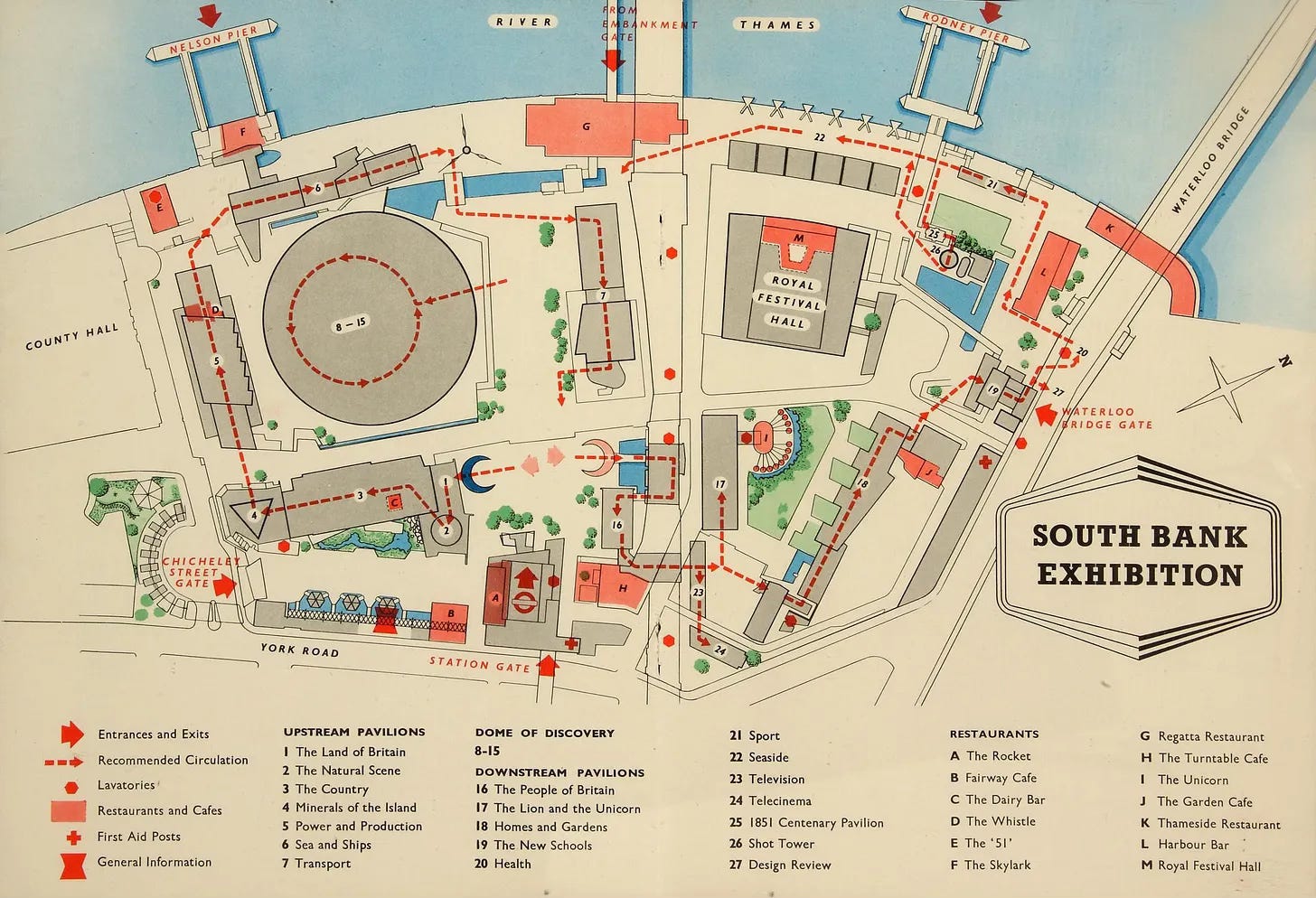
One was a Substack post, in which my longtime fellow poet-blogger Jeremy Noel-Tod has shared an extraordinary text in full: Dylan Thomas’ ‘fifteen-minute radio postcard’ from the 1951 Festival of Britain for the BBC Welsh Home Service. Just by sharing this utterly delightful thing, ‘a prose rhapsody far more verbally vivid and inventive than it needed to be’, Jeremy has given us all a present — a gift, anyway, wrapped with a big bow, and maybe the image of an idealised present. Something to aim for.
For the first time ever, reading it, I really wish I could have gone to the Festival of Britain. I want to have seen that. What really comes through in Dylan’s description — and in the others fascinatingly quoted in the post — is the sheer optimistic expansiveness of it all, all eyes on the future, the excitement of international culture making everything bigger, in a miraculous peacetime, and the trust that this is what will happen.
It’s just gorgeous. Here’s a smallish extract:
“And other visitors begin, of course, at the end. They are the people without whom the exhibition could not exist, nor the country it trombones and floats in with its lions and unicorns made of ears of wheat, its birds that sing to the push of a button, its flaming water, and its raspberry fountains. They are the suspicious people over whose eyes no coloured Festival wool can possibly be pulled, the great undiddleable; they are the women who “will not queue on any account” and who smuggle in dyspeptic dogs; the strangely calculating men who think that the last pavilion must be first because it is number twenty-two; the people who believe they are somewhere else, and never find out they are not; sharp people who have been there before, who know the ropes, who chuckle to their country cousins: “You get double your money’s worth this way”; vaguely persecuted people, always losing their gloves, who know that the only way they could ever get around would be to begin at the end, which they do not want to; people of militant individuality who proclaim their right, as Englishmen, to look at the damfool place however they willynilly will; people nervously affected by all such occasions, who want to know only, “Where’s the place?”; timid people who want to be as far from the skylon as possible, because “you never know”; foreigners, who have been directed this way by a school of irresponsible wits; glassy benighted men who are trying to remember they must see something of the exhibition to remember before they go home and try to describe it to their families; young people, hand-in-love, who will giggle at whatever they see, at a goldfish in a pond, a model of the Queen Elizabeth, or a flint hammer; people too bored to yawn, long and rich as borzois, who, before they have seen it, have seen better shows in Copenhagen and San Francisco; eccentric people: men with their deerstalker caps tied with rope to their lapels, who carry dried nut sandwiches and little containers of yoghurt in hairy green knapsacks labelled “glass with care”; fat, flustered women in as many layers of coats as an onion or a cab-driver, hunting in a fever through fifty fluffed pockets to find a lost packet of bird-seed they are going to give to the parrots who are not there; old scaly sneezing men, born of lizards in a snuff-bin, who read, wherever they go, from books in tiny print, and who never look up, even at the tureen-lid of the just-tethered dome or the shining skylon, the skygoing nylon, the cylindrical leg-of-the future jetting, almost, to the exhibition of stars; real eccentrics: people who have come to the South Bank to study the growth and development of Britain from the Iron Age till now.”
Do read Jeremy’s whole post.
And the second was this. Picture our modern, Year 2026, far-right foot-soldiers marching through a crowded town on a Saturday market day — shoving women, threatening elderly people, shouting about ‘lefty scum’ and ‘small boats’ with a megaphone and drum and seas of flags, and a special guest in the person of Paul Golding, leader of the fascist group Britain First. These people like making Nazi salutes. After the march ends — across town, down by the hostel where under-18 asylum seekers are housed (the teenagers these men gratuitously refer to en masse as ‘rapists’) — the ringleaders circle back and keep going, in more relaxed mode, swashing drunkenly down the high street with a ghetto blaster playing all their favourite songs. All of which are football-crowd songs; maybe that’s the only music they know. They’re not very alive to messaging, for a bunch of virulent Muslim-haters, because the most triumphant song they play is this. They clearly haven’t seen the video:
And it was the disjuncture between that day in November and this video at sent me into tears yesterday, when I came across it on Facebook — shared by one of the most joyful people in it. 1998 feels an awfully long time ago.
I know ‘the day after the Brexit referendum’ might feel possibly a little bit random, for ‘the day when everything changed’. You could say 9/11, or the day Cameron & Osborne got elected, or the 2011 cuts, or the 2011 riots (some connection shurely?) — but on that day in 2016 something that had felt fixable finally just broke.
Happy tenth anniversary.
No posts
Comments
Nothing yet. Say the first thing.
Sign in to join the conversation.