
At the start of this year I found myself, for the first time in my adult life, without an identity or a plan: I had just left my role as CFO of ZeroAvia and felt completely lost. I embarked on quite the soul-searching journey in the months that followed (with a big catalyst being my psilocybin retreat in Jamaica). Friends and fellow travellers were kind enough to recommend a few books that really helped me to make sense of my experience and come back to myself. They have since become staples for many of my coaching clients and friends, so I thought I would share a summary of my top 5 here in the hope that they help someone else too!
This book has become a staple for exited founders and others going through major life/identity changes. It starts by differentiating between a change, which is an external event, and a transition, which is your internal adaptation to the change. Historically, societies would offer a lot of support to people going through major life changes such as adulthood, parenthood and marriage through rites of passage and other ceremonies. In today’s world, we turbocharge through many of these at the same time without taking the time to fully assimilate what has happened and what that means for us.
Bridges introduces a basic framework for any transition:
Ending: any transition, however positive, starts with an ending or a loss. Something comes to an end - a job, relationship, identity, role, life. It’s critical to take the time to identify what we are letting go of, and make space for the associated grief.
Neutral zone: The old has come to an end, the new has not yet started, so we are in limbo. We often feel numb, confused, disinterested in life, lacking energy. In my experience, this was the hardest part and where I found myself in January. Most of us try to skip the step because it’s uncomfortable and seemingly pointless. However, without taking the time to be in this space, a new beginning would be built on shaky ground and would be unlikely to last.
New beginning: a new sense of purpose and identity emerges, like spring after a period of winter slumber. Our energy and sense of wonder and joy return and we throw ourselves into our new chapter.
My key take-away’s:
Patience and compassion: you need to let these phases unfold without rushing or sticking to a fixed timeline, as uncomfortable as it might be. It’s ok to be in turmoil - take it easy on yourself
Self-reflection: there is so much to learn about who we are in each of these stages. Putting in place a self-reflection practice and/or working with a therapist or coach can be particularly helpful during this time.
Temporary structures: to support yourself especially during the neutral zone, it’s good to put in place a temporary “scaffolding” that keeps things ticking along and helps you feel like there is some purpose and direction (i.e. trick yourself into thinking that you’re in control)
In this book, the authors present Adler’s psychology through a Socratic dialogue between a philosopher and a young man. The book argues that happiness comes from living authentically, rather than seeking to please others and therefore living out their (imagined) expectations for us rather than our own life. Unlike most of his contemporaries, Adler argued that past traumas do not determine one’s future, and we are fully responsible for the life we have today - in fact, we actively choose it (even if we are unhappy).
The book suggests three pillars for a happy and fulfilling life:
Self-acceptance: we need to form an accurate view of ourselves, and then accept it fully without judgment, feeling inferior or superior, or believing that we should be different
Seeing the world as our “comrades”: we should see everyone and everything around us as a gift to help us on our development journey, rather than a competitor or enemy
Finding purpose and impact: life’s ultimate goal is not self-centred success but working together to improve the world around us. If this is pursued without # 1 and 2, this leads to ego-driven, people-pleasing, needy actions - something that unfortunately is quite common in the climate space in my experience (and not from bad intentions, but simply because we are trying to prove something to others rather than actually advocating for a cause)
My key take-away’s:
We choose to be unhappy: this is a harsh thing to hear, but I think very true, and gives the power back to us to turn things around
The past does not control the future: the past is subjective. We are responsible for the story we tell ourselves about it, and that is something we can challenge and change.
Separation of tasks: to be happy and free, we need focus on what is truly within our control, and let other people get on with what’s not. So simple, and yet so hard to do sometimes!
This book has become the backbone for my coaching work (and was a big part of the reason I went into coaching to begin with). It brings together the ideas of many of my other much-loved authors and schools of thought (including Gay Hendricks, Byron Katie, Eckhart Tolle, Sedona Institute, Buddhism) into a simple and practical, and yet incredibly profound framework for leadership (and life more broadly).
The central framework to this approach is a line. At any point, we are either above or below the line. Being above the line enables creativity, collaboration and connection, and therefore is a superior state, but the goal is not to aim to be above 100% of the time but rather to be aware (hence “conscious”) of where we are and why, accept ourselves for being there, and then be willing to shift back up.
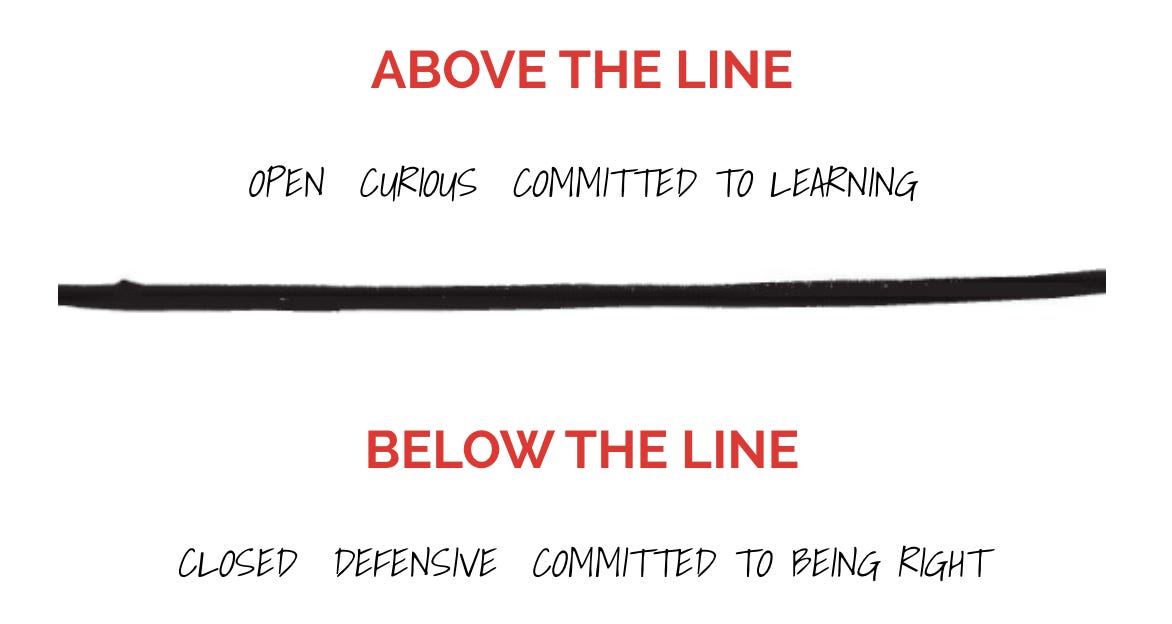
The authors offer 15 Commitments that help leaders embody conscious leadership. Commitment #1 is the most foundational: I commit to take 100% responsibility (not more and not less) for my wellbeing, and encourage others to do the same.
My key take-away’s:
Radical responsibility does not mean taking responsibility for others: in the past I was definitely guilty of taking too much responsibility for other people, and probably not enough for myself. This helped me to see how that tendency was fuelling my own insecurities, and keeping me below the line
We need to align our careers to our “Zone of Genius” - the intersection of what you love to do and what you’re naturally skilled at, where your efforts feel effortless and deeply fulfilling. This is work that is an expression of your unique gifts. For me, the first 15 years of my career were definitely in my “zone of excellence” rather than “zone of genius”. I am so grateful that this year I was able to change that!
We are the only real and reliable source of security and approval - I’ve spent much of my life seeking external validation and confirmation of my worth, and this year I finally internalised that I’m the only one that can give that to myself
I would highly recommend visiting their website that has tons of resources.
This book zooms in on the Neutral zone described above - the “in between” state when our identity is being rebuilt. Drawing on ancient yogic wisdom, including the Bhagavad Gita, Haas describes the “dark night of the soul” as a period of profound inner struggle, disillusionment, or loss that serves as a gateway to deeper self-realisation.
The book emphasises that such periods of darkness are not signs of failure but essential stages in spiritual evolution, helping individuals shed egoic attachments and false identities.
It offers three absolutely beautiful pieces of advice that are central to Hinduism:
Be true to your nature: living in accordance with our nature is the ultimate act of kindness to ourselves (this is very much the same idea as the Zone of Genius above!)
Let go of the fruits: don’t attach yourself to the outcome of your actions, as this isn’t something you can control.
Make your work an offering to the divine: find a way to be of service (but aligned with 1 and 2)
My key take-away’s:
“Dark nights” show you what’s not working in your life and give an opportunity to bring you back to yourself
Surrender the need for control as you navigate the periods - embrace the pain, chaos, and uncertainty
We need to learn to release the grip of our story about ourselves and how things should be - the sooner we do that, the easier these period will be
This book introduces Internal Family Systems (IFS) - a therapeutic approach that views the mind as composed of different “parts” or sub-personalities, each with its own feelings, beliefs, and motivations. The book challenges the view that we are all selfish demonic creatures that need to be disciplined and kept in check, and that any bad behaviours need to be diagnosed and corrected (and often medicated). Instead, he suggests that at our core we are all loving and compassionate beings, and that any negative behaviours we might have (for example an eating disorder) are actually parts of us that are trying to protect us from pain. By engaging with those parts compassionately, we can heal past trauma, release ours parts from those protective roles that have become unhelpful, and restore internal harmony.
Central to IFS is the idea of the “Self,” a core of calm, clarity, and wisdom within everyone that can lead the healing process. As we heal past trauma, we become more “Self-led” - our parts learn to trust that we can take good care of ourselves.
Through practical exercises and case examples, Schwartz shows how embracing all parts of ourselves with understanding and curiosity leads to greater self-acceptance, emotional resilience, and wholeness.
My key take-away’s:
We genuinely do have multiple parts of our personality - when we feel an internal tension, or find ourselves wanting contradictory things at the same time, this is our different parts engaging with each other
Even our most destructive behaviours serve a protective function in response to a painful event in the past that we couldn’t handle at the time
Ignoring, rejecting or shaming “bad” behaviour is the surest way to keep it going - it affirms the need for it to play its role. Rather, we should engage with that behaviour with curiosity, compassion and gratitude for the hard work it has put in to keep us safe
No posts
Comments
Nothing yet. Say the first thing.
Sign in to join the conversation.