
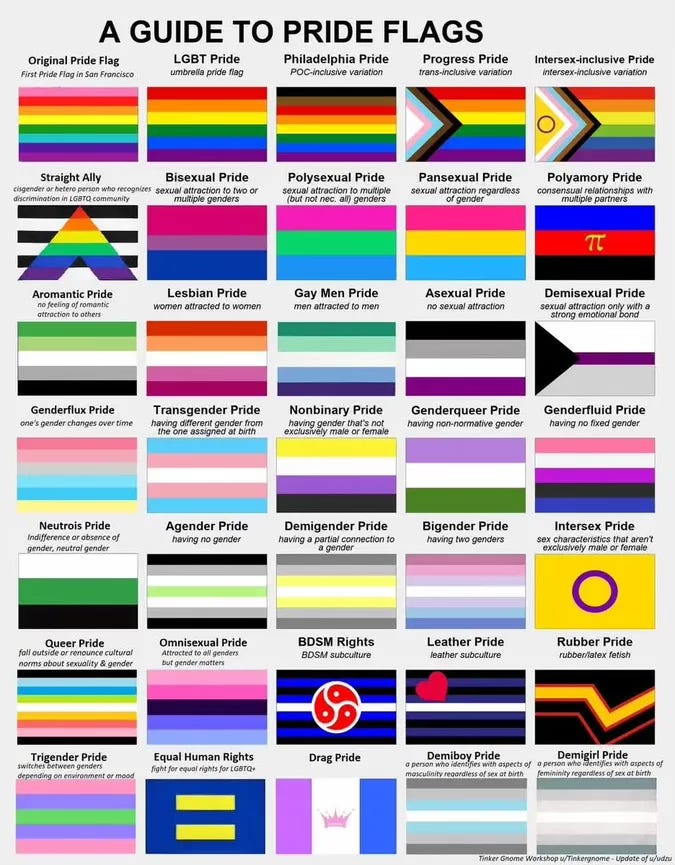
What is owed to children and youth is not affirmation of whichever label they decide to stick on to themselves, but the developmental time and space to find out who they actually are. Adults are supposed to be the guardians of that time and space.
Yes, it’s common knowledge that when kids reach a certain developmental milestone, they enter a prolonged period of moratory exploration in which they “try on” a variety of different interests, identities, expressions and personalities. But it’s not only human biological processes which drive this normal, necessary period of development. What makes this essential developmental stage possible is the presence of adults acting as adults in adolescents’ lives. Adults are required to be the adults while the child is vulnerable: We hold boundaries. We express doubt. We advise the child to wait. Kids need the grown ups to act as helping, watchful waiters so that kids can then be free to do what they need to do — which is to become.
This is no small thing. Self discovery is the subject of epic poetry, ancient plays, soaring operas, cathedral ceilings, music videos, Netflix series and the silver screen — and for good reason. Psychologically speaking, it’s kind of everything.
Human beings have developmental stages with unique needs, and adults have an essential role in every part of the process. To the detriment of kids, in recent years we decided to treat adults guiding or cautioning kids as harming to kids. We told adults they must only affirm children. Developmental psychology, across every major framework, treats childhood as a structured period of exploration in which a stable identity is the outcome of time, testing, and revision — not its starting condition. E. H. Erikson treats the entire span of adolescence as a moratorium during which commitment is meant to be provisional (Identity: Youth and Crisis), and J.E. Marcia’s identity status model identifies foreclosure — the premature adoption of an identity without exploration — as a developmental risk precisely because it shortcuts a process that depends on duration (Journal of Personality and Social Psychology).
Adolescence is, by design, a period of not knowing. Erik Erikson was the first to map this period of human development systematically in his book, Childhood and Society, in which he argues that identity formation is not something that happens to a child. It is something a child has to achieve, through a process that is genuinely uncomfortable, genuinely open-ended, and genuinely necessary. He labeled this process “moratorium,” in which different possibilities are held open and explored, commitments are “tried on” provisionally, and a state of uncertainty is endured long enough for something real to emerge from it. Presenting adolescents with lists, flags or wheels of identity categories does not support moratorium. Rather, it installs a framework before the youth has the developmental equipment to discover it or question it, producing foreclosure by prior instruction, and the child who has absorbed, from the earliest years of schooling, a particular understanding of what gender identities are available and how they work is not a child who later enters adolescent moratorium with an open field. She enters it with a pre-installed map. This is a monstrous form of theft.
Adolescent moratory exploration is essential for healthy identity formation in humans, and a successful moratorium is dependent upon the presence of adults who are permitted to hold a boundary, express doubt, or ask a child to wait — without that caution or guidance being treated as harm. Limiting kids’ miraculous, timeless, transcendent humanity to a list of identity frameworks disrupts moratorium and produces identity foreclosure in kids. Even a cursory reading of mainstream child development experts reveals this. Put another way, our 21st century focus on sexuality and sexual identities — what could be called our “intersectional-privilege-wheel” understanding of human identity — constricts children to a base stack of growth-stunting identity cages.
We’re herding kids into little prisons and telling them they are liberated.
This isn’t liberation. This is abuse.
It’s not just adolescent self-discovery we’re fiddling with. It’s all the stages of development. When children’s entertainment brands, books, TV shows, YouTube and theme parks target preschoolers and toddlers with gay, trans, drag, and kink messaging, the assumptions are clear: If children learn early that all manner of different relationships, families, and ways of being are safe, commonplace and normal, they will develop into open-minded, kind and accepting people. It’s generally believed that early installation of queer identity frameworks staves off prejudices before they have a chance to form.

As you can guess, these assumptions simply are not supported by the record of how children actually develop. Child development theory, which describes how children actually develop, derives from more than half a century of cross-cultural empirical research, by theorists from incompatible traditions. The gold standard of child development theorists include, but are not limited to, Jean Piaget (The Psychology of the Child), Lawrence Kohlberg (The Philosophy of Moral Development), Erik Erikson (Childhood and Society), Sandra Bem (The Lenses of Gender) and John Bowlby (A Secure Base).
First and foremost, what the mainstream child development literature establishes beyond a shadow of a doubt is that children are not miniature adults. Anyone or anything that treats kids as though they are little adults is not serving children. They are using children to serve other purposes. Yes, kids’ brains are quite different. They are not cognitively equipped for abstract identity frameworks.
To be clear, children are not cognitively equipped for abstract identity frameworks.
Books, TV shows, drag shows or classroom lessons which aim to install particular “schemas” before children have the cognitive capacity to evaluate them is not education in any meaningful developmental sense. It is schema formation by prior occupation of the developmental space. Piaget establishes that children under seven are in the preoperational stage, not yet able to subject information to logical evaluation or understand its implications at any level of abstraction. Messaging aimed at four to six year olds is directed at a developmental population that cannot distinguish between information and instruction — between a story that reflects the world and a story that is shaping how they will see it. Piaget is explicit that premature exposure to concepts beyond a child’s developmental stage leads to distorted assimilation: children absorb ideas without true comprehension, causing confusion or rote acceptance of authority rather than genuine understanding.
Additionally, messaging which aims to “liberate” children from heteronormativity actually disrupts the developmental process of gender constancy. At the cognitive level, such messages pull children back to a stage of thinking they are in the process of moving beyond. Kohlberg’s account of gender development establishes that gender constancy, the understanding that gender is stable and independent of superficial changes in appearance, consolidates in most children between the ages of five and seven. Before that point, children may genuinely believe that changing clothes or hair can change gender. This is a normal and temporary feature of preoperational thinking, not a window of opportunity for intervention.
Jamie, a transgender retelling of Cinderella in story form, aimed at eight to eleven year olds, operates in direct tension with this developmental reality. The protagonist looks in the mirror and declares “I’m a boy, I always have been” after cutting her hair and putting on a suit. Accompanying worksheets reinforce the “born in the wrong body” narrative and encourage allyship framed around immediate affirmation of the declared identity. A child in the concrete operational stage, still consolidating the understanding that observable characteristics are stable, is not being given tools to think more clearly about sex and identity. Instead, he is being presented with a narrative in which feelings override observable biological reality, dressed in the authority of a fairy tale. Kohlberg’s framework predicts precisely what this produces: not critical understanding, but “magical thinking,” the reinforcement of exactly the preoperational confusion between appearance and reality that developmental progression is supposed to resolve. The material that presents itself as liberating children from sex stereotypes and oppressive gender roles is, at the cognitive level, pulling them back toward a stage of thinking they are in the process of moving beyond.
The trans desistance literature compounds this developmental concern. Multiple longitudinal studies report that the majority of children presenting with gender distress resolve that distress naturally without medical intervention. Messaging which teaches kids to always, immediately accept and affirm a trans identity as immutable reinforces distress rather than allowing for the natural developmental resolution the evidence predicts.
Believe it or not, there was a time when everyone understood that romantic and sexual self-definition are not developmental tasks for children ages six to twelve. Erikson’s psychosocial stages establish that children between six and twelve are developmentally focused on industry and competence, on building skills, navigating peer cooperation, and developing a sense of capability in relation to the world. Romantic and sexual self definition are not developmental tasks of this period. They become relevant in adolescence, when identity formation in Erikson’s sense genuinely begins. Teaching kids about myriad types of romantic and sexual relationships is not age appropriate. It is the delivery of adult romantic and emotional content to children who are, on Erikson’s account, developmentally years away from the stage at which such content becomes relevant to their own experience. Questions about attraction, desire or what feels good in a relationship have no appropriate answer for a seven year old because the seven year old is not in, and should not be expected to be forming judgments about, romantic relationships. Asking such questions of children does not open children’s minds. It imposes an adult framework onto a developmental stage that has entirely different priorities.
The assumption that earlier is better, that installing inclusive schemas before prejudice can form is straightforwardly protective, is not supported by the developmental literature and in several respects is directly contradicted by it. The concern sharpens considerably around content that addresses gender identity specifically, that encourages children to adopt particular frameworks for understanding their own inner life before the cognitive prerequisites for doing so are present, and that is delivered in institutional settings without parental involvement.
Kids are very much developmentally distinct beings, progressing through concrete, sequential stages of growth that have their own logic, their own requirements, and their own vulnerabilities. Whatever a person’s personal point of view may be on our culture’s frenzied celebration of everything gay, trans, kink, drag, queer and non-heteronormative, adult opinions take a back seat to what kids need developmentally; and, in light of what we know about children’s development (or used to know, as the case may be) PRIDE’s penetration into the world of children is cause for grave concern.
It’s important to remember that the very act of inventing and labeling categories of people causes the people inside the categories to begin to live differently, reshaping themselves around the label and behaving in the ways the category predicts.
That behavior then loops back and appears to confirm that the category was real and waiting there all along. In light of these effects, it is very probable that our expectation that kids make meaning from an assortment of abstract identity boxes, categories they are not equipped developmentally to evaluate and understand fully, risks stunting their healthy development. Certainly, limiting children’s and adolescents’ understanding of their own timeless, transcendent humanity to a series of small identity frameworks is a harmful constriction.
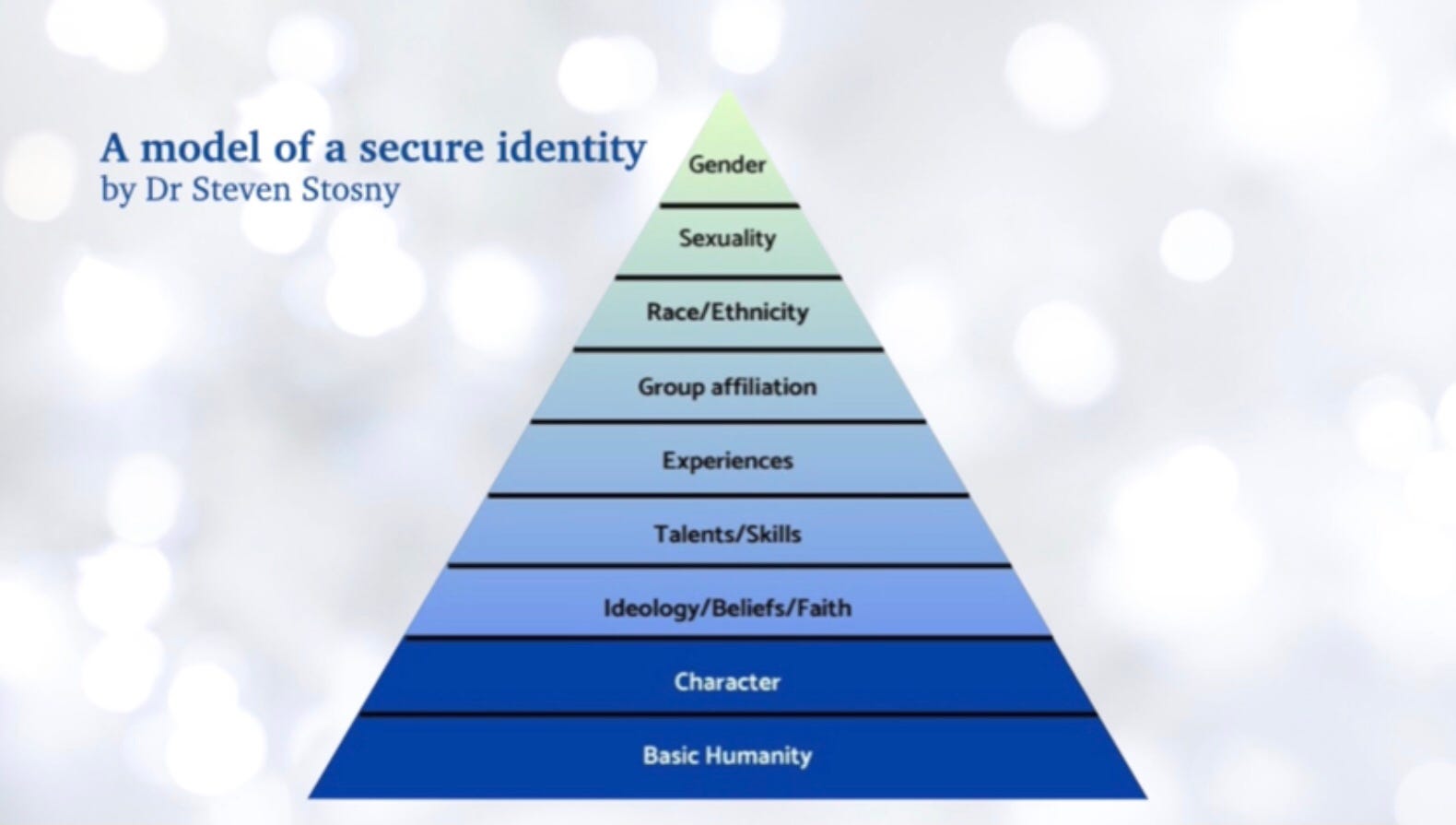
Let’s talk about constriction. “Constriction” is a word psychologist Steven Stosny uses to describe individuals putting all of their identity eggs into a few small baskets. People who constrict their sense of who they are to those aspects of identity at the peak of Stosny’s identity pyramid (see above) set themselves up for psychological crisis. Children’s programming that constricts human identity to only these aspects risks causing tragic suffering in kids. According to Dr. Stosny, this kind of suffering can only be ameliorated by the child learning to expand his or her sense of identity to include the more foundational aspects.
The small aspects of identity — such as an ethereal, difficult-to-pin-down sense of “gender identity,” romantic and sexual preferences or orientation, superficial ethnic traits, changeable group affiliations and experiences — are abstract, inconstant, temporal, surface-level, and unreliable. A person who focuses only on these aspects of identity, while failing to place the foundational aspects front and center in his self-consciousness, will experience a crisis of identity disruption. On the other hand, kids who are taught to focus on the foundational aspects of human identity will develop a secure and resilient sense of self. The foundations are concrete, unchanging, and reliable. The bottom most, widest aspect of identity — basic humanity — is rooted in biological, physical reality. It is unchanging. There’s nothing abstract or difficult to pin down about it.
Stosny writes that something magical happens when people think about their connection with all humans. Doing so fosters respect, appreciation, compassion, and kindness. It alleviates feelings of isolation, humanizes the perceptions of others, and buffers the negative judgments humans tend to inflict on themselves and that others inflict on them, judgments that produce so much anxiety and resentment — especially for kids. In other words, building a sense of self on our basic, shared humanity makes us anti-fragile; and, when we remember our basic, shared humanity, we automatically like ourselves better and treat others humanely.
Character, too, encompasses those enduring, foundational aspects of human identity that withstand the flux of life and the test of time: mental and moral qualities such as honesty, flexibility, humility, resilience, generosity, and accountability — in addition to personality and temperament. Character is the unchanging, timeless person who occupies the body, the soul possessing the more surface traits. A person with a secure identity returns often to these two foundational truths: He is part of the human family, and he is a timeless, unchanging soul. Children and teens who are taught to lay the foundations of their lives on these bottom rungs will develop a sense of who they are that is resilient and secure. Kids who learn to constrict their understanding of themselves to the top rungs become like a pyramid that is upside down: they are easily “toppled,” vulnerable to psychological crisis, sensitive, fragile. This has an outsized impact on life satisfaction. Kids deserve better.
Basic humanity, and character. Focusing on the things which are most important about who we are promotes the development of a broader, richer, and more resilient sense of self. On the other hand, a narrow identity causes heartache. Dr. Stosny even writes that people with narrow or constricted identities suffer anxiety, rigidity, depression, and, in extreme cases, a fragmented sense of self. People who identify only with the upper rungs of the pyramid, at the expense of the foundational aspects, experience prolonged stress or dysphoria. Stosny even goes so far as to contribute most of the ideological and cultural strife in the world to individuals hyper-focusing on the upper rungs while violating the foundation, writing, “The same culture wars that have devolved public discourse into name-calling and pejorative adjectives can destabilize individual identity by making it reactive and narrow. They make us behave uncharacteristically and violate our basic humanity.”
Anxiousness, depression, and resentment are ameliorated by nurturing in ourselves a sense of our basic humanity and in exercising our capacity for compassion, kindness, and appreciation. This is the recipe for achieving tolerance and respect for others, and for feeling sure about our selves and our valuable contribution to the world. As you can imagine, kids who are taught these foundational psychological principles about identity enjoy an enhanced sense of self, and even become invulnerable to harsh self-judgments and any disrespectful regard by others. In other words, as mentioned above, with good instruction about identity, kids become anti-fragile.
It’s easy to see the danger today’s kids face in light of Stosny’s understanding of healthy identity formation. Limiting children’s and adolescents’ understanding of their own timeless, transcendent humanity to a series of small identity frameworks is a harmful constriction. In calling aspects of a person — like his sex, sexual orientation, “gender identity,” group affiliations, ethnicity and experiences — his “identity,” we limit kids’ once-in-a-lifetime journey to figure out who they are to a series of small labels.
We constrict them to an assortment of sad pre-fab boxes.
We restrict them to a stack of stunting, intersectional cages.

Hi. I’m Katy. If you are new to my KIDS FIRST Substack, welcome! Usually, my posts aren’t as long and information-dense as this one. If you made it all the way to the end, congratulations. I hope the information here is valuable to you.
KIDS FIRST is both a mindset and a call to action. I believe kids’ needs must come before adult agendas, in every aspect of life. Our K12 schools exist for the benefit of America’s children and teens, but over time, they have become agenda-serving systems rather than kid-serving. It’s time for a reset.
Thank you for reading.
Comments
Nothing yet. Say the first thing.
Sign in to join the conversation.