
I was given steroids for inflammation and swelling after oral surgery yesterday, and I feel better than I’ve felt in a month. I have so much energy and look better as it took the inflammation out of my face, eyes, etc. Not sure how I feel about this false, ingested feel-betterness—I think the takeaway is being reminded of what energy feels like and to figure out how to feel this way without a drug that does whatever else it does to my body.
Reminds me of little Tux, when he hurt his back and could barely walk and the vet gave him steroids and he suddenly turned into SuperDog, which was a relief but also worrisome.
The other takeaway of the dental extravaganza was the fuzzy feelgood of having established myself enough here in London that people actually cared and checked on me. That was one of my little fears moving to the UK—who is going to show up if I’m in need? In Austin I had a cohort. If I’d moved to LA, there’s people who would help me. I have family in the UK, but…after 2.5 years, I’ve come to think that it would be a super burden to ask any of my family to help me. They have extraordinary busy lives with all sorts of kids and jobs and their on-going needs and responsibilities. So this little procedural trial balloon has left me thinking, I’m ok here. I have friends that I’d show up for and who will do the same. Whew!

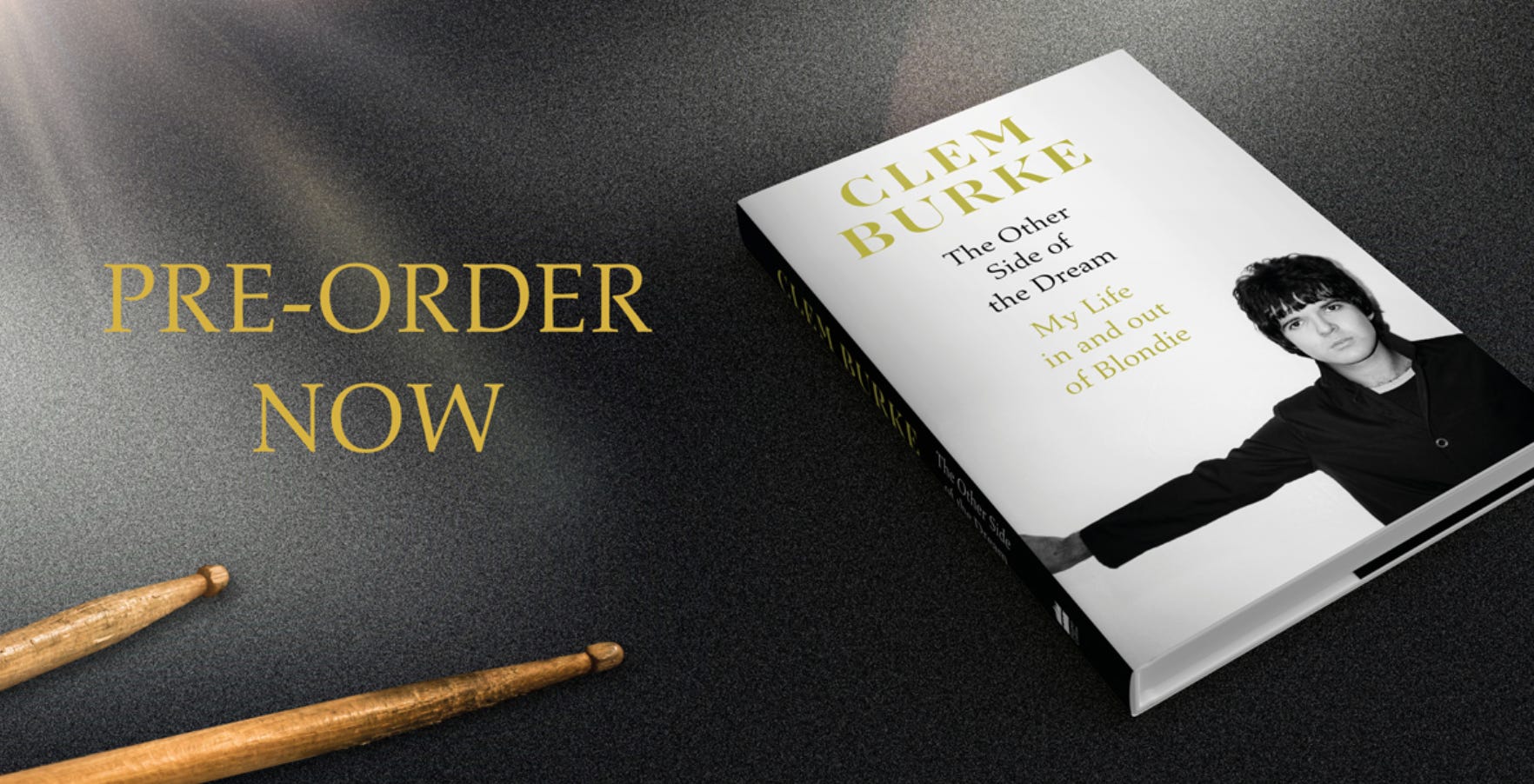
Some big news: Clem Burke’s book is now available for pre-orders. The Other Side of the Dream, My Life In and Out of Blondie has been one of my main labors of love for well over a year. He had been working on the book for a decade, on and off—his mad touring and recording schedule kept it slow-going, as well as the bouts of insecurity that a musician who isn’t the center and front of their famous band goes through when writing a memoir. I understood that all too well.
When I first went to him to give care and support in July of 2024 for his cancer, it was forefront in my mind. We had to get this book out—where was the manuscript? He had a finished one he’d done with some editorial input from writer Peter Stoneman—I was very relieved. There’s a lot that can be done with a manuscript, much easier than having big ol’ nothing. After reading it, I had suggestions for additional chapters and antidotes, and once we got his chemo to a tolerable place, for about three months, this book gave him something to think about other than being sick. I wanted to make sure he had something to focus on and that it would hopefully, open the portal to reflection and gratitude for his life—the life he loved which had changed so radically after his diagnosis. Each day I gave him assignments and helped organize the existing manuscript with the new stories and writing. By the time we sent his publishers a first draft, he got an email saying it was one of the cleanest best first drafts the editor had ever seen. It was a really good day, and really good days were rare.
They sent a copy-edited version back quickly, marked up with questions and verifications of this and confirmations of that, which needed author review. Clem and I did this together and he managed to pick dozens of photos and come up with a discography with his manager Tommy—but that was as far as we got before cancer took even this job away from him. By time he passed away, it was left to me and Tommy to push the book into it’s final stages. That means chasing photographer credits, a rigorous legal review, more proof-reads, cover design, a foreword from Fred Armisen—and I was asked to write an afterword, because the book did not address his illness and death. It was one of the hardest things I’ve ever written. I needed a tone and balance that honored his wish for privacy, and yet also gave readers a sense of the devastation and courage in the face of losing his identity and purpose in life while facing terminal cancer. It makes me cry every time I read it.
I know he’d be really proud that it made it to publication. It felt to me like it was the most important thing I could do for him, and I’m grateful he trusted me to push him.
Now just to figure out how to promote a book with no author to do book tour, signings, and events. I’m thinking up creative ideas, some of them great, but just don’t know if I have the ability to guide them into happening. And starting my own next book is lurking at the back of my mind always. This is what they do, books one must write. No matter what else in life is going on, they cast a shadow over it until you get going. I’ve gotten going in some small measures, but not enough to get out from under that book shade.

I didn’t expect to be so mind-boggled in my 60’s. It’s the times we live in, this I know. My mind is sharp, not boggled, but so much in our world has taken on hyperobject proportions. This term and concept, from professor and writer Timothy Morton was introduced to me during an environmental writing course I took in college. His book, which I have not read, employed the term to address issues like climate change, petroleum, nuclear radiation…even styrofoam.
From the way I understand it, the characteristics of a hyperobject are the absolute massive problematic scale of something, to the point that an individual feels powerless to act—we cant see the end, we can’t fathom a way out, or around, or through. This is dizzying and numbing; our brains are wired to problem solve. An inability to generate a productive outcome can lead to anxiety, psychological overwhelm, mental fatigue, avoidance and blameshifting. We evolved by solving immediate problems and threats—but hyperobjects exist without boundaries, across vast timescales—our brains can’t compute and grapple with accepting the reality of the situation.
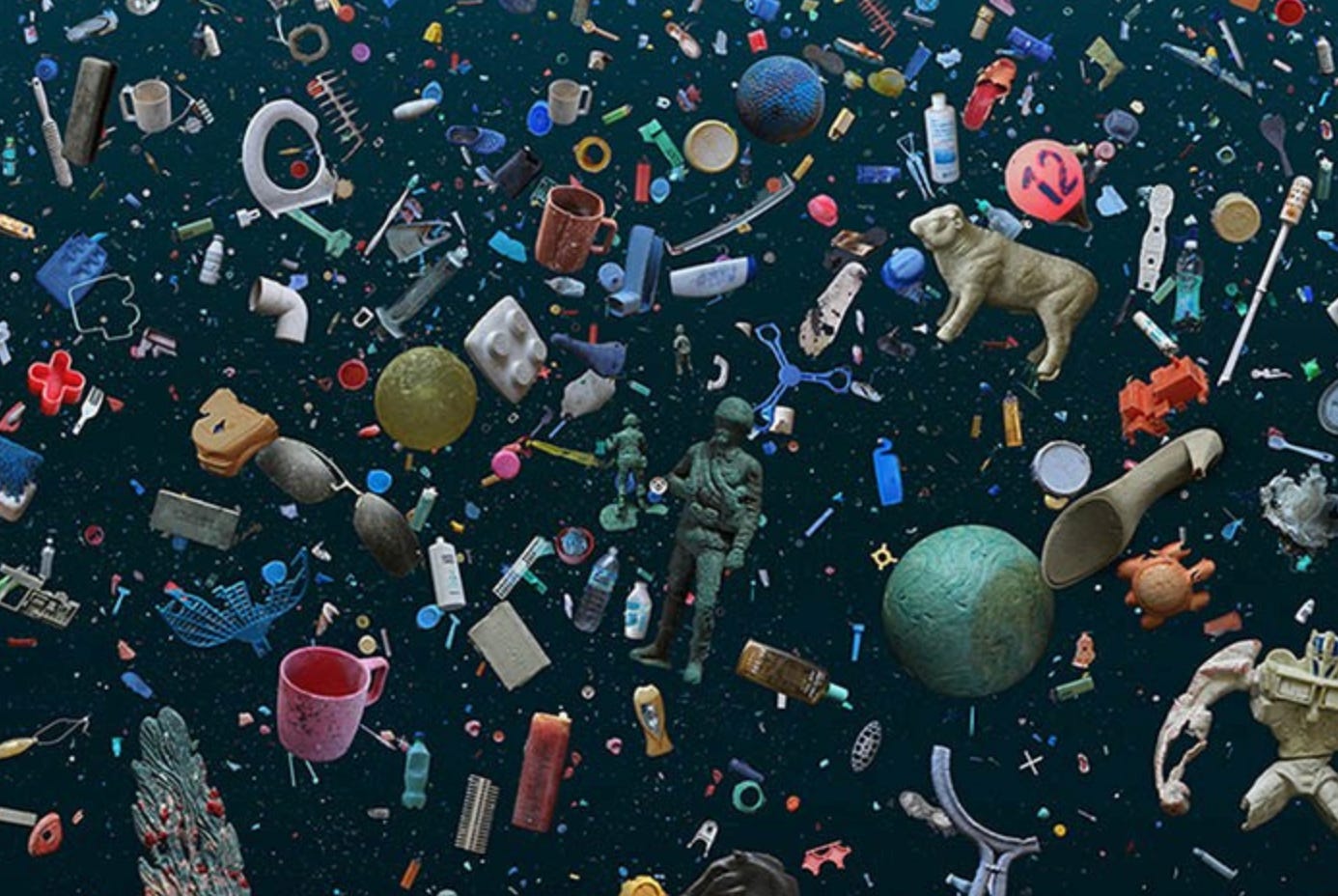
It was the styrofoam example that got me to grasp the idea of a hyperobject.
Styrofoam is a hyperobject because it is an unnatural substance that has become a permanent, inescapable part of the earth's geology and ecology, far outscaling the humans that created it.
Here is why petroleum is a hyperobject.
Petroleum is an overwhelming, inescapable force that has already reshaped the planet and our civilization, defying our ability to fully understand or control it. We can never see the whole, complete "object" of global oil all at once. It is found in countless consumer items—and it’s impossible to fully disconnect from it.
Even trying to grasp what defines a hyperobject has it’s own shades of hyperobject-ness! These qualities explain the concept further: Non-Locality— A key trait of hyperobjects is that they are not located in one specific place. We are never just interacting with filling the car with gasoline, but with the entire global, intertwined system of extraction, transportation, and consumption. Hyperobjects are Time-Stretched—for instance, petroleum comes from ancient organic matter that lived millions of years ago, but the effects of carbon emissions and plastic will last for thousands of years. This massive temporal scale makes it difficult to grasp. Another key trait is Interobjectivity—Hyperobjects are formed by relations between many different objects. Oil is not just a substance; drilling technology, geopolitical systems, consumer demand, and the Earth's geology are all part of the product.
All this is context, because I increasingly feel like the modern world—all of it—the dissolution of truth, power plays, the wars, AI, the massive divide between haves and have-nots, the erosion of standards and democracy, big data, big pharma, big money, the health care system—the scale of it all takes the form of a hyperobject, in the same way insurmountable environmental problems do. Human beings are now hostage victims of non-human crises that humans created.
The world and the way I’ve always perceived it doesn’t exist anymore and i don’t know what that means other than it makes me mind-boggled and I don’t know any other way to cope other than to ignore it and cling to the things that still are the way I understand them. Music, books, writing, connection, love, laughter, compassion, community, family. Will those things save humanity? Probably not, but they will save some of us in what’s left of our lifetime.
I used to play this song in one of my bands, a fast punky version.
Speaking of songs, and maybe a bit related to what I was saying in the hyperobject mini-essay of how brains can’t cope with the magnitude, and the fake feel good of steroids in my first para—here’s a snippet of a very rough home demo of a new Psycher song called “Soma Coma.” It’s inspired by Aldous Huxley’s Brave New World— the drug Soma given to people by the government so they can escape and find happiness.
I have loads of fun making demos, playing all the instruments, getting Brix over to write and sing together. It’s pure joy. After the next batch we get written, will probably head over to NYC this summer to record them there. There is a plan here, a Psycher plan and foundation is being laid with each track. We want twenty songs, and Some Coma is the ninth. A ways to go but what a trip!
As always, I can’t thank you enough for participating in my deal here on Substack. Please subscribe and recommend and share if you think it’s of value. I think that’s the only way to grow it.
Comments
Nothing yet. Say the first thing.
Sign in to join the conversation.