
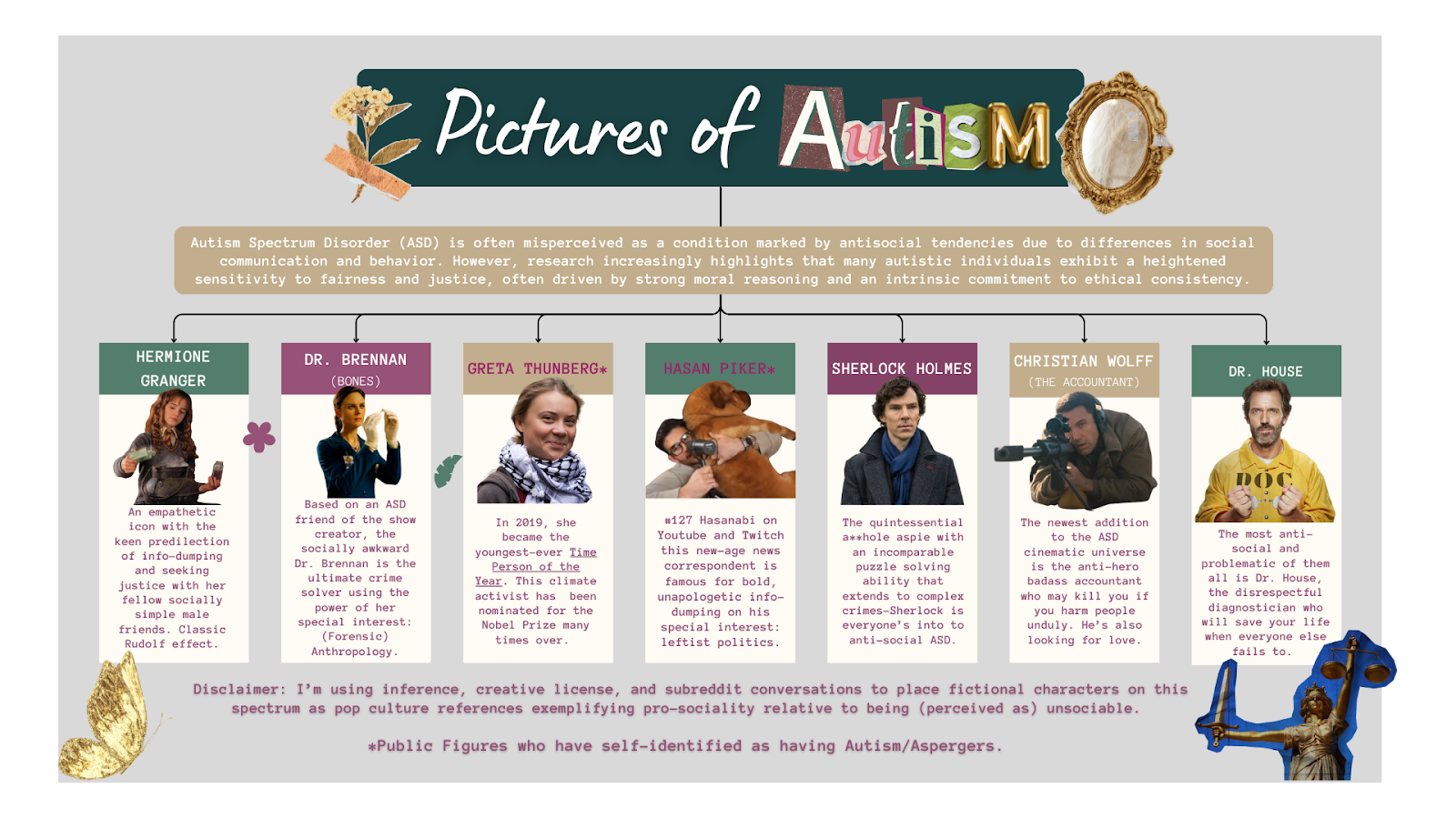
Think of your favorite autistic character. Quick!
Now, think if they were ever actually diagnosed or announced as autistic.
Unless you were thinking of Quinni from Heartbreak High or Raymond from Rain Man (don’t get me started on that), you likely realized they weren’t. Instead, they were “autistic-coded” as dubbed by the internet. Before we hit the comments with the ‘well actually’ yes of course there are some but many of those remain unclear. I referenced this in a prior piece however, I want to spend more time on the lack of Autistic Pride in the media.
I’m getting myself started on Rain Man (1988). I watched this movie for the first time the other night and was disappointed but not particularly surprised. The Rudolf Effect was the main character of this “classic” starring Tom Cruise and the completely non-autistic Dustin Hoffman. That being only valuing someone’s idiosyncrasies (ie. autism) when it brings a direct and substantial benefit to the “leader” of the group. Half of Cruise’s lines included the r-slur and calling his autistic brother an idiot when he wasn’t denying the diagnosis completely. The fact that this particular movie is seemingly the most often referenced when comparing another suspected autistic to another is problematic to say the least.
“Not a fan of labels ma’am,” answered the clinician when Christian Wolff’s mother asked what her son had. The logline of this movie on IMDB is: “As a math savant uncooks the books for a new client, the treasury department closes in on his activities and the body count starts to rise.” Rotten Tomatoes provides the same descriptor—mathematics savant. This is not to say that two things can’t be true—his character certainly has the math flavor of autism, unlike myself. I’m rewatching the movie as I write this to double check if they ever actually say it. They do, once. Again, he’s a badass but his label as a savant and excellency in accounting point to the Rudolf Effect but with an edge—a violent one. Spoiler alert, he also has an estranged brother fluent in profanities and violence. Don’t get me wrong, my fellow autistic sibling is actually an accountant so we have a shared appreciation of the two films.
That said, my appreciation is not without limits/reservations. Another being that the higher rated sequel, hailed as “better in every way” significantly altered the physical presentation of Wolff’s woman in the chair Justine completely removing her stims and general disheveled appearance. Moreover, the community of semi-criminal children at the center led by Justine is intriguing but again, the Rudolf Effect functionality is funded by millions of criminal dollars most will never have access to. While I adored the love search arch and brother power duo, I noticed that the drivers of the plot (lead actors) were still all white (passing). I have mixed feelings about the overall plot but that’s for another article.
I can point to many more examples like this. Perhaps one of my favorite movies of all time primarily for the ways in which it gutted me into crying for three days straight—Imitation Game. This movie was based on the true story of Alan Turing. His experiences of childhood bullying and ostracization resonated in a way I had not expected. Each stage of life showed him resented or hated by all but one true friend. His redeeming quality was the Rudolf Effect—nothing short of solving the world’s greatest puzzle, ending World War II, and creating computers. Once the war ended, not even that was enough. Moreover, his diagnosis was never explicated, just coded.
There is an obvious pattern that is clearly outlined so what of the other examples. I’m not the only one on the internet taking notice of this. In an 2022 identity piece by Suzannah Weiss discussed how viewers perceived Gregory from Abbott Elementary as ‘autistic coded’ as a fan myself, I agree. Writer and showrunner Quinta Brunson is not shy about having autistic friends and potentially being on the spectrum herself which I take as anecdotal evidence. I love the show, Gregory’s character, and his relationships with his coworkers. So much so that I think had he been written as diagnosed on the spectrum—without changing anything else about him—he would make a wonderful addition to the utter lack of BIPOC neurodivergent representation in mainstream media.
I felt scene watching Bones, Hermoine was always my favorite character in Harry Potter (FJKR), Lessons in Chemistry warmed my yearning heart, Love on the Spectrum shifted the reality TV, and Shane Hollander is a certifiable icon (Happy Pride). But until writers canonize autism rather than silently coding it into character, it makes it feel as though the diagnosis should remain covert. Moreover, until then all people will ever think about autism is Rain Man or maybe now the Accountant. I don’t know about you, dear reader, but I am not a middle aged white man nor a mathematical genius. I am skilled, smart, capable, and talented but not a savant in any particular area—as far as I know. I’ve experienced my own version of the Rudolf Effect in my life albeit not to any epic proportion (yet). That said, I would love to see a fellow ordinarily extraordinary AuDHD woman wearing her golden flag with pride on screen. Until then, i’ll be here, waiting, wondering, hypothesizing and philosophizing.
No posts
Comments
Nothing yet. Say the first thing.
Sign in to join the conversation.