
Dear one,
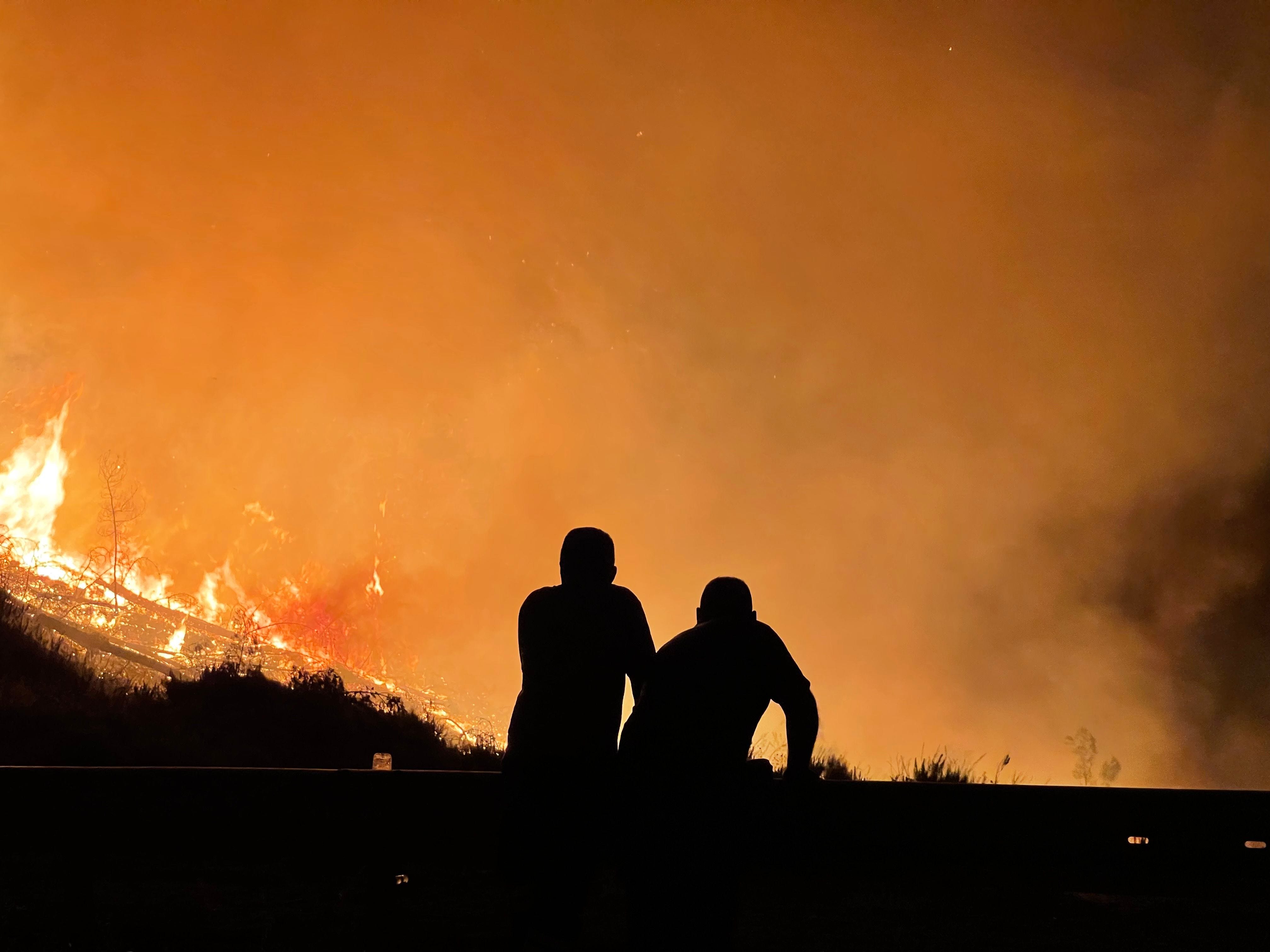
The world is burning.
And if you live in the Western United States or many places in Europe right now, you know that’s not a metaphor. Here in Portland, the sun has been blotted out into a small orange disk, and all of us are relegated indoors, sealing our windows and running air purifiers. Meanwhile, the forests I love so much — my sanctuary, my home — are being destroyed. When I pause to actually feel it, my heart stops in my chest.
For many, I know the smoke is simply an inconvenience, and they’re continuing with their daily lives. But for those of us who have healed underneath old growth cedars, who have taken naps in their mossy duff, a wound is splitting open.
And I want to name, before I go any further, that there is a different order of grief happening for people across this state right now — people who have lost their homes, their animals, their whole sense of ground beneath them, in these fires. What I’m about to write comes from a place of reverence for the natural world, not from a distance that makes light of what’s actually being lost. If you are one of the people this fire season has taken something real from, please know that everything below is offered alongside that grief, never over it. There is no bigger picture that makes a burned home less devastating, and I don’t want anything I say here to suggest otherwise.
I decided to write this today because, while I am feeling this particular moment very keenly, another part of my awareness has come online — the one that recognizes patterns and the bigger picture, that hears the whispers of the plant world.
Before I dive in, I want to make something clear. I am not a professional East Asian medicine practitioner — my partner is. What I’m about to share comes from what I’ve learned from him, and it’s likely an approximation of the whole truth, coming as it does from a system that is ancient and vast. So please know going in: this is one woman’s interpretation of what she’s learned from her expert partner.
That said — if I zoom out and put on my Aquarian big-picture glasses and look at this entire situation, something becomes very clear. There is a great imbalance occurring, and the natural world is screaming for our attention. This might seem obvious to some, but stick with me, because the particulars are fascinating.
In East Asian medicine, there’s a framework called Five Element Theory — an intricate system for understanding how five elements (Wood, Fire, Metal, Earth, and Water) interact with one another, both externally in the world and internally in our own bodies. Much of Chinese medicine and acupuncture is built on this concept, and personally, as someone endlessly fascinated by systems of natural understanding, I believe there are real answers to be found by looking at our current situation through this lens.
In Five Element Theory, each element both generates and controls another, in two interlocking cycles. In the generating cycle, Wood feeds Fire, Fire’s ash becomes Earth, Earth compresses into Metal, Metal collects Water (think of dew forming on a cold metal surface), and Water nourishes Wood again. In the controlling cycle, each element also checksanother so that none grows unchecked: Wood parts Earth, Earth dams Water, Water douses Fire, Fire melts Metal, and Metal — in the form of an axe — fells Wood. It’s a closed, self-correcting loop, each element in conversation with the others, none allowed to dominate for long.
When one element becomes excessive or deficient, the whole system leans in to try to rebalance it — and that leaning often shows up as pathology. A classic example: when Metal becomes too rigid or excessive in the body, it can manifest as skin conditions, chronic constipation, or a suppressed immune system — the body’s own attempt to hold a boundary that’s grown too hard, too closed. Grief that never gets expressed is said to lodge in the lungs and large intestine, Metal’s organs, and eventually the body tries to force what the mind won’t: a cough that won’t quit, a grief that finally breaks.
Each element also has a virtue when it’s in balance, and a clear signature when it isn’t. For obvious reasons, I’m very interested right now in Fire’s relationship to Metal.
Fire controls Metal. Think of a forge — raw ore held in flame until it goes molten and can be reshaped. That’s the relationship: Fire is what keeps Metal from calcifying into something too hard to work with.
When Metal gets excessive, it becomes sharp, hard, cold, and inflexible. You only need to look at the world we’ve built lately to see that Metal has gotten quite excessive. Look at the sharp corners we’ve built everything into — boxes, screens, squares. Look at what you’re reading this on right now. Look at what we’ve built to transport us everywhere. Our whole civilization is built from metal: cold, unyielding. Protective, to some degree, yes — but also inflexible, closed off, numb.
It seems to me that nature is trying to correct itself. That this enormous wave of fire is its response to an excess of Metal, an attempt to melt what has become rigid. Forest fires are a natural occurrence — in fact, some conifer species, like lodgepole and jack pine, are serotinous, meaning their cones are sealed shut with resin and can only open and release their seeds when heat from a fire melts that resin away. The forest, in other words, has its own relationship with fire as a means of renewal built directly into its biology.
But this? This feels like a clear over-response to our own excess, our obsession with metal and shiny things. Humans love shiny things. Our obsessive, possessive relationship with gold and gems is a tale as old as time. We have become Smaug in the mountain, hoarding our treasure, and our collective unconscious is burning the world in our stead.
By the way, I don’t think it’s a coincidence that so many of us are having health problems and literally “burning out.” Think about that phrase for a second. We are burning out. The Earth is burning out.
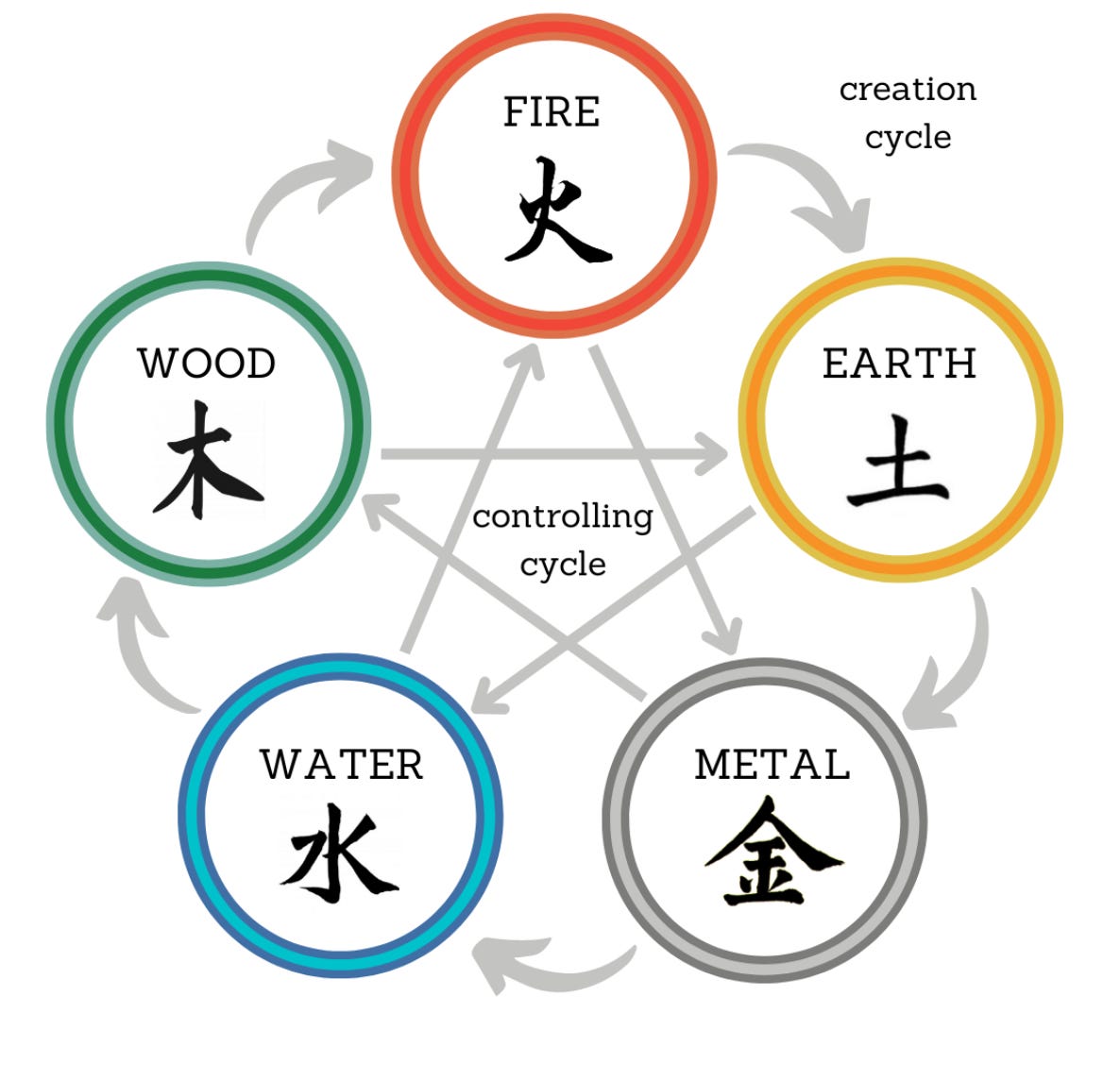
Photo Source: Simmy’s Yoga Lab
So then — what happens practically when fire does its job well? It forces us to meet the deeper essence of Metal: our need for rest. Deep rest. De-pressed. Our need to meet with grief, because grief is Metal’s element. We have forgotten how to grieve. We have to feel it. To cry — crying is, quite literally, Metal melting.
We need to gather in community and dance and sing and wail and make art. We need to sit in silence without our metal phones and devices and let something original arrive.
Joy is often associated with Fire (there’s a whole separate conversation to be had about joy becoming pathological in East Asian medicine, but that’s for another letter). Still — have you ever noticed that when you start dancing, start singing, hear music that’s truly beautiful, it cracks you open? That something so joyous brings you straight into grief? Fire and Metal, doing their dance.
So then the question becomes: what does Metal look like when it’s healthy? What would that look like in our world?
According to Five Element Theory, healthy Metal looks like recognizing what actually has real value — honoring it, and letting the rest fall away with dignity, grieving that loss well. It looks like living with integrity. With discernment.
That’s what we’re missing. We’ve forgotten what has true value, and we’re clinging tightly to what doesn’t have much value at all — our image (hello, social media hellscape), our possessions, our sharp metal accumulations.
I’ll bet if you listed your five most valuable people, places, and things — if you really had to choose — would it be your phone? Your computer? Your image? Your power? Or would it be your relationships? The people you love? The places where your heart feels nourished?
Do we have what it takes to discern what is truly valuable to us? Are these fires burning things down — are we getting burnt out — so that we can melt the metal around us and see what’s actually of value?
Perhaps so.
So, what can we small humans do in the meantime to work with this dynamic? It’s easy to feel like none of this matters at the scale we’re talking about — that a single person’s grief ritual or a single conversation with a friend is nothing against a million burned acres. I understand that feeling. But I don’t think it’s true. The little things are the big things. Balance doesn’t return to a system all at once, from the top down — it returns one small correction at a time, in a million places at once, which is exactly how the imbalance got here in the first place. So, a few thoughts:
Let yourself grieve, on purpose. Don’t wait for it to ambush you. Set aside real time to feel what’s actually breaking your heart about what’s happening to the world. Sometimes, I watch a sad movie just to get me going and tap in.
Get in community, in person. Sing badly or dance without an audience. Wail if you need to. Metal softens fastest in the presence of other bodies doing the same thing. There are many beautiful and supportive groups that are actively helping grief move through right now. Seek them out.
Practice discernment, daily, in small ways. Before you buy the thing, post the thing, chase the shiny thing — pause and ask what’s actually valuable here. When you can say “no” to what’s not important, what’s truly valuable can really shine through.
Put the phone down and let boredom or silence arrive. Something original can only show up in the space unbalanced metal usually fills with noise. This is a big one and we are really struggling with this. But if you can set a timer for 20 minutes and just set everything down and do nothing, that can be the most radical thing of all.
Tend something living. A garden, an animal, a relationship. Metal wants to accumulate; tending is its opposite — it asks you to give rather than hoard. This will help you heal your heart and your grief.
Name your five. Actually write down the five people, places, and things that matter most, and let that list quietly reorganize how you spend this week.
Beyond the inner work, there are people who need real, material support right now. A few places I trust to get help where it’s needed:
GoFundMe’s verified Oregon wildfire fundraisers — individual and family fundraisers, vetted by GoFundMe’s Trust & Safety team, for people who’ve lost homes.
American Red Cross, Cascades Region — funds shelters, meals, and emergency supplies for evacuees across Oregon.
Oregon Community Foundation’s Disaster Readiness and Response Fund — search “Oregon Community Foundation disaster fund” for their current donation page; grants go directly to community recovery efforts.
Native Arts and Culture Foundation — currently collecting donations for the Warm Springs community, where the Bench Fire has forced evacuations and destroyed homes on the Confederated Tribes of Warm Springs Reservation.
United Way of the Columbia Gorge — Rowena Fire Relief Recovery Fund — supporting shelter, food, and clothing needs in the Gorge.
And if you’d rather help locally and in person, dial 211 or visit 211info.org for a current list of what’s actually needed and where — donating the right thing to the right place matters more than donating quickly.
I don’t know if any of this is the whole truth. I told you at the start it probably isn’t. But I know that when I sit with the orange sky and let my heart actually break instead of scrolling past it, something in me softens that was rigid yesterday. Maybe that’s the whole point.
With you in the smoke,
Katrina
Katrina is a heart-centered astrologer, diviner of patterns, and earth-wise companion for those moving through seasons of grief, transition, and reawakening. Her work is shaped by lived experience with loss, illness, and transformation—initiations that led her to the wisdom of the stars and the medicine of nature. With a presence both grounded and poetic, she offers astrology readings and intuitive guidance to help others remember who they are and reclaim the beauty of their becoming. Learn more or schedule a reading at pathofre-membering.com
No posts
Comments
Nothing yet. Say the first thing.
Sign in to join the conversation.