
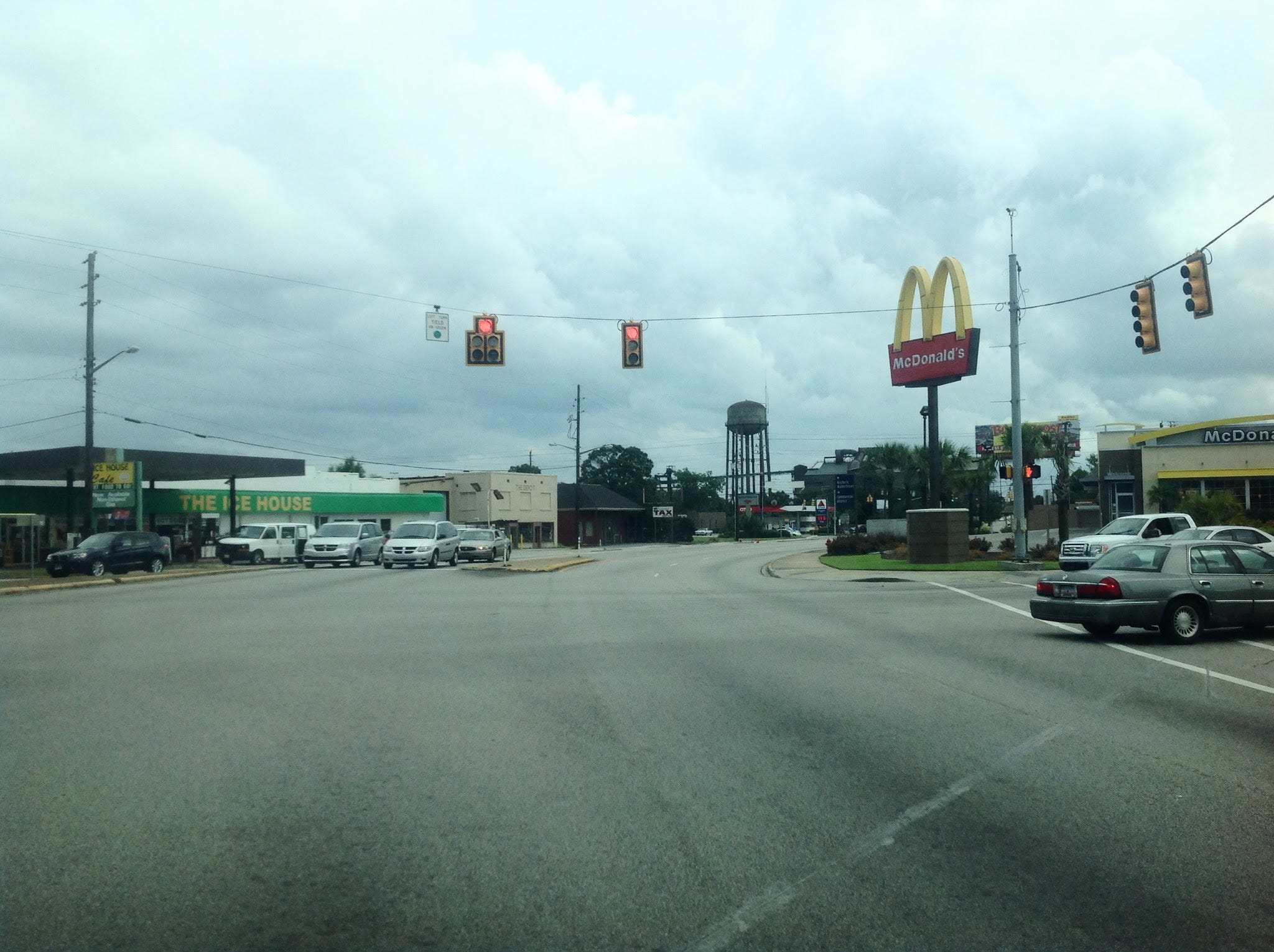
Mingo sits at the intersection of Highways 41 and 51 in Williamsburg County, South Carolina. It’s nothing special; it’s a gas station with a hot bar inside. It smells like shit on the outside, and, when you open the door to enter the establishment, the air is thick and heavy with a mixture of cigarette smoke, hot grease, and fish bait. As I walk in, feeling out of place, with my black Kate Spade purse and two daughters dressed in Hanna Andersson clothes, I think to myself, Thank God, I got the hell out of here.
There are hunters, travelers, and locals making small talk—all characters bustling in, around, and out of the little store like bees to a hive. It’s a real “out in the middle of nowhere” kind of place—but not for me. No. Mingo is one of those places that lives right smack dab in the center of my being. And though, I don’t recognize any of the faces there anymore, I still do in this weird sort of way. I see familiarity in their expressions, in their tone, in their demeanor, as they slink in, buy fried potato wedges and lottery tickets, and slink out, picking up the phone to talk loudly to their mama about how they could hear them and they were on their way to their house.
We stop to get gas, use the restroom, and obtain a little road snack. The food behind the curved, warm glass brings me back to my Granny’s kitchen: fried chicken, collards, white rice, brown gravy, cabbage,and fried okra. As we sit at the clanky table and take our first bites, I learn quickly that the food is just okay, but, on a scale of time-traveling capabilities, it’s excellent. I smile as I watch my family—my husband and our four- and six-year-old girls—devour Southern delicacies from styrofoam containers. They don’t see the acrobatics my heart is doing in my chest at this moment—swelling with nostalgia, sighing with grief.
It’s a strange thing to go back to a mainstay of your childhood when it’s no longer a mainstay in your adulthood.
The whole place looks different from how I remembered it growing up. The new owners must have changed the orientation of the store. There used to be a counter with a bar by the cash register where my Granny’s second husband used to come at night to drink cheap beer when we’d stay with her on the weekends to give Momma a break from her five chil’ren. Granny wouldn’t allow alcohol in the house because of her experience with her first husband—my Papa. Yes, the man accepted Jesus as his Lord and Savior and got sober but not until after some damage had already been done. I only know this information through small tidbits, tiny crumbs, that I picked up throughout my life, directly and indirectly, from my mother and grandmother.
Ain’t that the way life goes sometimes? Like the hurricanes that come shrieking through, pelting the Lowcountry, chaos followed by calm. Everyone in this joint probably still remembers and can tell stories of Hugo, the storm I slept through as a two-year-old in a crib. Mom and Dad thought that if we stayed in our home further south, we would have had it ‘real bad,’ so they packed up our family of three and drove to Georgetown—the one constant of our lives—in September of ‘89. Little did they know that we’d end up in the belly of the beast. Looking back, I suppose we had already taken up residency there. Despite all the reconstruction that’s been done, there are still signs.
Over time, the stories—our stories—that were once gale-force winds in our bodies shift and become just whispers in the breeze of our children and children’s children’s beings. Or, at least, that’s the hope, right? I know them—the stories of my grandparents and great-grandparents—though I don’t really know them. They have a home in me in some mysterious cosmic manner, and I’m just beginning to appreciate their place. I wonder what the wind feels like to my little anemometers, my two golden suns, here in Mingo—is it a blast or a zephyr?
A short and round lady in her 60s wheels a cart from the kitchen to a refrigerated cooler and begins stocking it with tasty treats like homemade banana pudding and carrot cake. As she does this, she greets everyone with a bright smile and grounds them by saying: “How ya doin’, honey?” And I wonder if she knew my Granny or my Papa. She must have; they’re from the same cloth. I want to ask her. I want to beg her for her stories—I’m sure they’re good ones. They always are.
Then, I imagine my Granny being there with us. She would walk into the store with a wobble and say a commanding “Hey, there! How ya doin’?” to the clerk, and she’d reply to their greeting, “Oh, I’m doin’ all right, honey. Thank you for askin’.” I imagine someone complimenting her on her great grandbabies, and I’d see the pride and joy wash over her face. She’d dote on them, beaming like the lighthouse figurines that graced her mantle—ceramics among frames that include scriptures from the Bible about how God never leaves or forsakes you, about how you can put all your worries on Him, about how He is love.
Then, I imagine my Papa being there with us. He would walk in like he was walking into a dance hall, saying sing-songy hellos to folks, waving his fingertips in an electric and frantic way to the clientele, winking at women in what I always believed—and still do—an innocent and playful way. I picture him walking up to the woman stocking the fridge to ask for some ‘nana pudding for a dolla’. He’d say, “I’m just a poor man. C’mon, please, honey?” And he’d say, “You know, I like my coffee like I like my women: black and strong.” He’d flash a big smile and let out an impish cackle, then suck on the toothpick dangling from his mouth. She’d likely respond with a perceptive laugh and say, “Oh, you a mess, W.L.!” Then, he’d join us at the table and ask for somethun’ to eat, and we’d buy him some fried chicken livers and divvy up our sides to split. He’d say a blessing and thank God for the hands who made the food and for his grandbabies and his precious great grandbabies. And we’d all respond, “Amen.”
As I’m sitting there with my family at that luncheonette table, I don’t know how much time has passed—I’m lost in my daydreams, in the gift of remembering. An old man with primmed white hair and a long, white beard approaches our table and brings me back to the present. He sees and points to my girls and looks at me and Erik and says with authority, “Tell them you love ‘em every day.” And his eyes turn red, lining with tears, and, in turn, my eyes do the same. Mirror neurons. In a second, I feel the history of this man—I sense the love, the joy, the pain, the grief in his being. I nod and spit: “Oh, yessir, we do. We sure do.” And then I panic in my head—We do, right? I think we do…
“Good,” he says, satisfied, and I start to weep because I feel the history of my life in that store too—I feel the love, the joy, the pain, the grief—and it hits me all at once. It’s like getting caught up in a hailstorm in an open field down the road in Andrews, South Carolina, thirty years ago. It hurts so bad, and it feels so good at the same time. I look to my kids, and I think about how they’ll feel this feeling too one day, or, at least, I hope so. Dear God, I hope so. And I think about how they’re being introduced to these places and these faces “out in the middle of nowhere” and how it’s all becoming part of their centers.
Did they catch what that old man said?
Did they catch the story behind his eyes?
Did they catch the story behind their Mama’s?
Did they catch all the love that was felt in that time and space?
Surely, they did. Mirror neurons in Mingo.

Hey, y’all! It’s been a while. I’m on a runaway train heading into the end of the school year at my new j-o-b, but I’ll be back to writing more regularly this summer. I’ve missed you all. A bit of joyful news in our household: Erik has been working on this really cool collaboration between Zillow and Kacey Musgraves. And wouldn’t ya know that her newest album contains a lot of the themes of the essay you just read? If that ain’t a sign of universality, I don’t know what is! Be sure to take a little peek.
As always, thank you for being here. If you’d like to continue supporting my work, here are some really great options:
Human/Mother is a publication designed for humans who are also parents and dealing with some pretty heavy life stuff. You can peruse, choose, and take what you need here.
Comments
Nothing yet. Say the first thing.
Sign in to join the conversation.