
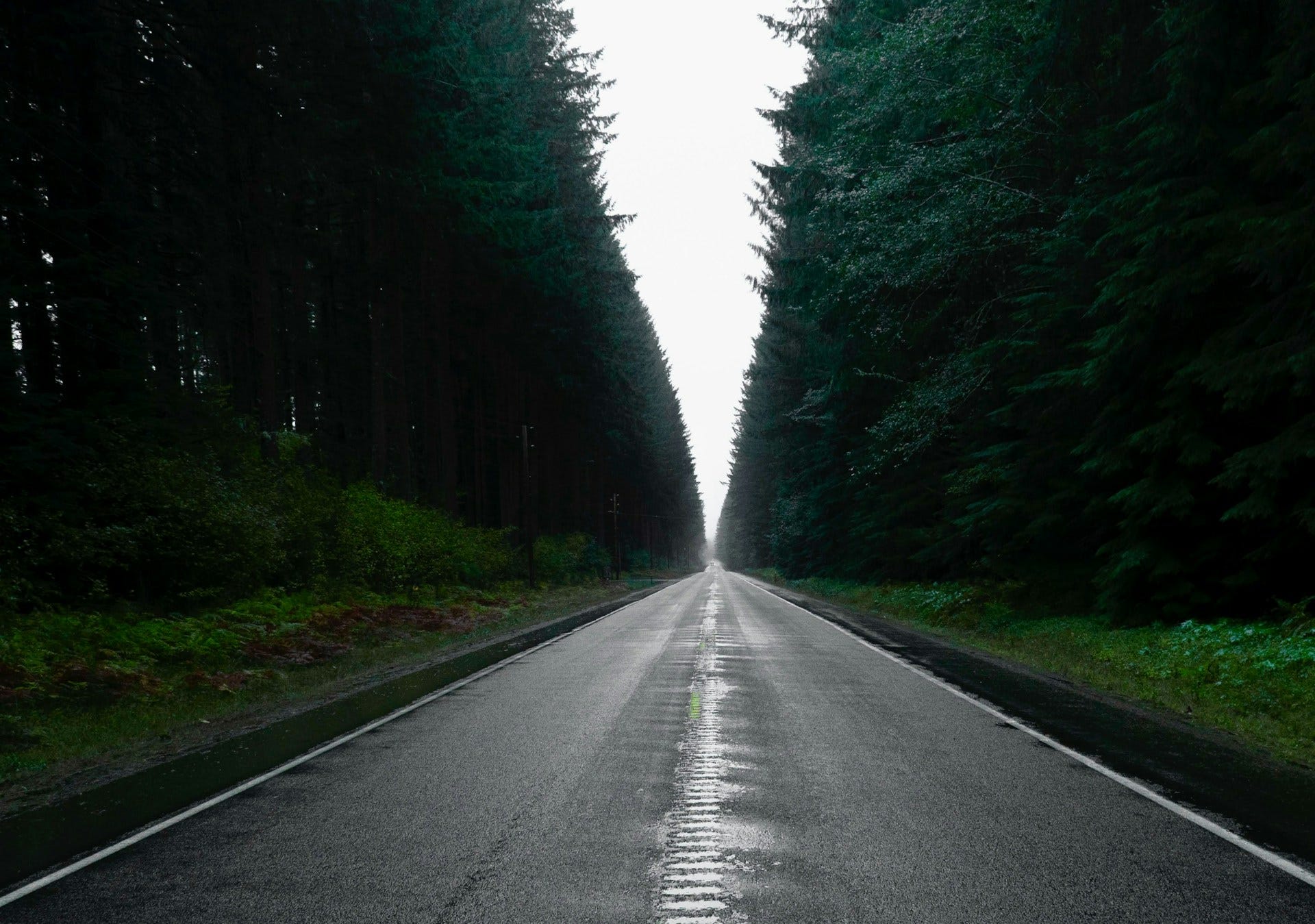
Driving home from my monthly infusion yesterday, I tried to focus my eyes on the horizon—you know, the kind of focus that makes everything else a bit blurry: the truest sky-blue sky with tufts of cotton ball clouds; the summery green trees framing the road. As I did, I noticed how the scene splits in two, how a barely-there haze comes across each side of the dividing line, and how the peripheral road beneath becomes dotted with slick, shadowed spots, like water shimmering on its surface.
Have you ever noticed this? Can you picture it?
My easily-carsick self couldn’t stare for long, but it was long enough for a whisper to drop into my ears, almost startling me:
I’m not sure I even realized how perfect mirage is for how hope feels right now. Since I last wrote you, hope has shapeshifted further, at times feeling like it did when my pain was first believed back in February, at other times feeling just as uncertain as it did as I cried over hummus and gluten free pita two weeks ago.
The ups and downs make hope feel illusive, uncertain, something I struggle to hold onto for very long. It’s shifty, mirage-like.
When I zoom out or look down at my feet, what I see is that the landscape of these ups and downs is a wilderness. In her book, Tethered to Hope,1 Adriel Booker calls this “liminal space.” Towards the end of the book, she has some wonderful journal prompts—which felt like The Artist’s Way’s homework—one of which is “Describe your liminal space.”
I wrote about getting sick in 2012, the potential catalyst for the cascading medical issues I’ve faced since then, all of which grew exponentially worse after my CRPS2 diagnosis in 2023. So, my liminal space has by no means been short. It’s been full of ups and downs, ins and outs, betters and worses.
What’s different about this year—which led me to purchase Adriel’s book—is that this space is coming more into focus. The ground is firmer. It’s becoming clearer, not because suddenly I know it exists or is ending, of course, but that it has a waypoint, a guide, a means by which I can orient myself.
After writing that word out, I searched for it on my phone, hoping to find a definition; instead, it showed me a document I wrote way back in 2015, called “the hazy horizon”—cue my jaw hitting the floor. I was a missionary in India, facing down a lot of dark, hard times, between my own depression and the organization I was with being in dire financial straights.
Its subtitle held a prayer:
let us lift our eyes away from the heaviness to the horizon. though hazy, the dawn remains to break, and the night will surely end. “take heart,” he said.3
I followed that prayer by quoting an old devotional I was reading at the time4, but it ended with a quote that made my jaw drop all over again. In my present-day journal, I wrote this in response:
After so long of my own wilderness feeling limitless, after so long of feeling lost in it, this horizon’s edge is a glimmer of hope that a liminal space is neither limitless nor a place we’re perpetually lost in; instead, it is “a road that leads [you] home.”

This would normally be a post for paid subscribers only, but I don’t know, I’m just feeling sharing this ongoing part of my story will each of you. After all, suffering doesn’t only afflict those who can afford to read about it. I hope it meets you wherever you are at.
If you are looking for more words of hope and have a little room in the budget, consider upgrading to a paid subscription. You’ll receive a full archive of posts and occasionally posts behind the paywall. If now is not the right time, you can support me by liking this post (hit the❤️), commenting, or even buying me a cup of coffee.
Those who have known me since the first summer I spent in India (in 2010) might know I’m not talking about an actual real friend, but a biblical character. I’ll try and keep this brief, but his story has been very formative in my life to say the least.5
The first words I knew from his story are nestled in another wilderness, in his very own liminal space, between pulling off a cunning but life-altering heist, and a very unknown future. I plucked words that God spoke to him—as only an evangelical golden child can—and applied them to fit my own story. “I will bring you back to this land,” suddenly became about India, not a barely-named wilderness.6
But then I arrived back in India… and nothing was as promised. Hence my document’s descriptor: “hazy horizon.” Nothing was as clear as it once had been.
So I went back to Jacob’s story. To his wilderness, hoping to find a bit about my own hidden in it.
And while it might’ve informed my own at the time, it’s taken a decade to see through it like a lens—not co-opting it, but letting it show me a better way forward in this moment’s liminal space.
Perhaps because I know my own story better. I mean, I just printed a bound copy of my memoir and sat it on my bookshelf to rest. I know my story better.
But knowing and living my story are two different things. And something I’m learning right now is this:
I’ve felt alone for a long time, perhaps in a similar way to Jacob, later in life. After several decades, another chapter shows him—don’t miss this—on his way home to meet his brother, the same brother left holding nothing on the other end of that heist Jacob pulled off. Jacob’s scared of what’s going to happen. Unable to hold out hope that forgiveness might be possible. He’s pretty sure he’s about to lose his life on the other side of a final night he’s spending alone.
It’s there he wrestles. Scholars don’t agree on whom he wrestled with. An angel? God? His brother himself? Either way, it’s just him. No spectators to cheer him on. No words from the one he wrestles with (until after).
Jacob asks for a blessing, and gets it—via a broken hip. A permanent limp. He also gets a new name, which feels significant given what happens next. At first light, Jacob-now-Israel gets up and goes to his brother, who has forgiven him. Who welcomes him home. Finally, his next chapter begins. Maybe the first one where it no longer feels like liminality, but like real life.
I, too, have felt alone for a long time, wrestling with God over and over again. Thinking that was the way forward, the only way forward. But all along, I was meant to go across the river, embrace my brother, and make a life with those I love and those who love me.
It’s too easy to feel like that’s the mirage, right? That there couldn’t possibly be a horizon that leads home. That that’s too big a hope to have right now. That aloneness feels much safer than vulnerability.
Today, that might feel true for you and me; even typing this right now, it feels true—too big, too risky. I’m writing this before yet another doctor’s appointment (a few hours before this publishes), where my hopes will be judged and my next steps will be in someone else’s hands.
But can I tell you what I also heard yesterday while staring at the horizon, with all its hazy, murky, shadowy slants in my blurry eyes?
I’ll offer a slightly adapted version of that prayer I wrote over 10 years ago again—as an offering of solidarity with wherever you are in the process of waiting for the Light to reveal the real for you:
let us lift our eyes to the horizon. though hazy, the dawn remains to break, and the night will surely end. “Take heart.”
Affiliate link. I receive a tiny portion of your purchase, which is an amazingly easy way to support me.
Complex Regional Pain Syndrome. A chronic pain syndrome characterized by hard-to-treat pain that rests in one limb, even after the healing process, but can often spread to other limbs/areas. I’ve personally felt it spread to my chest after an endoscopy, although that has largely resolved. But at the end of the day, it makes any pain signal larger-than-life.
I promise, every single detail will be in my memoir! Stay tuned.
No posts
Comments
Nothing yet. Say the first thing.
Sign in to join the conversation.