
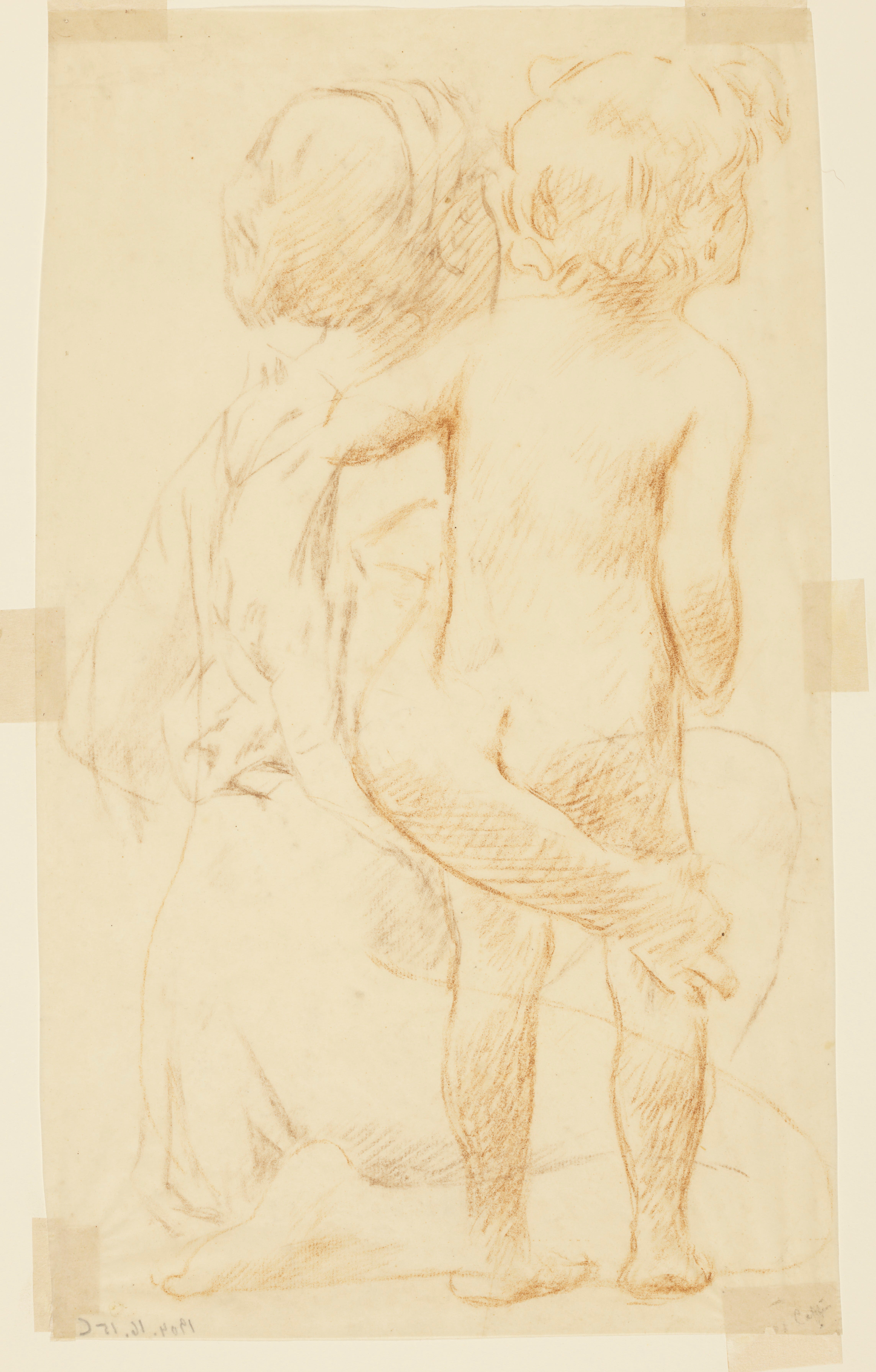
I have a stock response for when people comment on how similar our children look to one another: “We make one kind of baby.” The saying is also true to one aspect of their personalities: they are intense. When we found out our third child was a girl, our first thought was “Thank you, God! Maybe she’ll be our chill baby.” Joke’s on us! We are 3 for 3 on blonde-haired, blue-eyed, full-throttle kids. We make one kind of baby. (Maaayybe this next baby…just kidding).
There’s a camaraderie amongst the mothers-of-intense-kids I know. Just last week, one of my kids started playing with a brand-new friend at a baseball game. The other mom and I cautiously approached each other offering our well-rehearsed explanation/apology for what our intense child was capable of. One sentence in, we realized our luck: both kids were intense! No apology or explanation needed! We understood the risk and were grateful that our kids would have a playmate who could match their energy.
When two mothers of intense children find one another, there’s an immediate relief: she’s not going to judge me or my child or make those comments that only appear good-natured (“What a handful!”). She gets it. Her kid can handle mine. She can handle me.
Bringing kids out in public is always a little stressful, no matter the child’s temperament. Any kid at any time could get hurt or lost, could be whiny or annoying, could have a disruptive meltdown. But when you take an intense child out in public, you also run the risk of others’ perceptions: of your child being perceived as too much and you being perceived as a bad parent. “Why can’t you get your kid under control?” you know they’re thinking, “We’d never let our kid __________ (run wind sprints in front of Five Guys, hang upside-down from the tallest monkey-bars, make that much noise during a ball game, to offer a few purely hypothetical examples).
It’s taken me a while to come to terms with my kids’ intensity. There are plenty of days that it still feels nearly impossible to hold the intensity of all of them at once. But I’ve learned (I am learning) to reframe the intensity of my beautiful, wild children in ways that are bolstering me as a mother, giving me the mental and emotional space to not just endure their intensity, but to delight in it.
Before we get any further, I want to make one thing abundantly clear: This is not an essay on the methodology of parenting intense kids but the philosophy of it. I have no interest in telling you how to parent your intense kids. My interest lies in challenging how to think about your child’s intensity. If you need tips and tricks, look elsewhere, I cannot help you. But if you’re willing to have your mind changed on this particular topic, read on.
I also want to be honest about my fear in writing this essay in the first place. I really, really love my kids. I want to protect them from judgement, harm, and everything that every mother wants to protect her kid from. Sharing anything about them on the internet is an inherent risk, particularly when the thing that I’m sharing already brings judgement.
But to say nothing is to silently agree with the lie that a child’s intensity is a moral flaw, a fault in their character, and/or a result of bad parenting. Continuing to duck my head and take my kids out of any space in which their personality (not misbehavior, but their much-ness) is deemed “too much” is to agree with the wrong thinking that intense kids are bad kids. And I can’t do that anymore. So I’m writing anyway. If you’re a parent of an intense child, I sincerely hope this piece is of some encouragement to you. And if you’re not a parent of an intense child, I hop this piece might invite you to offer us moms-of-hurricanes (and the hurricanes themselves) a little more compassion.
The reason mothers of intense kids feel relief (rather than mere recognition) upon meeting one another is because we live under a perpetual social stress: the almost ubiquitous belief that intensity in a child is the same as misbehavior. And while intensity in a child can lead to misbehavior, the two outputs are not synonymous. This begs the question: what is it really that bothers grownups about intensity in children?
Certainly, part of the struggle is the intensity itself: intense children can be loud (so, so loud), and parenting them can be physically demanding (i.e. my third trimester body waddle-running down the street after my naked, maniacally-laughing toddler who is strangely adept at riding a scooter). Parents of intense kids may find themselves in more power struggles, more difficult conversations with teachers, and more moments of pure terror as their child launches themself off another too-tall surface.
But what can be harder than dealing with the intensity itself, what I think lies beneath the general adult distaste for intense children, is that intensity in children shatters our illusions of control. Many of us came into parenthood with the unconscious belief that our children’s personalities were ours to design. We thought our children arrived as blank slates ready for us to fill in according to our values and expectations of what a child should or should not be, how they should or should not act, what we did or did not have the bandwidth to parent. But this is not the case. Charlotte Mason says that “children are born persons”, that we’re born in fullness, already equipped with preferences and temperaments. In this framework, the parent is not the architect of the child’s personality, but its chief witness and steward.
Each experience of witnessing and stewarding a child’s personality is unique. Stewarding a naturally quiet, cautious, or compliant child is not the same as stewarding a child who is naturally intense. I don’t mean to say that one is inherently easier or harder, better or worse, but they are demonstrably different.
Intense kids tend to offer much less space (emotionally, physically, phonically) to their assigned grown-ups than naturally mild kids. The will and activity of the intense child demands almost constant attention. It’s the adults’ inability to think of or do anything other than pay undivided attention to the child that’s behind our exasperated sighs. We’d really prefer that our children make fewer demands on our time and attention, that they’d just be quiet, go somewhere else, make fewer messes, play alone, not feel so much. But the intense child has no other mode of operation. They’re all gas no breaks, baby! They’e sprinting or they’re asleep. There is no in between. And we, their parents, are along for the ride.
I don’t mean to say that a parent of an intense child has no agency, nor that loving these children requires that we surrender our duties as teachers, trainers, and order-makers. But we do need to examine how we think about their intensity, being careful not to buy into the common narrative that intensity is inherently and wholly “bad”.
When I asked my followers on Instagram whether they’d classify their kids’ temperament as “intense” (as opposed to “mild to moderate”), the majority said “yes”. There is, of course, no objective scale for child-intensity. A child is deemed “intense” largely based on the mothers’ perception, which is a vast psycho-social ecosystem all its own. What is intense to one mother may appear mild to another. And there are different “flavors” of child intensity: some of our children are intense in their emotional sensitivity. Other children seem to have no emotional sensitivity whatsoever which leads to trouble in peer relationships. For some children, their intensity is measured in decibels, for others, it manifests as constant defiance. Some of our children have seasons of intensity with clear beginnings and ends, while others bust down the delivery room door and keep the pedal to the metal forever.
One important observation: many mothers who deemed their child intense were referencing their oldest child who was two or three years old. I want to speak to this for a moment.
Parenting a toddler for the first time is bewildering. Honestly, it’s still bewildering for me and I’m in my third round! Two and three year old children are intense as a rule. Calm and compliant two and three year olds are a miraculous exception. For many parents, it’s the first time the child is expressing their own will, when tantrums and opposition first surface. You’ve likely thought to yourself: “where did my sweet baby go?”
I want to offer you a quick love note: take heart. This new burst of big, two-year-old emotions does not indicate that your child will be intense forever. Right now, your little one is coming online, developing immense neural networks and having a hard time making sense of it all. They’re going to freak out. They’re going to scream “no” at you. This is not because they’re being disrespectful—they don’t yet have a conception of what respect is. It means that they are two, and two is intense. Eventually they will not be two and they may return into the calm and agreeable little one you previously enjoyed.
But there’s also a chance that they’ll turn three or four and continue in their intensity. They may not be in a constant tantrum-state, but the big desires, big will, big feelings, and big reactions will live right on. If this is your reality, welcome to the club. You’re gonna be tired, but you’re gonna have the best stories.
I want to be careful not to portray intense children as a monolith. Intense children can be immensely sensitive, empathetic, helpful, and kind. They are as nuanced and lovely as any other “type” of child (this thinking is problematic in itself, but that’s another topic for another day). Let me get more specific so we’re on the same page.
The intense child has been called “strong-willed” and “spirited” by writers and parenting experts. They are deeply convictional people: they know what they want. They do everything with gusto. They have an oversized confidence in their abilities, which can be scary to watch. They’re more likely to ask forgiveness than permission. They don’t handle “no” with grace. Intense kids can be astoundingly creative, clever, and hardworking. They can also be loud and angry and aggressive.
It’s the “shadow side” of the intense child that leads some schools of parenting to advise parents to “beat the strong will out of the child”; to punish every display of intensity for fear of the child taking too much control from the parent. Control is at the heart of this methodology. Since intense kids are harder to control, they’re perceived as threats (to our peace and reputation) rather than complex, God-breathed creatures full of potential and vitality. In our efforts to feel “in control” of our children, we demand they shrink to fit our expectations. We elevate ourselves to the position of God who is the author of personality and identity.
Here’s the risk: If no childhood intensity is allowed in a family unit, we are teaching the child that their passions (which can be exceedingly good and beautiful) are dangerous, inconvenient, intrusive, and to be avoided. We are implicitly teaching them that what’s important is that they are forgettable, ignorable, that their presence be of as little consequence as possible. And as we rob our children of living as fully-alive, beautiful creatures, we rob ourselves of the joy of bearing witness to their sacred unfolding.
If we are to raise these children to be the fullest version of themselves, we must learn to honor their intensity (as a personality trait) despite the cost to our time, attention, and nervous system. Their intensity isn’t the main problem, our perception of their intensity is. What we think about our children determines how we treat them. And if we think that our children’s intensity is “what’s wrong with them”, we run the risk of treating them as a problem to be solved, demanding (implicitly or explicitly) they bend themselves into someone they’re not to remain in our love.
It behooves us as parents of intense children to do the work of analyzing (criticizing, repenting of) our perception of their God-given affect. It’s up to us to allow the Spirit to reveal and cleanse our hearts of the disappointment, resentment, bitterness, and anxiety so common in parents like us.
One way to gage the health of your heart in this area is to honestly consider how you think about parents of naturally mild children. If we aren’t careful to ensure that we are spiritually and emotionally healthy, the demands of raising intense children can lead us into a dark cave of comparison, self-pity, and division. Without diligent attention and intention, the parent of the intense child is likely to see the parent of a less-intense child and say “must be nice” with a roll of the eye and a twist of the stomach. Christian moms of intense children: beware this phrase! It is fertile soil for resentment, judgement, gossip, and fracturing of communities. I know the pang of wishing we could move through our days with less resistance. I know the temptation to belittle mothers of less-intense children because it seems like their job is inherently easier than ours. But this thinking isn’t true or helpful. God’s given us these children in all of their much-ness, and dwelling on the illusion of greener grass will only harm our family, friendships, and allow this comparative disease to fester.
So, what do we do? How do we think about our children’s intensity in a way that honors who God’s made them while also upholding our role as their primary teachers, trainers, protectors, and guides? As always, it begins with an analysis of our minds and a willingness to have them “transformed and renewed” (Romans 12:2) by the kindness of God.
If you’ve made it this far, chances are you have an intense kid. Can I just say how much I love them? I mean that honestly. Intense kids are so fun, so funny, so interesting. Your child’s intensity isn’t their “badness”. It isn’t a moral flaw. Their passion and zeal is not something you necessarily need to train them out of. Now, your child will do bad things, and they will do bad things with intensity. You will need to correct these behaviors, but don’t mistake the behavior for the intensity with which the behavior was enacted.
At its most basic, your child’s intensity is a tool: a means by which they accomplish what they set their minds to. When they set their minds to dominate a game of Candy Land, we do well to hold some space for teaching and practicing self-control. But when they set their minds to love, creativity, truth, beauty? Stand back! Let it happen! Do not squash this intensity! We want this kind of intensity to take root. We want it to be nourished. Think of what beauty this intensity could build if harnessed and trained: they could grow to become justice warriors, entrepreneurs, civil servants, people of holy consequence. Intense kids don’t do things half-way. If captured by a holy imagination, just think of what they could accomplish!
Of course, “harnessing and training” a child’s intensity is easier said than done. Intense kids are marked by deep conviction, and getting them to act in a way that does not align with those convictions can mean intense resistance. Being resisted by our children is exhausting. I’d rather give myself multiple paper cuts every day than constantly fight my child to do something that’s ultimately for their good. But it’s part and parcel with raising children, no matter their temperament.
One thing that’s helped me in this particular struggle is the consideration of how God parents me. If I’m honest about how I respond to God’s correction, his leading me away from what feels good to and leading me to what actually is good, it isn’t usually with immediate exuberance or gratitude. Even as a grownup who knows that God’s way is better than my best-laid plans, I resist, resist, resist his loving discipline…with intensity.
And yet, he continues to invite me into holiness, endurance, and godly growth—often through the continual refinement of parenting children who treat me the way I treat God. Remember what the writer of Hebrews said, that “For the moment all discipline seems painful rather than pleasant, but later it yields the peaceful fruit of righteousness to those who have been trained by it,” (Hebrews 12:11).
It yields the peaceful fruit of righteousness. This is our end goal. We are creating structures and spaces for our children’s intensity to be trained in godliness, humility, and joy. But let’s be honest about what this will require of us. We should expect resistance along the way, our children being as human as we are. Our role just isn’t as much “setting the table and letting them choose from their options” - it’s trying to keep up with them as they choose whatever they’re going to choose regardless of what we put before them and making sure they don’t self-destruct. We’re going to have to be exceedingly watchful, patient, and persistent. We will have to correct the same behavior a thousand times. We will have the same conversations over and over. We will spend time in the emergency room. We will have to apologize for losing our cool. But when we set the prize within eyeshot, we may just make it the distance. Our children will have the prize of peaceful righteousness, and we will have the prize of watching our gorgeous child grow into a change-maker, a leader, and a very good friend.
I’ll end by honoring you, the blessed mother of such a wld creature. Here’s to you: the deep-breath-taker, the wide-eyed laugher, the knocked-on-her-tail after a tackle-hug. May peace abound when the preschool teacher asks for a word, when all those eyes settle on you in the grocery store. May you see your child through the gaze of God and may you rejoice in their much-ness. May it cease to feel like a threat and begin to feel like a whispered promise. May you expand to hold enough exhale for the both of you. May you say with confident joy “She’s a lot, and it is so, so very good.”
No posts
Comments
Nothing yet. Say the first thing.
Sign in to join the conversation.