
If you like what you read today do click through to like the post or leave a comment or share with a friend. It makes a difference and I’m very grateful. :)
Thank you for reading The Living Library, the online studio for my creative and coaching practice. I am a complex systems and humanity enthusiast doing and making a lot of different work. Here I share some of that work, and write about all manner of things relevant to existence, creativity, non-normative circumstances, and complexity.
You can learn more about me and what I’m about here, see if you might really love coaching with me here, or learn more about my book and creative work here. If you think anyone else might enjoy doing those things, do share with them too. 😌
I am supposed to be doing my final edit of my book before putting it out to query, but instead I am deep inside the worst ME/CFS crash I’ve had in many months. It’s not just the cognitive and physical capacities that have shrunk down to the capacities of ants, but my emotional world is all untethered and aggravated, a sign we are a long way down the ME/CFS road, at the bit where there is insufficient capacity for advanced emotion regulation.1
So, we are not editing books right now. We are not writing substacks (except when we are). We are not seeing people right now, given how reactive and antisocial we are. No, we are trying, carefully, slowly, to make all the room necessary for my compromised little recovery systems to do what they are still able to do, to slowly get us back up the hill, and not add to their load via exertion or stress, for as long as it takes to come back up to something like my previous baseline.2
This is normal and fine. It is normal and fine! Truly, in this version of creative and work practice, where we must make our way alongside intermittent incapacity and disability, it is normal and it is fine. Sometimes we think we will be able to start querying by the end of the month, and it turns out it will be more like another month or six weeks beyond, and in this reality, what is that? Normal. And fine.
Reading with my eyes is currently a form of exertion too high for recovery. Luckily, TV and audiobooks are not. So I listened to the most zeitgeisty of books, Yesteryear, by Caro Claire Burke.
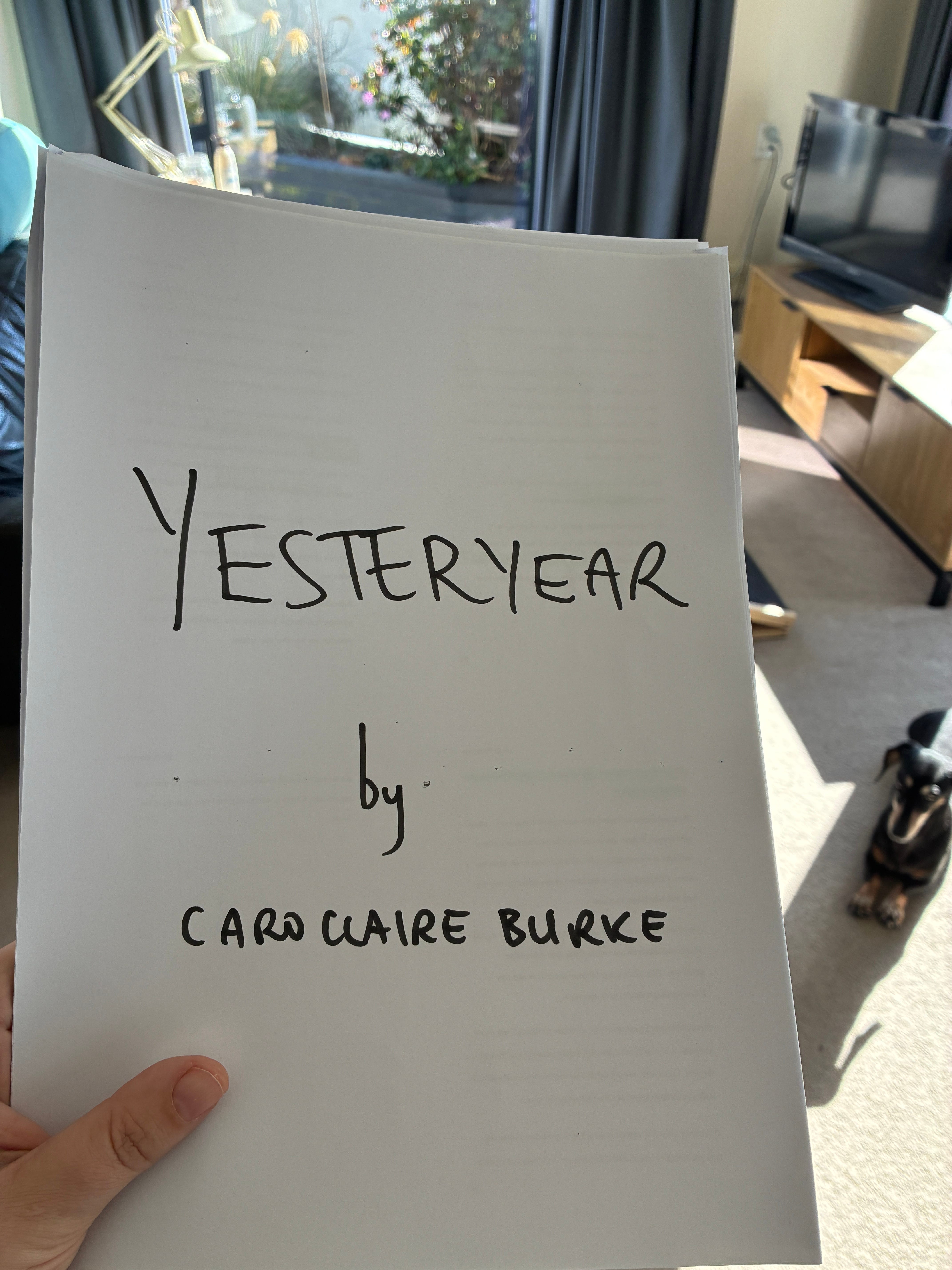
Yesteryear is about a trad wife influencer who wakes up somehow back in nineteenth century pioneer times and must live the reality of the lifestyle she presents online.
I mostly do not read zeitgeisty books at the height of their zeitgeisty powers, because I get all my novels from the library, and everyone is competing in the queues for the zeitgeisty books from the news. But Spotify gives me 15 hours of non-refundable audiobook a month, and I use that on the books of the moment whose library queues are in the three figures.
Here is what I thought of Yesteryear:
It is a very interesting book. I had a very nice time. It was too long but it pulled me along anyway.
I thought its multi-layered critique of what the systems of patriarchy do to the individuals who must live under it was thoughtful and nuanced.
I thought the bits in the past were quite boring but I always think stories from pioneer times are boring, so I don’t blame the book for that.
I enjoyed an unlikeable protagonist whose every motivation made sense to me.
Even when it got a bit extra heightened and silly at the end, I still came away feeling I’d had a nice time, that I had been witness to an author doing interesting things.
If it were not a book of the moment I would have thought, “Interesting book! I had a nice time!” and then wandered off to think about something else.
But then I went on Goodreads to see what others thought, since I knew it was big in the culture currently. And what I found there fascinated me.
There were people who went in assuming from the premise that it was funny, or a satire, and were confused that it seemed to be neither. I did not understand these people.
There were people who loved it, loved its critiques and its portraits and thought it was an immediate cult classic. These people were more enthusiastic than me, but I could see how they arrived at their enthusiasm.
And there were a lot of people who thought it was so heavy-handed and ridiculous as to be symptomatic of stupid books and stupid people and stupid, polarised, straw man culture everywhere. I could also see how these people might have arrived at their conclusions, though I reached different conclusions.
There were no doubt all kinds of other people too but these were the three main camps I saw from my little survey.
What’s interesting to me is the breadth of responses. Obviously a breadth of response is what almost all art provokes - almost everything will have at least one five star and one one star review - but it seemed especially stark here. Each review so certain of its conclusions.
I was surprised to think anyone thought it was heavy-handed or ridiculous, because I thought the characterisation that could be read that way was contextualised well and placed in proper context, and because the real life world of trad wife influencers does seem to be pretty intense and heavy-handed.
But then I remembered some of the plot points later in the book, and I thought, “Huh”. I had let those drop to the background because the cultural critiques and interplay between systems and individuals was, I thought, so well done. It didn’t bother me that these other parts were heightened or extreme to a point of silliness.
And that’s what was interesting. This thing where I seized on one aspect of the book that many people did not seem to value or experience, and all kinds of people seized on other bits that pleased or annoyed them but flew right by me, it was such a lovely experience of how our context changes our experience of external things. How all of us is present, always, even when we think we might have objectivity. The most important bits for each of us, in our own little worlds and personalities and contexts, will always rise to prominence in our awareness. For me, the systemic stuff trumps plot. For many readers of novels, plot is quite important, actually.
I am evangelical about the role of context in all things, obviously, but here it was so clear to me that my impression of the book is rooted in my context, just as everyone else’s impressions are rooted in theirs. The only way you get to so many different viewpoints on the same unchanging cultural object is that everyone’s impressions arise not just from that object but also from their contexts. None of us are right and none of us are wrong. The bits that please or provoke us depend on who we are and what context the book finds us in.
And is that facile and obvious and not worth mentioning? That all perspective depends on who we are and where we are and what else is happening? I don’t think so. I think, in a world that would shuffle us into binaries and certainties and strip us of our contexts and human complexity, that would ask us to have takes and opinions and to be certain and unchanging in them, it is a lovely thing to be reminded of.
We experience nothing without context. We meet each other always, with our context in tow. Even as we read the same book, we are not having the same experience.
And doesn’t that just keep our humanity, individual and collective, firmly in view.
May your context be pleasing for you currently, or resourced in other ways if not.
May I one day finish editing and querying my book.
May none of us ever, for any reason, have to be influencers.
Until next time
Katie
Yes, ants are a terrible metaphor for small capacity, given their famously enormous capacities relative to their size, but they are a small size relative to me, so their capacity, if it were mine, would actually be laughably small. Also I just told you my cognitive capacities are compromised; you’re not allowed to start in with critiques of my metaphors.
That piece by Todd Davenport is an excellent examination of the physiology of ME/CFS crashes, for any of you medical science fans out there.
Comments
Nothing yet. Say the first thing.
Sign in to join the conversation.