
Instead of writing a long tribute to the benefits of retrieval practice, I’ll leave that to two gentlemen that wrote fantastic articles about retrieval in a much more profound way than I would myself. Read SOL in the Wild’s The Power of Retrieval: Helping Students Remember When It Counts and Lee Wheeler’s Retrieval is Learning articles.
“Let’s start at the very beginning, a very good place to start. When you read, you begin with A-B-C…” -Julie Andrews, The Sound of Music
Today, I’m opening my Retrieval Practice Notebook and sharing a description of an A-Z recall activity.
I normally use A-Z at the end of a unit of study. I see it as a variation of a “brain dump” activity. It’s a comprehensive review of topics like—court cases, events, documents, people, religions, geography, government, etc., that were discussed over the course of a unit of study.
I ask my students to open their journal to a fresh clean page and they write the alphabet vertically down the page. Once all the letters are listed, I then usually ask for a volunteer or two to tell me a word that we have studied for a certain letter. I choose a letter that the majority of the class will easily write. For example, at the end of my Exploration and Colonization Unit, I would ask for a word for the letter J, knowing that 98% of the class will come up with the word, Jamestown. The goal is for students to begin to focus on remembering different aspects of the unit. After the initial word, I reinforce the idea of writing as many words as possible for each letter of the alphabet. I give students about five minutes to write as much as they possibly can for each letter.
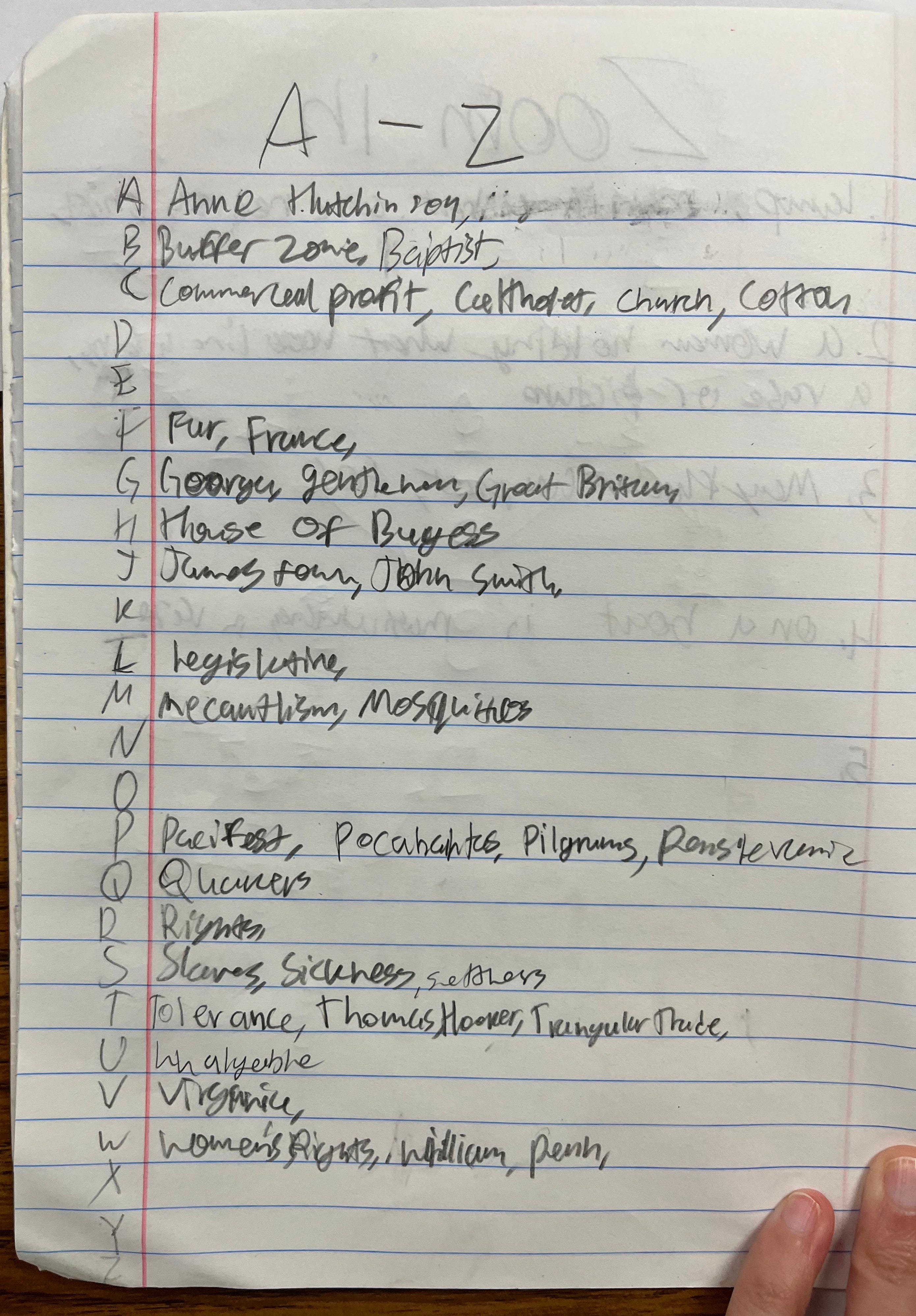
It’s important to note, that I don’t allow students to use their notes or textbook to help. This is a retrieval activity. Students summon their own recollection, while strengthening their learning and memory.
I do my best to walk around and point out great words that I might not have seen yet. At the end of the five minutes, I ask for students to volunteer to share their words for each letter. Praising students for their words and ideas goes a long way in participation. By the end of the activity, I try to make sure that every student has shared something that they have written down. In addition to providing me with the opportunity for feedback and reinforcement of key ideas, it also sets the foundation of how this retrieval practice will work for the rest of the year when it comes to student involvement.
No posts
Comments
Nothing yet. Say the first thing.
Sign in to join the conversation.