
With over 100 standards to teach from August to the STAAR test window opening in the middle of April, each day counts for this 8th grade American History (1492-1877) teacher. The temperature rises during the second semester. In addition to covering the last few units of study, teachers also have to consider building in days of review. On a good year, I have 10 solid review days to prepare my students for a standardized test that covers 100+ standards. There are bad weather days, UIL events, MAP testing, mock test days, etc. that interrupt instruction, review, and bring sudden changes to my scope and sequence. Time, and the use of it, is of the essence.
Although my instruction has focused on daily retrieval practices this past fall, I did include spaced retrieval with daily warm up questions. However, I’ve been asked to follow a certain STAAR blitz review that is different from my standard daily warm up starting this month, which I do believe will be helpful and should benefit my students. Nevertheless, I’ve quickly realized that I have to build more spaced retrieval into my units of study. Spaced Retrieval is a technique to help students remember information over longer intervals of time. I want students to be able to see connections between different eras and build relational memory.
After this current winter storm passes, I will begin the next unit of study, Sectionalism. Here are a few of examples of strategies that I have planned to include or have as an option of spaced retrieval for this next unit that has nine days of actual instruction. Almost all of the recall activities are from the book, Powerful Classrooms: Evidence-Informed Strategies and Resources by Patrice Bain. In the book, Mrs. Bain and other teachers share retrieval practices that have been successful.
On Day 3 of Unit 8: Sectionalism, my students will participate in a Power Ticket strategy. The heart of instruction will be studying the impact slavery had on the North, South, and West. In addition, students will verbally compare the lives of slaves to free blacks living in the South and North.
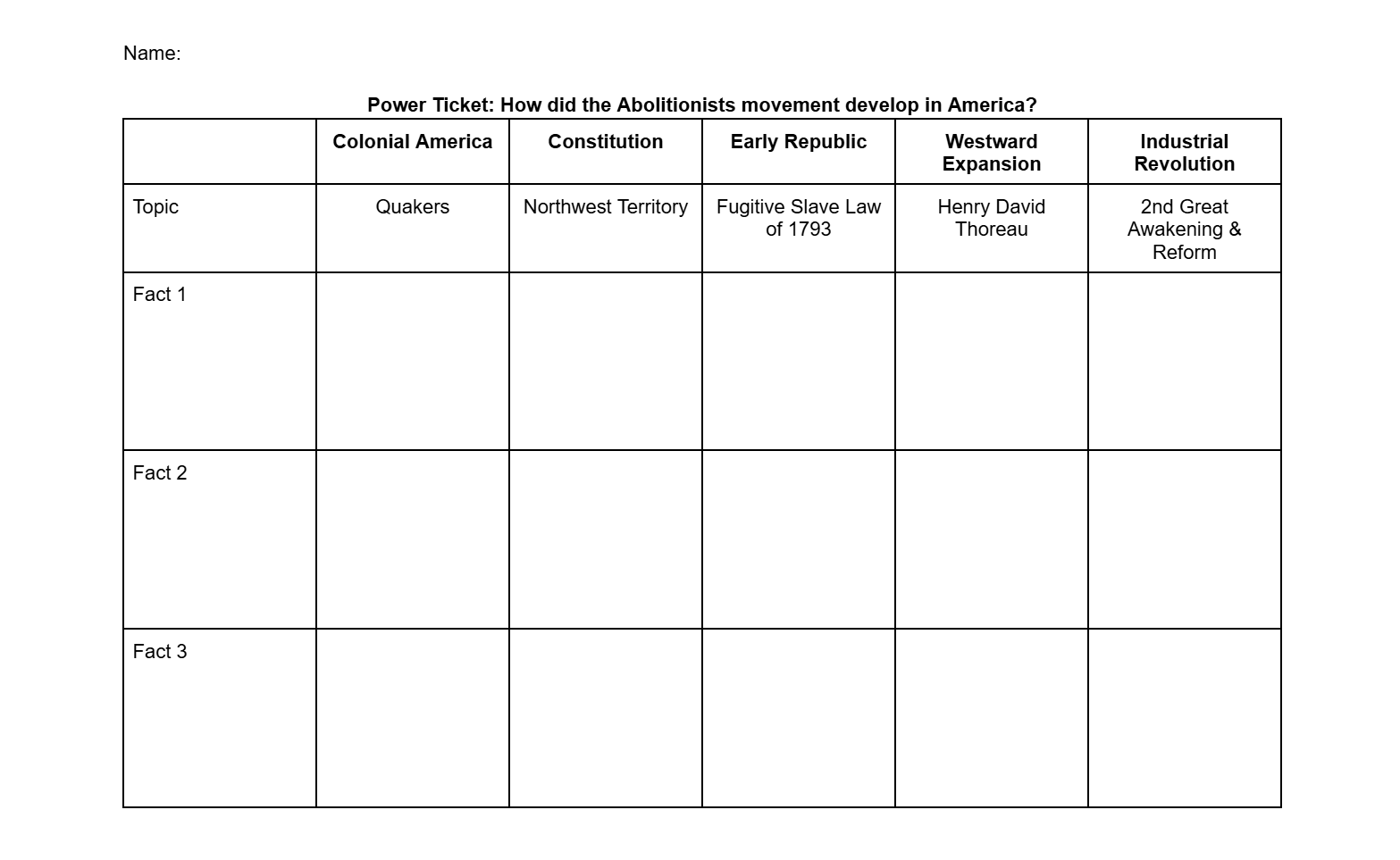
This strategy provides a couple of important aspects that help review.
It traces the abolitionists movement in America.
It affords opportunities to remember important figures and their impact.
It reestablishes the idea of Sectionalism and the deepening divide in America.
Finally, students will write a paragraph with sentence stems to answer the essential question.
I will manage this Power Ticket by having students individually write one fact that they know about each subject. For fact 2, students will turn to the partner and share their fact 1. They will write down what their partner said. Finally, for fact #3, I will share an overview for each topic. Students will write one fact from my short lecture to add as their final fact. Before writing their paragraph, students will participate in a Turn and Talk to discuss answers to the essential question.
On Day 4 of Unit 8: Sectionalism, my students will study the Compromises that saved the country from the Civil War: the Missouri Compromise and the Compromise of 1850. My students will have a short writing activity for their daily retrieval practice, and will participate in an Odd Man Out spaced retrieval strategy.
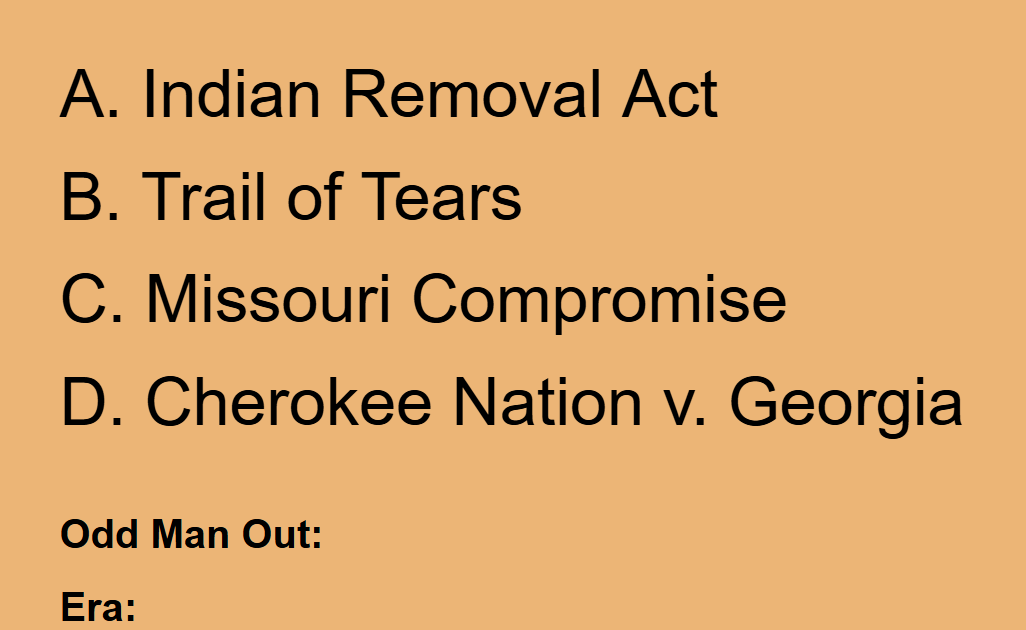
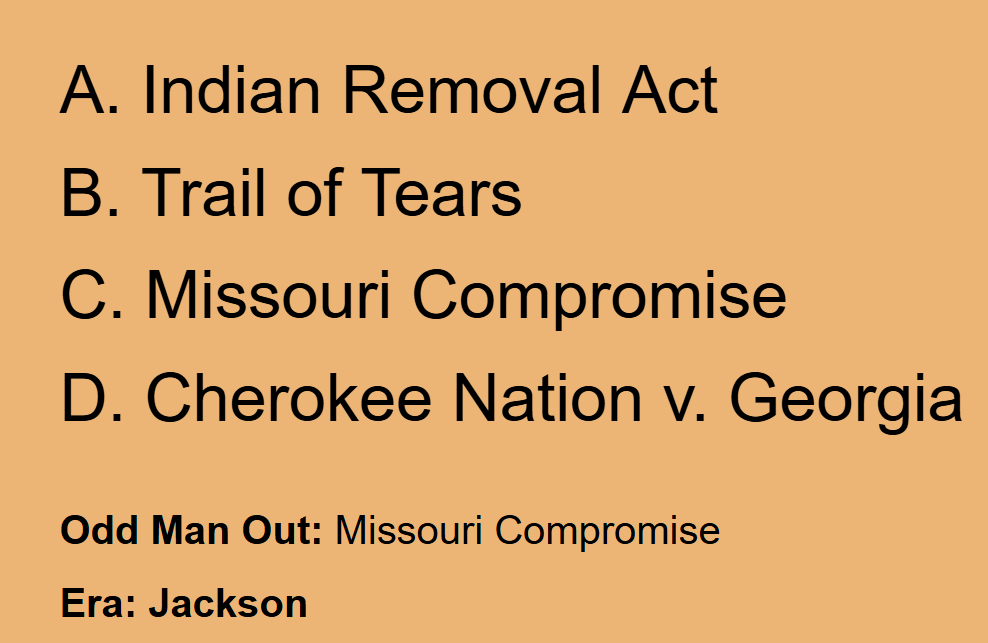
For this strategy, students will use their mini-whiteboard and divide their board into two sections. In the first section, students will label it Odd Man Out and the other titled Era. I ask students to study the four choices, find the one that doesn’t relate and to write it on the Odd Man Out side of the board. For the other side, students will write the unit of study or era for the three choices that are related to one anther. I project several slides from units that are tested the most on the STAAR test.
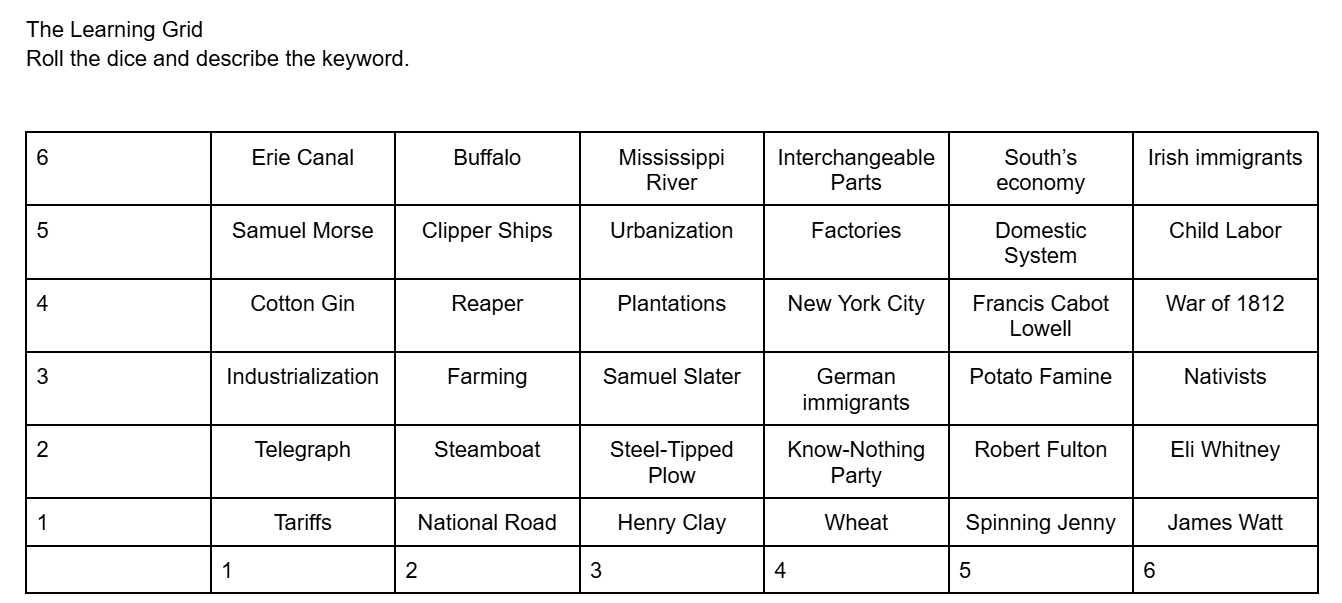
Day 9 of Unit 8: Sectionalism, after teaching students about John Brown’s raid and a daily retrieval practice A-Z activity. I’m going to project a learning grid on our screen that is full of terms from the previous Industrial Revolution & Reform Units. I roll a pair of dice to get two numbers, those two numbers create the x and y that I follow to land on a word. Students will describe that word in a historical context on their mini-whiteboard and share. Eventually, I roll the dice to get two words. Students will then write those two words in a sentence on their whiteboard and share it with me.
Like most teachers, the second semester of school is crammed with events but also a high-stakes standardized test that determines distinctions and accountability grades for a school. It matters a lot. I have to prepare my students to the best of my ability and have them ready and confident to answer any of the questions thrown their way. I’m hoping with a few purposeful planned days of spaced retrieval strategies embedded within a unit of study this spring, it helps create a foundation of knowledge.
No posts
Comments
Nothing yet. Say the first thing.
Sign in to join the conversation.