
Imagine if there was a drug that could curb runaway inflammation in the body, boost the immune response, help avoid organ rejection after transplant surgeries, fight fungal infections, starve solid tumors and other types of cancer, prevent muscle loss in elderly patients, potentially slow down neurodegenerative disease, ameliorate the symptoms of depression and anxiety, and make us live longer? It sounds like a mythical panacea; yet a molecule that combines all these seemingly contradictory properties does exist. It’s called rapamycin.
Rapamycin, as the name may suggest, is an antibiotic, originally noted for its ability to inhibit the growth of the Candida albicans fungus. Later, it was also found to have anti-cancer properties, approved as an immunosuppressant agent for organ transplant patients, and is now being investigated as one of the most promising life extension medicines. Underlying all these complex functions is a relatively simple mechanism. But before I bore you with the mechanistic details, let’s rewind. How did this incredible drug come into existence?
An island expedition
In 1964, a Canadian team of 38 scientists and over 150 crew members set sail to a volcanic island in the middle of the Pacific Ocean. They brought back soil samples containing spores of Streptomyces hygroscopicus, a soil bacterium that looks like fuzzy white mold. The Streptomyces bacteria are legendary superheroes of biotechnology, producing over a third of clinically used antibiotics, and this one turned out to be no exception. Scientists grew the bacterium in the lab, isolating from it a compound that inhibited the growth of fungal pathogens and naming it rapamycin after the island it came from—Rapa Nui.
Rapa Nui, or Easter Island, is a Chilean territory that lies over two thousand miles west of the South American continent. The Canadian scientists wanted to study the population and ecosystems of Rapa Nui because they had heard rumors that an airstrip was about to be built there, connecting the island to civilization. They thought it an interesting experiment to document how an isolated system, preserved like a fly in amber, would change in response to such a perturbation.
Their fallacy was that by the 1960s, the life of the island and its inhabitants had already been irrevocably changed. Rapa Nui was a barren landscape inhabited by about a thousand people, a god-forsaken place with infertile soil, a lack of fresh water, and no trees. Sheep grazed its empty windswept hills, with a haunting sight of hundreds of toppled moai statues scattered around the island. It wasn’t always like that—once upon a time, Rapa Nui was covered in tall palm trees and supported a thriving society. What had happened to it?
American historian Jared Diamond proposed a tempting hypothesis of a human-induced ecological collapse that led to famine, war, and even made the native residents turn to cannibalism. While this theory gained widespread popularity, serving as a cautionary tale of environmental destruction—a so-called ‘ecocide’—it is simply not true. To find out what really happened, we have to go back to the time when the moai figures stood tall.
Garden of Eden
Recent archeological estimates suggest that people first arrived on Rapa Nui around the year 1200. They were of Polynesian origin, likely from the Marquesas Islands in the middle of the Pacific, some 2500 miles away from Rapa Nui. Polynesian people were incredible sailors: they navigated the vastness of the Pacific Ocean using a combination of skills, including reading the night sky and patterns of waves—a method detailed by Wade Davis in his book The Wayfinders.
They would send out scouts to find remote lands in the Pacific Ocean—a mission that may seem impossible to us, but not to them. Even today, Polynesian sailors can name over 300 stars in the night sky. They could detect lands far over the horizon by watching the refraction pattern of the waves against the hull of the canoe. In the absence of a written script, they tracked their voyages using a ‘dead reckoning’ technique whereby the wayfinders knew the geographic position of their vessel by remembering the entire journey there.
So, when Polynesian explorers returned with the news that they had discovered a new land, they put together an ark—a fleet of canoes with women, children, domestic animals like chickens and pigs, seeds of plants, and tubers like sweet potatoes and taro—to settle the island of Rapa Nui. It was a Garden of Eden in the middle of the Pacific, with a year-round temperate climate and lush green vegetation. The island was covered in thick palm trees that towered almost a hundred feet tall—a now extinct species that was once among the largest palm trees in the world.
But don’t be deceived: the volcanic island was not the easiest place to cultivate food. Long periods without rain were common, and harsh Pacific winds swept across the hills, depositing salt spray on the soil. The settlers cleared some of the forest for farming and built what are called ‘rock gardens’, structures that prevented the loss of nutrients from the soil. They even had underground gardens where plants like sweet potato and taro were grown in large volcanic caves protected from erosion.
With time, the Rapa Nui residents developed sustainable agriculture and built a thriving society. When the first Dutch sailors arrived in 1722, there was an abundance of food on the island, which the Rapa Nui people happily shared and traded for textiles. By that time, the tree cover had indeed mostly disappeared from the island, but the reason for that was probably not what you’re expecting.1
Walking giants
One of the most enigmatic and puzzling things about the residents of Easter Island to Europeans was their obsession with erecting the giant human-like stone statues called moai. It was long thought that the islanders cut the trees to transport the statues by rolling them, which was the reason for deforestation and subsequent ecological collapse. But the palm tree trunks would not be able to support the giants—they were too soft and would have simply crumbled under the weight. Some moai rose up to 30 feet tall and weighed as much as a Boeing 737 plane loaded with passengers and fuel. The statues were transported over 20 kilometers from the site of the quarry to the coast across a hilly terrain. When the Europeans asked how the Rapa Nui residents moved the statues, they would simply answer: “They walked.”
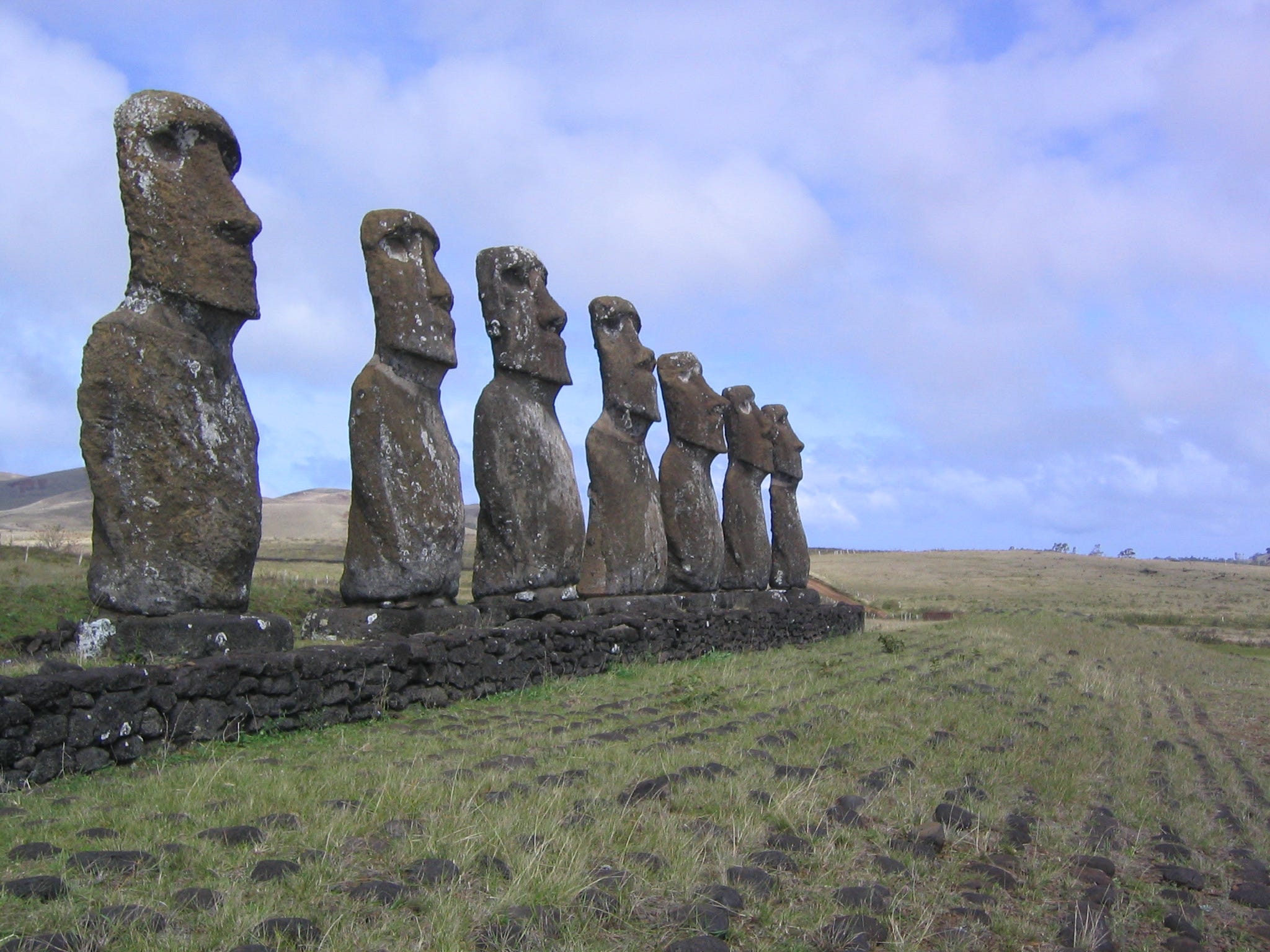
This supernatural account is only partly a metaphor. In the Rapa Nui cosmology, the dead did not go to heaven or hell but rather roamed the windswept plains and found a home in the stone statues. The ancestor figures always faced inland, protecting their descendants. The laborious process of their carving and transport emphasized the importance of these statues in society. Unfortunately, only about twenty percent ever made it to their final display location. Some were abandoned partially carved when a crack would be discovered in stone. Others fell down and broke along the transport route. Archeologists noticed a pattern in the way the broken statues lay: face up on the ascending slope and face down on the descending slope, suggesting that the statues were not rolled but transported vertically.
The current hypothesis is that the standing statues were rocked back and forth by two teams of people pulling on ropes, making it seem like they were walking. In one experiment, a team of archeologists managed to move a statue this way at a rate of 100 meters per hour, meaning it could have walked a kilometer a day.
The moai statues are monuments to the once great Rapa Nui civilization. Unfortunately, like many other civilizations, they fell victim to European diseases and exploitation. The population was reduced from about 3000 to just a few hundred people over the following century and a half. In 1888, Chile claimed Easter Island and converted it into a sheep ranch, confining its remaining residents to a small walled area, forbidding them from moving freely about the island, with no alternative but to work for the farm owners to buy food and supplies from them. Until 1966, the Chilean Navy governed the island, perpetuating the exploitation.
The silent observers
This was the tragic state of Rapa Nui when the Canadian vessel Cape Scott, carrying physicians and scientists, arrived on the island at the end of 1964. But they had not come on a humanitarian mission. Just like the early Europeans puzzled over how the moai statues were moved, the Canadians wanted to know—why did the Rapa Nui people not get tetanus?
The islanders walked around barefoot but rarely succumbed to this soil-borne disease. Scientists figured there must be something special about the soil and wanted to collect samples. This was one of the goals of the Medical Expedition to Easter Island (METEI), spearheaded by a Canadian physician, Stanley Skoryna, who is credited with the discovery of rapamycin. However, unbeknownst to them, the METEI mission played another important role in history.
As the international researchers carried on their work between 1964 and 1965, a quiet resistance movement, led by a schoolteacher, fomented on the island. The wild story of this non-violent revolution is described in an article by Mike Damiano—a fascinating read that features a nun smuggling a letter to the president of Chile on board the Cape Scott ship. In the letter, the Rapa Nui people demanded civil rights: to be able to elect their own officials, move freely about the island, and maintain their traditions.
The fortuitous presence of a foreign research team at that exact historic moment prevented a violent suppression of the civil rights movement and helped secure a peaceful transition from military rule to a democratically elected government. In 1966, Chile’s president signed the Ley Pascua (Easter Island Law), which granted the people of Rapa Nui the same civil rights as those living on the mainland: “[the Rapa Nui] people could no longer be abused with impunity. They could no longer be detained on their own land. They were no longer serfs.”2
Just imagine being a part of the METEI research project: unwittingly participating in a historic event and also contributing to the discovery of rapamycin, a molecule with huge potential implications for human health. Since then, the population of the island has grown to about 8,000 people, with almost half of the residents being native Rapa Nui. Many of the moai statues have been restored and reinstalled thanks to efforts like the Easter Island Statue Project (EISP), and a revival of cultural traditions, including song and dance, is on the rise.
It is as though the regenerative power of the land of Rapa Nui has awakened once again after centuries of suppression.
Still wondering what happened to the Rapa Nui palms? It wasn’t the stone giants that caused their extinction, it was the Polynesian rats. The rodents that were brought on the island as domestic animals thrived on the palm kernels. Their voracious appetite and formidable reproductive powers ensured that no palm seeds were left to grow the trees.
Excerpt from “We wish to be able to sing”: https://magazine.atavist.com/2021/we-wish-to-be-able-to-sing-easter-island-chile-revolution
Comments
Nothing yet. Say the first thing.
Sign in to join the conversation.