
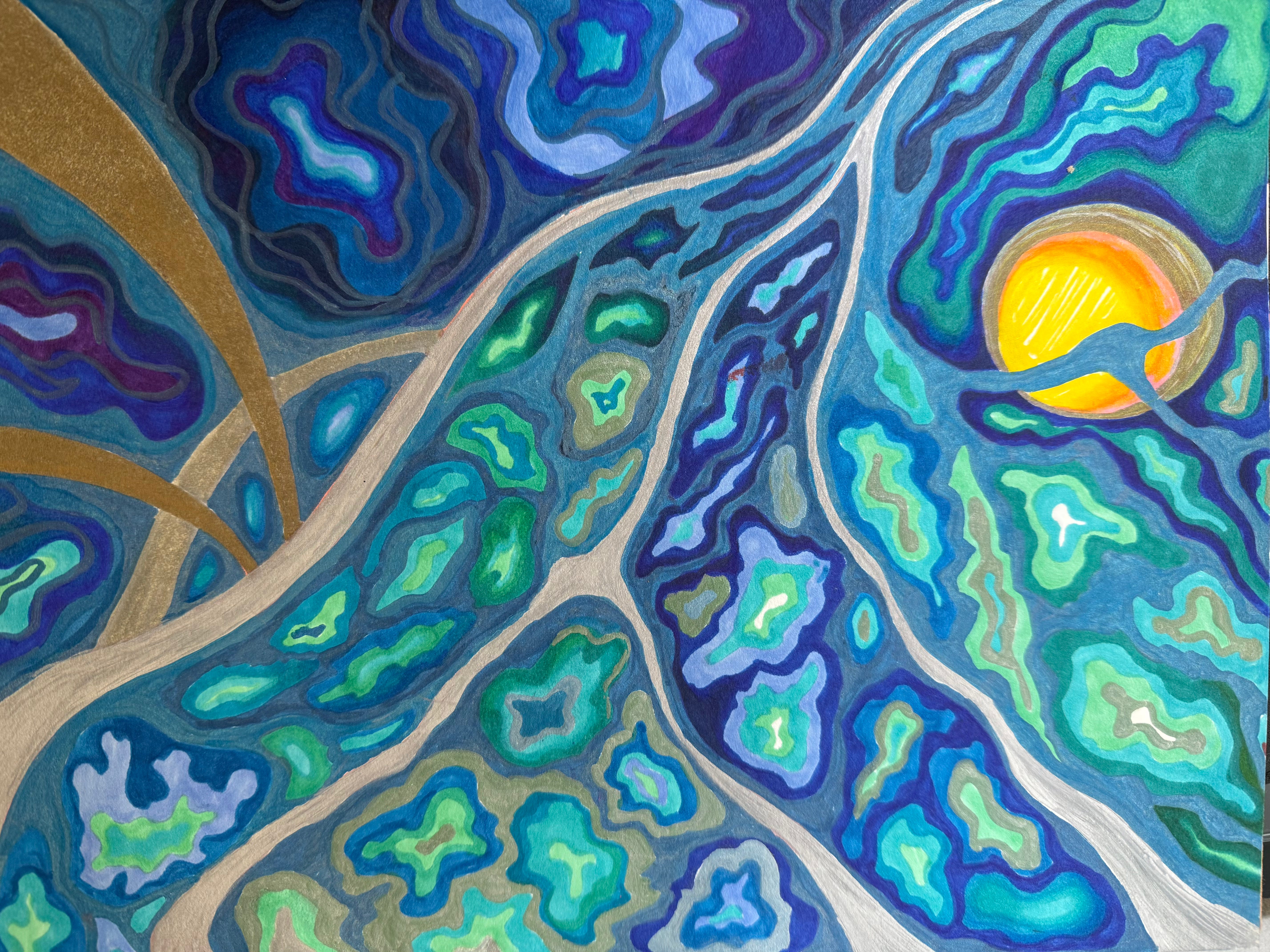
I don’t remember the day of April 26, 1986, because I had not yet been born. But whether I like it or not, it’s preserved in my genetic memory. It was the day of the Chernobyl Nuclear Power Plant disaster. My mom had described the evening of the tragedy in vivid detail. She was stationed in a southern Belarusian city of Gomel, about a hundred miles north of Chernobyl, as a young teacher on her first post-graduation assignment. It was a warm April evening, and she had spent hours outside, aimlessly walking the streets and enjoying the nice spring weather. That night, she woke up with extreme vertigo, barely able to walk down the corridor to the dorm bathroom—a classic symptom of acute radiation poisoning.
The USSR authorities tried to keep the incident under wraps. There had been no public announcement for people to evacuate or even take precaution by staying indoors. Although the atomic energy station was based in Ukraine, the radioactive cloud blew north with the swift spring winds and covered a large swath of Belarus, as well as parts of Lithuania, Russia, Poland, and other European countries. Within two days, the deadly high-energy particles traveled as far up as Sweden, where local scientists detected abnormal activity and were able to pinpoint the source of radiation to the Soviet nuclear facility.
Growing up, the Chernobyl catastrophe occupied a large space in our collective consciousness. I remember being five years old and thinking that eye floaters were radiation (obviously, they were just dust, but I thought I had a built-in Geiger counter in my eyeballs). We were told not to gather certain types of wild mushrooms because of their high tendency to accumulate radioactive cesium isotopes. Kids were prescribed a ration of iodized salt to displace the radioactive iodine-131 that bioaccumulates in the thyroid and (to a lesser extent) breast tissue. Then there were the school drills: once every year, instead of classes, we would all practice putting on the rubber gas masks, which were clearly out of commission. We would low-key suffocate in them and laugh looking at each other’s alien faces until the mask goggles fogged up.
By the time I was in high school, about 20 years later, the radiation levels across Belarus had substantially decreased. Iodine-131, for example, has a half-life or approximately 8 days. But other isotopes like Cesium-137 (with a half-life of 30 years), Strontium-90, and Plutonium were still found in soil, agricultural products, and wild-foraged mushrooms and berries. Thousands of people were evacuated from the contaminated zones, which were deemed too dangerous even for the hardened Soviet people. Chernobyl and the nearby Ukrainian city of Pripyat became ghost towns, with their eerie post-apocalyptic landscape serving as a reminder of the deadly consequences of nuclear disasters.
But there was still life in and around Chernobyl. When scientists returned to the site after merely a decade, they found a thriving ecosystem. Wild wolves, horses, and boars reclaimed a niche left empty after humans departed. Domestic dogs that were left behind by their owners formed free-roaming packs. The most surprising discovery, however, was that life managed to find a way even in the most radioactive of environments: in the heart of Chernobyl, inside a concrete sarcophagus, a black fungus covered the walls of Reactor #4, the epicenter of the nuclear meltdown.
Black magic
Scientist Nelli Zhdanova was the first to document this phenomenon, which includes at least 37 different fungal species. No one had anticipated discovering organisms living in a place where the radiation levels were sufficient to kill a person from less than ten minutes of exposure. Incredibly, scientists showed that these fungi could not only withstand radiation, but utilized it, converting the high-frequency rays into biological energy in a way that is similar to photosynthesis.
The radiotrophic fungi, which include species like Cryptococcus neoformans, Cladosporium sphaerospermum, and others, have one thing in common: their cell walls are packed with melanin. That’s right, the same dark pigment that gives dark color to our skin and hair. In human skin, melanin acts as a built-in sunscreen to protect the cells from UV radiation. But it turns out, it does a lot more than that. Melanin is also a potent antioxidant that can neutralize free radicals that damage cells. It has the ability to absorb metal ions1, including heavy metals like mercury, cadmium, and lead. Studies also show that melanin plays an important role in thermoregulation, protecting fungi from extreme heat (up to 47°C) or cold (−20°C).
It wasn’t just the fungi that turned black. In the forest surrounding Chernobyl, tree frogs developed a darker color due to higher concentrations of melanin in their cells—an example of rapid evolution driven by a survival advantage. This is a type of biological intelligence in action: when the black fungus Hormoconis resinae is exposed to chronic radiation in the lab, it produces more melanin. Lab studies have also shown that mice fed fungal melanin can survive lethal doses of gamma irradiation. This indicates that melanin could potentially be used as a treatment for radiation exposure.
Radiosynthesis: photosynthesis on steroids
Melanin has a remarkable ability to absorb a wide range of photons, which is the reason for its dark appearance—it absorbs but does not emit back any light. Beyond the visible spectrum, it also absorbs invisible UV, as well as X-rays and gamma rays, which have thousands to millions of times more energy—enough to shred DNA and destroy proteins inside cells. Melanin’s shielding capacity against X-rays and gamma rays is half that of lead, which is traditionally used to protect biological organisms against radiation. But how exactly does it do it?
Melanin is composed of indole and phenol rings. Indoles and phenols are cyclic molecules, which means they form closed-loop structures. Many cyclic (also called “aromatic”) molecules—such as amino acids tryptophan, tyrosine, and phenylalanine and their derivatives—are known to absorb light photons. It’s a biophysical property that’s based on the fact that the electrons in those molecules are distributed, making them more stable. As a result, ring-like structures absorb energy from photons, usually putting it back out in the form of fluorescence.
But melanin is more like a lace: the way the indole and phenol rings are attached together forms a complex and disordered structure that can absorb a broad range of photons—from low-energy, visible light wavelengths to powerful gamma rays. Its complex structure allows it to neutralize high-energy particles in its cyclic lace, dissipating that energy as heat or—as some scientists have suggested—electricity. By absorbing X-ray and gamma radiation, melanin protects DNA and other essential molecules from damage.
The most fascinating aspect is the hypothesized ability of melanin to convert radiation into energy that fungi can use for growth—a process named ‘radiosynthesis’. The theory behind it is that, just like photosynthetic plants use chlorophyll to absorb visible light photons, fungi use melanin to absorb gamma and X-ray photons. Although this is still a theory, supporting evidence shows that this could be possible. In one experiment, scientists exposed melanin to a gamma-ray beam and saw that it produced an electric current. That irradiated melanin was then able to reduce NAD+ to NADH, a key energy carrier in biological systems.
A new life form
If this theory turned out to be correct, it would uproot everything we know about biology. The established view is that only photosynthetic organisms can convert electromagnetic radiation (which visible light is a part of) into a biologically useful form. Life on Earth subsists on the energy input from the Sun that photosynthetic plants and algae use. Those organisms, in turn, feed the rest of us. The emergence of photosynthetic organisms created the oxygen we breathe and the ozone layer that protects us from the harmful cosmic radiation, including gamma rays.
But what does it mean for the possibility of life on other planets, those that don’t have the ozone layer like Earth does, and where life has to endure constant bombardment with high-energy particles? Melanin could be the missing link for extraterrestrial life. In fact, scientists are now exploring that possibility: some have proposed using melanin to shield astronauts from space radiation, while others think we can use melanized fungi to terraform Mars.
Radiotrophic fungi can survive in extreme environments and withstand low temperatures, high salt concentrations, and acidity. For example, black fungi were found living on bare Antarctic rocks that resemble Martian terrain. In 2018, NASA even conducted an experiment aboard the International Space Station to study whether radiotrophic fungi could be used as a radiation barrier in space. Black fungi could turn out to be essential companions in our quest to colonize other planets.
The fallout of Chernobyl
Now, is there a potential use of melanin for human health, too? The short answer is yes, and I will talk more about that in my next blog post. But for now, I want to bring the topic back to where I started.
Belarus has not had an easy time since the Chernobyl incident. Thyroid cancers were extremely prevalent in the 1990s, as were birth defects in people living close to the southern border. My own aunt, who lived in Gomel her whole life, died from breast cancer about a decade after the power plant meltdown. The local government carried out public health campaigns, but those were clearly not sufficient. For example, in the 90s, children in Gomel’s public schools were given red wine at lunch to combat the effects of radiation, but that seems like putting a Band-Aid on a broken limb.
International efforts drew some attention to the lingering radiation problem, but they also had minimal impact. I was a beneficiary of those foreign charities growing up. While it allowed me to study and travel abroad, it came with a stigma: when my school group traveled to the UK to compete at an international choir festival, the organization that sponsored the trip called us “Chernobyl children”, as if we were mutants that just crawled out of the reactor. I’m not sure whether that was part of the attraction, but our concerts gathered pretty large crowds.
It’s hard to mitigate radiation exposure because it’s an invisible enemy. Yes, perhaps you can eat melanized mushrooms (some common edible mushrooms, such as wood ear and black truffles, are a rich source) and use iodized salt to help your body detox radioactive isotopes. The best we can do, however, is prevent something like that from ever happening again. The Chernobyl accident will forever remain a stain on the USSR's history. For a country that was so paranoid about the threat of a nuclear war, its worst nightmare came not from an outside enemy but from within.
Rare metals are important for fungal cell physiology, so it is possible that melanin also helps concentrate them from the environment to be utilized by fungi.
Comments
Nothing yet. Say the first thing.
Sign in to join the conversation.