
On February 9, 1964 I sat in my grandparents’ living room to watch the Ed Sullivan Show, as my family often did. Grandma would let us eat our dessert1 in the living room as we watched. That night I viewed over 700 hysterical teenage girls screaming as the Beatles performed in the U.S. for the first time. It was my introduction to obsessive fandom, and I didn’t understand why those girls were screaming. I was five years old.
I lived through my teen years without falling for a movie star, a music group, or a sports team. There were no posters on my walls (though there were houseplants on the windowsills), no stack of record albums (yes, I am that old), no memorization of arcane facts about the object of my obsession.
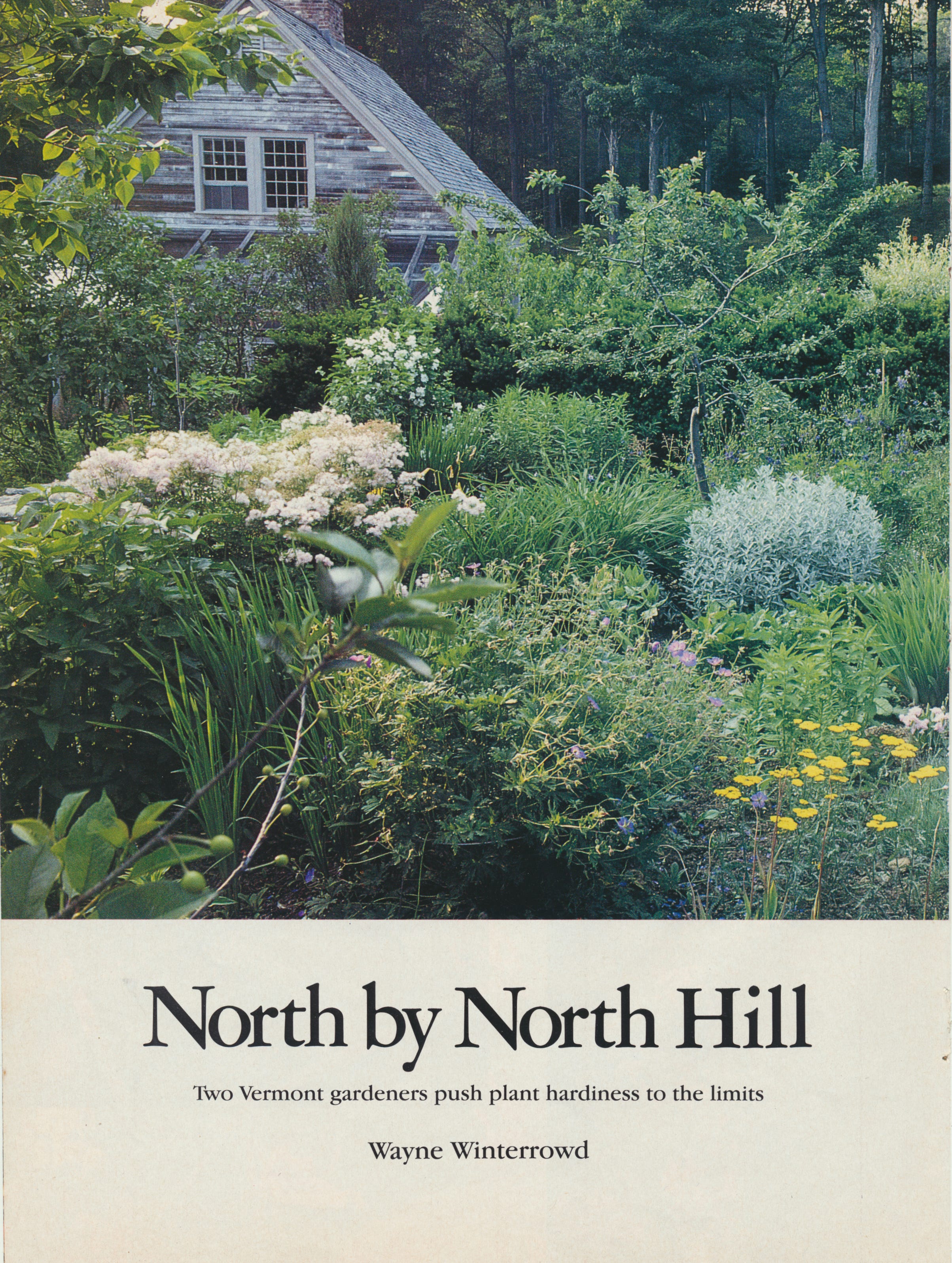
But in my thirties I became obsessed with the garden and writings of Wayne Winterrowd and Joe Eck, authors of A Year at North Hill (affiliate link) and several other books2. Theirs was the garden featured in Horticulture magazine that helped me articulate my idea of a garden; Wayne Winterrowd was the author.
It started innocently enough. I subscribed to Horticulture and I ordered the back issue containing that inspirational article ($4.95 plus shipping and handling) so that I could re-read it to my heart’s content.
I became aware that Winterrowd and Eck had written several other articles for Horticulture previous to my subscription, and I ordered 11 more back issues. There was no internet then, no magazine website to look up archived issues. Furthermore, magazines were different. They were thicker and the articles were more substantial, more like essays. I read every article, not just the ones they wrote.

I learned they were publishing a book. I managed to review it for Fine Gardening. The review copy was missing the cover jacket and there was a circular stain on the cover where someone had rested their coffee mug, but it was mine!
The endpapers had a map of the garden3. I studied this as I read through the book, trying to match the garden area described or photographed with a spot on the map. What would it be like to visit this garden? How did they learn so much about plants? Where did they even find them?
I studied that map a lot, because I re-read that book every winter.
I must have talked about that book more than I realized because someone told me that Winterrowd and Eck open their garden to the public every summer. What! Imagine actually walking their garden paths, smelling their roses, sitting on the bench in their perennial garden! But—that’s all the way in Vermont. Maybe when our kids are grown I can make that trip.
I continued to hunt for more about their garden. It was featured in The American Man’s Garden by Rosemary Verey. Brief bios of each gardener appear in the back of the book, and oddly enough Verey gives the birth years for Winterrowd and Eck. I did the math. If I waited until I turned 60, Wayne would be 77 and Joe would be 73.
Would they still be alive then? Would they still be gardening? Would the garden still be open to the public? I couldn’t count on any of that.
And then my sister4 said something that pushed me over the edge. She pointed out that southern Vermont was an easy day trip from our brother’s house outside of Albany, NY. And his house was two and a half hours from mine. I wouldn’t have to drive all the way to Vermont in one go. I wouldn’t have to pay for a hotel and expensive restaurant meals. Suddenly a pipe dream became a possibility.
I wrote to Horticulture and inquired about tickets. I learned they only opened the garden on the last day of June, the last day of July, and the last day of August to raise money for a charity. I consulted with my brother and his wife for a mutually agreeable date and my sister-in-law agreed to go with me5. I sent an SASE with my requested time and date and got my two tickets.
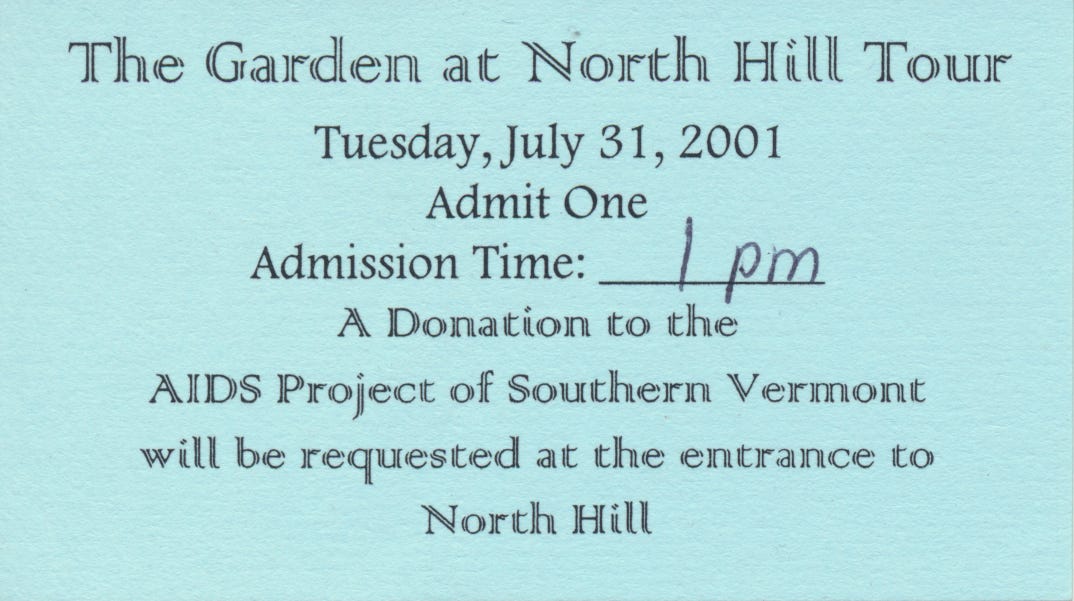
No GPS in those days. We had two Delorme Atlas and Gazetteers, one for New York and one for Vermont. An outline of the state was on the back cover, divided into numbered rectangles. Each rectangle corresponded to a page in the book. We plotted our way the night before, marking it with a highlighter. My sister-in-law drove, and I gave her directions.
We arrived at the Readsboro Elementary School and ate the lunch we had packed. We boarded the shuttle that would take us to the garden. I wore a backpack with books I was hoping to get signed. I had never been on a garden tour and I had never met a famous author. I was 43.
When we arrived, the steps leading up to the house threw me off, precisely because they were steps. On the map I had studied for a decade, the path to the house looked flat. There were the heaths and heathers in the place I expected. I just forgot while poring over the map that it didn’t show elevation, and after all, the garden at North Hill was on a hill.
The perennial garden was much smaller than appeared in its photos, and they roped off that area. You couldn’t sit on the bench. Thinking back, I suspect it wasn’t in any shape to be sat on by a hundred people.
The paths were quite narrow, surprising for gardeners who wrote Elements of Design6. But then, when they made those paths, they were just getting started and didn’t know better, and didn’t expect those paths would one day be walked by hundreds of people.
I inadvertently chose a different way through the garden than everyone else. I came face to face with people going the opposite direction, and one of us had to step in the garden beds to let the other pass. I cringed inwardly to do so, but had no choice.
While I was studying the plants and the paths, my sister-in-law, an architect, was studying the spaces. We were at the brook, and I was trying to look for the Petasites, and she exclaimed, “Look how these trees organize the space. They control what you can see on the other side of the bank.”7 I looked up and tried to understand what she was saying.
I knew the colchicums were planted in the conifer bed and went to look for them. I saw all the places where the bulb foliage had been cut back. It had never occurred to me to cut back the foliage. I always let it die in place. I wondered if they would have left it if they weren’t expecting visitors. No. They were very exacting in their aesthetics. Everything had to look good all the time.
I saw where the Himalayan blue poppies grew. Sadly, they were already done. The rose garden was also done. What a mad tangle of thorny branches.
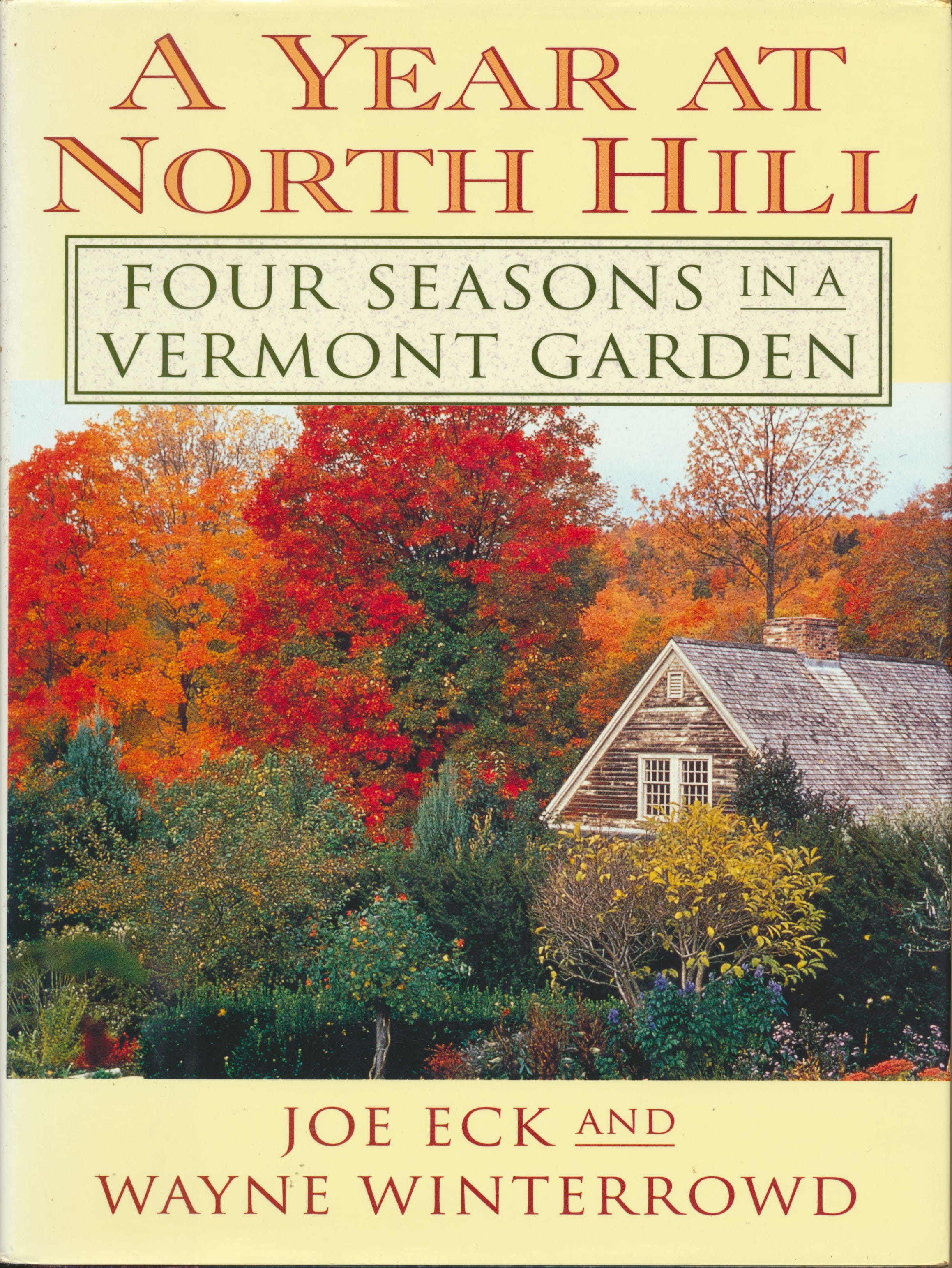
I finally found Wayne Winterrowd and got him to sign my second copy of A Year at North Hill.8 My good copy, complete with dust jacket.9 I think what remained of his Louisiana accent (yes, I knew he was born in Louisiana) sounded like an Irish brogue to me, because he reminded me of a leprechaun.
I gushed; he was gracious and talked to me like a normal human being (which of course he was). Joe was nowhere to be seen. I got the impression Wayne thrived on crowds and Joe wished they would go away.
My sister-in-law waited in the shade while I went through the entire garden a second time, trying to imprint it on my memory. We were not permitted to take photographs. I found out later that one of Joe’s and Wayne’s income streams was charging magazines for photographs of their garden or of particular (especially rare) plants. I surmise they did not want that income stream diluted.
I am glad I went. Wayne Winterrowd died in 2010. The North Hill property was sold in 2019, the year I turned 61.
I have every book either of them wrote, but my obsession has dissipated. They showed me that a cold climate garden could be every bit as fabulous as one in a more favorable climate. I learned to take hardiness zone ratings with a grain of salt, and pay more attention to providing the conditions that suit the plant.
I wonder how I would respond to their garden if I could see it today. I’ve been to many private and public gardens since I visited North Hill, and I’m not quite so starry-eyed. I think I would recognize more of their plants and I hope I would be more sensitive to their design.
I still read A Year at North Hill every year, and I get something different from it every time.
Note: I earn a small commission from Amazon affiliate links.
a bowl of Jello with a few banana slices suspended in it
Only the hardcover edition has the map.
Technically, only Joe Eck wrote it. But I don’t believe for a minute that Wayne was ignorant of standard widths for garden paths.
I don’t remember exactly what she said, but it was about how the space was organized. She was looking up and I was looking down.
“For Kathy, Best wishes from North Hill. Please come again. Wayne”
I could have sworn I had a third copy, a paperback to loan to friends. I must have loaned it to someone who never returned it. If you are that person, please give it back so I can loan it to someone else.
Comments
Nothing yet. Say the first thing.
Sign in to join the conversation.