
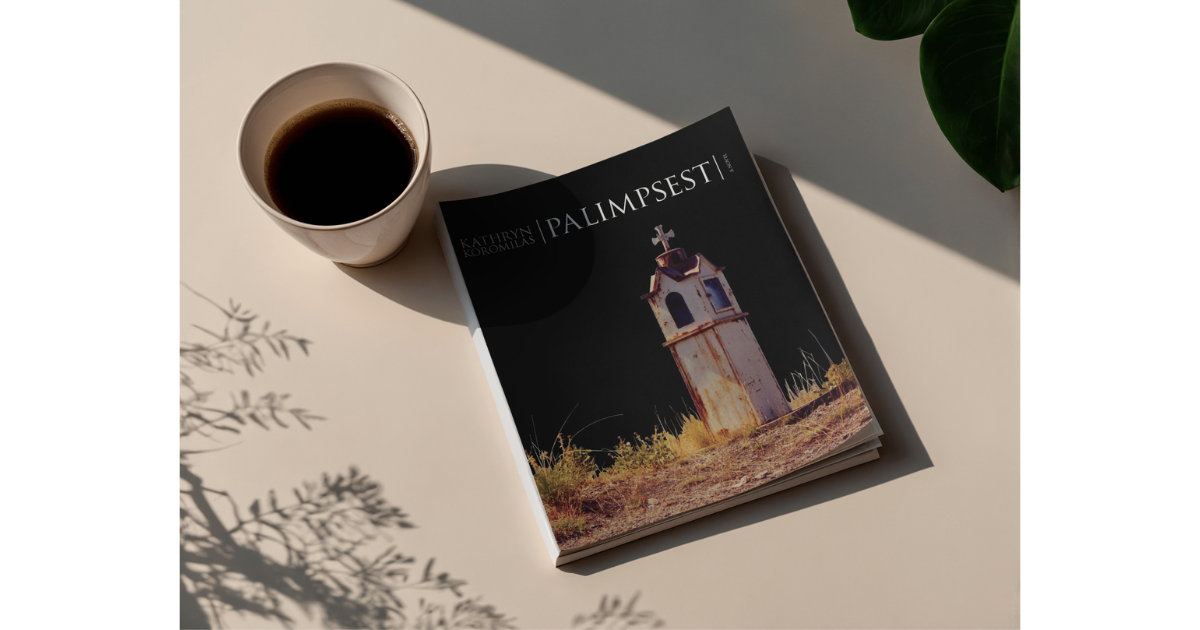
Welcome to Palimpsest: A Novel. This is a subsection of my personal newsletter, Metanoia Road. Every Thursday, I share a chapter of this novel (first published in 2010), and I invite you to read along with me. If you’d prefer not to receive these chapters, follow the instructions here to unsubscribe from this section only. This way, you can continue to receive other letters & writing from me, and we can stay in touch. If you’ll be reading - thank you - you can catch up on previous chapters here. 💙

Dear You —
Welcome back to Palimpsest: A Novel. Here is Chapter 6.
Previously: Our protagonist Kally Palamas has travelled to Zelopolis village in Greece with her mother, Anastasia, after her father - Akindynos Palamas - was found dead on Zelopolis beach. We’ve learned a little more about her - she’s a philosopher who is no longer working as one - and we’ve met her parents who are separated. Her father Akindynos, an autodidact, left the marriage to return to Greece where he established a philosophy school.
Catch up on previous chapters here. Or download chapters 1-6 as a PDF here.
In this chapter, we’re with Kally, her mother, Anastasia, and grandmother, Kallisto, just after her father, Akindynos, is buried.
According to Orthodox theology it took my father forty days to rest. Whether he chose heaven or hell, we couldn’t know, but that he now lives either in light or in darkness it is certain.
They were a frightful forty days for the bodiless Akindynos. For the first two he remained close to us, hovering above us, watching us as we cried over him, as we dressed him, as we fitted him into his temporary box-bed. Then as we inserted the box-bed into the ground and as we returned home without him, he was there, hovering, hovering all over. That’s what souls do. They stay as close as they can. They’re reluctant, I suppose. It must be difficult to believe it’s all true. The afterlife, that is. And then, of course, it must be difficult to say goodbye. Especially when they are lost. Like Thalia. She never said goodbye. She had nowhere to go. They closed the doors on her.
On the third day Orthodox dogma postulates that it is time to go, time to exit this sphere and enter the next, once and for all. On the third day after Akindynos left us we visited the church and cemetery for a second time. The priest shuffled over to the still-fresh grave and mumbled (they always mumble) the Trisagion Prayers, those most ancient of prayers exclaiming the holiness of God three times. Nicodemos, the Pharisee, was probably the first man who ever cried out those prayers, back when he was helping Joseph take Jesus’s body off the cross. Now, the priest just mumbled them – a habit, a ritual – devoid of the awe that once inspired them. We paid the priest a sum of money, which Grandmother Kallisto had folded neatly into a tiny white envelope. The priest took it — an easy exchange, slick and practised — and he was done.
My father’s soul, now comforted, took one final look at all of us (he hadn’t seen me for ten years, what did he see now?), his home (I had already usurped his bed), and his village. He looked as far as he could see and began (begrudgingly, I imagine, for he never expected the Church would be right about the afterlife) on the upward journey. The next thirty-seven days were horrible, horrible days for him. Days of obstacles, accusations, temptations. A swarm of evil spirits accused him of all sorts of sins. What did they accuse my father of? Ignorance? Is that a sin? Or a virtue? Enthusiasm? Obsession? Arrogance? Or just simply, apostasy? If he passed the tests, he met God. After that, he travelled some more, back and forth. He visited heaven, and he visited hell. And he was given a choice. Hell is a choice, after all. What did Akindynos chose? Where did he rest? On the fortieth day, his choice made, his place appointed, he rested.
I used to wonder how a reasonable person could believe in such things, in heavens and hells and gods and afterlives. I still wasn’t convinced that anyone really did. Not really. Bertrand Russell was probably right. Didn’t he say that it was our emotions and nothing more that made us believe? Yes. It was true. It was true. And I confess this: I found it all a solace, this gentle, pliable, hopeful package of answers. It soothed me. And I had a need to be soothed.
Every human being, once dead, transmogrifies into one or more new figures — phantasmata, if you will — for each person that is left behind. It is not unlikely that these spectres are invited by the left-behind in hope of snatching a fragment of knowledge from the world beyond, the world to which everyone will adjourn, regardless how young or old, beautiful or wretched, superior or deficient.
For Grandmother Kallisto, Akindynos’s phantasma retired with her when she went to bed. Grandmother Kallisto slept to the left of the bed that night — not in the centre as she usually did — patting the right side of the bed and inviting Akindynos to rest beside her. The next morning, conversing with her son in the silent, wordless way one does with the dead, she gimped out of the back door of the house, and down a path intricately woven with pebble and weed to the very end of the yard, to tend the chickens. The act of tending them was so terribly mundane perhaps she imagined she would die of grief right there, before the crisscrossed wire gate of the chicken pen. If it wasn’t the mundane that caused her to pause, place her hand over her heart and hope it would stop, it was curiosity. Akindynos had sometimes said that the Lord’s Elysium could not resemble what the ladies at church said it would, and other times he said that there was no Elysium at all, and that she should not concern herself with death. Akindynos would say, mimicking his philosophical ancestors, ‘Mana, when you are alive, death is not here. And when death is here, you are not.’ But Grandmother Kallisto could not remember what it was like to think like her ancestors. All she knew were the teachings of the Church, and of Christ and of the Virgin for whom death is always present. She knew about death. For a long time she felt death’s demonic fingernails scratching the rough skin on the soles of her feet and around her heels as she rested her legs at night. She never minded the demon’s presence, but Akindynos entreated her to hold on, to stay. He spoke to her in a shadowy, undefined way of his dream of a New Zelopolis where Grandmother Kallisto would taste the long-forgotten paradise of her ancestors, before she entered that other paradise, the one her God had lately been trying to tempt her with.
‘I would have been one of the first ladies in New Zelopolis,’ she told me one morning when Anastasia wasn’t present.
‘I am of good stock, clean and pure Hellenic stock.’ She traced back her lineage so that I could know where she came from, and where I came from.
Our family, she told me, came from the ancient Zelopolians who’d always lived in the region, always lived in their pure, upright, Hellenic way. Akindynos had already taught Grandmother Kallisto that the Zelopolian race had never been hairy cave dwellers, like the other races on this planet, but had always been civilised, with their perfect language, the ancient Hellenic language, and with their customs and music and technology and, of course, with their philosophy. She was proud of this history even though she knew nothing of it, nothing other than that which Akindynos had told her. But the little she had come to know made her happier, and she’d noticed that she’d begun to walk taller, her head held high, lighter. But now, without Akindynos, and with all the other problems that had concerned him of late, Grandmother Kallisto knew that there would be no New Zelopolis. In any case, she had grown tired of waiting.
As for me, in the days after my father’s death, his spectre persisted in whatever the television was broadcasting late into the night: black and white scenes of a Greece expectant, in the fifties and sixties, with the promise of reform and modernisation, but instead sliding towards military junta. Many of my friends’ parents had followed the mass exodus out of Greece prior to the Colonel’s coup in 1967. They all exhibited similar notions of Greece characterised by extreme hopefulness, a feeling that Akindynos had shared even though he’d left much earlier, just after the war. It was the happy promise of the sixties before the shame of the dictatorship from which no Greek recovered. Anastasia was always critical of Greece, embarrassed by its peasant modernity; cynical of its glorious antiquity and, worst of all, a disbeliever of the continuity between the ancient and the modern Greeks. This, I understood, could now be attributed to the fact that she left Greece in 1973, after the Colonel’s sojourn. Embarrassed and cynical, Anastasia agreed to wed Akindynos, they were from the same village, and I was born in December 1975. Only much later did she come to love him.
For Anastasia, Akindynos’s spectre had to be exorcised once and for all. And it took her one whole night and one whole morning. She scrubbed walls, floors, tables, chairs, inside cupboards, behind curtains, under beds and in sinks and toilet bowls, as if the ghost could be expelled with bleach, tap water and a clean rag. She scoured and flushed and purged the house all the while playing out her own private wake to the elegiac rhythms of her moirologia, her words for the dead, while I slept and woke and slept again on my father’s coffee-coloured armchair in front of the television.
When she was done she stood in the kitchen and spoke in English. ‘The woman is filthy,’ she said, and flicked her eyes in the direction of Grandmother Kallisto who sat rucked up at the table with a framed photograph of her son in her lap. ‘We’ll stay for the three days, the nine days, we’ll place the shrine, and then we’ll go home. This village always smelt of death.’
Thank you for reading with me. See you next Thursday for Chapter 7.

Hey, thanks for reading. Over the course of this serialisation, I’d love to hear your thoughts on the story, the writing, the themes, as well as your own obsessions and explorations into forms and genres that hold your stories.
Comments
Nothing yet. Say the first thing.
Sign in to join the conversation.