
NOTE FROM KATHLEEN WEBER: No one offers better analysis on the Iran War than SIR LAWRENCE FREEDMAN, the dean of British military strategists. He concludes that it's time for the US to shuffle off the stage so that the remaining nations of the world can work out a compromise on the Strait of Hormuz.
subscribe to Sir Lawrence Freedman—Comment is Freed
The Islamabad negotiations were supposed to conclude the Iran War in such a way that the US and Israel would have something to show for the thousands of lives lost and ruined, the vast quantities of ordnance expended, and the huge costs incurred. Their failure lays bare the extent of the calamity. The theocratic regime has been wounded but it remains in charge in Iran. The nuclear issue - top of the agenda in Islamabad - remains unresolved. The regime’s military-industrial complex has been degraded but by the time of the ceasefire it was still able to launch missiles against Israel and neighboring states and controlled access to the Strait of Hormuz. The international economy has been dealt a blow from which it will take many months, even years, to recover. America’s European allies are being chastised as if this whole mess is their fault, while those in the Gulf are left questioning the wisdom of the large bet they placed on the Trump administration.
Elements of this assessment might change. Ways might yet be found to open the Strait of Hormuz and to resume negotiations. Much depends on what happens inside Iran and how well the regime can cope with the intense economic and social challenges it faces (and was facing before the war began). If it does eventually fall then there will be claims that the war was ‘worth it’ for that reason alone, assuming that something better replaces it and the outcome is not more chaos.
The lessons of this war are not hard to find. They are exactly the same as those that should have been learnt from other wars that went badly wrong. The design was complacent, with the typical error of seriously underestimating the opponent. Trump joins a long list of political leaders who have been beguiled by the prospect of overwhelming early blows achieve decisive effects only then to struggle to find a new strategy when they did not, and the enemy turned out to be resilient and resourceful. This war confirmed the cliché about how they are much easier to start than to end, and the folly of focusing on how much the enemy is being hurt rather than on whether political objectives are close to being met. The temptation behind the resort to war is that it is the ultimate arbiter, a way of getting a desired outcome without the need for messy compromises. In the end, as with this one, most wars demonstrate the limits of military power, especially when unsupported by a realistic political strategy.
The lessons on the efforts to bring the war to a conclusion are less familiar because the process in this case has been so chaotic and is not yet over.
One lesson, again not new, is not to set ultimatums unless you are confident that you can get the adversary to comply, because either you will have to back down or raise the violence to an unsustainable level. Another is not to announce a ceasefire when there is no shared understanding of what is included and what can be left for later. Lastly the objectives described when a war is launched, even when amended during its course, are those against which the peace will be judged.
Mistakes of such consequence require attention to failures of process as well as policy. But the key processes here are those that took place inside Donald Trump’s mind rather than in the weakened national security system around him. It is not difficult to work out where this war came from and why it went so awry. This was Trump’s decision, prompted by Israel’s Benjamin Netanyahu. He owns every twist and turn. If all had gone well, he would have enjoyed the glory. As it has gone badly, he can only pretend that the outcome is far better than it seems, proclaiming a win at every opportunity, and blame others for what has gone wrong.
For a student of strategy Trump is a unique phenomenon. He mocks all those international relations theories that assume rational decision-making, supposing that the big decisions of war and peace are made by individuals able to link means to ends, cause to effect, in some coherent way, even when they are acting under conditions of uncertainty. Such deliberations of course do not guarantee good outcomes. Past presidents have made some truly bad decisions after taking advice and considering their options carefully. But none can compare to Trump in his ability to generate contradictions and confusions at such a dizzying pace.
There is a staggering gap between Trump’s confidence in his extraordinary talents, so that a great power’s strategy can be safely left to his mood of the moment, and the harsh reality of his limited grasp of the meaning of the events unfolding around him. As he starts from the assumption that there is none more powerful, his default tactics always involve bullying. When the targets are unresponsive all he can do is either double down, with ever more lurid threats, or else move on, as if there was never an issue, without acknowledging defeat.
Because he wants everything to happen on his terms, he is terrible at forming coalitions, accepting warm words and concessions as his due while offering little in return. He insults and chastises those who fail to give him what he wants, even if they are notional allies. When things are not going well, he fills the gap with delusional statements about what is happening and what is to come. This drains credibility from his statements though the media still reports them as if they can be judged by the same standards as those of other political leaders.
An unhinged leader is never a good idea, but the effects can be contained if the rest of the government is working as it should. During Trump’s first term, when the same personality disorders were present if not quite so severe, senior positions in the administration were filled by relative heavyweights. These so-called ‘adults in the room’ were often derided for their complicity in the bad decisions of 2017-21 but we could do with some of them now. Precisely because Trump felt hemmed in during his first term, he sought loyalty above all this time. As I wrote a couple of weeks ago, his national security system has been hollowed out. Staff work is minimal. Vital countries lack ambassadors. A few people, some rank amateurs, handle the full range of foreign policy problems on behalf of Trump. And they all defer to him, with his moods and delusions, not only because he is the president but also because of his overbearing personality.
This can be seen in the New York Times account of the decision-making which led to the war. Trump was attracted by Netanyahu’s case for the war, and his claims about the ease with which the regime could be brought down. This was a classic promotion of the short war fallacy which few of the president’s advisers accepted. They were not convinced this would be an easy win. While they might be able to destroy Iran’s ballistic missile program in a few weeks, there could be no certainty that the regime would be so weakened that it could not choke off the Strait of Hormuz or hit back against neighboring countries, and the idea that conditions would be created for the Iranian opposition to overthrow the regime was far too optimistic.
Hence his advisors’ comments when Trump met with them after Netanyahu had gone home. CIA Director John Ratcliffe described the regime change scenarios as ‘farcical’ and Secretary of State Rubio considered them ‘bullshit.’ Susan Wiles, White House Chief of Staff, worried about the political fallout. Vice-President Vance expressed skepticism and warned of all the ways that the operation could go wrong. General Caine, Chairman of the Joint Chiefs of Staff, explained that the Israelis ‘oversell, and their plans are not always well-developed. They know they need us, and that’s why they’re hard-selling.’
Trump concluded that regime change was up to the Israelis, but he saw value in the idea of killing Iran’s top leaders and dismantling the Iranian military. Though Caine warned him that a major campaign against Iran would drastically deplete stockpiles of American weaponry and that it would be difficult to secure the Strait, Trump decided that the war would be over quickly. The Times reports that ‘Trump would often seem to hear only what he wanted to hear.’
Now the reason why seasoned reporters are able to put together apparently authentic accounts of decision-making is that those involved know that it is in their interests to have themselves appear in the best possible light. This is why many presume that Vance was the main source for this story. While staying anonymous, ‘sources’ can also point the finger at the likely fall guy, in this case the Secretary of Defense Pete Hegseth, who was the most enthusiastic about the operation, and who might now be regretting severing relations with the Washington press corps.
Because Trump’s unhinged statements naturally demand attention, far too little attention has been given to Hegseth’s role. This goes beyond his persistently optimistic accounts of what was achieved and how well the war was going. He is being attacked for systematically misleading the president on how well the war was going. One administration official is quoted: ‘Pete is not speaking truth to the president. As a result, the president is out there repeating misleading information.’
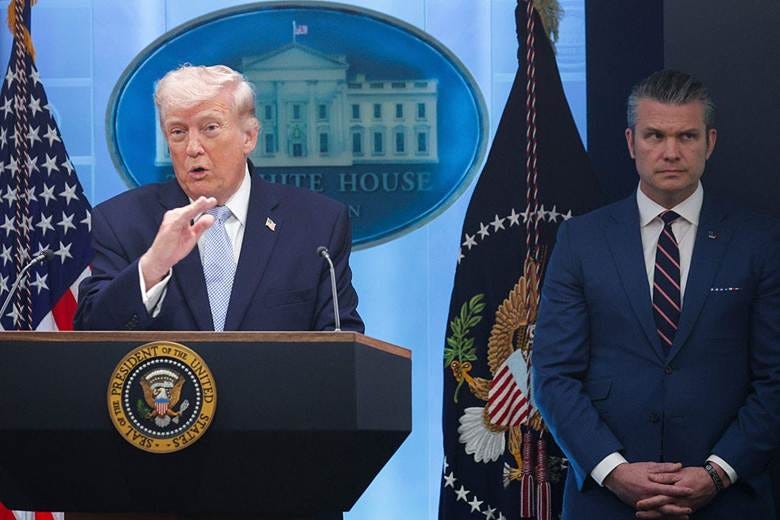
But the problem goes much deeper. It lies in his whole framing of the conflict, and the dark theology which informs his world view. Hegseth is a member of the Communion of Reformed Evangelical Churches (CREC), which provides Christian rationales for rightist politics. It is nationalist, misogynistic and racist. He sports a tattoo that says “Deus Vult” – “God wills it” – the rallying cry of Crusaders. His own form of craziness was in full display at his joint press conference of 8 April with General Caine. Caine’s contribution was to present success in narrow terms:
‘Since the beginning of major combat operations, the United States Joint Force has struck more than 13,000 targets, including in that 13,000, more than 4,000 dynamic targets that popped up on the battlefield and were immediately addressed, thanks to the exceptional command and control system and intelligence acumen and agility of our Joint Force.
CENTCOM forces destroyed approximately 80 percent of Iran’s air defense systems, striking more than 1,500 air defense targets, more than 450 ballistic missile storage facilities, 800 one-way attack drones storage facilities. All of these systems are gone. We’ve devastated Iran’s command and control and logistical networks, destroying more than 2,000 command and control nodes and degrading their ability to target US and friendly forces.’
Hegseth was more exuberant, as if this catalogue of destruction described a triumph. He explained the ceasefire as a consequence, in language that has aged quite rapidly:
‘President Trump forged this moment. Iran begged for this ceasefire, and we all know it. As the president Truthed this morning, a big day for world peace. Iran wants it to happen. They’ve had enough. Operation Epic Fury was a historic and overwhelming victory on the battlefield, a capital V military victory.’
Later he added:
‘The Iranians humiliated and demoralized. We control their fate, not the other way around. That’s why they came to the table.’
But then note the finale:
‘Our troops, our American warriors, deserve the credit for this day, but God deserves all the glory. Tens of thousands of sorties, refuelings, and strikes carried out under the protection of divine providence, a massive effort with miraculous protection.’
Whether or not Trump wishes to share any of the glory going with God, and leaving aside the nagging question of why God allowed the Iranians to close the Strait of Hormuz, this puts Hegseth on a par with the Islamist ideologues of Tehran and turns the conflict into a holy war. No wonder the Pentagon finds itself now challenging the Pope Leo directly, because of his more traditional theology of peace. The Pope warned in January about how ‘a diplomacy that promotes dialogue and seeks consensus among all parties is being replaced by a diplomacy based on force.’
This matters because a man with Hegseth’s moral compass would not push back against what turned out to be the culminating moment of Trump’s rhetorical war against Iran. This was his 7 April post:
‘A whole civilization will die tonight, never to be brought back again. I don’t want that to happen, but it probably will.’
Frustrated because Iran was resisting his demands, Trump had decided to raise the stakes dramatically by issuing the scariest threats he could imagine, even though on any interpretation this would constitute a monstrous war crime (and Pentagon lawyers would have been well aware of that even if they could expect to be overruled). Hegseth claims that this threat did the trick are undermined by the evidence that Trump was the one who found that he needed a way out of the ultimatum. Not only did it make him look even more like a cartoon villain, it also boxed him into a corner. He scrambled around with Pakistan’s help to get a ceasefire. This was announced without an agreed text. The Iranians inserted into the conversation their own ten point plan, which was largely a statement of their demands. When announcing the ceasefire Trump acknowledged this plan as a ‘workable basis upon which to negotiate’ the basis for a discussion, although he later denied that he had done so. When CNN pointed out that the Iranians were claiming victory on this basis, Trump lashed out claiming the Iranian statement was a fraud (which it wasn’t) and that the US had achieved a ‘total and complete victory. 100 per cent.’ Now he laments that Iran is not acting as a defeated nation should:
‘Iran is doing a very poor job, dishonorable some would say, of allowing Oil to go through the Strait of Hormuz. That is not the agreement we have!’
While Israel agreed to stop bombing Iran it did not agree to stop bombing Lebanon. Indeed, it marked the wider ceasefire with some of its heaviest strikes. This is not unusual for Israel - as soon as it senses a ceasefire coming it seeks to cause maximum damage before it is obliged to stop. Now the end to the deadly fighting inside Lebanon depends on the planned talks in Washington between Israel and the Government of Lebanon, from which Hezbollah is excluded.
The US-Iranian talks in Pakistan were certainly intense, but the lack of a deal is not surprising. It is not just that Vance has no serious negotiating experience, or that his throwaway remarks demonstrate his lack of grasp of the region and its politics, but that with the sticks used up, getting a deal required carrots and he had insufficient to offer. ‘They have chosen not to accept our terms,’ said Vance. If the war had been the success Trump and Hegseth claimed Iran would not have had a choice.
We are now in a limbo in which (hopefully) the US and Iran hold fire though none of the issues in dispute have been resolved. Iran still wants promises that there will be no further aggression, reparations, and sanctions relief. The US still wants some closure on the nuclear issue and the Strait of Hormuz opened. For now, the Strait is the big issue and that provides Iran with its leverage. It is not going to give up its biggest card without something in return (even though this card may weaken over time).
If the situation continues to drift, then the US will find itself increasingly marginalized. Trump seems keen to hand the problem over to the Europeans and the Gulf states and this may be preferable to waiting for the US to sort things out. These allies did not want this war, were not consulted about it beforehand, and now find themselves stuck with its dire consequences. Although they have provided the foundation for America’s global influence, Trump dismisses and derides them. Instead of looking for ways to get back into his good books, they are now almost past caring. They no longer trust the US to act sensibly and capably, to make deals and stick to them. What may well mark the next stage in this crisis, and in international affairs more generally, is other states finding workarounds to a lack of US leadership. This has already happened in trade policy and to a degree with Ukraine. The US will never be irrelevant but while it wields its power so incompetently and counter-productively then its international influence will be correspondingly diminished.
Thanks for reading As Time Goes By! This post is public so feel free to share it.
Comments
Nothing yet. Say the first thing.
Sign in to join the conversation.