
It’s hard to believe that this is the last week of July. Time is most definitely flying by as the date nears when my daughter will leave for college. Not to mention that I turn 54 next month!
Over the weekend, I watched DTF St. Louis on HBO, and I loved it. It is profoundly sad, but also digs deep into humanity, which I appreciated. I started reading Whidbey by T Kira Madden, which was recently longlisted for The Center for Fiction’s First Novel Prize. I’m only 100 pages in, but it has my full attention. There are some fantastic debut novels out there!
Today’s guest post is by author Rachel Peterson. Rachel graduated from Miami University of Ohio with a degree in English and creative writing. Born and raised in Ohio, she started her career in advertising before spending nearly a decade in New York City as a marketing executive for technology companies. An avid traveler, Rachel now splits her time between Manhattan and the Midwest, where she lives with her husband, Ken, their dog, Olive, and horse, Hope.
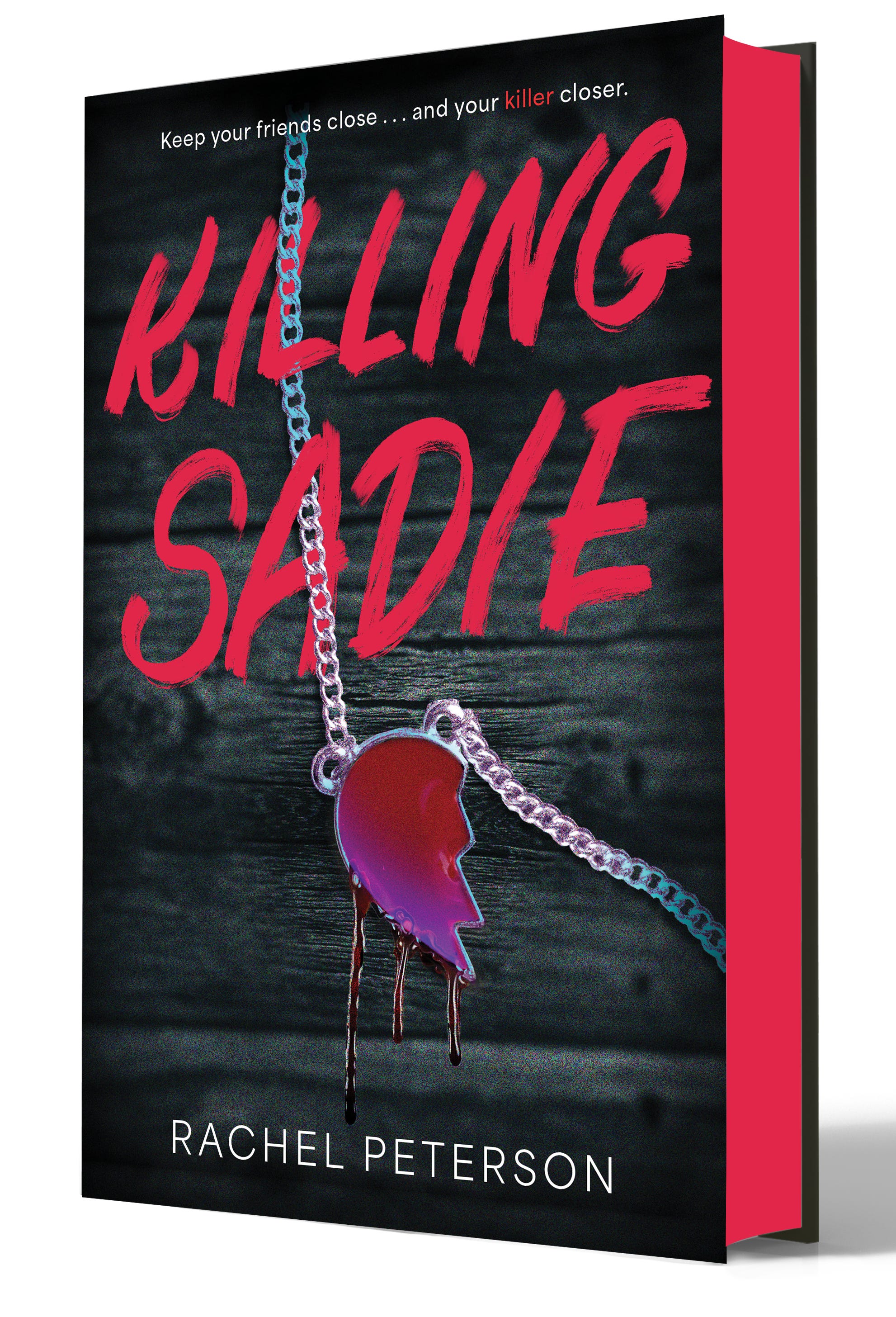
Her book, Killing Sadie, will be published on August 4.
What We See in a Fractured Mirror:
Finding the kernel of truth in our characters and ourselves.
If the version of yourself today is more driven by the phone call or text you might get in the next twenty minutes (Shifting into work mode? Family mode? Friend mode?) than your true self, take a seat! You have come to the right place, and the room is at capacity.
I would know, because here I sit. Author of unhinged thrillers. Partner. Daughter. Equestrian. Dog lover. Proud English major. Former tech exec. Reminders of every version of myself, especially the work-mode me, are currently piling up in my inbox. And in twenty minutes, really, who knows which version will arrive on the scene!
The idea of juggling multiple versions of who we are is nothing new. Just ask Shakespeare, or Jane Austen, or any number of classic authors who played with identity and the construction of self. In fact, the sheer timelessness of the struggle is exactly why it continues to be worthwhile to explore, especially in the stories we write or help shape.
Regardless of which hat you might be wearing at this very moment, I think the secret – and the challenge – is still being able to recognize yourself, or your characters, when the cracks start to show.
But first, a little time travel
As an author of young adult thrillers, I spend a solid chunk of time looking at this challenge from the teenage point of view. For better or worse, I came of age during a time when online life was just starting to pick up (elder millennial here!), which means fractured remnants of my teenage feelings are strewn over defunct blogging sites and old AIM away messages like confetti. And all I could think, as I was diving into the unreliable narrators and twisty secrets of my debut novel Killing Sadie, was: Thank goodness!
Hey there, teenage self. I hear you shouting at me from beyond the Y2K-era digital grave. And what a bold reminder: We really have been struggling with how to merge, or hide, disparate versions of ourselves pretty much forever. As a teenager, that experience held some particular struggles. What does it mean to be treated like a child one moment, and an adult the next? And how can you find agency when you’re both longing for independence, but still in a stage of life where independence can be in frustratingly short supply?
The wonderful thing about connecting with those very real struggles of teenage life was that it also brought to fresh light all of the ways we still deal with those struggles in adulthood. We wear so many different hats in our daily lives that it can become hard to reconnect with what we think of as our true selves. To look at it one way, it’s a challenge that never really goes away. To look at it optimistically, it’s an endless opportunity to continue discovering more of ourselves and our creativity. We expect characters to change and transform over the course of stories. Why can’t we do the same?
The truth is relative, at least for our characters
One of the instigating ideas behind Killing Sadie was the memory of being a teenager and going through major life events that impacted everyone at my school, but watching each individual person react to or perceive the event in a different way. There seemed to be an infinite proliferation of truth, and it was (and still is) impossible for us to process something without reflecting our view of ourselves in one way or another. Whether that’s a flaw or a virtue, I couldn’t tell you.
Particularly when designing my teenage characters, their self-perceptions were the central pieces of the puzzle. Sadie’s best friend Liz is reliant on her identity as Sadie’s best friend. Everything that she sees and experiences when it comes to the murder is through that lens, even though so many other elements of herself and her relationships to other characters should be a bigger part of the picture. And Sadie’s boyfriend Ben (one of the most fascinating characters to write, if only because he is so deeply problematic) is reliant on his truth of himself as the good guy, which he interprets as a free pass on taking responsibility.
The most fascinating part about working with these characters was their absolute belief that their version of the truth is the truth. It was a critical piece of the story structure, but also one that echoes loudly in the real world. I really cannot imagine sitting down with this group for a game of two truths and a lie – luckily, readers can!
Excuse me, do you know who I am?
We don’t like to have our presentation of ourselves challenged, whether directly by others or indirectly by circumstances that come up in our lives. By way of example, I recently dealt with a prolonged family emergency. During that time, it was very important to me that I show up as “the one who lightens the mood”. Tell a joke, make everyone laugh, get a smile. When this version of me was lovingly questioned by a close friend (some coping mechanisms can be spotted from a mile away), I felt an immediate sense of defensiveness. Excuse me, do you know who I am?
Extrapolate that situation out to work, parenting, caretaking, partnership, and – especially when you bring in the version of ourselves we present on social media (still figuring out how to author IG) – it really is no wonder that we cling so tightly to the things we believe are true about who we are. Being able to present a specific, selected version of ourselves to the world is a massive part of feeling agency in our environments. It’s true of us in the real world, and it’s true of teen characters in a thriller being questioned about murder after a barn party.
A love letter to you
When I pick up a mystery or thriller, I’m looking for the perfect blend of escapism, heart-pounding moments, and characters that still feel real. Even the most outrageous plot twist is believable when grounded in emotional truth. One of the most fun parts of working with teenage characters is not only the sheer depth of the emotion, but also how quickly it can shift and transform, whether felt deeply or performative. It’s a reflection of a specific kind of turbulence unique to growing up, but also of a universal one in other, perhaps more “acceptable” forms as we get older.
The emotions never go away; we just learn how to harness and package them (ask me why I love horses) – the desire to be seen, needed, and accepted is ever-present at just about every age. Yet simultaneously, our definitions of ourselves tend to become less fluid as we get older. We take on some of our most important roles, which cannot be shed as easily as some we may have played in high school. We hold more tightly to our versions of what is true, and can become less open to the idea that it might change.
In the world of Killing Sadie, that is precisely what makes for so many delicious twists. In our real lives, I would suggest that being open to new versions of ourselves – our hopes, dreams, ideas of success – is ideally not the recipe for murder, but rather an opportunity to take a deep breath, let go a little bit, and reconnect with who we are independent of our circumstances.
If the mirror is already fractured, why not play around with the pieces until you find the reflection that really looks like you?
Comments
Nothing yet. Say the first thing.
Sign in to join the conversation.