
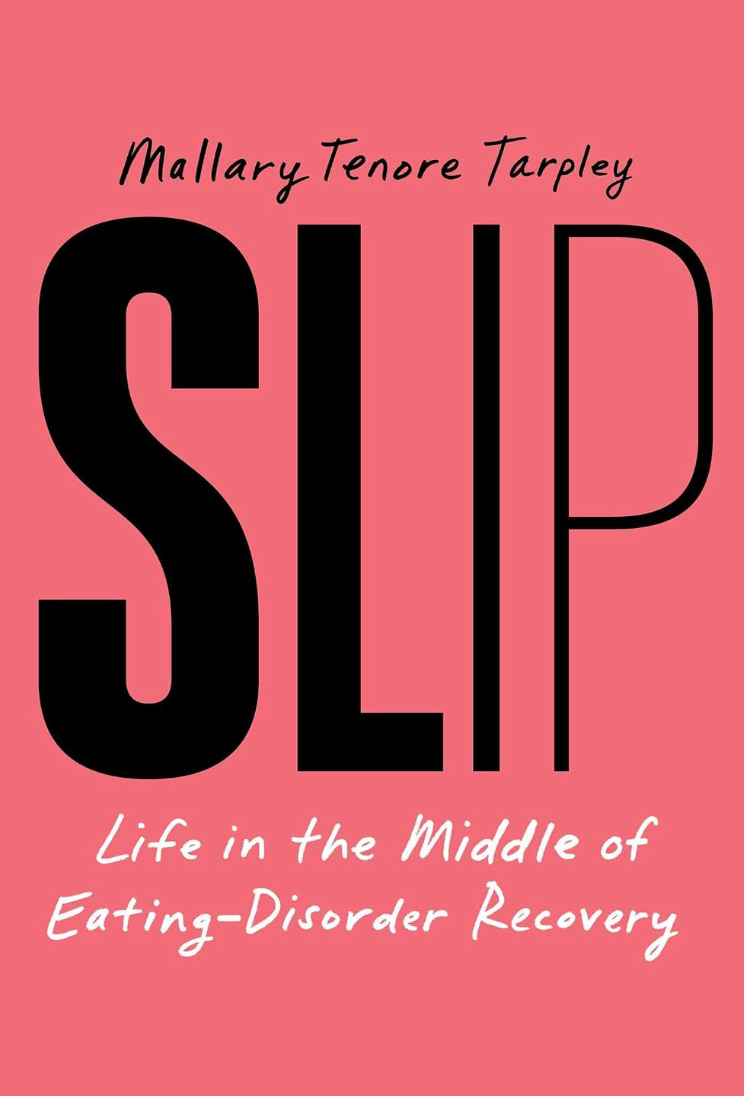
Today’s guest post is by an author near and dear to me. I worked with Mallary Tenore Tarpley on the hardcover publication of her memoir SLIP: Life in the Middle of Eating Disorder Recovery (Simon Element) last summer. As you’ll read, I mainly focused on podcasts, while Mallary’s in-house team took on other aspects of the campaign. What has struck me about Mallary is her tenacity in promoting her work: she has consistently promoted it here on Substack, on Instagram, and on Facebook. I often use her as an example when talking to other authors about sustaining momentum.
I hope you find today’s guest post helpful.
About the Author:
Mallary Tenore Tarpley is a journalism and writing professor at the University of Texas at Austin’s Moody College of Communication and McCombs School of Business. Her writing has appeared in The New York Times, The Washington Post, the Los Angeles Times, Time, and Teen Vogue, among other publications. She is the recipient of a prestigious Alfred P. Sloan Foundation grant, which helped support her research and writing. Mallary graduated from Providence College and has a Master of Fine Arts in nonfiction writing from Goucher College. She lives outside of Austin, Texas, with her husband and two children. Slip is her first book.
A Year of Book Promotion
Like many authors, I dreamed of my first book becoming an instant bestseller. (Cue the blush emoji.) I knew this was extremely unlikely, but I couldn’t help hoping.
My memoir, SLIP: Life in the Middle of Eating Disorder Recovery, was not a runaway success. But it received considerable attention when it was first published and has continued to gain traction nearly a year later. This is largely because I’ve made an ongoing commitment to publicity, with hopes of expanding SLIP’s long arc of impact.
In the months leading up to my book’s publication, I was lucky to have support from Kathleen (whom I hired as a freelance publicist) and from my in-house publicist, Ashtin Ballard. Together, they lined up opportunities I wouldn’t have gotten on my own. I also devoted a couple of hours a day to publicity, knowing I would mostly have to handle this herculean task on my own once my book was published.
As I get ready for my book’s paperback release and celebrate its recent Spanish translation, I’ve been reflecting on my publicity efforts and lessons learned. I’ve put together a quick by-the-numbers breakdown of what I’ve done over the past year and am sharing related tips for other authors who want to build their audience and boost sales.
Since last August:
45 BOOK EVENTS
81 PODCAST INTERVIEWS
12 PUBLISHED ESSAYS & ARTICLES
37 MEDIA MENTIONS
ONE YEAR’S WORTH OF LESSONS
EVENTS
I kicked off my launch with a nine-bookstore tour, focusing on places where I had connections and knew people would show up. At each of my events, I reconnected with friends, family members, grade-school teachers, and medical providers who knew me from all different chapters of my life.
You have to determine, though, if a tour makes sense financially. Since I paid for the tour myself, I tried to maximize my time at each stop, and I encourage others to do the same. When visiting North Carolina, for example, I spoke at Flyleaf Bookstore in Chapel Hill, met with patients at an eating disorder treatment center in Durham, and gave an author talk at Duke University. I’ve since spoken at other universities, eating disorder treatment centers, book festivals, and conferences.
I’m continuing to do events (including one for the paperback launch), but most are now local or virtual. As I posted about my events and the book gained traction, I began getting more speaking opportunities. This taught me to feel more comfortable asking for compensation, especially in cases where I was being asked to put together a presentation or speech. It never hurts to inquire about payment, and you should always ask whether your book can be sold at the event. Lots of conferences and universities can partner with local independent bookstores to have your book available on site.
In one of my newsletter posts, I share takeaways for authors who are considering a tour (including factors to consider if you’re a working parent), as well as 10 tips for giving author talks.
PODCASTS
I’ve done 81 podcast interviews over the past year — thanks in large part to Kathleen, who booked most of them. I did the bulk of these interviews in the two months leading up to my book’s publication, and it was great practice. By the time my tour started, I felt confident speaking about the book and answering impromptu questions about it.
I also pitched a lot of podcasts myself. Sometimes, I’d get responses right away. Other times, a single pitch took months of legwork. There was one memoir-related podcast I really wanted to appear on, so I pitched it and then sent two follow-up emails over the course of three months. The host eventually responded with a “yes” and thanked me for my persistence. (Silence doesn’t necessarily mean “no.”)
I’m continuing to pitch podcasts, and I now try to be even more strategic about it. If the podcast or host doesn’t have much of a social media presence and isn’t creating content for each episode, I usually skip it. It’s hard enough knowing what moves the needle in terms of sales (or what doesn’t). If the ROI seems noticeably low from the outset, I try to protect my time for bigger opportunities.
PUBLISHED ARTICLES
Publishing personal essays and reported articles is a great way to draw attention to your book, but it takes dedication. Even as a journalist by trade, I still have to work hard at getting freelance essays placed. On more than one occasion, I’ve pitched a single essay to a dozen or so news outlets before getting a “yes.”
With help from my in-house publicist, I’ve ultimately published work in a variety of outlets over the past year, including The Wall Street Journal, TIME, USA Today, and Teen Vogue.
I’ve been surprised by the audiences that some of my essays have attracted. A piece I wrote for The Wall Street Journal, for instance, unexpectedly led to several emails from readers who said they had struggled with alcohol addiction and could relate to my framing of eating disorder recovery as “a middle place” where slips happen, but progress is possible. Some told me they bought the book after reading the piece — a reality I saw reflected in my sales numbers the following week.
I’ve written more about this in my newsletter; in this post, I offer pitching tips, and in this one, I share 10 questions to help spark personal essay ideas.
MEDIA MENTIONS
Media attention is hard to get these days, so you have to practice patience. To publicize SLIP, I’ve pitched dozens of media outlets with a range of ideas: author Q&As, reviews, event coverage, stories about the middle place of eating disorder recovery featuring me as an expert, etc. Each of these ideas came to fruition.
The media appearance that led to the most copies sold was my interview with NPR’s 1A, which I booked with the help of a friend who works in public radio. NPR also published an author Q&A, which led to several other media opportunities. Media begets media. Even if you don’t have media connections, you can get creative with your outreach. Try contacting your alma mater to see if the alumni magazine would be interested. I did this and ended up on my alumni mag’s cover, with my book in hand.
Try pitching local TV and radio outlets as well. I ended up doing several interviews for local NPR affiliates as well as three TV segments for NBC affiliates in Texas, Missouri, and Florida. Local TV interviews don’t always need to coincide with publication; my interview with the Florida station aired five months after my book came out.
Lastly, reach out to journalists who cover the topics you’re writing about to let them know that you’re available as an expert source. I did this, and it led to some great coverage. One of the stories I was quoted in — a New York Times piece about anorexia in mid-life — ended up generating a lot of pre-orders.
MARKETING AND SOCIAL MEDIA
My publisher helped with marketing — through social media posts, ads, Goodreads giveaways, and more. This was all helpful and gave me ideas for developing my own social media strategies.
Now that my book has been out for almost a year, I’m continuing to use social media as an outreach and promotional tool. After my umpteenth “buy my book!” post, I started mixing promotional posts with practical advice and reflections related to my book’s themes. I’ll usually mention my book in one of the slides or in the caption, but it’s not the focal point. I find that these posts tend to get the most engagement and are the most likely to get shared. (See an example here and here.) That’s the ultimate goal: to not just get people to buy your book but to help generate word of mouth, which is perhaps still one of the best publicity tools we have.
To help with word of mouth, I’ve reached out to several book reviewers with large followings on Instagram. In a couple of cases, they ran giveaways for my book. In cases where they’ve asked me to mail them a copy, they’ve always posted about it afterward with a favorable review.
I also mailed copies of SLIP to well-known authors and journalists whom I’ve come to know over the years. In one case, I reconnected with Katie Couric, whom I had interviewed for a story back in 2010. I mailed her a galley copy, not knowing if anything would come of it. She responded positively and invited me to write a piece for her website. She also has the galley on display in the set of her “Next Question” podcast. It appears in the background of videos she posts on social media, and acquaintances occasionally tell me they’ve spotted it. This was unexpected, free exposure. Has it sold copies? I don’t know. Does it make me smile every time I see it in the background? Yes.
OUTREACH TO BOOKSTORES
I used to think that if a book was commercially published, it would be sold in most bookstores. But that’s not necessarily the case.
Often, you have to be your own best advocate. Every time I go to a Barnes & Noble or a local independent bookstore, I ask if I can sign copies of my book (if it’s in stock). I then post a photo of me holding a signed copy and tag the bookstore on social media, with a note of thanks. If my book isn’t in stock, I ask the store’s booksellers if they would be willing to order a couple of copies. Most have been super supportive and have said yes.
I’m continuing to reach out to bookstores, now with a focus on SLIP’s forthcoming paperback release. This summer, I created a database of independent bookstores from across the country, with the help of a graduate research assistant who’s working with me. She reached out to nearly 400 stores in the database to let them know about the paperback release and the recent Spanish translation. Several stores responded favorably.
Over the past year, I’ve learned that publicity isn’t something you finish when your book launches. It’s an ongoing commitment that requires creativity, persistence, and a willingness to keep showing up.
I’m putting these lessons into practice as I continue promoting SLIP and begin working on my next book idea. If you’d like to help shape the project, I’d love for you to take my survey. (And please feel free to get in touch!)
From Kathleen:
Want to be part of an experiment? Filmmaker Steven Bernstein is releasing a short film this weekend called GRQ: Get Rich Quick. It’s about a guy who invests all of his money in crypto to try and save his house and marriage…while there are earthquakes. What could possibly go wrong?
Steven was a client, and he is trying to reinvent the distribution model into an internet-first, internet-driven structure, then follow with a streaming partner.
There are two screenings on the 26th, one in the afternoon and one in the evening. Q&A after with the actors, and copies of his book GRQ to all who attend. Very important: here is the link to the site for people to get tickets: bit.ly/GRQ-watchparty

Comments
Nothing yet. Say the first thing.
Sign in to join the conversation.